This book critically analyses the functions and interconnectedness between religion and digital media in a range of East Asian countries. It discusses both how religious organizations make use of new technologies, and also explores how new technologies are reshaping religion in novel and interesting ways. Based on extensive research, the book focuses in particular on Christianity in South Korea, Neo-Shintoism in Japan, Falun Gong in China and Islam in Southeast Asia. Offering a comparative perspective on a broad range of media practices including video gaming, virtual worship, social networking and online testimonials, the book also investigates the idea that use of technology in itself mirrors religious practices. With an analysis of the impact of religion and new technology on national consciousness in a range of geographical locations, the authors offer a broadening of the scope of the study of religion, culture and media.
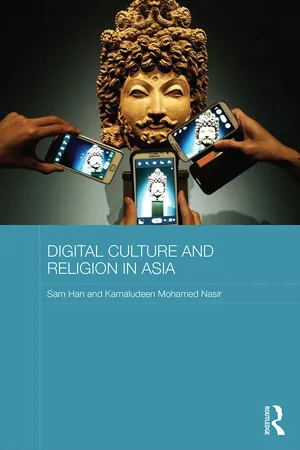
- 130 pages
- English
- ePUB (mobile friendly)
- Available on iOS & Android
eBook - ePub
Digital Culture and Religion in Asia
About this book
Information
1 Digital Christianity in Korea
Practical affects and additive religion
Introduction
Dear Korean,
Why are Koreans so devoutly Christian, more so than other Asian cultures? Just about every Christian club on my university campus is run by Korean students. Did Korea have a lot of missionaries in the past?
Curious Chinese Chick
On Ask a Korean!, a blogger called “The Korean” (“TK” for short), answers many questions submitted by readers on Korean and Korean American culture. Self-described as a “Korean American living in Washington D.C./Northern Virginia,” TK, for the most part, functions as a demystifier of Korean culture, both in the homeland and in the diaspora (mostly the United States, where the largest Korean population outside Korea lives). Many of the questions he answers are indicative of this cross-cultural role that he and his blog play. Under the “Popular Questions” link on his website are questions such as: “What does ‘oppa’ mean?” and “How do I pick a Korean among Asians just by looking at them?” The nature of these questions betrays the kind of tone that TK takes in his responses—wry, sarcastic and militantly cranky. In his response to the (aforementioned) question about Christianity and Koreans, we see this quite clearly:
Although it may not seem that way, the history of Christianity in Korea is over 200 years. The first Catholic church in Korea was set up in 1784, and the first Protestant church in Korea was established in 1866. Protestant missionaries were quite influential in 19th century Korea, setting up schools and hospitals that would later become the premier institutions of the country. (For example, Yonsei and Ewha Universities, as well as Yonsei Severance Hospital.) […]
After an initial period of persecution, Korean Christians did not really have any impediments to proselytizing. It also helped that in the early days, Christian missionaries were not simply the bringers of a new religion, but the bringers of new modernity as well. Many of them brought books on modern science such as astronomy, mathematics or medicine. American missionary Horatio Allen served as the doctor for the Emperor Gojong, for example. In other words, Christianity was associated with cutting-edge technology, which made it even more popular among Koreans. […]
Koreans? Whopping 25 percent, with roughly 16.5 percent Protestants and 8.5 percent Catholics.
The original question, however, is not only about Christianity in Korea but also about the preponderance of Korean students in the Christian club of an American university campus. This is, of course, a different sort of question, one that has a slightly different focus. It is a question about Christianity among Koreans in America. Acknowledging this complexity, TK goes on to specify a particular important factor:
[S]ince churches became where Koreans congregate, even non-Christian Koreans had to be involved with a church somehow, or they would not know any other Korean. Remember that immigrant life is full of hazard; even the most ordinary problem could be insolvable for an immigrant. Korean churches, in effect, became Korean community centers, which helped recent immigrants deal with those problems. This function of Korean churches is going very strong, and it puts Korean immigrants who are Christians at a distinctive advantage.
(TK 2007)
This blog post serves as a means of entry to the broad questions asked in this chapter. What does it mean to think about the practice of religion, specifically Christianity, across borders but among the same “peoples”? Is there something identifiably “Korean” about Korean Christianity? Furthermore, what does it mean to be “Christian” and what does it mean to be “Korean”?
We tackle these questions in this chapter by focusing on the forms of communality and collectivity engendered by Christianity in Korea, especially by the ways in which digital media are used. Beginning with a section on Christianity in Korea, we provide a brief history and also explain the dynamic interplay of evangelical Christianity with Korean shamanism and nationalism. We then go on to discuss the importance of digital culture in Korea, pointing to the place of digital culture in national identity. Then, we finally discuss the particularities of the digital Christian practice in Korea, focusing on the practical and affective quality of Korean megachurches, which are some of the largest in the world, use media and construct religious communality through sentimentality.
The history of Christianity in Korea
As the original question suggests, the association between Korea and Christianity is one that has, especially outside Korea, taken root in public consciousness. As early as 1996, the New York Times covered the rise of evangelical Christianity in Korea with an article that exuded an inquisitive tone. “Indeed,” the article states, “several of the world’s largest Christian churches are in South Korea, and scholars say Yoido Full Gospel Church is the largest of them all. Now, about three-quarters of Korean Christians are Protestants, mostly in fundamentalist denominations like that of [Yoido]” (WuDunn 1995). The fact that the world’s largest church was in the bottom half of an East Asian peninsula was somewhat surprising.
Asia, in Western and even global popular culture, still holds a rather unusual position. It is of course still seen as the safeguard of martial arts, Confucian filial piety and tradition(s) of various kinds. However, there is also the hypermodern Asia. “The New Asian City,” in reference to Hong Kong, Seoul, Tokyo, Taipei and Singapore, is a trope that has received intense circulation since the rise of the so-called Asian Tiger economies in the 1980s. Religion, as entangled in the discourse of modernity and globalization, of course adds to this.
To think about the “modernity” of a religion seems to be a silly, even ludicrous, endeavor. After all, in the post-Enlightenment, “modern constitution,” as Latour calls it, religion, as part of superstition and tradition, is relegated to the past (Latour 1993). Religion, in that framework, cannot be modern by definition. However, indeed, some religions are viewed as more modern than others, as we can see by the particular form of geopolitical Malthusianism of the McWorld vs. Jihad thesis. (This obviously includes Huntington’s “Clash of Civilizations” as well.) In the case of Asia, Christianity, since its introduction to Asia, and Korea specifically, has held some cachet, vis-à-vis modernity. As the blogger rightly points out, Christianity, as a proxy of Western culture, was viewed as a “modern” religion. Now, there is no doubt that the Christian West’s own rendering of the narrative of modernity has more than a little part to play in this. At any rate, we say all of this to raise the point that studying “Christianity in Korea” is a complicated affair. To do so is not simply to oppose Christianity with extant “folk religion,” as there is no such thing as the former or the latter. Christianity, as was the pre-existing religious landscape of Joseon (which is what Korea used to be called prior to Japanese annexation and colonization), is dynamic. As many scholars of religion have made clear, to study religion as a stable entity is to rob it of its internal contentions, its tensions and movement. For instance, Christianity, while nominally singular, is of course as diverse as there are sects.
Christianity’s recent rise in Korea has very much to do with what Max Weber called “elective affinities.” The significance of this concept for the study of religion is its ability to address the complexities and dynamics of how the ethics, or value system, of a particular religion mesh, blend and reconstitute themselves into mass culture, and even social structure. The Weberian case is a rather instructive one. The Protestant ethic of capitalism represents a sort of “secularization,” if you will, of Christian ethics, and capitalist mode of production. It explained, according to Weber, the nearly religious ethos of capitalist values. The “other-worldly” orientation of the Protestant “calling” became—to oversimplify it—the capitalist “vocation.” Thus, the capitalist ethos is a product of Protestantism and capitalism, according to Weber.
In Korea, we can say that Christianity’s rise, too, represents not one but a series of elective affinities. As the New York Times article discussed above makes note, prior to the rise of Christianity in Korea—which, for the record, still maintains a majority of non-Christians—most Koreans ascribed to a variety of religious practices. Shamanism and Buddhism, along with Confucianism, which does not fit nicely into the category of religion, pervaded the spiritual lives of Koreans. Many of them would select with abandon from all these spiritual modes. Koreans at the time practiced a grab bag of rituals in order to, among other things, cure illness, accrue material wealth, and bear male children. Contemporary evangelical Christianity in Korea undoubtedly draws from this. Today, many churchgoers state that the expectation of material gain is one of the reasons why they attend church. As one congregant at Yoido Full Gospel Church, the largest church in the world, Lee Jea Kyun says, “It was for material reasons that I joined the church” (WuDunn 1995). Hence, the story of Christianity in Korea is not a story of displacement. In the words of Charles Taylor’s A Secular Age, it is not “subtractive” but, to coin a phrase, “additive” (Taylor 2007).
Today, there are over 14 million Christians in South Korea, which is nearly 30 percent of the country. (Statistics, along with information generally, are rather difficult to find for North Korea, especially when it comes to religious affiliation. However, judging from prior studies, the juche ideology of Kim Il-sung has become something akin to state religion.) Of the Republic of Korea’s Christians, the overwhelming majority are Protestant and, moreover, evangelical. This is a rather surprising statistic if one looks at the history of Christianity in Korea, which saw, as did most parts of Asia, Catholicism as the first instance of Christianity on the shores of the peninsula. Today, of the nation’s Christians, roughly two-thirds are Protestant.
For reasons that we will elaborate below, the prominence of evangelicalism in Christianity in Korea has historical roots as well as cultural logics. However, before getting to that, we must remark upon how rare it is in East Asia to have such a significant Christian population. This is especially unusual in the case of Korea, as Christianity had come to the shores after it had already been brought to China and Japan. Today, neither country features a significant Christian population. As Timothy S. Lee has noted, given that Japan and China were both heavily shaped by Buddhism and Confucianism, it is rather curious that evangelical Protestantism remains such a force in South Korea (Lee 2010, xiii).
Lee has put forth a model based on politics to explain the rise of evangelical Protestantism in Korea (Lee 2010), but for him, a political theory of religion in Korea requires a foray into mythology, nationalism and folk religion. Christianity in Korea has had important elective affinities with the preexisting form of Korean nationalism rooted in common blood and shared ancestry. It could even be described as an ethnonationalism. However, as Lee, drawing on the work of Shin, rightly points out, Korean ethnonationalism emerged with the “Sino-centric world order,” which included not only China but also Japan. This fact “compelled Koreans to search for another kind of paramount collective identity” (Lee 2009, 75). The unintended consequence of the failures of the pan-Asian Chinese suzerainty was Korean nationalism, based on a mythological figure named Tangun. Purported to be the son of a bear transformed into a woman and Hwanung, son of the Lord of Heaven, Tangun (or Dangun) founded Old Joseon (Go-Joseon) with its capital being modern-day Pyongyang. Sparing the details of Korean mythology, it is safe to say that Tangun still maintains a very important status in nationalism above and below the 38th parallel. The North Korean government in 1993 publicized the “discovery” of his tomb in Mount Taebak, near Pyongyang (Lankov 2012). Tangun is one of the rare points of agreement in North-South relations, despite widespread skepticism about the actual existence of the tomb, where there now lies a mausoleum in true Soviet fashion.
Folk religion is the fuel that feeds the fire of Korean nationalism, as many observers of the Korean peninsula have noted, but it is also the resonant point between evangelicalism and Korean folk religion. As Lee notes, Christian missionaries were attracted to folk religion and mythology as a “point of contact” between Christianity and Korean religiosity (Lee 2009, 78). They do so by interpreting the myth through the Trinity, linking the Abrahamic God to “Hananim,” sometimes referred to as Hanunum and Hanulnim. It was this word, Lee notes, that was used in the Korean translation of the Gospels of Luke and John. The latter is widely used as the introductory text for new converts (ibid., 79). The advantage of translating “God” as “Hananim” is its status as a “cultural given.” Hananim was already a concept that had existed in Korean folk religion as a high god.
Thus we come to the most prescient point of Lee’s argument that links the story of Christianity in Korea with ethnic nationalism and folk religion. By the turn of the 20th century, the world that Korea had known for centuries was dissolving. Dynastic China, the source of much of East Asian culture and learning, would soon see its end. Japan was not only modernizing under the Emperor Meiji, but it was also surging geopolitically, occupying and then annexing Korea. According to Lee,
Disillusioned people strove beyond traditional options in their search for salvation. One such nontraditional option was the Protestant church, which promised a new life to whoever would convert. In China and Japan, such promise might have sounded hollow. In Korea, however, none of the imperialistic powers that plagued the natives were Protestant, affording the missionaries’ prima facie appeal.
(Lee 2010, 126)
In addition, Christianity also lent some of the “most potent symbols of Korean nationalism” during the period of Japanese occupation and colonization. The March First Movement featured a disproportionate number of Christians. As one of the first acts of protest against Japanese colonialism, the mass demonstrations are widely cited as the beginning of the Korean Independence Movement. Due to high Christian involvement, according to Lee, there is still a “positive association between Protestantism and Korean nationalism” (Lee 2010, 120).
Protestantism did not gain a foothold in Korea based purely on singular, or internal, reasons. That is to say, it was not Protestantism, in and of itself, that somehow, against the odds, produced a Christian foothold in Korea. It was a complicated mixture of various, sometimes even conflicting, factors, including historical, (geo)political, social and, indeed, theological, that contributed to Korea’s status as the rare Christian outpost in Asia. Additionally, though, it explains the particular form of Christianity in Korea.
Korean evangelical Christianity is characterized by an intensely “practical and devotional character.” It is “practical” because “it is much more enterprising in devotional practices than in theological ideas, and in the sense that it tends to set great store by concrete criteria such as strict observance of the Sabbath, fervent prayer, regular tithing, this-worldly blessings, and the size of church membership” (Lee 2010, 116). One example of Korean Christianity’s “practicality” is kibok. The concept of kibok is most easily described as “this-worldly blessings,” but there are some additional aspects to it. Kibok is rooted in the belief that one’s faith, if adhered to properly, “will enable one to obtain not only otherworldly blessings but also this-worldly blessings such as material wealth, cure from diseases and resolution of personal problems” (ibid., 122). Lee connects this “practical tendency” of Korean evangelicalism to its literalist bent. The biblical literalism of evangelicalism “encouraged its adherents to conceive of biblical blessings in concrete … terms” (ibid., 125). In addition, the this-worldly nature of kibok also represents a resonant point between Christianity and shamanism in both its emotional disposition and affective character. Christianity in Korea, then, takes a distinctly shamanist flavor, especially in its material orientation, a feature pointed out in the New York Times article.
Digital Korea
As one of the most technologically advanced countries in the world, Korea boasts a culture that not only features digital technologies but also feeds on it. Today, Korea has the highest percentage of online households. Culture and technology are, in Korea as in Asia more broadly, converging to the point of being indistinguishable. US President Barack Obama has remarked on this several times in public speeches. The mention of South Korea usually is adjoined with that of new digital technologies. In a 2012 speech to students at Hankuk University in Seoul, he mentioned KakaoTalk, a mobile messenger app that has garnered wide use in Asia (Nakamura 2012). Obama is not simply pandering to his audience. He also mentioned Korea’s technological prowess in North Carolina during a speech on education. He commented on the United States falling behind South Korea in connectivity, justifying his initiative to bring high-speed Internet to American schools (Rucker 2012). South Korea, then, functions as a signifier of technological advancement on the world stage. Globally, to think Korea is to think technology.
If religion, as a category, is inextricably linked to national culture and national identity, then indeed the import of technology and how a nation is viewed and also how it sees itself is clear especially in the case of Korea. The question then becomes: How did Korea become associated with new digital technologies?
One way to trace the relationship between “digital technologies” and Korea is to do so through the history of industry and economics. This would require going back to the 1980s, when the Asian Tigers—Singapore, Taiwan, Hong Kong and South Korea—experienced a remarkable rate of growth and jumped into the First World. Each of the Asian Tiger economies had different specialties. Singapore and Hong Kong were financial centers while South Korea and Taiwan were involved in light manufacturing. For the latter two, light manufacturing meant clothing but also information technology. This became more acute as the global economy, in the wake of the IT revolution, came to revolve around the increasingly cheaper consumer electronic goods. Of course, for most of the 1980s and 1990s, the IT manufacturing in these economies consisted of factories that would do outsourced work for US-based multinational corporations. Yet, by the early 2000s, firms native to Taiwan and Korea were beginning to make some noise in the global consumer electronics market. Today, brands such as HTC, Asus, Acer, Samsung and LG are all globally recognizable. Thus, light manufacturing, a catch-all term for consumer-oriented products, for those two economies became associated with information technology such as cell phones and computers.
In the case of South Korea, this history, however, also has a pre-history. Post-war(s) Korea’s political history is marked by a series of unsavory characters, including military dictators and presidents who have been imprisoned for corruption after their tenures. It was only in the 1990s that “democracy” came to Korea. Economically, South Korea’s history is characterized by chaebol. Roughly speaking, chaebol means conglomerate. These corporations are structured ...
Table of contents
- Cover
- Half Title
- Title Page
- Copyright Page
- Table of Contents
- Acknowledgements
- Introduction: Understanding digital culture and religion in/of Asia
- 1. Digital Christianity in Korea: practical affects and additive religion
- 2. Religion as moral infrastructure: the practice of neo-Shintoism in Japan
- 3. Religion as propaganda: Falun Gong?s info war
- 4. New media Islam in Southeast Asia
- 5. Hyper-real religions in Asia: beyond popular culture and popular religion
- 6. Religion for millennials: the prospect of religious life and identity in the new Asian century
- In lieu of a conclusion…
- Reference
- Index
Trusted by 375,005 students
Access to over 1.5 million titles for a fair monthly price.
Study more efficiently using our study tools.
Frequently asked questions
Yes, you can cancel anytime from the Subscription tab in your account settings on the Perlego website. Your subscription will stay active until the end of your current billing period. Learn how to cancel your subscription
No, books cannot be downloaded as external files, such as PDFs, for use outside of Perlego. However, you can download books within the Perlego app for offline reading on mobile or tablet. Learn how to download books offline
Perlego offers two plans: Essential and Complete
- Essential is ideal for learners and professionals who enjoy exploring a wide range of subjects. Access the Essential Library with 800,000+ trusted titles and best-sellers across business, personal growth, and the humanities. Includes unlimited reading time and Standard Read Aloud voice.
- Complete: Perfect for advanced learners and researchers needing full, unrestricted access. Unlock 1.5M+ books across hundreds of subjects, including academic and specialized titles. The Complete Plan also includes advanced features like Premium Read Aloud and Research Assistant.
We are an online textbook subscription service, where you can get access to an entire online library for less than the price of a single book per month. With over 1.5 million books across 990+ topics, we’ve got you covered! Learn about our mission
Look out for the read-aloud symbol on your next book to see if you can listen to it. The read-aloud tool reads text aloud for you, highlighting the text as it is being read. You can pause it, speed it up and slow it down. Learn more about Read Aloud
Yes! You can use the Perlego app on both iOS and Android devices to read anytime, anywhere — even offline. Perfect for commutes or when you’re on the go.
Please note we cannot support devices running on iOS 13 and Android 7 or earlier. Learn more about using the app
Please note we cannot support devices running on iOS 13 and Android 7 or earlier. Learn more about using the app
Yes, you can access Digital Culture and Religion in Asia by Sam Han,Kamaludeen Mohamed Nasir in PDF and/or ePUB format, as well as other popular books in Social Sciences & Ethnic Studies. We have over 1.5 million books available in our catalogue for you to explore.