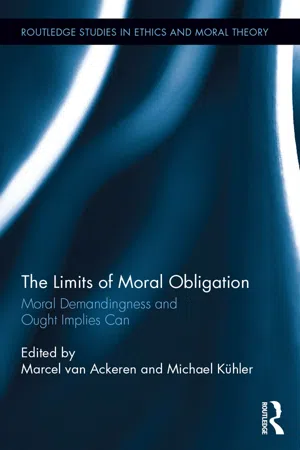
This volume responds to the growing interest in finding explanations for why moral claims may lose their validity based on what they ask of their addressees. Two main ideas relate to that question: the moral demandingness objection and the principle "ought implies can." Though both of these ideas can be understood to provide an answer to the same question, they have usually been discussed separately in the philosophical literature. The aim of this collection is to provide a focused and comprehensive discussion of these two ideas and the ways in which they relate to one another, and to take a closer look at the consequences for the limits of moral normativity in general. Chapters engage with contemporary discussions surrounding "ought implies can" as well as current debates on moral demandingness, and argue that applying the moral demandingness objection to the entire range of normative ethical theories also calls for an analysis of its (metaethical) presuppositions. The contributions to this volume are at the leading edge of ethical theory, and have implications for moral theorists, philosophers of action, and those working in metaethics, theoretical ethics and applied ethics.
eBook - ePub
The Limits of Moral Obligation
Moral Demandingness and Ought Implies Can
- 210 pages
- English
- ePUB (mobile friendly)
- Available on iOS & Android
eBook - ePub
The Limits of Moral Obligation
Moral Demandingness and Ought Implies Can
About this book
Information
1 Ethics on (the) Edge? Introduction to Moral Demandingness and ‘Ought Implies Can'
DOI: 10.4324/9781315740812-1
This volume responds to the growing interest in ideas that seek to provide reasons for why moral claims may lose their validity based on what they ask of their addressees. Two main ideas relate to that question: the moral (over)demandingness objection and the principle ‘ought implies can.’ Both ideas are meant to mark, and give reasons for, certain limits or boundaries of moral obligations. Conversely, if these boundaries were about to be crossed by moral demands, ethics would seem to be “on (the) edge”—literally as well as figuratively. Yet, although these two ideas can be understood as providing an answer to the same question, they are usually discussed separately in the philosophical literature. This volume is, therefore, intended to provide the first combined discussion of these two ideas, especially regarding their interrelation, and to take a close look at the consequences for the analysis of the limits of moral obligations in general. To this end, we will, firstly, introduce and explain the most crucial features of both ideas in this introduction, before the subsequent chapters take on the challenge of discussing them and their interrelation in more detail.
1 (Over)Demandingness
The debate on (over)demandingness has evolved greatly. But it is best to distinguish two strands, namely one on demandingness and one on overdemandingness. In a nutshell, the discussion on demandingness tries to answer the question of how to analyze that morality demands something of agents and what the nature and sources of demandingness are. Discussions on overdemandingness or the demandingness objection 1 focus on the questions if, why, and when demandingness becomes excessive, and if and how normative theories which make very heavy demands on individual agents should be altered.
These two sets of questions have not always been analyzed separately. In one sense this is possible, in another it is not. For, on the one hand, demandingness is an interesting philosophical issue on its own, without any specific stance on the questions that constitute the debate on overdemandingess. Demandingness alone poses serious philosophical questions: 2
- What are the poles of the conflict that is essential to demandingness? Is the conflict not to be found between morality and self-interest (narrowly understood), but only between morality and well-being (interests) or ground projects, as some have claimed? 3 If so, what is the relation between self-interest and well-being? Is there a gap, or is self-interest a part of well-being? Do the poles of the conflict consist of context-independent sets of considerations, i.e., a moral point of view and a personal point of view, as well as a corresponding dualism of practical reasons? 4
- What is the nature of the conflict? Are conflicts conceptually 5 or empirically necessary, 6 or impossible like ancient eudaimonists have claimed? If conflicts are possible—under which conditions? 7 What causes these conflicts?
On the other hand, there is a close relation between the two strands, for every position on overdemandingness at least presupposes an idea of what might be excessive, namely demandingness. The debate on overdemandingness is essentially a debate on ethical theories, for the related demandingness objection was meant to criticize ethical theories for making implausible heavy demands, in the sense that acting in accordance with these demands would be too costly for an agent. Here are some key questions of this debate on overdemandingness:
- If and how can we distinguish between plausible and excessive demands? Can we define a demarcation line between what would be acceptably demanding and what could be evaluated as ‘excessive’? Can otherwise plausible demands be excessive? If so, why and under which circumstances?
- Which aspects or claims of a normative theory are the sources of overdemandingness? How are these aspects and claims related to each other?
- Should we alter normative theories which make heavy demands? If so, how?
The question of whether moral demands are (conceptually or empirically) in conflict with the well-being or (self-)interest of the addressees of those demands is thus distinguishable from the question of whether the conflict may arise only to a certain degree (or frequency), or else has to be seen as a product of invalidly overdemanding moral claims, or if and how theories have to be altered to minimize the conflict. Therefore, the problem of demandingness is different from the problem of overdemandingness or the demandingness objection. It seems to be possible to deal with the first problem without the second, but speaking of overdemandingness—regardless whether one wishes to argue for or against a form of the overdemandingness objection—presupposes a clarification of what might be excessive (or not), namely demandingness. At least from the standpoint of the overdemandingness objection, a strict separation of these two topics, demandingness and overdemandingness, seems neither desirable nor possible. But nonetheless it might be useful to keep in mind that it is, indeed, possible to distinguish these two sets of questions. One reason is that the expression ‘the problem of demandingness’ sometimes gives rise to confusing the topics, for some took it to refer to the questions (i.e., problems) which we listed under the topic demandingness, while others read the expression as referring to ‘problematic demandingness’ in the sense of ‘excessive demandingness,’ which is a key term in the debate on overdemandingness.
Another reason for distinguishing the two strands stems from the observation that some positions in the debate on overdemandingness seem to presuppose a certain conception of demandingness or to be influenced by it. To put it simply, those who think that moral demands and self-interest, or the well-being of agents, inevitably or always conflict with each other are more inclined to rebut attempts by those who advocate a form of moral demandingness objection and their call for moderate theories. On the other hand, the stance in the overdemandingness debate which calls for moderation very often seems to be connected to or even based on an understanding of demandingness which takes conflicts between moral demands and self-interest not to be necessary, or necessarily deep or frequent.
A brief history of the debate supports this observation, but also makes it clear how the topics interrelate. According to the opinio communis, the demandingness objection arose as a reaction to consequentialism, 8 especially against impartial maximizing act consequentialism. 9 The main argument can be summarized as follows: “If it is wrong for me to act in my own interest whenever I could instead do something that would serve the interests of others more than any act open to me could serve my own interest, then arguably I am only rarely allowed to act in my own interest. This is absurd, and a view of morality of which this is a consequence is surely wrong.” 10
The following increasingly detailed discussion concerning the premises and conclusion of this anti-consequentialist objection is still ongoing. 11 It was argued that consequentialism cannot or should not be made more moderate; 12 or conversely, that moderate and less overdemanding variants are possible and desirable, for instance by referring to rules 13 or by disproportionately strengthening the interests of the addressees of the demands. 14
The debate, which became virulent after Peter Singer’s famous paper “Famine, Affluence and Morality” (1972), always had a focus on global poverty, 15 for the terrible situation of a growing number of human beings creates a steady and enormous demand to help other people. But the problem of demandingness is not only related to world poverty. In recent years, other possible sources of demandingness have been debated, e.g., future generations, 16 climate change, 17 and animal rights. 18 Nor are demandingness and the demandingness objection problems that only consequentialist theories are facing. Among other types of theories that have come under scrutiny are contractualism, 19 virtue ethics, 20 and Kant. 21
Apart from debating the (specific) demandingness of specific types of theories, there are other strands in the literature which refer to all normative theories as such. Many of these strands are influenced by the work of Bernard Williams. Accordingly, a number of authors have raised doubts concerning the role of ethical theories in our lives. Especially modern theories are supposed to neglect or diminish the importance of pe...
Table of contents
- Cover Page
- Half-Title Page
- Title Page
- Copyright Page
- Table of Contents
- Preface
- 1 Ethics on (the) Edge? Introduction to Moral Demandingness and ‘Ought Implies Can’
- 2 What is Demandingness?
- 3 Differential Demands
- 4 Putting the Central Conflict to Rest? Raz on Morality and Well-Being
- 5 Over-Demandingness Objections and Supererogation
- 6 How Encounters with Values Generate Moral Demandingness
- 7 Why Does Ought Imply Can?
- 8 Demanding the Impossible: Conceptually Misguided or Merely Unfair?
- 9 Obligation, Ability, and Blameworthiness
- 10 Demandingness, “Ought”, and Self-Shaping
- 11 Moral Conflicts, the “Ought Implies Can” Principle and Moral Demandingness
- 12 The Force/Scope Trade-Off
- List of Contributors
- Index
Trusted by 375,005 students
Access to over 1.5 million titles for a fair monthly price.
Study more efficiently using our study tools.
Frequently asked questions
Yes, you can cancel anytime from the Subscription tab in your account settings on the Perlego website. Your subscription will stay active until the end of your current billing period. Learn how to cancel your subscription
No, books cannot be downloaded as external files, such as PDFs, for use outside of Perlego. However, you can download books within the Perlego app for offline reading on mobile or tablet. Learn how to download books offline
Perlego offers two plans: Essential and Complete
- Essential is ideal for learners and professionals who enjoy exploring a wide range of subjects. Access the Essential Library with 800,000+ trusted titles and best-sellers across business, personal growth, and the humanities. Includes unlimited reading time and Standard Read Aloud voice.
- Complete: Perfect for advanced learners and researchers needing full, unrestricted access. Unlock 1.5M+ books across hundreds of subjects, including academic and specialized titles. The Complete Plan also includes advanced features like Premium Read Aloud and Research Assistant.
We are an online textbook subscription service, where you can get access to an entire online library for less than the price of a single book per month. With over 1.5 million books across 990+ topics, we’ve got you covered! Learn about our mission
Look out for the read-aloud symbol on your next book to see if you can listen to it. The read-aloud tool reads text aloud for you, highlighting the text as it is being read. You can pause it, speed it up and slow it down. Learn more about Read Aloud
Yes! You can use the Perlego app on both iOS and Android devices to read anytime, anywhere — even offline. Perfect for commutes or when you’re on the go.
Please note we cannot support devices running on iOS 13 and Android 7 or earlier. Learn more about using the app
Please note we cannot support devices running on iOS 13 and Android 7 or earlier. Learn more about using the app
Yes, you can access The Limits of Moral Obligation by Marcel van Ackeren, Michael Kühler, Marcel van Ackeren,Michael Kühler in PDF and/or ePUB format, as well as other popular books in Philosophy & Ethics & Moral Philosophy. We have over 1.5 million books available in our catalogue for you to explore.