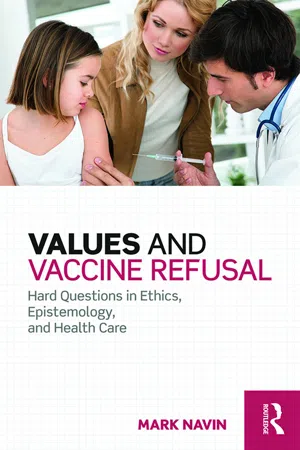
Parents in the US and other societies are increasingly refusing to vaccinate their children, even though popular anti-vaccine myths – e.g. 'vaccines cause autism' – have been debunked. This book explains the epistemic and moral failures that lead some parents to refuse to vaccinate their children. First, some parents have good reasons not to defer to the expertise of physicians, and to rely instead upon their own judgments about how to care for their children. Unfortunately, epistemic self-reliance systematically distorts beliefs in areas of inquiry in which expertise is required (like vaccine immunology). Second, vaccine refusers and mainstream medical authorities are often committed to different values surrounding health and safety. For example, while vaccine advocates stress that vaccines have low rates of serious complications, vaccine refusers often resist vaccination because it is 'unnatural' and because they view vaccine-preventable diseases as a 'natural' part of childhood. Finally, parents who refuse vaccines rightly resist the utilitarian moral arguments – 'for the greater good' – that vaccine advocates sometimes make. Unfortunately, vaccine refusers also sometimes embrace a pernicious hyper-individualism that sanctions free-riding on herd immunity and that cultivates indifference to the interpersonal and social harms that unvaccinated persons may cause.
eBook - ePub
Values and Vaccine Refusal
Hard Questions in Ethics, Epistemology, and Health Care
- 240 pages
- English
- ePUB (mobile friendly)
- Available on iOS & Android
eBook - ePub
About this book
Information
1 Gender, vaccine denialism, and resistant epistemic communities
DOI: 10.4324/9781315764078-2
“The physician-patient relationship, like so many other human relationships, requires an element of trust. I certainly neither want nor expect a return to the paternalistic ‘doctor knows best’ mindset of bygone years, but I do need to know that [a] patient’s parents respect my training and expertise.”(Saunders 2014)
When parents trust pediatricians, they usually vaccinate their children (Benin et al. 2006; Larson et al. 2011). And when it comes to vaccine science, parents generally place more trust in pediatricians than they place anywhere else (Freed et al. 2011). So, we should pay attention when these trusting relationships break down, as they often do in the case of vaccine denialism.
Are vaccine denialists irrational, overly emotional, or insufficiently attentive to the evidence about vaccines their pediatricians offer? I don’t think they are. But some advocates of routine childhood vaccination seem to embrace narratives that emphasize the supposed cognitive deficits of vaccine denialists. For example, Seth Mnookin writes for The Atlantic that vaccine denialism is characterized by “irrational rhetoric,” and Michael Specter writes in Denialism that vaccine denialists are victims of “irrational thinking” (Mnookin 2011b; Specter 2009). An article in Scrubs (a magazine for nurses) provides advice for overcoming the “irrational fears” patients may have about vaccines, while a book reviewer for NewScientist.com frames the differences between advocates of mainstream medicine and vaccine denialists in terms of “vaccines vs. irrationality” (Mooney 2011; Pregerson 2011). Even some writers who have been more sympathetic with vaccine denialists claim vaccine denialists are unreasonable (Ropeik 2011). More troubling has been the occasional tendency of critics to ascribe a gendered idea of irrationality to vaccine denialists: hysteria. For example, both the New York Post and National Public Radio (NPR) have attributed decreased rates of childhood vaccination to ‘vaccine hysteria’ (Goldberg 2011; Moss-Coane 2011). One may invoke ‘hysteria’ without sexist intent, but that may not block worries about the gendered nature of that term’s conception of irrationality, especially given the prominence of mothers among vaccine denialists.1
In this chapter, I argue that it may sometimes be reasonable for parents (especially mothers) to refuse to grant credibility to the testimony of pediatricians. This is for both general reasons and for reasons that are particular to parent-pediatrician interactions. Parents may be aware of physicians’ historical and ongoing abuse of their (epistemic) power, and they may have been treated paternalistically by pediatricians. Furthermore, vaccine denialists sometimes participate in democratic communities of ‘parent-researchers’ that reject the authoritarianism of traditional medical practice. Accordingly, one reason vaccine denialists may disagree with vaccine proponents about the reasons to vaccinate is because they also disagree about the sorts of practices that are conducive to good reasoning about health care choices. In place of the priority mainstream medicine places on empirically grounded and peer-reviewed research, vaccine denialists often uncritically affirm their fellow parents’ beliefs about their children’s health, and they refuse to recognize differences in medical expertise and competence.2
My task in this chapter is both descriptive and evaluative. I describe the different epistemic practices and values that are present in communities of vaccine denialists. My work should also inform the judgments we make about vaccine denialists, by showing that some of the practices that lead to vaccine denialism are better than those which are prevalent in mainstream medicine, while some of them are much worse. The fact that vaccine denialists are motivated by a commitment to some good epistemic practices (such as non-authoritarian relationships between pediatricians and parents) is a reason for thinking that they are not as ‘irrational’ as many have claimed them to be. However, vaccine denialists are insufficiently committed to truth-oriented inquiry.3 The poor epistemic practices prevalent in vaccine denialist communities prevent vaccine denialists from endorsing the well-established results of vaccine science.
Comments on method: epistemology, feminist philosophy, and testimony
It may help to make three preliminary points about this chapter’s methodology. First, I assume an empirically grounded conception of medical knowledge, though I do not presuppose a particular epistemic theory.4 Also, I take for granted that our dispositions and practices may do a better or worse job of orienting us towards medical knowledge. My use of terms such as ‘epistemic virtue’ and ‘epistemic vice’ should be understood in the context of these general presuppositions. Here, I draw on virtue epistemology, a tradition that goes back to Aristotle and which has recently received renewed interest. Virtue epistemologists are less interested in identifying ‘necessary and sufficient’ conditions for knowledge than in describing the dispositions that better orient knowers towards knowledge. These virtues include trustworthiness, credibility, and accuracy, among many others.5 Accordingly, an ‘epistemic virtue’ relative to inquiry about medicine is a disposition which facilitates the acquisition of empirically grounded medical knowledge. In contrast, an ‘epistemic vice’ relative to inquiry about medicine is a disposition which inhibits the acquisition of empirically grounded medical knowledge. For example, I will argue that it is epistemically vicious for vaccine denialists to avoid interactions with mainstream pediatricians who may challenge their views. A disposition to avoid potentially productive epistemic ‘friction’ is not conducive to acquiring medical knowledge.
Second, I turn to feminist scholarship in this chapter (and elsewhere in the book) because the interactions that occur in mainstream pediatric practice and among vaccine denialists are often influenced by gender, and because they manifest the sorts of gender-related power inequalities that have often been the focus of feminist work.6 For example, the work of caring for children is gendered feminine, as is parental care for children’s health, e.g. ‘doctor mom’. And mothers make most of the decisions about how children interact with medical professionals. A report from the Henry J. Kaiser Family Foundation found that, in around 80% of households with children, mothers take the children to the doctor and have primary responsibility for making decisions about medical interventions (Henry J. Kaiser Family Foundation 2013). The public faces of vaccine denialism and refusal are often the faces of mothers, such as Alicia Silverstone, Jenny McCarthy, and Barbara Loe Fisher (Silverstone 2014; Williams 2014). Their online communities often focus on mothers, such as the Thinking Moms’ Revolution (2014) or Moms against Mercury (2014). And books and other media in the vaccine denialist/refuser world are often directed towards mothers, too, e.g. Mother Warriors (McCarthy 2008). In contrast, the epistemic practices of physicians are often gendered masculine (even though many physicians are women).7 Therefore, interactions between parents and pediatricians surrounding vaccination decisions take place against the background of gender inequalities and gendered conceptions of the reasoning of physicians and parents.8
Third, this chapter’s discussion of the epistemic virtues and vices of vaccine denialists draws on the autobiographical testimony of vaccine denialists. Vaccine denialists have firsthand knowledge of how they have been treated by physicians and how the internal practices of vaccine denialist communities differ from those that are prevalent in mainstream medical contexts. Furthermore, we sometimes have good reason to lend credibility to the reports of social subordinates about the conditions of their social subordination. Parents – and especially mothers – who believe that they have been treated disrespectfully by physicians are likely to know more about the conditions of their treatment than their pediatricians are likely to know.9 Of course, parental testimony may be legitimately challenged by the testimony of others, including physicians. But, for my purposes, parental testimony is sufficient to illustrate both the virtuous and vicious epistemic dispositions to which vaccine denialists are prone.10
Reasonable skepticism
There are good reasons to question the consensus view that vaccine denialism results from parental (and especially maternal) irrationality.
First, the socially privileged have often attempted to quell dissent by impugning the rationality of those who have challenged distributions of power. Anti-labor employers such as Henry Ford famously thought unions were bad for workers and that workers were too blinded by their short-term interests to realize this putative fact (Ford 2013, chap. 18). Racists who defended Jim Crow frequently insulted the cognitive capacities of civil rights activists.11 And advocates for patriarchy have long invoked the supposed irrationality of women as a justification for their cause. Today, some businesses make money by convincing the public that grassroots protestors are irrational. A company called Stratfor tells its clients that (for a fee) it can persuade (what it calls) the realists, idealists, and opportunists that radicals are unreasonable agitators, with the aim of delegitimizing otherwise popular resistance movements (Horn 2013).
Since I am especially interested in the relationship between mothers and pediatricians, it may be helpful to reflect on the history of the relationship between femininity and ‘irrationality’. As early as Plato, ideals of reason were often tied to ideas of masculinity while conceptions of irrationality were tied to ideas of femininity. Philosophers including Susan Bordo, Virginia Held, and Genevieve Lloyd (among many others) have shown how the supposed dichotomy of the ‘rational man’ and the ‘irrational woman’ has often been constructed and invoked to deny women equal social and political status (Bordo 1987; Held 1990; Lloyd 1993). This history of ‘irrationality’ is a reason to resist the quick conclusion that mothers’ vaccine denialism can be explained by scientific illiteracy or by their failure to exercise reasonable control over their emotions.
A second reason to resist the claim that mothers act irrationally when they refuse to defer to the (supposed) epistemic authority of medical experts is that medical authorities have often harmed women.12 In particular, activists and scholars have revealed and criticized the tendency of physicians to treat women’s bodies as mere objects on which to perform their craft (Sherwin 1992). Women have often been abused in medical contexts, including coercive (interventions in) pregnancy and childbirth, involuntary sterilization, and more general violations of women’s autonomy and informed consent. Consider one regrettably contemporary example: non-consensual pelvic exams. In many countries, it has until recently been common, if unofficial, practice for rooms of medical students to perform non-consensual pelvic examinations on women who had been anesthetized for medical procedures. In many cases, pelvic exams were not indicated for the procedures women had consented to receive (Coldicott, Pope, and Roberts 2003; Dwyer and Rothstein 1993). In the context of these sorts of historical (and sometimes ongoing) abuses, it is not ‘irrational’ for mothers to refuse to blindly trust the testimony their children’s pediatricians offer about vaccines.
We can find further support for the reasonableness of mothers’ skepticism about the testimony of medical authorities by reflecting on the particular ways in which mothers have been subjected to medical abuses. It is common for mothers to report they were disrespected or coerced during their hosp...
Table of contents
- Cover Page
- Half-Title Page
- Title Page
- Copyright Page
- Dedication
- Table Of Contents
- Preface
- Acknowledgments
- Introduction
- 1 Gender, vaccine denialism, and resistant epistemic communities
- 2 Bias and the ‘irrationality’ of vaccine denialism
- 3 Purity, disgust, and ‘unsafe’ vaccines
- 4 Parental prerogatives and the morality of vaccination
- 5 Coercive vaccination
- 6 Vaccine exemptions
- Conclusion
- Index
Trusted by 375,005 students
Access to over 1.5 million titles for a fair monthly price.
Study more efficiently using our study tools.
Frequently asked questions
Yes, you can cancel anytime from the Subscription tab in your account settings on the Perlego website. Your subscription will stay active until the end of your current billing period. Learn how to cancel your subscription
No, books cannot be downloaded as external files, such as PDFs, for use outside of Perlego. However, you can download books within the Perlego app for offline reading on mobile or tablet. Learn how to download books offline
Perlego offers two plans: Essential and Complete
- Essential is ideal for learners and professionals who enjoy exploring a wide range of subjects. Access the Essential Library with 800,000+ trusted titles and best-sellers across business, personal growth, and the humanities. Includes unlimited reading time and Standard Read Aloud voice.
- Complete: Perfect for advanced learners and researchers needing full, unrestricted access. Unlock 1.5M+ books across hundreds of subjects, including academic and specialized titles. The Complete Plan also includes advanced features like Premium Read Aloud and Research Assistant.
We are an online textbook subscription service, where you can get access to an entire online library for less than the price of a single book per month. With over 1.5 million books across 990+ topics, we’ve got you covered! Learn about our mission
Look out for the read-aloud symbol on your next book to see if you can listen to it. The read-aloud tool reads text aloud for you, highlighting the text as it is being read. You can pause it, speed it up and slow it down. Learn more about Read Aloud
Yes! You can use the Perlego app on both iOS and Android devices to read anytime, anywhere — even offline. Perfect for commutes or when you’re on the go.
Please note we cannot support devices running on iOS 13 and Android 7 or earlier. Learn more about using the app
Please note we cannot support devices running on iOS 13 and Android 7 or earlier. Learn more about using the app
Yes, you can access Values and Vaccine Refusal by Mark Navin in PDF and/or ePUB format, as well as other popular books in Philosophy & Ethics & Moral Philosophy. We have over 1.5 million books available in our catalogue for you to explore.