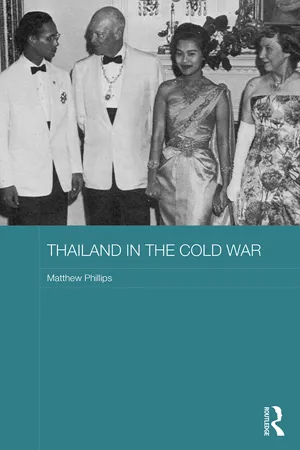
Thailand's position during the Cold War was ambiguous: the country's political leadership was very keen to maintain the country's independence on the world stage, yet at the same time was anxious to establish the country's credentials as staunchly anti-communist. However, as this book argues, Thailand, though never formally a client state of the United States, was very closely embedded in the Western camp through the commitment of Thailand's cosmopolitan urban communities to developing a modern, consumerist lifestyle. Considering popular culture, including film, literature, fashion, tourism and attitudes towards Buddhism, the book shows how an ideology of consumerism and integration into a "free world" culture centred in the United States gradually took hold and became firmly established, and how this popular culture and ideology was fundamental in determining Thailand's international political alignment.
- 218 pages
- English
- ePUB (mobile friendly)
- Available on iOS & Android
eBook - ePub
Thailand in the Cold War
About this book
Information
1 ‘A theatre with two stages’
Jim Thompson’s Thailand
In the latter half of March 1967, just a few days before Easter Sunday, three men were spending an evening together in Bangkok. It was an uneventful evening, spent between men who knew each other well. Jim Thompson was one of Southeast Asia’s best known American residents, famous for making Thai silk known to the world. Charles Sheffield was acting manager of the Thai Silk Company, which Thompson had founded two decades earlier. William Warren was a writer and journalist who, based in the city for many years, had long made Thompson one of his most prized contacts. This time, the book he was writing was about Thompson’s house, a hotchpotch of old wooden buildings and palaces from around the country that combined to create one of the city’s most spectacular and opulent residences. The book was near completion, and all that was now needed was to catalogue the collection of historic artefacts accumulated by Thompson during two decades in Southeast Asia. As the three proceeded to walk through the different levels of the dwelling, measuring Buddha statues and commenting on the origins of various Burmese tapestries, the only thing of note about Thompson’s demeanour was that he seemed tired.1 Yet this was to be the last time that William Warren would spend time with the man who had been one of his most important subjects. It was the height of summer, and Jim Thompson was about to make a trip he knew well, into the cool Malaysian highlands. After a couple of days relaxing with his long-standing friend Connie Mangskau and the owners of the cottage, Dr Ling and his wife Helen, the small group marked Easter Sunday with a picnic. That afternoon, he was supposed to be taking a nap in his room. Yet at some point, Dr Ling later reported, he had left, leaving his suit jacket and his cigarettes back at the house. Little else is known about what happened to Jim Thompson that afternoon, except that he was never seen again.2
For the American public, headlines about the disappearance of Jim Thompson made little impact. In January of the same year, Martin Luther King had written an article linking the civil rights movement with the Vietnam War. In doing so, he had made a powerful connection between American military involvement in Southeast Asia and the calls for racial equality at home.3 A generation of black Americans were beginning to join forces with a bourgeoning anti-war movement based largely in US universities, and central to the movement was the charge of hypocrisy made against US policy in Southeast Asia. A day before Thompson’s disappearance, 5000 had marched against the war in Chicago, and two weeks later 400,000 marched on the United Nations in New York. Fuelled by the draft, and driven by a rising uncertainty over the purpose of the US fight in Southeast Asia, the transformation in US public opinion was rapid. In a short few months, the idealism that had shaped American attitudes to the Cold War from the end of the Second World War were to come under a scrutiny from which it would never quite recover.4
However, while Jim Thompson’s disappearance might have quickly slipped from the American public’s attention, his legacy within the minds of the international community was already secured. Since his arrival in Asia in 1945, Thai silk had become integral to the branding of the Thai nation, and his house, nestled on the banks of a Bangkok canal, had become an unmissable attraction for tourists to the country. As a result, Jim Thompson’s disappearance immortalised his status as a ‘good’ American, and his story was quickly re-located from the difficult years of the mid-1960s to the memory of a now fading post-war American moment.5 During those early years of the Cold War, a ‘climate of victory’ had intoxicated writers, editors and film producers with regard to their thinking about America’s status in the world.6 Tied to the ideological logic promoted through the idea of an ‘American Century’, figures such as Jim Thompson, who left America to live in places like Thailand, were revered as central to the country’s future as a global leader.
Jim Thompson’s story was particularly compelling. He had originally been sent to Thailand as part of an Office of Strategic Services (OSS) mission to liberate the country at the end of the Second World War. After a trip back to New York, made only a few months into the occupation, Thompson returned to Thailand intending to stay. After a short period spent working on the refurbishment of the Oriental Hotel, he soon refocused his attention on a different project, selling the silk that he had found being produced in some of Bangkok’s poorest communities.7 He worked hard to support the development of this small cottage industry into a set of commercial processes and social relations that made it possible to produce a product tailored specifically for the post-war American market. Over a few short years he developed dyes, patterns and techniques that resulted in the production of a high-quality fabric available in quantities sufficient for both export to the metropolitan centre of New York, but also for an increasing number of American visitors to the country.8
With his silk production already a successful business by the late 1950s, Thompson refocused once again, putting considerable effort and resources into building a new house. Put together to create a building that Thompson regarded as distinctly Thai, the house was from the start of the project designed to be a space made specifically for entertaining guests from America.9 Already a celebrity among the engaged American public, Thompson was clear about the fact that the house was to be a theatre, in which guests, including diplomats, film stars, academics, journalists and spies, could sit and view the comings and goings of Thai communities living below on the canal.10 Soon after finishing construction of the house, Thompson increased his constituency, opening it up to tourists for a number of days a week. By the start of the 1960s, with American policy makers continuing to receive the broad support of US media outlets, Jim Thompson remained one of Thailand’s best known American residents. More than that, however, the vision of Thailand that he had invested so much in asserting was now providing the predominant framework through which US visitors experienced the country. As a result, while the man’s physical disappearance in the latter half of the decade remained little more than an intriguing mystery to the American public, the cultural narratives that Jim Thompson had both exploited and constructed continued to shape American, and increasingly global, visions of the country.
Imagining an age of abundance
Unlike the time he spent in Thailand, Jim Thompson lived the first half of his life in relative mediocrity. Born into an upper-middle-class family on the east coast of America, in 1928 he graduated from Princeton University. He then went on to study at the University of Pennsylvania’s School of Architecture, but his failure to complete the post-graduate course there left his career as an architect frustrated. While he found employment with Holden, McLaughin and Associates in New York, the fact that he had not graduated meant he was unable to sign off on his designs. Yet, while his diminishing prospects in the city were, before the Second World War, becoming ever more apparent, his experiences there would nevertheless prove invaluable. Coming from a good white family, and already financially secure, his work with a leading architect firm in the city would have brought him frequently into contact with the New York financial and political elite.11 Over his years in Bangkok, his knowledge of New York-based culture, and his understanding of how that culture was disseminated to the American nation at large, would prove vital to his success.
In the first half of the twentieth century, New York stood out as culturally, socially and economically distinct when compared with other American cities.12 Throughout the country, lifestyles had at the turn of the century been clearly split. The first was an elite cultural life, confined to opera houses, museums, clubs and concert halls. The other was the world of working men and women, where cultural institutions such as neighbourhood associations, the union hall, and the mutual aid societies were the basis of community identification. While this same split existed in New York, there began to develop from the end of the nineteenth century, first around Broadway, and increasingly throughout the city, a new form of cultural production.13 William R. Taylor has described this environment as a ‘cultural marketplace’, in which appeals to a broader market went some way to breaking down the earlier class distinctions.14 Beginning with ‘itinerants and storefront theatricals’, he explains how there emerged ‘new cultural institutions that collected and displayed entertainment, just as the new department stores displayed goods’.15 While this commercialisation of cultural life may have held within it the disavowal of class distinction, or the oppressive reality of city life, Taylor points out how ‘the new newspapers, the popular songs, and the graphic and photographic art had an open, and non-prescriptive function for consumption’ that helped ‘consumers from across the social spectrum to decode the city’.16 As someone who traversed the space between a New York-based ruling elite and what Barbara and John Ehrenreich have described as the ‘professional–managerial class’, Jim Thompson would have been immersed in such a cultural life.17 Moreover, by moving to New York in 1928, he would also have been privy to a decade in which that kind of cultural production was scaled up to provide ideological narratives for the nation at large.
With many of the country’s major publishing houses already located in the city, the 1920s also saw New York become the centre of the burgeoning advertising industry.18 With the economy booming, fuelled to a great extent by speculation on Wall Street, New York was cemented as the location of a set of industries focused on the production of modern American life. However, during October 1929, the decade of growth came to an abrupt end when prices on the New York Stock Exchange fell dramatically. Whether cause or symptom, the stock market crash was nevertheless followed by a decade in which a vast number of Americans suffered from unemployment, the rapid decline in personal incomes and poverty inducing malnourishment and illness.19 It also resulted in an ideological shift in American politics. When Franklin D. Roosevelt was elected President in 1932, free market capitalism began to be challenged with strong and popular state-led policies that sought to protect working Americans from the excesses of unfettered capitalist growth. Unionisation was promoted, taxes were imposed that sought to redistribute wealth, and social welfare programmes were implemented in order to offer relief to the most destitute families.20 Also included in the ideological framework of the ‘New Dealers’ was the view that during the preceding decade, Americans had been taken advantage of by the capitalist system and, as a result, credit had been extended while people were encouraged to purchase substandard or unnecessary products. As a result, it became increasingly popular in Washington to see normal Americans as what Lizabeth Cohen has described as ‘citizen consumers’ who needed to be represented, and therefore protected, from those advertising agencies and salespeople who over the preceding decade had invested so much time and energy in seeking out their valuable incomes.21 Throughout the decade this consumer movement picked up pace, receiving strong support from the academic community, and resonating strongly with ethnic minority groups, women’s groups and workers in both the industrial and the professional sectors.22
However, while the consumer movement grew in popularity, the large corporations and the financial business elite fought against its ideological logic. For them, American consumers remained central, but rather than seeing them as citizens who needed to be protected from big business, these groups sought to promote the idea that the citizen was a purchaser who, if allowed unfettered access to the market, could stimulate the economic growth that would lead to higher employment and, in turn, create greater levels of consumption. In quoting directly from a film made by Chevrolet in 1937, entitled From Dawn to Sunset, Lizabeth Cohen notes how this vision worked in direct opposition to the consumer movement that had gained momentum under the stewardship of the Roosevelt government. In it, the film suggested that consumers should be given the ‘pleasure of buying, while trapping “the purchasing power of pay packets” to fuel “a prosperity greater than history has ever known”.’23
What is particularly noticeable about this group’s message was the way that, in the immediate aftermath of the crash, it sought to view the crisis as a momentary failure of systems that would eventually return the economy to growth. Rather than making strong commentaries on the economic climate of the day, instead it sought to draw from a memory of the 1920s combined with the emotional appeal to a brighter future for all. Moreover, exploiting New York’s unrivalled position as a ‘cultural market place’ during the 1920s, it was the financiers who resided in the city who emerged as central to the production of an American future undeterred by the temporary failings of the system. The Rockefeller Center, for example, was built at the height of the depression as a physical reminder on the New York skyline of what had been achieved during the 1920s, and what might come next. It was also intended to act as a site for ‘cultural diffusion and transmission’, which, by exploiting the latest in public relations practices, quickly became a physical centre for a New York media industry that was increasingly focused on a national market. As William Buxton has noted, the Rockefeller Center, by integrating ‘philanthropy, knowledge and commerce, as well as family con...
Table of contents
- Cover
- Half Title
- Title Page
- Copyright Page
- Table of Contents
- List of Figures
- Acknowledgements
- Explanatory notes
- Introduction
- 1. ‘A theatre with two stages’: Jim Thompson’s Thailand
- 2. In and out of Vogue: dressing for progress before and after 1945
- 3. If not ‘Great’, then what? Rethinking Thainess in post-war Bangkok
- 4. Cultural spectacle, political authority and the subversion of Thai modernity
- 5. The Tourist Organisation of Thailand and Cold War propaganda
- 6. It’s a small world after all: Thailand’s integration into free world culture
- Conclusion
- Bibliography
- Index
Trusted by 375,005 students
Access to over 1.5 million titles for a fair monthly price.
Study more efficiently using our study tools.
Frequently asked questions
Yes, you can cancel anytime from the Subscription tab in your account settings on the Perlego website. Your subscription will stay active until the end of your current billing period. Learn how to cancel your subscription
No, books cannot be downloaded as external files, such as PDFs, for use outside of Perlego. However, you can download books within the Perlego app for offline reading on mobile or tablet. Learn how to download books offline
Perlego offers two plans: Essential and Complete
- Essential is ideal for learners and professionals who enjoy exploring a wide range of subjects. Access the Essential Library with 800,000+ trusted titles and best-sellers across business, personal growth, and the humanities. Includes unlimited reading time and Standard Read Aloud voice.
- Complete: Perfect for advanced learners and researchers needing full, unrestricted access. Unlock 1.5M+ books across hundreds of subjects, including academic and specialized titles. The Complete Plan also includes advanced features like Premium Read Aloud and Research Assistant.
We are an online textbook subscription service, where you can get access to an entire online library for less than the price of a single book per month. With over 1.5 million books across 990+ topics, we’ve got you covered! Learn about our mission
Look out for the read-aloud symbol on your next book to see if you can listen to it. The read-aloud tool reads text aloud for you, highlighting the text as it is being read. You can pause it, speed it up and slow it down. Learn more about Read Aloud
Yes! You can use the Perlego app on both iOS and Android devices to read anytime, anywhere — even offline. Perfect for commutes or when you’re on the go.
Please note we cannot support devices running on iOS 13 and Android 7 or earlier. Learn more about using the app
Please note we cannot support devices running on iOS 13 and Android 7 or earlier. Learn more about using the app
Yes, you can access Thailand in the Cold War by Matthew Phillips in PDF and/or ePUB format, as well as other popular books in Social Sciences & Asian History. We have over 1.5 million books available in our catalogue for you to explore.