This collection, first published in 1963, includes 29 of George Eliot's essays written between 1846 and 1868. Through these essays, Pinney has managed to convey her range of subject-matters and variety of style. This title, with an introduction and footnotes written by the editor, will be of particular interest to students of literature.
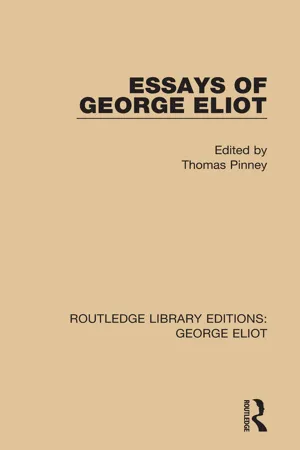
- 476 pages
- English
- ePUB (mobile friendly)
- Available on iOS & Android
eBook - ePub
Essays of George Eliot
About this book
Information
1
Poetry and Prose, from the Notebook of an Eccentric
Coventry Herald and Observer, 4 December 1846, p. 2b; 15 January 1847, p. 2b; 5 February 1847, p. 2bc; 12 February 1847, p. 2ab; 19 February 1847, p. 2ab
The sketches and impressions grouped together as 'Poetry and Prose, From the Notebook of an Eccentric' are George Eliot's first published original writing, except for the short poem entitled 'Farewell' that appeared in the Christian Observer for January, 1840. (Despite the title, no poetry was included in the 'Poetry and Prose' essays.) They are slight, awkward, and self-consciously literary, but the careful reader will discover in them the presence of ideas and attitudes that look forward to the preoccupations of George Eliot's mature work. It is interesting to note that in her last book, Impressions of Theophrastus Such, she returned to the form of these early essays: though they are separated by more than thirty years, her first and last published prose compositions are both moralia.
The five articles in 'Poetry and Prose' were republished in 1919 as Early Essays by George Eliot, privately printed by Major George Redway. The book contains an editor's note which, as Professor Haight observes, 'under the kindest interpretation must be called equivocal'.1 It reads in part:
At the time of George Eliot's death, or perhaps a few years later, the manuscript which is here printed was placed in my hands for publication. Ever since then it has lain among forgotten papers, and now, in order to prevent the total loss of a literary treasure—for such I deem it—I am accepting the responsibility of printing a few copies.
Copies of the essays, clipped from the Coventry Herald and pasted in a Commonplace Book of George Eliot's friend Mrs. Bray, had been displayed at the Coventry Public Libraries on the occasion of George Eliot's centenary in 1919. No manuscript of the essays is known to exist, and the coincidence of the exhibit with Major Redway's reprint is difficult to overlook.
* * *
Introductory
A WEEK ago, I stood sole mourner at the grave of my friend Macarthy. He lies in a village Church-yard;—not one of those peaceful green plots which seem to speak well for the influence of the Bishop's blessing, in which there is some spreading chesnut or yew of age immemorial, that seems to say to the world-weary, 'Come and rest under my shadow.' No. The Church-yard in which Macarthy lies looks not like a Gottes-acker, but a Vicar's acre, the profits of which (including the grazing of half-a-dozen sheep) go to eke out the Curate's yearly hundred, upon which he supports, or rather diets, the gentility of his wife and ten children. It is a thoroughfare for a materialized population, too entirely preoccupied with the needs of the living, to retain an Old Mortality's affectionate care for tomb-stones and epitaphs, or to offer to the graves that terrified veneration which hurries past them after sunset. They are in the strong grasp of giant Hunger, and fear no shadows. Not one of this plodding generation will long remember Macarthy, 'the sick gentleman that lodged at Widow Crowe's,' and when the grass is green and long upon his grave, it will seem to say of him as truly as of others—'I cover the forgotten.' But it is not so, Macarthy. With me thou wilt still live: my thoughts will seem to be all spoken to thee, my actions all performed in thy presence; for ours was a love passing the love of women.2 My friend was one of whom the world proved itself not worthy, for it never made a true estimate of him. His soul was a lyre of exquisite structure, but men knew not how to play on it: it was a bird endowed with rich and varied notes, which it was ready to bestow on human hearers; but their coarse fondling or brutal harshness scared it away, and the poor bird ceased to sing, save in the depths of the forest or the silence of night. To those who saw only the splendour of his genius, and the nobility of his sentiments, his childhood and youth seemed to promise a brilliant career; but any who were capable of a more discriminating estimate and refined analysis of his character, must have had a foreboding that it contained elements which would too probably operate as non-conductors, interposed between his highly-charged mind and the negatively electrified souls around him. The quality on which a good prophet would have pronounced my friend's fate to hang, was one which will be held to have placed him not above, but simply out of, the sphere of his fellow men. It was a morbid sensitiveness in his feeling of the beautiful, which I can compare to nothing but those alleged states of mesmeric lucidity, in which the patient obtains an unenviable cognizance of irregularities, happily imperceptible to us in the ordinary state of our consciousness. His ideal was not, as with most men, an enshrined object of worship, but a beautiful shadow which was ever floating before him, importunately presenting itself as a twin object with all realities, whether external or mental, and turning all their charms into mockery. He moved among the things of this earth like a lapidarian among false gems, which fetch high prices and admiration from others, but to him are mere counterfeits. He seemed to have a preternaturally sharpened vision, which saw knots and blemishes, where all was smoothness to others. The unsightly condition of the masses—their dreary ignorance—the conventional distortion of human nature in the upper classes—the absence of artistic harmony and beauty in the details of outward existence, were with him not merely themes for cold philosophy, indignant philippics, or pointed satire; but positively painful elements in his experience, sharp iron entering into his soul. Had his nature been less noble, his benevolence less God-like, he would have been a misanthropist, all compact of bitter sarcasm, and therefore no poet. As it was, he was a humourist,—one who sported with all the forms of human life, as if they were so many May-day mummings, uncouth, monstrous disguises of poor human nature, which has not discovered its dignity. While he laughed at the follies of men, he wept over their sorrows; and while his wit lashed them as with a whip of scorpions, there was a stream of feeling in the deep caverns of his soul, which was all the time murmuring, 'Would that I could die for thee, thou poor humanity!' From the age of twenty, I never knew him to form a particular predilection for any individual, or admit any new intimacy. He seemed to have learned by experience, that his sensibility was too acute for special friendship—that his sympathy with mankind was that of a being of analogous, rather than of identical race. Even animals, which usually attract those who are cut off by any material or immaterial barrier from their own kind, seemed to have a repulsion for him. He was their zealous protector, it is true, and I have known him walk back a hundred yards to give a consolatory pat on the head to an ugly cur, which he thought he had repulsed too unkindly; though all the while feeling the direst aversion to the ill-favoured brute. He seemed, indeed, to shrink from all organized existences. He was an ardent lover of Nature, but it was in her grand inorganic forms,—the blue sky, the stars, the clouds, the sea, mountains, rocks, and rivers,—in which she seems pregnant with some sublimer birth than the living races of this globe. He would lie on the grass gazing at the setting sun, with a look of intense yearning, which might have belonged to a banished Uriel. The roaring of the wind would produce in him an enthusiastic excitement, a spiritual intoxication. He felt a delight in the destructive power of the elements, which seemed to be in singular conflict with his angelic pity: had he been a witness of an earthquake, a city on fire, or the eruption of a volcano, I know not which would have predominated in him, bleeding compassion for the sufferers, or wild ecstacy at the triumphant fury of the forces of Nature. Such in part was Macarthy; and it is no wonder that before he had well attained manhood, he renounced all attempts at any profession, which must have made him one of the weary labourers in the treadmill of society. He thought the fetters of comparative poverty less heavy than those of wealth, and determined to content himself with his small hereditary property. This he considerably reduced by travelling in foreign countries, and by gifts which for him were lavish, so that when, at the age of forty, he sought his native village, in the belief that he was near his end, his means of support were contracted to the merest pittance. I was his earliest friend, and though we had been long separated, our hearts had been too closely entwined while their affections were yet young and tender, to have ever lost the loving bias by which they had formed one stem. He sent for me, implying that I was to receive his last wishes. I found him in a poor little dwelling, the occupant of a widow's spare room. His emaciated figure confirmed the idea expressed in his letter, that it would not be much longer animated by that bright spirit which now gleamed with augmented intensity from his deep-set eyes, as if glowing at the prospect of deliverance from its captivity. When we had talked long and earnestly together, he pointed to a large trunk filled with manuscripts. 'When I am dead,' he said, 'take these as the only memorial I have to give, and use them as you will.' I refused to leave my friend until he was committed to his mother earth; and it then became my most interesting employment to examine the papers which contained the best history and image of his mind. I have found the results of profound thought and widely extended research—productions, some of which have been carefully meditated, others apparently thrown off with the rapidity of inspiration; but in all of them there is a strange mixture of wisdom and whimsicality, of sublime conception and stinging caricature, of deep melancholy and wild merriment. No publisher would venture to offer such caviare to the general; and my friend's writings are not old and musty enough to fall within the scheme of any publishing Club, so that the bulk of them will probably be their own tomb. Meanwhile, among his other manuscripts, I have discovered three thick little volumes, which were successively carried in his pocket, for the purpose of noting down casual thoughts, sketches of character, and scenes out of the common; in short, as receptacles of what would probably have evaporated in conversation, had my friend been in the habit of companionship. From these fragmentary stores, I shall now and then give a selection in some modest nook of an unpretending journal—not to the world, far be so ambitious an aspiration from me—but to the half-dozen readers who can be attracted by unsophisticated thought and feeling, even though it be presented to them in the corner of the weekly newspaper of their own petty town.
How to Avoid Disappointment
One of my favourite lounges in Paris is the studio of an artist, who tolerates my presence on the score of a slight service which I happened to render him some years ago, and which he magnifies into a lasting claim on his gratitude. I soon acquire an almost passionate interest in the progress of a noble picture. I love to think how the perfect whole exists in the imagination of the artist, before his pencil has marked the canvass,—to observe how every minute stroke, every dismal-looking layer of colour, conduces to the ultimate effect, and how completely the creative genius which has conceived the result can calculate the necessary means. I love to watch the artist's eye, so wrapt and unwordly in its glance, scrupulously attentive to the details of his actual labour, yet keeping ever in view the idea which that labour is to fulfil. I say to myself,—this is an image of what our life should be,—a series of efforts directed to the production of a contemplated whole, just as every stroke of the artist's pencil has a purpose bearing on the conception which he retains in his mind's eye. We should all be painting our picture, whether it be a home scene, after Wilkie,3 a Paul preaching at Athens, or a Brutus passing sentence on his son. We should all have a purpose in life as perfectly recognized and definite as the painter's idea of his subject. 'Indisputably,' says your man of the world, 'I have never for a moment swerved from the determination to make myself rich and respectable. I chose my wife with that object; I send my sons to the University, I give dinners, I go to balls, I go to Church,—all that I may be "respectable." Am not I a man of purpose?' Then there is the man of public spirit, who has devoted his life to some pet project, which is to be the grand catholicon for all the diseases of society. He has travelled, he has lectured, he has canvassed, he has moved heaven and earth, has become the victim of a fixed idea, and died disappointed. Doubtless, such men as these have a distinct purpose in life, but they are not the men of whom my artist reminds me—who seem to me to be painting a picture. The kind of purpose which makes life resemble a work of art in its isolated majesty or loveliness, is not the attempt to satisfy that inconvenient troop of wants which metamorphose themselves like the sprites of an enchantress, so that no sooner have we provided food for the linnet's beak, than a huge lion's maw gapes upon us. It is to live, not for our friends, not for those hostages to fortune, wives and children; not for any individual, any specific form; but for something which, while it dwells in these, has an existence beyond them. It is to live for the good, the true, the beautiful, which outlive every generation, and are all-pervading as the light which vibrates from the remotest nebula to our own sun. The spirit which has ascertained its true relation to these, can never be an orphan: it has its home in the eternal mind, from which neither things present nor to come can separate it. You may infallibly discern the man who lives thus. His eye has not that restless, irresolute glance, which tells of no purpose beyond the present hour: it looks as you might imagine the eye of Numa to have looked after an interview with Egeria; the earnest attention and veneration with which it gazed on the divine instructress still lingering in its expression. Such a man is not like the parasitic plants which crawl ignobly or climb aspiringly, just as accident has disposed the objects around them. He has a course of his own, like our forest trees, a fixed form of growth, which defies and hurls down the stones and mortar with which society attempts to bind him in. He loves individuals, he labours for specific objects, but only as transient forms of the abiding reality which he seeks; so that if the individual pass away, if the object be frustrated, his love and his labour are not essentially disappointed.
I said one day to my artist, when he was ardently engaged on a favourite picture, 'Adolphe, has your love of art ever been tested by any great misfortune?' He replied, 'I have suffered—I am suffering under a great calamity; not the blighting of ambition, not the loss of any loved one, but a far more withering sorrow; I have ceased to love the being whom I once believed that I must love while life lasted. I have cherished what I thought was a bright amethyst, and I have seen it losing its lustre day by day, till I can no longer delude myself into a belief that it is not valueless. But you see,' he said, turning to me and smiling, 'I love my pictures still; I should not like to die till I have worked up my chosen subjects.'
Who would not have some purpose in life as independent in its value as art is to the artist?
The Wisdom of the Child
It may not be an original idea, but never mind, if it be a true one, that the proper result of intellectual cultivation is to restore the mind to that state of wonder and interest with which it looks on everything in childhood. Thus, Jean Jacques Rousseau, couched on the grass by the side of a plant, that he might examine its structure and appearance at his ease, would have seemed to a little child so like itself in taste and feeling, that it would have lain down by him, in full confidence of entire sympathy between them, in spite of his wizard-like Armenian attire. But I will extend the parallel, and say that true wisdom, which implies a moral as well as an intellectual result, consists in a return to that purity and simplicity which characterize early youth, when its intuitions have not been perverted. It is, indeed, a similarity with a difference; for the wonder of a child at the material world is the effect of novelty, its simplicity and purity of ignorance; while the wonder of the wise man is the result of knowledge disclosing mys...
Table of contents
- Cover
- Half Title
- Title
- Copyright
- Original Title
- Original Copyright
- Dedication
- Preface
- Contents
- Introduction
- Abbreviations
- 1. Poetry and Prose, From the Notebook of an Eccentric (4 December 1846-19 February 1847)
- 2. [The Progress of the Intellect] (January, 1851)
- 3. [The Life of Sterling] (January, 1852)
- 4. Woman in France: Madam de Sablé (October, 1854)
- 5. Three Months in Weimar (June, 1855)
- 6. Liszt, Wagner, and Weimar (July, 1855)
- 7. [Westward Ho! and Constance Herbert] (July, 1855)
- 8. Lord Brougham's Literature (7 July 1855)
- 9. The Morality of Wilhelm Meister (21 July 1855)
- 10. The Future of German Philosophy (28 July 1855)
- 11. Life and Opinions of Milton (4 August 1855)
- 12. Evangelical Teaching: Dr. Cumming (October, 1855)
- 13. [Tennyson's Maud] (October, 1855)
- 14. Margaret Fuller and Mary Wollstonecraft (13 October 1855)
- 15. Translations and Translators (20 October 1855)
- 16. Thomas Carlyle (27 October 1855)
- 17. German Wit: Heinrich Heine (January, 1856)
- 18. Introduction to Genesis (12 January 1856)
- 19. The Antigone and Its Moral (29 March 1856)
- 20. The Natural History of German Life (July, 1856)
- 21. Silly Novels by Lady Novelists (October, 1856)
- 22. [Three Novels] (October, 1856)
- 23. Worldliness and Other-Worldliness: The Poet Young (January, 1857)
- 24. A Word for the Germans (7 March 1865)
- 25. Servants' Logic (17 March 1865)
- 26. The Influence of Rationalism (15 May 1865)
- 27. Address to Working Men, By Felix Holt (January, 1868)
- 28. Notes on Form in Art (1868)
- 29. Leaves from a Note-Book
- Appendices
- Index
Trusted by 375,005 students
Access to over 1.5 million titles for a fair monthly price.
Study more efficiently using our study tools.
Frequently asked questions
Yes, you can cancel anytime from the Subscription tab in your account settings on the Perlego website. Your subscription will stay active until the end of your current billing period. Learn how to cancel your subscription
No, books cannot be downloaded as external files, such as PDFs, for use outside of Perlego. However, you can download books within the Perlego app for offline reading on mobile or tablet. Learn how to download books offline
Perlego offers two plans: Essential and Complete
- Essential is ideal for learners and professionals who enjoy exploring a wide range of subjects. Access the Essential Library with 800,000+ trusted titles and best-sellers across business, personal growth, and the humanities. Includes unlimited reading time and Standard Read Aloud voice.
- Complete: Perfect for advanced learners and researchers needing full, unrestricted access. Unlock 1.5M+ books across hundreds of subjects, including academic and specialized titles. The Complete Plan also includes advanced features like Premium Read Aloud and Research Assistant.
We are an online textbook subscription service, where you can get access to an entire online library for less than the price of a single book per month. With over 1.5 million books across 990+ topics, we’ve got you covered! Learn about our mission
Look out for the read-aloud symbol on your next book to see if you can listen to it. The read-aloud tool reads text aloud for you, highlighting the text as it is being read. You can pause it, speed it up and slow it down. Learn more about Read Aloud
Yes! You can use the Perlego app on both iOS and Android devices to read anytime, anywhere — even offline. Perfect for commutes or when you’re on the go.
Please note we cannot support devices running on iOS 13 and Android 7 or earlier. Learn more about using the app
Please note we cannot support devices running on iOS 13 and Android 7 or earlier. Learn more about using the app
Yes, you can access Essays of George Eliot by Ian Adam, Thomas Pinney,Ian Adam, Thomas Pinney in PDF and/or ePUB format, as well as other popular books in Literature & English Literary Criticism. We have over 1.5 million books available in our catalogue for you to explore.