One key concept in the large body of scholarship concerned with theorizing social relations is the idea of 'cosmopolitanism'. This book unpacks the idea of cosmopolitanism through the linked knowledges of the Global South. It brings into dialogue an inter-disciplinary team of local and transnational scholars who examine various temporal, cultural, spatial and political contexts in countries as different, yet connected, as Malaysia, Indonesia, Singapore, India, Bangladesh, Japan, Korea and Vietnam. The book also considers a wide range of subjects – present and historical, real, as represented in literature and in theatre, and as theorized in philosophy – across these diverse contexts, but always focusing on regions and places where inter-Asian intermingling has taken place. The conclusions arrived at are varied and considerably enrich social theorizing. The book reveals a cosmopolitanism that is much more specifically Asian than the cosmopolitanism usually associated with the West, demonstrates how concepts of 'nation', 'local' and 'globalization' play out in practice in Asian settings, and re-examines concepts such as migration, diaspora, and the construction of identities. The book has much to offer scholars engaged in history, literary studies, anthropology and cultural studies.
eBook - ePub
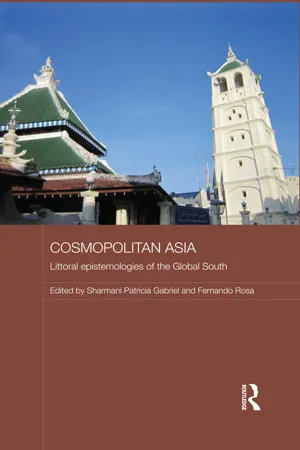
Cosmopolitan Asia
Littoral Epistemologies of the Global South
- 194 pages
- English
- ePUB (mobile friendly)
- Available on iOS & Android
eBook - ePub
Cosmopolitan Asia
Littoral Epistemologies of the Global South
About this book
Information
1
Migration, transnationalism and modernity
Thinking of Kerala’s many cosmopolitanisms
Introduction
This chapter is inspired by questions that emerged from the current debate on cosmopolitanism in the English-speaking metropolitan academy. I speak from my own location – that of the ‘post-colony’ – borrowing this term from Niranjana (1998). In her reckoning, ‘post-colony’ refers not only to a position (the ‘postcolonial’) but to a location as well, a difference that definitely marks our political engagement as feminist intellectuals in third-world spaces who strive to not only make feminism comprehensible but also emphasize the dependence of such translation on contingent political and cultural contexts (Niranjana, 1998: 144). Academics in the ‘post-colony’ likewise seek to translate debates that unfold in first-world academic contexts, but their translation is shaped by local political–cultural contexts.
It is apparent that the terms of the debate are set by long-standing contests within the first-world academia – between universalists who preserve or rework Kantian cosmopolitanism (Nussbaum, 1996) and others who seek to rearticulate the idea in non-Eurocentric ways and/ or in the backdrop of possibilities opened by intensified globalization (Connolly, 2000). Postcolonial scholars have taken distinctive positions within the latter group (Rovisco and Nowicka, 2011). Another strategy has been to turn cosmopolitanism into a purely descriptive category shorn completely of Eurocentric normative import (Gidwani and Sivaramakrishnan, 2003). Nevertheless, as Robbins (1992) and Cheah (1997) point out, these interventions often stay within the concerns and contexts of first-world academic metropolises. While it would be absurd to claim that the above struggles are irrelevant to the post-colony, it may be necessary to revise the question: how may the idea of cosmopolitanism be rearticulated against Eurocentrism and the depredations of global capital in the post-colony? This clearly involves more than what postcolonial scholarship has attempted.
Consider, for instance, an elaboration of cosmopolitanism that refers to ‘a more generally and historically deep experience of living in a state of flux, uncertainty, and encounter with difference that is possible in rural, urban, or metropolitan settings’ (Gidwani and Sivaramakrishnan, 2003: 344–345). The ‘rural cosmopolitan’, an agent of local cosmopolitics, does not await transformation from elsewhere (Gidwani and Sivaramakrishnan, 2003: 345). However, they add that these changes may not be progressive: often, ‘the transformations of social space circular migrants enact, re-inscribe and consolidate traditional arrangements, rather than undermine them’ (Gidwani and Sivaramakrishnan, 2003: 362). Surely, this does little to counter the Eurocentric geographic imagination that renders the local/vernacular into the parochial. Nevertheless, I find it unhelpful to stop here because these insights do not relate to ongoing struggles around space and recognition in South Asia as the post-colony. While highlighting the agential capacities of people who straddle worlds of difference may indeed be an oppositional move in the first-world academy, it may not suffice in the post-colony.
To pose this question is to implicitly critique mainstream social science in the specific post-colony that I write from: Kerala, India. Here, social science, since the early twentieth century, has been largely wedded to the state’s governmental concerns and an entrenched conception of the [sub]national,1 which is highly developmentalist. Mid-twentieth-century multidisciplinary research focused on matriliny, communism and community politics, all of interest to first-world researchers, and all of which came to be viewed as unique markers of the [sub]nation (Devika, 2007b). The highpoint of this trajectory was the 1970s discourse around the ‘Kerala Model’2 of social development, through which developmentalism came to be projected as the unique cultural feature of modern Kerala. Interestingly, Kerala has functioned since then as a heterotopia for left-leaning developmentalist social scientists of the Anglo-American academia.
In this sense of the local that left unquestioned the hegemony of Kerala’s new elite – specifically, those caste-communities including the Syrian Christians, Nairs and the Ezhavas who gained heavily from the socio-economic transformations of the twentieth century (Jeffrey, 2003) – disadvantaged groups figure as outliers to the central tendency (Kurien, 2000). However, a host of factors including the steady growth of oppositional civil social politics since the 1980s, and the strengthening of Dalit and feminist social research critical of Kerala Model discourse in the 1990s and after have contributed to destabilizing developmentalist [sub]nationalism. In short, there is an ongoing struggle over reimagining the local in which social research is deeply implicated.
As a critical researcher, I seek perspectives from first-world cosmopolitanism debates that help us to critique dominant models of researching the connections between migration and modernity in Kerala and reimagine the local as historically shaped by other places. This cannot be through privileging the universal implicitly (as in Kerala Model discourse) or effectively effacing the local in favour of the cultural hybrid or the rural cosmopolitan. Instead, I hope to make better use of the different senses in which the notion of cosmopolitanism has been glossed in the ongoing debate. Different social groups in Malayalee society have related to the world beyond given cultural borders differently. These trajectories have been shaped by both the internal social dynamics of late nineteenth-century to early twentieth-century Malayalee society and the opportunities opened up to specific groups by the integration of the economy of the Malayalam-speaking regions to the capitalist world system in the mid to late nineteenth century. The present effort to investigate different cosmopolitanisms in twentieth-century Malayalee society is close to Sheldon Pollock’s suggestion about cosmopolitanism as ‘action rather than idea’, and his ‘historical analysis of cosmopolitan and vernacular ways of being and the kinds of cultural and political belonging to which they have related’ (Pollock, 2000). This may also make sense of apparently paradoxical features of contemporary Malayalee society that are explained only weakly within the dominant developmentalist paradigm: for instance, while the Malayalam public sphere is remarkably cosmopolitan, the social domain in Kerala is characterized by intense conservatism that evokes traditional values continuously. Moreover, by pursuing such a line of enquiry, I perform, to borrow Menon’s (2007) words, a ‘locally rooted cosmopolitanism that declares affiliation with other worlds and places’ (p. 393).
This chapter claims that the history of twentieth-century Malayalee (‘speakers of Malayalam’, the language of Kerala, and refers to the people of the State) modernity is inextricably bound with the intertwined histories of migration and transnationalism, and of shifting, diverse cosmopolitanisms. In the two sections that follow, I make a preliminary foray into the complex history proposed above. In the ‘Conclusion’ section, I reflect on what it holds for scholarship and struggle.
Critical cosmopolitanisms and modernity: late nineteenth and early mid-twentieth centuries
If ‘cosmopolitanism’ is understood exclusively as elite mobility and ‘a conquering gaze from nowhere’ (Donna Haraway, quoted in Robbins, 1992: 171), then the only group in early twentieth-century Malayalee society who could claim to be ‘cosmopolitan’ was the members of the colonial bureaucracy. By then, many elite Malayalees, especially of the Nair and Syrian Christian communities, had joined the colonial civil service. The memoirs and autobiographies of such individuals reveal much about this form of power. For example, the autobiography of Menon (1983), who was a bureaucrat under the British and later became a senior diplomat of the Indian government, is mostly an account of his travels to, and observations about, many parts of the world, from Africa to the Pamirs. In the ‘Foreword’, he constructs himself as an Indian who has lived in many diverse regions of the world, always ‘at peace’ (Menon, 1983: 10) – able to deal with difference without losing his identity. The colonial bureaucrat, he notes, was often familiar with many languages and diverse cultures (1983: 205).
Strikingly, the centrality of ‘Indian culture’ to such a mobile self is also argued as characteristic of ‘Indian culture’ (Menon, 1983: 10). This view ignores the exclusions through which this image of ‘Indian tolerance’ is constructed – specifically, the fact that historically, what we have known in South Asia is not the ‘peaceful coexistence’ of different groups but a society organized hierarchically upon caste differences. Not that this framework was utterly rigid but that change was not automatic, especially for disadvantaged groups. This ‘high-Hindu-centric’ vision of tolerance also accompanied claims regarding the ‘cosmopolitanism’ of Malayalee society, in which Hindu kings are celebrated for having welcomed Christianity and Islam to Kerala, and informs much mainstream history here (Panikkar, 1957), despite evidence that the welcome was limited when the newly arrived faiths appeared to be disturbing the hierarchical caste ordering of society (John, 1981: 347, 444–445). In this ‘casteist cosmopolitanism’, foreigners were welcomed and accepted only insofar as they would integrate within the hierarchical framework of caste society. It is not surprising, then, that the cosmopolitanism of the Malayalee who was part of the mobile colonial elite pegged itself on an equally elite and mobile ‘casteist cosmopolitanism’ that was deemed indigenous.
There were, however, other kinds of cosmopolitanisms that could be turned around to question colonial power; some of these predated British domination. Most striking, perhaps, is the cosmopolitanism of the Catholic Church, available most frequently to the Syrian Christian clergy. Of the surviving materials that give us a sense of these connections, the most valuable document is the eighteenth-century travelogue Varthamaanapustakam, by Paremmakkal (1985 [1785]) of his travels to Rome via Bahia and Lisbon. Alangatt Kariattil Ouseph Malpan (born in 1742) and Paremmakkal (born in 1736), who journeyed to Rome together to secure a local Metropolitan for the diocese of Malankara by which they hoped to counter the domination of the Portuguese in church affairs, were both accomplished scholars. Malpan was a student in Rome in 1755–1766 and was fluent in French, Italian and Latin. Paremmakkal had learned Sanskrit, Syrian, Latin and Portuguese. Many students travelled to Rome to study at the Propaganda Fide; two young students accompanied them there, and they also met two Malayalee students in Rome. In Varthamaanapustakam, one senses the abiding assumption of a non-exclusivist, worldwide community of Christians centred upon Rome, the breaches of which are noticed and protested. About the apathy and hostility of a Catholic priest whom they approached for shelter en route to Chennai (from where they were to embark for Europe), Paremmakkal (1985 [1785]) remarked:
In defiance of the Holy Book’s command to love foreigners and not to forget the love of the foreigners, which is stated in many places such as the Epistle of the Romans and the Epistle to the Hebrews, and forgetting the Way of Christ in which our Lord Himself has declared that law and prophecy are fulfilled through love, he drove us to a wayside inn where people of many castes, women and men, virtuous folk and evil ones, come together.
(p. 97)
While this Catholic cosmopolitanism was indeed being advanced by a member of a community that was fully integrated into traditional Malayalee caste hierarchy on advantageous terms,3 it certainly did allow for a rebuttal of European superiority. Indeed, Paremmakkal’s spirited rejoinder in the book to a hostile letter sent to Rome by Portuguese clergy stationed at Kochi furiously condemns their pretension of racial superiority. Pointing out that the Christians of Malankara are older in the faith than the Europeans, he contests the Portuguese clergy’s notion of nobility (Paremmakkal, 1985 [1785]: 352). The possibility of local elites evoking cosmopolitanism against colonialism grew as high-caste Malayalees began to seek Western education after the mid-nineteenth century. The biographer of the early nationalist intellectual Sir C. Sankaran Nair recounts an incident in which Nair opposed the view of Judge Holloway of the Madras High Court, that the English were the only unconquered race in history. Nair argued that England was actually the longest colonized country in the world, since the Saxons had not ever shaken off the Norman conquest. Holloway replied that it was wrong to say so since both Saxons and Normans belonged to the same race. Nair retorted that ‘in that case, we are all the progeny of Adam. And for that reason, your argument has no relevance at all’ (Menon, 1971: 11–2).
However, by the late nineteenth century, missionary discourse also espoused a cosmopolitanism that, unlike the above, was capable of mounting a powerful critique of traditional caste hierarchies on behalf of oppressed lower-caste people. Dilip Menon notes this in late nineteenth-century lower-caste Malayalam novels, which upheld the vision of a community of equality and brotherhood in Christ. Anti-slavery writings found resonance here through translations and adaptations; furthermore, these novels pointed to the link between travel, escape from slavery and social mobility through returning rich and endowed with values from abroad that enabled the subject to resist casteism (Menon, 2006). Such cosmopolitanism was available not just to the mobile colonial elite; it laid bare the ugly underbelly of high-Hindu cosmopolitanism and directly exposed it as casteist; it questioned not just European racist hubris but also caste oppression that structured the local. Most importantly, it gestured at the possibility of possessing a wider mental map that exceeded the local and the national.4 And it appears that writing from the 1920s by non-elite labourers who went to Malaya and Ceylon indicates that the oppositional cosmopolitanism of the late nineteenth-century lower-caste novels fructified in such travel (Menon, 1997).5
Menon’s observations seem to be corroborated by the writings of Pottekkad (2004a, 2004b), who travelled extensively in these areas in the early 1950s and who mentions innumerable meetings with Malayalee immigrants in Southeast Asia and Africa under British rule. Strikingly, though most of the people whom he met – and this is immediately after Indian independence – express a feeling for their Malayalam-speaking homeland, this hardly approximates to national feeling. Indeed, Pottekkad met very many people who had settled down, married local women, spoke the local language as well as any local and were well established in local socio-economic life. To mention one such instance, he writes about a certain Harry Joseph of Sumatra who had left Travancore at the age of 11, picked up some education i...
Table of contents
- Cover
- Title
- Copyright
- Dedication
- Contents
- List of figures
- List of contributors
- Foreword: cosmopolitanisms and the cosmopolitical
- Preface
- Acknowledgements
- Introduction: Asian cosmopolitanisms – towards littoral conjunctions
- 1 Migration, transnationalism and modernity: thinking of Kerala’s many cosmopolitanisms
- 2 ‘Beyond the limits of nation and geography’: Rabindranath Tagore and the cosmopolitan moment, 1916–1920
- 3 Tamils and Greater India: some issues of cosmopolitanism and connected histories
- 4 Creole Hadramis in the cosmopolitan Malay world of the 1800s: fragments of biographies and connected histories
- 5 Malang cosmopolitanism of the 1950s
- 6 Crossing the Indian Ocean and wading through the littoral: cosmopolitan visions in Amitav Ghosh’s ‘antique land’ and ‘tide country’
- 7 Contesting imagined communities: the politics of Tai cosmopolitanism in upland Vietnam
- 8 Bayam cosmopolitanism: postcolonial ecologies of the amaranth
- 9 Cultural cosmopolitanism in the Malaysian theatre
- 10 Cosmopolitanism without empire? Tense and tender ties in Don Lee’s Country of Origin
- Index
Trusted by 375,005 students
Access to over 1.5 million titles for a fair monthly price.
Study more efficiently using our study tools.
Frequently asked questions
Yes, you can cancel anytime from the Subscription tab in your account settings on the Perlego website. Your subscription will stay active until the end of your current billing period. Learn how to cancel your subscription
No, books cannot be downloaded as external files, such as PDFs, for use outside of Perlego. However, you can download books within the Perlego app for offline reading on mobile or tablet. Learn how to download books offline
Perlego offers two plans: Essential and Complete
- Essential is ideal for learners and professionals who enjoy exploring a wide range of subjects. Access the Essential Library with 800,000+ trusted titles and best-sellers across business, personal growth, and the humanities. Includes unlimited reading time and Standard Read Aloud voice.
- Complete: Perfect for advanced learners and researchers needing full, unrestricted access. Unlock 1.5M+ books across hundreds of subjects, including academic and specialized titles. The Complete Plan also includes advanced features like Premium Read Aloud and Research Assistant.
We are an online textbook subscription service, where you can get access to an entire online library for less than the price of a single book per month. With over 1.5 million books across 990+ topics, we’ve got you covered! Learn about our mission
Look out for the read-aloud symbol on your next book to see if you can listen to it. The read-aloud tool reads text aloud for you, highlighting the text as it is being read. You can pause it, speed it up and slow it down. Learn more about Read Aloud
Yes! You can use the Perlego app on both iOS and Android devices to read anytime, anywhere — even offline. Perfect for commutes or when you’re on the go.
Please note we cannot support devices running on iOS 13 and Android 7 or earlier. Learn more about using the app
Please note we cannot support devices running on iOS 13 and Android 7 or earlier. Learn more about using the app
Yes, you can access Cosmopolitan Asia by Sharmani Gabriel,Fernando Rosa,Sharmani Patricia Gabriel in PDF and/or ePUB format, as well as other popular books in Philosophy & Social Philosophy. We have over 1.5 million books available in our catalogue for you to explore.