Contemporary society encounters profound economical, socio-ecological and political crises challenging the democratic foundation of our societies. This book addresses the potentials and challenges for Action Research supporting democratic alternatives. It offers a broad spectrum of examples from Scandinavian Action Research showing different openings towards democratic development. The book's first part contributes with a wide range of examples such as Action Research in relation to the Triple Helix/Mode II contexts, to design as a democratic process, to renewal of welfare work and public institutions, to innovation policies combining Action Research with gender science. In the second part of the book epistemological and ontological dimensions of Action Research are discussed addressing questions of validity criteria related to Action Research, the transformation of knowledge institutions and the specific character of creativity in Action Research. The book offers a basis for theoretical as well as practical oriented discussions and critical reflections within the field of Action Research and related research orientations, involving a wide range of actors.
eBook - ePub
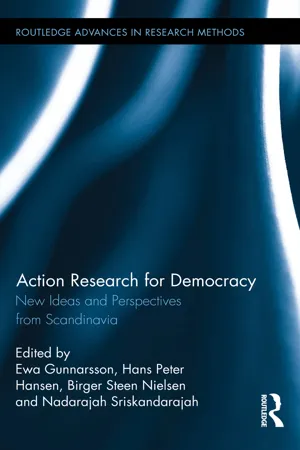
Action Research for Democracy
New Ideas and Perspectives from Scandinavia
- 252 pages
- English
- ePUB (mobile friendly)
- Available on iOS & Android
eBook - ePub
Action Research for Democracy
New Ideas and Perspectives from Scandinavia
About this book
Information
Part I
Renewal of Working Life and Welfare Institutions Through Democratisation
Openings Created by Action Research and Interactive Research
Introduction to Part One
This first section gathers contributions on different kinds of initiatives in the renewal of working life, production and institutions within Scandinavian welfare states. The contributions are examples out of a rich spectrum of Action Research within these fields, stemming from Sweden, Denmark and Norway. For several decades, the Scandinavian welfare state, taken as the basic societal framework of people’s everyday lives, has not only been undergoing permanent changes, but has in fact also been under attack as to its basic principles and structures, although often, these attacks are promoted as necessary changes to save the welfare state. During the current crisis, this tendency has been intensified. The dismantling of the welfare state goes hand in hand with a debilitation of democratic influence, not to speak of the agenda of earlier times of the deepening and widening of democracy. This has been replaced by New Public Management or (recently) governance as a dominant trend. This does not imply that employees and citizens should be considered and treated just as being passive, as objects. On the contrary, they should be activated, taking “responsibility of their own life”, being innovative and productive. Therefore, de-democratisation could go hand in hand with “participation”, in regulated and dosed forms, that is.
In this situation, Action Research—when related to workplaces, the labour market or welfare institutions—is forced into a difficult balancing act. An innocent incorporation of Action Research into “participation” and “innovation” strategies is not possible if the essentials of Action Research are to be respected. As we see it, a democratic orientation makes up the basic demarcation line. But then, the questions and difficulties of how to balance and perform specific Action Research projects and initiatives within more comprehensive societal perspectives and strategies just start. All the contributions here presented share a democratic horizon, but they differ as to basic understandings of, for instance “innovation” as a specific societal strategy or of the character and quality of “democracy” and “participation”. Likewise, they could all be seen as having part in a quest for a renewal of the welfare state, taken in a broad sense, as opposed to the ongoing dismantling tendencies. But the renewals looked for might point in different directions.
The chapters differ in terms of their subjects and their foci and levels of discussion. All of them, however, present or are related to rich, empirical material. Interwoven in their analyses and discussions, they all directly or indirectly deal with questions of learning, knowledge creation and knowledge theory, methodology and methods, some of them especially distinguished by careful and lucid descriptions and discussions of the specific character of knowledge creation within action research, its possible forms and preconditions. As to the basic theme of democratisation, we could say that it, in its institutional and societal dimensions, in most of the contributions is more or less indirectly present, with a few exceptions. But at the level of processes of participation and knowledge creation, it is explicitly dealt with and reflected on through and through and thus demonstrated as pivotal for Action Research. And that, in fact, makes up a necessary and fundamental ground of any also societal discussion of democratisation. In the Introduction, we have sketched some of the traditions of Scandinavian Action Research, focusing on those that are primarily represented in our two books. In the present book, they are all represented, and we have deliberately put them together in both sections, not in order to blur the differences, but to allow them to talk to each other across these differences, making their corresponding endeavours visible.
In Scandinavian countries, work and working life, especially related to industrial work, has historically made up an important part of the development of Action Research. Work and working life still make up a (not the) decisive centre of gravity within Action Research, but increasingly with a focus on welfare or professional work. This is also reflected in this section. The first chapters do in fact deal with work in relation to production, taken in a broad sense. Thus, Bennich, Svensson and Brulin discuss how Action Research or Interactive Research, as they prefer to call it, could promote joint learning processes with the unions in order to promote a more democratic working life. Furthermore, they discuss the concept of the Triple Helix partnership and especially whether it is able to include the unions on equal terms, thus discussing its democratic potential. Closer to specific Action Research practice, Westerlund and Sundblad deal with the item of design as a democratic process and its implications for innovation. They elaborate on a relationship between the quality of the design and the establishing of democratic relationships between designers and relevant stakeholders that integrate the stakeholders’ experience and knowledge in the design work. Their contribution is followed by the chapter by Lindberg, who, from a gender perspective, raises critical questions to the actual innovation agenda as a democratic Action Research agenda. Lindberg argues that a combination of gender scientific theories/methods and participatory research methods can highlight and incite more equal power relations in the development and implementation of innovation policy. This integration of a gender perspective in a participatory approach is seen as decisive to the claimed innovation strategy, since it expands the existing knowledge on how to induce innovation among a wider spectrum of actors, networks and industries in order to transform the economy to be more knowledge-based. These three chapters make up a constellation contributing to an elaboration and (self-) critical discussion of the democratic innovation and modernisation strategy presented and discussed in the Introduction.
The following two chapters also deal with questions in relation to the work and labour market, but with a different focus, namely that of vulnerable persons and their position between a re-integration into employment and the risk of dropping out of the labour market, a problem that has been dramatically acute during the recent years’ crisis management and its neoliberal focus on “employability”. As such, it touches upon the very heart of the transformation of the welfare state into a workfare state. The subject of the investigation presented by Larsson and Nordmark thus is the rehabilitation of employees on long-term sick leave. They show how “empowering dialogues” as a specific democratic setting for creating knowledge is able to bring forward and integrate a wider range of voices and perspectives than usually is the case in the traditional, more one-sided, expert- and client-oriented approaches, thus finding practical solutions to the challenges to a strong degree based on ideas from those to whom the problems are a concern. This approach also could be found in the chapter by Tofteng and Husted, but with a specific focus on a dimension that could be considered underexposed within Action Research, that of the importance of developing and integrating a public dimension into Action Research projects. Based on a research project named The Festival of Differences, which examines how a more inclusive labour market can be created, Tofteng & Husted makes it obvious how Action Research could not just prepare or present its results in public arrangements, but public arrangements themselves could be an integrated part of Action Research itself, thus transcending a more traditional, mere “project level”. The chapter emphasises the correspondence between Action Research conceptualised and practised as a democratic way of knowledge creation and the democratic quality of a multi-voiced public space overcoming the reduction of citizens to the status of an audience, which characterises traditional public spaces.
Finally, the three last chapters deal with perspectives of welfare institutions, taken in a broad sense. Ahrenkiel shows how an Action Research approach inspired by Critical Utopian Action Research could open up to day care professionals collectively discussing and developing their work practices, thus defining their professionalism in terms of their actual work tasks instead of understanding it in relation to the predefined standards on which the official systems of accountability are based. The chapter points to the more far-reaching possibility of a redefining of democratic welfare, rising from initiatives that are in themselves characterised by a democratic quality, a perspective that has recently been brought in relation to the notion of “commons”, discussing whether welfare institutions, or maybe welfare itself, might be considered and treated as a commons. The two chapters closing this section both deal with teaching and pedagogy, which we here vis-à-vis neoliberal tendencies deliberately want to situate as an important part of welfare institutions and welfare work. Hvid Thingstrup, in her discussion of the democratic creation of teacher knowledge, brings an inspiration from Critical Utopian Action Research in play with inspirations from pedagogical multiculturalism, this opening up room for an inventive experimenting with new methods within Action Research. Her chapter accentuates the necessity of developing and paying critical attention to “the blindness and exclusions that characterise all pedagogical practices, including those who understand themselves as being multicultural and democratic”, while at the same time addressing and building on the experiences and life expectations of the teachers. Finally, Hiim focuses on the question of the relationship between researcher and teacher (or practitioner), with the teachers (or practitioners) themselves practising research activities. Hiim has brought the British tradition of Educational Action Research into a Scandinavian (Norwegian) context and developed it in relation to a specific didactic approach that is gaining influence in Scandinavia. She emphasises the special relevance of investigating this thematic, informed by intensified theoretical and methodological reflections now when action research is becoming more generally accepted, worrying that the epistemological base may erode when Action Research is becoming more mainstream. At the same time, questions of evidence-based practice are put at the centre of discussions within the field.
1 Interactive Research
A Joint Learning Process with the Unions
Maria Bennich, Lennart Svensson and Göran Brulin
Background and Objectives
The unions are currently experiencing severe problems, such as a decreasing membership, difficulties in influencing issues in working life and offensive and well-organised employers supported by liberal governments. If working life is to be made democratic, the unions must be strengthened and act more proactively on “new” issues like work organisation, competence development, gender equality and the working environment.
In this chapter, we will discuss the following questions and dilemmas:
Can Interactive Research help to promote a joint learning process with the unions in order to achieve a more democratic working life? Can a Triple Helix partnership include the unions on equal terms? The data is based on a Triple Helix partnership at Linköping University, which includes both companies and trade unions.
In the introduction, we start by presenting an Interactive Research approach and discuss some of the similarities and differences with Action Research. A critique of Mode II (developmental-oriented and demand-based) research is presented and an alternative model, (Mode III), which can be regarded as a synthesis of Mode I (traditional academic research) and Mode II, is discussed.
An Interactive Research Approach
Action Research has a long tradition in the Nordic countries. It was introduced at the beginning of the 1960s in Norway, and has become established as part of the growing Research & Development (R&D) work in all the Nordic countries, both inside and outside universities. Interactive Research has a ten-year history and is still developing (Johannisson et al. 2008; Tydén 2006; Westlander 2008). This is reflected in the increasing number of members (more than 300) of the Swedish Interactive Research Association (SIRA) (www.hj.se/encell/sira). In Sweden, a number of doctoral theses have focused on the Interactive Research approach, and many more are planned. The Helix Excellence Centre, based at Linköping University, involves some 50 researchers, including 20 PhD students (see www.liu.se/helix).
In the literature relating to Interactive Research, comparisons with Action Research are common. However, making comparisons and coming up with a clear definition has been problematic, because neither Action Research nor Interactive Research are regarded as a collection of principles with distinct theories and methods, but are instead seen as perspectives on how to conduct research (Svensson et al. 2007). Action Research has to have an action component, in the sense that the research should support some kind of normative change (in terms of problem solving, developmental work, restructuring etc.), and at the same time produce new knowledge.
A clear distinction is made in the literature, which is that interactive researchers do not emphasise the action component, but instead stress the importance of making research an integrated and cooperative part of the academic world (Svensson 2002). SIRA has declared that Interactive Research should be characterised by relationships between equals and a high degree of participation in the joint learning process. The knowledge that is produced should be of practical relevance, of a high scientific standard and have a critical perspective—also on the joint learning process. Interactive Research should not be considered as an alternative to analytical (social) science, but ought to be understood as a genuine academic research activity that is carried out inside universities but in close cooperation with different research and development centres. Interactive Research stresses the joint and critical learning that takes place between the participants and the researchers throughout the entire research process—from the definition of the problems to the analysis and dissemination of the results.
Both Action and Interactive Research emphasise the critical role of research. In Action Research, the critical component was an essential characteristic from the very beginning. Lewin (1946, 1948) and his followers based their thinking on a firm democratic platform. They wanted to change society so that it would become more equal and fair. The workplace was seen in an institutional context. This critical tradition has always been vital in Action Research, especially in research among oppressed groups, in social work, in schools, in ...
Table of contents
- Cover Page
- Half Title page
- Series page
- Title Page
- Copyright Page
- Contents
- Tables, Figures, and Photos
- Preface
- Editors' Introduction Why Action Research for Democracy?1
- Renewal of Working Life and Welfare Institutions Through Democratisation Openings Created by Action Research and Interactive Research
- Interactive Research A Joint Learning Process with the Unions
- Design as a Democratic Process—and Implications for Innovation
- Democratising Innovation Policy with Gender-Scientific Participatory Research
- Empowering Dialogues A Way to Democratise Knowledge Production?
- New Forms of Public Participation The Festival of Difference as Action Research on the Road to a More Inclusive Labour Market
- Redefining Democratic Welfare—Openings and Future Orientations Action Research in Danish Day Care Centres
- Action Research with Teachers Action and Critique in a Project on Multicultural Education
- Educational Action Research and the Development of Professional Teacher Knowledge
- Action Research Rethinking the Societal Role of Science: Democratisation, Sustainability and Historical Experience
- Can Action Research Strengthen Democratic Dimensions in Gender Mainstreaming Processes?
- Organising Research Institutions Through Action Research
- Towards Democratic Scientific Inquiry? Participatory Democracy, Philosophy of Science and the Future of Action Research
- Artistic Sense in Action Research
- Postscript
- List of Contributors
- Index
Trusted by 375,005 students
Access to over 1.5 million titles for a fair monthly price.
Study more efficiently using our study tools.
Frequently asked questions
Yes, you can cancel anytime from the Subscription tab in your account settings on the Perlego website. Your subscription will stay active until the end of your current billing period. Learn how to cancel your subscription
No, books cannot be downloaded as external files, such as PDFs, for use outside of Perlego. However, you can download books within the Perlego app for offline reading on mobile or tablet. Learn how to download books offline
Perlego offers two plans: Essential and Complete
- Essential is ideal for learners and professionals who enjoy exploring a wide range of subjects. Access the Essential Library with 800,000+ trusted titles and best-sellers across business, personal growth, and the humanities. Includes unlimited reading time and Standard Read Aloud voice.
- Complete: Perfect for advanced learners and researchers needing full, unrestricted access. Unlock 1.5M+ books across hundreds of subjects, including academic and specialized titles. The Complete Plan also includes advanced features like Premium Read Aloud and Research Assistant.
We are an online textbook subscription service, where you can get access to an entire online library for less than the price of a single book per month. With over 1.5 million books across 990+ topics, we’ve got you covered! Learn about our mission
Look out for the read-aloud symbol on your next book to see if you can listen to it. The read-aloud tool reads text aloud for you, highlighting the text as it is being read. You can pause it, speed it up and slow it down. Learn more about Read Aloud
Yes! You can use the Perlego app on both iOS and Android devices to read anytime, anywhere — even offline. Perfect for commutes or when you’re on the go.
Please note we cannot support devices running on iOS 13 and Android 7 or earlier. Learn more about using the app
Please note we cannot support devices running on iOS 13 and Android 7 or earlier. Learn more about using the app
Yes, you can access Action Research for Democracy by Ewa Gunnarsson,Hans Peter Hansen,Birger Steen Nielsen,Nadarajah Sriskandarajah in PDF and/or ePUB format, as well as other popular books in Social Sciences & Social Science Research & Methodology. We have over 1.5 million books available in our catalogue for you to explore.