Designed to fill an overlooked gap, this book, originally published in 1972, provides a single unified introduction to bibliographical sources of British military history. Moreover it includes guidance in a number of fields in which no similar source is available at all, giving information on how to obtain acess to special collections and private archives, and links military history, especially during peacetime, with the development of science and technology.
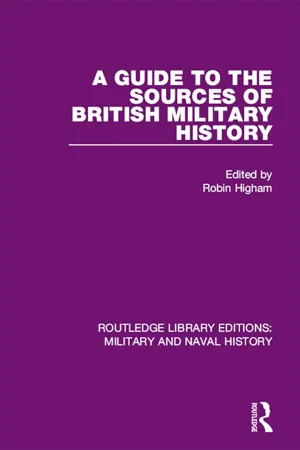
- 630 pages
- English
- ePUB (mobile friendly)
- Available on iOS & Android
eBook - ePub
A Guide to the Sources of British Military History
X
ECONOMIC, SCIENTIFIC, AND TECHNOLOGICAL BACKGROUND FOR MILITARY STUDIES, 1815–1914
No student of military studies can ignore in the nineteenth century the reciprocality and interrelationship of economic, scientific and technological factors. As in earlier centuries, these factors were affected by war. Pressures for raw materials and markets motivated the building of bigger navies, “showing the flag,” the prosecution of colonial campaigns and the establishment of colonial garrisons. Linking much of this was the “corridor” to India, with the side effects that the policy entailed. The “spatial dynamics” of making the Indian Ocean a British lake, when analysed, show a complex interrelationship of necessitarian ethics and noble intentions that stretched the sinews of the “mother country” to the limit.
Clues to the interrelationship of war technology and social change can be found under (2), (10), (15), (21), (31), (32), (47), (49), (83), (85), (90), (133), (136), (177), (246), (266), (267), (336), (341), (355), (459), (478), (488), (492), (496), (498), (499), (501), (506), (508), (510), (516), (520), (524), (527), (529), (532), (545), (565), (568), (582), (585), (586), (607), (620), (624), (629), (637), (640), (645), (648), (650), (654), (656), (658), (659), (669), (670), (673), (680), (698–700), (704), (715), (717). This can be evaluated in the light afforded by the general surveys of economic development provided by Ashley (51), Ashworth (53), Beard (76), Briggs (102), Cairnecross (119), The Cambridge Economic History (122), J. D. Chambers (145), S. G. Checkland (148), Sir John Clapham (153, 154), Cole and Postgate (163), Court (173), Crombie (182), Foy (249), the Hammonds (315, 317, 318), Heaton (333), Hoffman (348, 349), A. E. Kahn (390), Levi (408), Lipson (416), Meier and Baldwin (452), J. R. Meyer (454), Mulhall (472), Redford (540), B. C. Roberts (557), Thorold Rogers (560), W. W. Rostow (567), Thomson (642), Toynbee (652), Woodward (703) and Woolf (707). For “hindsight” evaluation, Mowat (469), Pigou (515), Plummer (518), Putnam (533) and Ball (67) are useful background reading.
Further analysis can best begin with those fact-finding groups, the Parliamentary committees and commissions (169), (170), (386), (387), which offer vast quarries of information from which much remains to be dug. Other valuable sources are contemporary journals (106), (568), (569), (570), (623), (682–4), the international exhibitions held from 1851 onwards of which Merle Curti (189) has been so helpful an analyst and the welter of guides for theses, records and statistics given under (16), (19), (29), (30), (45), (88), (95), (96), (179), (251), (331), (353), (359), (455), (463), (474), (497) and (539).
Two basic industries of the period are shipbuilding and railways. Shipping (8), sea power and its problems (71), (108), (296), ironclads (74), naval administration (103) bring up questions of comparative costs (521) and mass production (398). Here the steel industry is important (190), (293), (354), (411), (419), (438–440), (616). For specific naval personnel, recourse may be made to O’Byrne (489).
Similarly the relationship of railways to economic growth has been explored by Mitchell (462) and to war by E. A. Pratt (527). Interesting cross links between railway innovation and the volunteers can be found in (572).
Many studies exist of firms like John Brown (293), Mushets (494) and Vickers (669), or of firms like Unilever (688), D. Napier (689) or Siemens (585), (593). They should be consulted to see what interrelationships have already been established. Regional studies like those on Tyneside (125), Widnes (321), St. Helens (69), Crewe (144), the Midlands (174), Coventry (338), Wales (5), (383), the Black Country (11) and Liverpool (62) exist in abundance but must be tracked down.
Nor should the impact on agriculture be forgotten. From Orwin and Whetham (493a) a picture can be obtained of the impact of the Crimean, Franco-Prussian, and Boer Wars on farm prices, whilst Fussell (269), in one of his many informative books on agricultural history, gives the story of farmers’ tools before the tractor came. For the general history of food, written by a natural scientist, see Drummond (223).
Substantial help can be obtained from The Times, the Economist, and the Journal of the Royal Statistical Society. The annual bibliographies in the Economic History Review and in Isis are invaluable. So is the Journal of Economic History. Detailed historical studies will be found in the Liverpool publication Business History (117) which, biennially since 1958, has also included a select list of business histories, and in the even newer Industrial Archaeology, founded in 1964 as the Journal of Industrial Archaeology, which carries articles on the history of particular industries and on technology. Published by a firm specialising in books on such topics—David and Charles of Newton Abbot—it is edited from the new Technological University at Bath.
Initially an unofficial periodical of the armaments industry published from 1892 to 1920 was Arms and Explosives. Complete runs only exist in England at the Patent Office Library, the British Museum and the Bodleian.
A list of local record offices is given by Emmison and Gray (238) and of municipal corporation archives by Andrews (19).
In the last thirty years, attempts have been made to indicate hitherto inaccessible resource material afforded by theses housed in British University libraries; Luxmoore Newcombe (485), P. D. Record (538) and A.S.L.I.B. (45) have done much to remedy this, and, in certain fields like transport history, J. H. Dyos (231) has compiled a good bibliography.
Since Victorian scientists often wrote, sometimes pseudonymously, in the general periodicals, recourse might be made to Poole’s Index to Periodical Literature (523a). For these general periodicals, subsequent indices can be gleaned from Walter E. Houghton (353) whose own Wellesley Index to Victorian Periodicals 1824–1900 is currently under way. For books and pamphlets Halkett and Laing (308) is also useful.
OVERVIEWS, (a) Science. For stimulating “overviews” of science see Charles Singer ...
Table of contents
- Cover
- Half Title
- Title Page
- Copyright Page
- Original Copyright Page
- Dedication
- Table of Contents
- Editorial Note
- Acknowledgement
- Authors
- I. Introduction
- II. Military Developments from Prehistoric Times to 1485
- III. Military Developments of the Renaissance
- IV. The Navy to 1714
- V. The Army in the Eighteenth Century
- VI. The Navy in the Eighteenth Century
- VII. The Scientific, Technological and Economic Background to 1815
- VIII. The Army in the Nineteenth Century
- IX. The Navy in the Nineteenth Century:
- X. Economic, Scientific, and Technological Background for Military Studies, 1815–1914
- XI. Colonial Warfare, 1815–1970
- XII. Resources in the Dominions:
- XIII. The First World War on Land
- XIV. The First World War at Sea
- XV. The War on the Home Front, 1914–1918
- XVI. The Development of the Royal Air Force, 1909–1945
- XVII. The Inter-War Years
- XVIII. The Royal Navy, 1939–1945
- XIX. The Second World War on Land
- XX. Britain in the Second World War
- XXI. Science and Technology, 1919–1945
- XXII. British Defence Policy since 1945
- XXIII. The Evolution of Military Medicine
- XXIV. The Evolution of Naval Medicine
- XXV. The History of Military and Martial Law
Trusted by 375,005 students
Access to over 1.5 million titles for a fair monthly price.
Study more efficiently using our study tools.
Frequently asked questions
Yes, you can cancel anytime from the Subscription tab in your account settings on the Perlego website. Your subscription will stay active until the end of your current billing period. Learn how to cancel your subscription
No, books cannot be downloaded as external files, such as PDFs, for use outside of Perlego. However, you can download books within the Perlego app for offline reading on mobile or tablet. Learn how to download books offline
Perlego offers two plans: Essential and Complete
- Essential is ideal for learners and professionals who enjoy exploring a wide range of subjects. Access the Essential Library with 800,000+ trusted titles and best-sellers across business, personal growth, and the humanities. Includes unlimited reading time and Standard Read Aloud voice.
- Complete: Perfect for advanced learners and researchers needing full, unrestricted access. Unlock 1.5M+ books across hundreds of subjects, including academic and specialized titles. The Complete Plan also includes advanced features like Premium Read Aloud and Research Assistant.
We are an online textbook subscription service, where you can get access to an entire online library for less than the price of a single book per month. With over 1.5 million books across 990+ topics, we’ve got you covered! Learn about our mission
Look out for the read-aloud symbol on your next book to see if you can listen to it. The read-aloud tool reads text aloud for you, highlighting the text as it is being read. You can pause it, speed it up and slow it down. Learn more about Read Aloud
Yes! You can use the Perlego app on both iOS and Android devices to read anytime, anywhere — even offline. Perfect for commutes or when you’re on the go.
Please note we cannot support devices running on iOS 13 and Android 7 or earlier. Learn more about using the app
Please note we cannot support devices running on iOS 13 and Android 7 or earlier. Learn more about using the app
Yes, you can access A Guide to the Sources of British Military History by Robin HIgham in PDF and/or ePUB format, as well as other popular books in History & Military & Maritime History. We have over 1.5 million books available in our catalogue for you to explore.