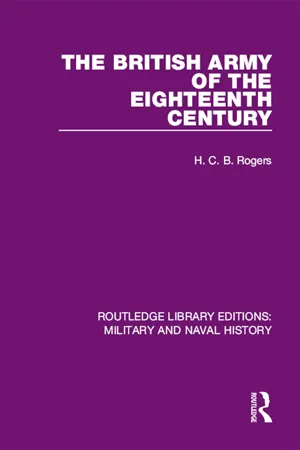
This book, originally published in 1977 examines in detail the organisation, training, and personnel of the British Army during the eighteenth century, and explains how the government policies of containing the enemy and colonial conquest were achieved. It also illustrates how the Army survived the constant nervousness of Parliament in reducing its strength after each emergency had passed. There are specific chapters devoted to the strategies of Marlborough, Amherst and Howe and to tactics as displayed at the battles of Ramillies, Fontenoy, Camden and Guildford Court House.
- 248 pages
- English
- ePUB (mobile friendly)
- Available on iOS & Android
eBook - ePub
The British Army of the Eighteenth Century
About this book
Information
Chapter 1
STRENGTHS AND ESTABLISHMENTS

After the Restoration of the Monarchy in 1660 both Houses of Parliament were determined that there should never again be a standing army, such as had been organised and maintained by Oliver Cromwell, and that soldiers in permanent employment should be limited to those required to garrison the fixed defences and to provide the regiments of the King’s Guard.1 The acquisition of Tangier in 1660 and the warfare waged in its defence necessitated the raising of other regiments, as did also the military assistance given by Charles II to Louis XIV; but it was never Parliament’s intention that these should become a permanent part of the military establishment, which in peace-time was to be limited to the ‘guards and garrisons’. Indeed, one could say with fair accuracy that the Regular Army gradually increased in strength, not only because of greater commitments, but also through the omission, for one reason or another, to disband regiments after the services for which they had been raised had terminated.
After the Revolution of 1688, which brought William of Orange to the throne, a standing army was at last, though reluctantly, approved, but only in the form of an increase in the establishment of the guards and garrisons. Parliament, too, insisted on having the right to decide the strength of the Army to be maintained in Great Britain in time of peace, and directed that none but native-born subjects should hold any military command;2 a proviso that was intended to lessen the danger of a coup d’état. In addition, in order that Parliament should retain the right to disband the Army, the ‘Declaration of Rights’, which William had to accept, contained the words: ‘The raising of a standing army within the United Kingdom in time of peace, unless it be with the consent of Parliament, is against the law.’ However, Parliament had not a complete say in the matter, because ‘the Government, Command, and Disposition of the Army’ remained Royal Prerogatives.3
Initially the Regular Army (that is, the guards and garrisons) was divided into three separate establishments: those for England (which included Wales), Scotland, and Ireland, each of which was charged to the revenue of the country concerned. When regiments were despatched overseas from Scotland or Ireland they were normally transferred to the English establishment, and the two former countries were permitted to raise new units to replace any thus removed from their strength. After the Act of Union in 1707, however, the English and Scottish establishments were amalgamated into one British establishment, but the Irish establishment remained separate for the remainder of the eighteenth century.
As overseas commitments increased, the guards and garrisons on the English (and later British) establishment came to include, not only the troops serving at home, but also those required to garrison the Channel Islands, the Mediterranean possessions, and the colonial ‘Plantations’, as well as regiments seconded for ‘sea service’ with the fleet. They did not include troops engaged in a theatre of war.
The position as regards fortresses in Great Britain was somewhat complicated because they came under the Board of Ordnance, which was not part of the Army. Attached to these fortresses, apart from the infantry garrisons, were small parties of gunners and master-gunners, many of whom were appointed to them for life. In the Establishment Warrant of the Ordnance the master-gunners were listed as part of the civil establishment and neither master-gunners nor gunners were subject to military discipline. The numbers of infantry placed in these fortresses were fixed by an establishment of 1683–84, and at that time, and for many years afterwards, they were organised in unregimented companies, some of which were composed of out-pensioners of Chelsea Hospital, or ‘invalids’ (that is, men who were not fit for general service).4
During the wars waged in Ireland and on the Continent by William III the Army increased greatly in strength; but when peace was restored in 1697 by the Treaty of Ryswick, it was reduced so quickly and drastically to a ‘guards and garrison’ status that by 1698 there was only a skeleton force of 7,000 men on the English establishment. Indeed there was a strong movement to abolish the standing army altogether and to reform the Militia so that it could replace it. Before the outbreak of the Civil Wars between King and Parliament, the Militia had been the only substantial military force in the country, and those many politicians to whom a standing army was anathema thought that it would still prove adequate for national defence. In the years after the Restoration it had grown inefficient, as the Duke of Monmouth’s rebellion had shown. Anxiety aroused by the mutiny of Dumbarton’s Regiment in 1689 resulted in a Bill for its reform being passed by the Commons, but it was held up in the Lords and eventually lost by the dissolution of Parliament in January 1690.5 A more radical bill to replace the Regular Army by the Militia was introduced in the Commons after the Peace of Ryswick and defeated. The Army was saved from further threats to its existence by Louis XIV. On 6 September 1701 James II died and on 13 September Louis recognised the exiled king’s son as James III, King of Great Britain. This was tantamount to a declaration of war, and Parliament found itself with the necessity of raising an army.
The first measures taken were to double the establishments of existing regiments and to raise new ones. This was not too difficult because the old soldiers who had been discharged some four years before could be re-enlisted.6 The demands made by the War of the Spanish Succession (1702–13), which followed, forced Parliament to vote increasing strengths for the Army, till the forces in the field reached a peak of 75,000 men in 1711. This was the year of the Duke of Marlborough’s final feat—piercing Marshal Villars’ ‘Non Plus Ultra’ lines. By the end of the year Marlborough had been dismissed and, as the war drifted to a close, the number of men with the colours dropped rapidly till in 1713 they totalled only some 23,000.7
It was not only the war that was drawing to an end, but also the life of Queen Anne, and the final reduction of the Army to its intended peacetime strength was carried out by leading Jacobite sympathisers in a way that was intended to ensure that Anne should be succeeded by the Jacobite Pretender to the throne. This attempt to use the Regular Army to further a political plot was made by Viscount Bolingbroke, the Secretary of State who had been in charge of the peace negotiations, assisted by the Duke of Ormonde, who had succeeded Marlborough as Commander-in-Chief and Captain-General and who was the leader of the Jacobites in London. Bolingbroke had negotiated privately with the Pretender, ‘James III’. In order that there should be no military resistance to his accession, Bolingbroke and Ormonde decided that regiments with a known loyalty to a Protestant succession should be disbanded, irrespective of their seniority. This plan violated the established practice of disbanding the youngest regiments first. It was put into effect, but before it could be completed Queen Anne died and the Elector of Hanover succeeded her peacefully as King George I.8
The military situation facing the new King was far from satisfactory. Although the loyalty of the Army was assured, a Jacobite attempt on the throne was to be expected, and the bulk of the troops on the British establishment were in Flanders and the colonial garrisons. In England and Scotland there were only 8,000 men and in Ireland a further 12,000. (The Irish establishment had been fixed at that figure in 1692 and so remained until 1769.) Some of the regiments disbanded by Bolingbroke were reformed immediately, and in July 1715, with a rising in Scotland imminent, the remainder were included in an order for the raising of thirteen regiments of dragoons and eight of foot. Five dragoon and eight infantry regiments were moved to Great Britain from Ireland and, in accordance with their powers, similar regiments were raised by the Government of Ireland to replace them.9 The reinforced Army proved just sufficient for the task, but defeat was only narrowly averted at the battle of Sheriffmuir. It seemed that the Jacobite threat had disappeared, and there followed the reduction of the Army to a strength which Parliament considered adequate for peace-time.
However, there was one important addition to military strength at this time, for on 26 May 1716, on the advice of the Duke of Marlborough, now Master-General of the Ordnance, two companies of artillery were formed at Woolwich as permanent units. Previously it had been the practice to form temporary artillery trains as required for particular operations. In 1727 the two companies were increased to four and the new corps was entitled the Royal Regiment of Artillery.10
The strength of the Army varied at this period, within narrow limits, according to the political situation. In 1719 there were only 12,000 men on the British establishment. There was a hurried but small increase in that year due to the short Spanish war and the Jacobite landing in Scotland. In 1720 the birth of Prince Charles Edward and the consequent increase in Jacobite activity led to the Government, against bitter opposition, raising the British establishment to 18,000. This was accomplished by increasing the number of men in existing regiments. Sir Robert Walpole, the Prime Minister, announced that this figure of 18,000 would be retained as the standard, but he was bitterly opposed to this and there were strong attempts in both Houses of Parliament to cut it.11 It still left the Army far too weak to secure national interests at home and overseas.
Any proposed reduction in the Army commanded, as it always has done in peacetime, considerable support; but there was more than the usual hostility to it at this time amongst the civil population. This may have been due to the use of the Army, in the absence of an effective police force, to maintain law and order. Troops had often to suppress riots, but it does not appear that they behaved badly on the whole in the execution of this unpleasant duty. Yet, as Fortescue says, ‘In many places the civil population deliberately picked quarrels with the troops in order to swell the clamour against the Army; and officials in high local and municipal station, in their rancour against the red-coats, would stoop to lawlessness as flagrant as that of the mob.’12 Under such provocation it is remarkable that the discipline of the Army remained as good as it did.
This unhappy state of affairs came to at least a temporary end with the outbreak of the so-called ‘War of Jenkins’s Ear’ against Spain in 1739. But it was typical of the Parliamentary Opposition that, whilst clamouring for war against Spain, they produced a motion for the reduction of the Army! Nevertheless, an increase in the strength of existing regiments was approved, and a remarkable reversal of public opinion was shown by a surge of enthusiasm which resulted in recruits coming forward in numbers far greater than were needed.13
Before this war came to an end Great Britain was involved in the much greater struggle of the War of the Austrian Succession. In 1742 Parliament voted to send 16,000 British troops to Flanders, and the British establishment was increased considerably, not only by raising more men in the United Kingdom, but also by incorporating the King’s Hanoverian troops, as well as Danish and Hessian mercenaries.14
After the victory of Dettingen in 1743, the estimates for 1744 provided for a larger army in Flanders, but as no increase in the total strength had been voted, the additional troops had to be found by depleting the already weak forces in Great Britain. Even then the Army in Flanders was inadequate for the task, and its General of foot, Ligonier, complained to Lord Carteret, the Secretary of State, that, ‘Our army is to consist of no more than forty battalions and ninety-two squadrons.’ Of that modest total only eighteen battalions and twenty-nine squadrons were British.15
Stinginess in voting the necessary military strength in due course exacted its retribution. Taking advantage of his knowledge that Great Britain was almost denuded of trained troops, Prince Charles Edward Stuart landed on the west coast of Scotland on 25 July 1745. To meet a rising of the warlike clans, Sir John Cope, commanding in Scotland, had no more than 3,000 men, mostly half-trained recruits. His almost inevitable defeat was followed by a Government panic, and the Duke of Cumberland, commanding in Flanders, was ordered by the King to send to England the ten best battalions under the command of General Sir John Ligonier. Later he was ordered to return himself with most of the remaining British troops under his command, and an existing treaty was invoked to demand the help of Dutch and Hessian troops. Large bounties were offered to induce men to enlist in the under-strength regiments in England. King and Government only narrowly escaped disaster, and the dangers of a cheese-paring economy in national defence were thus brought forcibly home. Unfortunately the lesson was soon forgotten.
After the defeat of the rebellion, British troops returned to Flanders, and the war ended in 1748 with the Treaty of Aix-la-Chapelle.
The British peace establishment was now fixed at 30,000 men, of whom 20,000 were to serve in Great Britain and 10,000 in garrisons overseas. The Irish establishment remained at 12,000, but this figure embraced thirty-seven regiments of cavalry and infantry, or an average of only 300 per regiment. But by retaining a large number of weak regiments, rather than having fewer at full strength, a nucleus was kept in being on which expansion could take place in war. This policy could not be applied to regiments on the British establishment because they had always to be available for general duties at home or overseas.
Nevertheless regiments were sometimes sent directly overseas from Ireland. An instance occurred in 1754 after Colonel George Washington, at the head of Virginian militia, had been forced to surrender to the French. The Governor of Virginia appealed for two regular battalions. Ligonier, then Lieutenant-General of the Ordnance, expressed the opinion that regular battalions were not likely to be of much value in the forest warfare then being waged on the American frontier, and thought that the provincial militia should be used, with the help of regular officers and supplies of arms. This view was of course quite correct, for it is a lesson that is constantly having to be re-learned that troops should not be used in a type of warfare for which they have not been trained. However, the Duke of Cumberland, then Captain-General, insisted that regular battalions should be sent, but, owing to a reluctance to reduce the forces in Great Britain, two of the weak regiments in Ireland, the 44th and 48th, were increased in strength by drafts from other regiments, and furnished with additional arms to bring themselves up to strength with American recruits. The result was a disaster, for they formed the major component of the force under General Braddock which was defeated on the Monongahela River by French and Indians in July 1755.
Although war had not been declared between Great Britain and France, the two countries were engaged in full-scale hostilities in America, and the unfortunate affair of the Monongahela created such consternation that small increases in strength already authorised were augmented.
In the early months of 1756 there was a near panic in Great Britain over the possibility of a French invasion, because the measures to increase the Army had hardly begun to take effect and there were all too few troops to meet this danger. The Government asked the King, as Elector of Hanover, for help. This small State had an army of the very respectable size of 29,000 men, and George II agreed to send half its infantry to England. In addition the Government obtained 8,000 infantry from Hesse-Kassel, with which State there was a treaty of subsidy.16 Apart from these reinforcements, there were renewed efforts to make the Militia into an effective force for home defence.
A bill to reform the Militia laws was passed through the Commons in May 1756, but it was thrown out by the Lords two weeks later. However, the following month Minorca fell to the French, and the fury that this aroused in the nation ensured that supporters of the Militia would get some sort of Act. They were finally successful in May 1757, though the Lords succeeded in making a number of modifications. As passed, the Act authorised a force of 32,000 men, recruited from the larger towns so that it would be easier to concentrate the men for their drills. As far as possible the Militia was to be recruited from vo...
Table of contents
- Cover
- Half Title
- Title Page
- Copyright Page
- Original Copyright Page
- Dedication
- Table of Contents
- Introduction
- Table of Principal Military Events in Europe and America
- 1 Strengths and Establishments
- 2 The Command and Organisation of the Army at Home
- 3 The Regiment
- 4 Officers and Men
- 5 Regimental Training and Tactical Organisation
- 6 Administration in the Field
- 7 Command and Staff in the Field
- 8 The Duke of Marlborough’s Strategy
- 9 Major-General Sir Jeffery Amherst in the Seven Years War
- 10 General Sir William Howe in America
- 11 Ramillies
- 12 Fontenoy
- 13 Camden and Guildford
- Epilogue
- Appendix
- Notes and References
- Index
Trusted by 375,005 students
Access to over 1.5 million titles for a fair monthly price.
Study more efficiently using our study tools.
Frequently asked questions
Yes, you can cancel anytime from the Subscription tab in your account settings on the Perlego website. Your subscription will stay active until the end of your current billing period. Learn how to cancel your subscription
No, books cannot be downloaded as external files, such as PDFs, for use outside of Perlego. However, you can download books within the Perlego app for offline reading on mobile or tablet. Learn how to download books offline
Perlego offers two plans: Essential and Complete
- Essential is ideal for learners and professionals who enjoy exploring a wide range of subjects. Access the Essential Library with 800,000+ trusted titles and best-sellers across business, personal growth, and the humanities. Includes unlimited reading time and Standard Read Aloud voice.
- Complete: Perfect for advanced learners and researchers needing full, unrestricted access. Unlock 1.5M+ books across hundreds of subjects, including academic and specialized titles. The Complete Plan also includes advanced features like Premium Read Aloud and Research Assistant.
We are an online textbook subscription service, where you can get access to an entire online library for less than the price of a single book per month. With over 1.5 million books across 990+ topics, we’ve got you covered! Learn about our mission
Look out for the read-aloud symbol on your next book to see if you can listen to it. The read-aloud tool reads text aloud for you, highlighting the text as it is being read. You can pause it, speed it up and slow it down. Learn more about Read Aloud
Yes! You can use the Perlego app on both iOS and Android devices to read anytime, anywhere — even offline. Perfect for commutes or when you’re on the go.
Please note we cannot support devices running on iOS 13 and Android 7 or earlier. Learn more about using the app
Please note we cannot support devices running on iOS 13 and Android 7 or earlier. Learn more about using the app
Yes, you can access The British Army of the Eighteenth Century by H. C. B. Rogers in PDF and/or ePUB format, as well as other popular books in Historia & Historia militar y marítima. We have over 1.5 million books available in our catalogue for you to explore.