A pioneering work in British military history, originally published in 1972, this book is both scholarly and entertaining. Although the book concentrates on a single institution, it illuminates a much wider area of social and intellectual change. For the Army the importance of the change was enormous: in 1854 there was neither a Staff College nor a General Staff, and professional education and training were largely despised by the officers: by 1914 the College could justly be described as 'a school of thought' while the officers it had trained were coming to dominate the highest posts in Commands and on the General Staff.
- 366 pages
- English
- ePUB (mobile friendly)
- Available on iOS & Android
eBook - ePub
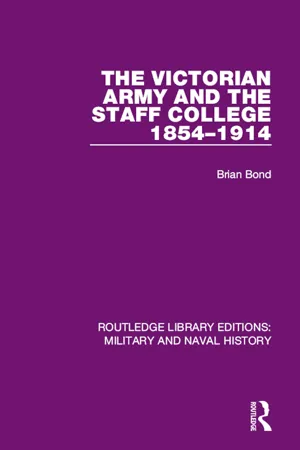
The Victorian Army and the Staff College 1854-1914
CHAPTER ONE
The development of military professionalism and the rise of General Staffs in the nineteenth century
The increased interest in military education in the eighteenth century. The French Revolution underlines the importance of educated and thoroughly trained officers. How potential officers were educated in Prussia, France and Britain. Problems posed by the narrow social sector from which officers were traditionally drawn. The development of a ‘professional’ structure and spirit in the British Army compared with the growing civil professions. The origins and significance of the Continental General Staff system and why Britain lagged behind.
The military profession is a recent creation of modern society. ‘Prior to 1800,’ in the opinion of Samuel P. Huntington, ‘there was no such thing as a professional officer corps. In 1900 such bodies existed in virtually all major countries.’ The nineteenth century had indeed witnessed remarkable developments putting the officer’s career structure on a definite basis, both as regards obtaining a commission and subsequent advancement. These developments tended to place a greater premium than hitherto on professional zeal, qualifications and length of service as against privilege stemming from aristocratic birth, influential connections or wealth. Huntington seems to assume, however, that officer corps dominated by mercenaries or aristocrats, and existing in a political context where ‘interest’ and privilege were enormous assets, were incapable of taking a serious (or professional) attitude to military science, education and training. There is overwhelming evidence on the contrary, to show that a passionate concern with these matters existed – particularly in France – from the earliest days of standing armies in the sixteenth century. In short, the Napoleonic era marked an important new phase, but not the origin of the concept of the army officer as a professional man.1
Perhaps the most important aspect of this development, which only achieved recognition in the course of the nineteenth century, was that would-be officers needed to be specially educated in military or semi-military institutions before obtaining a commission, whereas previously a haphazard system of apprenticeship after commissioning had been preferred. This radical departure from tradition (which persisted much longer in most navies) in turn raised the controversial question as to whether advanced professional education and training were desirable to qualify officers for positions in the higher command or on the staff.
Before the Napoleonic Wars armies and navies can scarcely be said to have been led by professionals as that term came to be understood in the nineteenth century. Officers were for the most part mercenaries or aristocrats: the former tended to view war as a business, the latter as a hobby. ‘In place of the professional goal of expert service, the former pursued profit, the latter honour and adventure.’2 After the Thirty Years War (1618–48), the military role of the aristocracy had increased while that of the mercenary captain declined. This was but one symptom of the consolidation of nation states whose monarchs felt the need for permanent military forces. Given the comparative poverty of national treasuries and the dreadful nature of the military trade, it was not surprising that the rank and file tended to consist of long-term ‘volunteers’ from the dregs of society drawn into service – and servitude – by a mixture of bribery and coercion. For their officers the monarchs relied heavily upon the feudal nobility to whom they offered social and political privileges in return for onerous and financially unremunerative service in arms.
Thus the military forces became the property of the Crown rather than of more or less independent individuals. The officers obtained a permanent employer and – more important as a precondition of professionalism – a permanent focus of loyalty. In the course of the eighteenth century, excepting in the ‘scientific corps’ of artillery and engineers, the aristocracy, and more especially the lesser and often impoverished nobility, attained a near monopoly of the officer ranks in the European armies.3 ‘The noblesse wanted a rewarding life in the open air consonant with their conceptions of honour; the king wanted a loyal officer corps. The bourgeoisie generally was more keen on the ring of coin than the roar of cannon.’4 It is of course dangerous to generalize about the attitude of the bourgeoisie since there were national variations in the status of commissioned service. In Austria, for example, being an army officer in the eighteenth century – at least in the lower ranks – carried lower status than in England.
The social composition of the eighteenth-century officer corps to some extent militated against the development of professionalism. In the first place aristocratic birth was virtually a sine qua non to obtain entry to all but technical arms. Thus in Prussia Frederick William I compelled the nobility to serve in the Army, while his son Frederick the Great, after having been obliged to admit middle-class officers during the intensive warfare between 1740 and 1763, proceeded to purge the officer corps in the firm belief that only the aristocracy possessed to the full the military virtues of honour, loyalty and courage.
This domination of the Army by the upper classes was reinforced and perpetuated by offering them a near monopoly of places at the cadet academies, several of which were founded in the mid eighteenth century. The French École Militaire, for example, was founded in 1751 expressly to serve the needs of sons of officers and the poorer nobility.
‘The regulations organizing the new institution provided for the education of 500 nobles, preference being given to those without fortunes; the purposes of the school were charitable as well as educational. Boys might enter between the ages of eight and thirteen and might stay on until the age of twenty. Besides having to prove their nobility for four generations on the father’s side, applicants had only to know how to read and write.’5
The French Government blatantly used military commissions as outdoor relief for the aristocracy, with the result that by 1775 there were nominally 60,000 officers – only about one in six actually serving – as against 180,000 other ranks. On the eve of the French Revolution, despite drastic reductions, there were still about 6,333 nobles and only 1,845 commoners and 1,100 soldiers of fortune.6 In the Prussian service before the catastrophic defeat at Jena in 1806 there were only 700 non-nobles in an officer corps of over 7,000.7
Not surprisingly, wealth, birth and interest played a major part in determining advancement to high rank. Except in the artillery and engineers, the British Army retained the system of purchasing commissions up to and including the rank of lieutenant-colonel until 1871. A less institutionalized system of purchase also existed in the Austrian Army up to 1857.8 Purchase was ended in France before the French Revolution chiefly because it handicapped the poorer country nobles rather than because it prevented recognition of professional merit. Indeed, the purchase system tended to discriminate against poor nobility in favour of affluent bourgeoisie. Derisory standards of pay and the absence of regularized pension schemes also severely restricted the social sector from which officers could be drawn.
Although military academies began to spring up in the eighteenth century, the level of professional education was low, and they seldom fulfilled the hopes of their founders. This was so largely because in their administration, governments were attempting to combine two conflicting ideas: that of educating a large number of poor nobles and that of advancing technical education. As to the former motive, a French historian has bluntly described Louis XV’s École Militaire as ‘une fondation d’intérêt philanthropique plus encore que d’intérêt militaire …’9 A further obstacle to the development of the academies lay in the fact that there were other and easier ways to obtain military commissions and advancement. This was true of Prussia, where Frederick the Great founded the Ritter Akademie (significantly also known as the Académie des Nobles) in 1765 to provide an education for the diplomatic service as well as the Army. Although the King himself supervised instruction and regarded the school as a proving ground for promising young officers, it was handicapped by the fact that commissions could be obtained at the age of twelve or thirteen. In France and Britain too it was quite common for young boys – and even occasionally females – to obtain commissions by purchase.10
An additional complication was that the new military schools tended to be more concerned with instilling certain values and behaviour in very young boys than with military instruction as such. Hence there arose a chronic debate as to what, beyond regimental drill, military education ought to be. The French, from 1751 onwards, laid heavy stress on mathematics, beyond any practical needs of future infantry officers, for its effect in developing and sharpening the intellect. Scharnhorst, the outstanding member of the Prussian military reform movement from 1806 till his death in 1813, shared this view which was to exert widespread and long-lasting effects on military education. For example, higher mathematics played a disproportionately large part in the syllabus of the British Staff College until well into the second half of the nineteenth century.11
Quite separate schools existed to train technically proficient officers for the artillery and engineers. Since what military science there was related chiefly to these arms, it was in the engineering schools that the most strictly professional education could be obtained. The French founded an artillery school at Douai as early as 1679, and an engineering school at Mézières in 1749. Prussia’s engineering school dated from 1706. The Royal Military Academy at Woolwich – significantly known as ‘The Shop’ – was founded in 1741 to provide a gentlemanly and technical education for both engineers and artillery. Although the instruction provided was better than nothing, neither the cadets’ military knowledge nor their discipline achieved a high standard in the Academy’s first sixty years. Even the passing-out examination instituted in 1764 was dropped on the outbreak of war in 1793.12
If the term is employed loosely, ‘military staffs’ can be traced back to the earliest recorded warfare. Indeed ‘when some unknown warrior chief asked help or advice from one of his co-belligerents, military history saw the first functioning of the military staff’.13 However, until the advent of more complex warfare in the late eighteenth century, specialist staff training and organization were of permanent importance only in logistics. Consequently the key figure in the early staffs was the Quartermaster General – a title which would later appear anomalous when revived by Germany for its operational chief of staff. With few exceptions, then, the pre-French Revolutionary Staff had little to do with military operations and consequently occupied a lowly status in the eyes of commanding generals. France was exceptional in possessing a truly modern general staff, organized by Lt-Gen. Pierre Bourcet between 1766 and 1771 and revived after 1783.14 Britain was more typical in having no specialist training and no permanent staff organization before the Napoleonic wars. She was highly exceptional in delaying the creation of a regular general staff until 1906.
The French Revolution and the Napoleonic wars, indeed, brought to a head a number of factors which, already before 1789, had begun to put a premium on greater professionalism in the leadership of armed forces in peace and war. In the first place, standing armies were becoming larger so that the individual commander, however brilliant, was unable any longer to maintain personal control in battle: greater responsibility and initiative devolved upon junior commanders. Moreover, even before the injection of ideology and mass enthusiasm in the French Revolutionary wars, improvements in communications and the destructive power of weapons were making warfare more intensive and potentially decisive as an instrument of policy. Above all, armies and navies were becoming sophisticated organizations requiring a multiplicity of experts, as exemplified in the combatant arms by the differentiation of the cavalry into heavy and light regiments, dragoons and hussars, and in the infantry by the emergence of specially trained skirmishers and light infantry units.15 It became increasingly difficult for the officer to remain competent in all branches of war; moreover the politician and the policeman were beginning to be regarded as specialists in the control of violence by means quite different from the soldier.
Clearly, the growth of nation states also provided a strong impetus to military professionalism. National treasuries provided the necessary wealth to maintain large standing armies while political events, such as the dismemberment of Poland, provided irrefutable evidence of the likely fate of nations which could not defend themselves. The rate of advance of military professionalism was closely related in each country to the degree to which national security was felt to be threatened. Even so it was usually only after a disastrous defeat that governments were prepared to initiate drastic military reforms. Thus, for example, Prussia’s emergence as the greatest military power in Europe owed its origins to the reforms following defeat and humiliation in 1806. The quality of the French Revolutionary armies owed a great deal to the extensive military reforms after 1763. France again overhauled her military institutions after 1815 and 1870, Britain after 1856 and 1902, and Austria after 1866.
The modern nation-states system also stimulated professionalism in another way. A professional officer corps must be imbued with a sense of service to the nation. It is a great advantage if the officer’s loyalty can focus on a single authority, most obviously a sovereign ruler. ‘Where there are competing authorities, or competing ideas as to what ought to be the authority, professionalism becomes difficult if not impossible to achieve.’16 Here lay one great advantage for Prussia (and later the German Empire) over France between 1815 and 1914.
Huntington has suggested a close link between the introduction of mass conscription and the growth of professionalism. In his view amateur officer corps had been feasible in the eighteenth century only because the rank and file were long-service professionals who knew their trade. After 1815 the continued practice – with varying degrees of thoroughne...
Table of contents
- Cover Page
- Half Title page
- Title Page
- Copyright Page
- Original Title Page
- Original Copyright Page
- Dedication
- Contents
- Figures
- Acknowledgements
- Abbreviations
- Frontmatter
- Introduction
- Chapter One The development of military professionalism and the rise of General Staffs in the nineteenth century
- Chapter Two The decline of the Senior Department and the foundation of the Staff College 1815–1858
- Chapter Three Growing Pains 1858–1870
- Chapter Four The Staff College in the Wolseley Era 1870–1890
- Chapter Five The Staff College 1890–1899
- Chapter Six The impact of the South African War on the Staff College and staff training 1899–1906
- Chapter Seven The creation and development of the General Staff 1904–1914
- Chapter Eight A school of thought: Henry Wilson and the Staff College 1906–1910
- Chapter Nine The Staff College on the eve of war 1910–1914
- Chapter Ten The Staff College, the General Staff and the test of war 1914–1915
- Appendix I Principal events affecting army organisation and the Staff College
- Appendix II Principal official inquiries concerning officer education and the Staff College 1854–1914
- Appendix III Manuscript Sources
- Appendix IV Commandants of the Staff College 1858–1914
- Appendix V The Staff College connections of the Commanders and Chief Staff Officers of the B.E.F. August-November 1914
- Index
Trusted by 375,005 students
Access to over 1.5 million titles for a fair monthly price.
Study more efficiently using our study tools.
Frequently asked questions
Yes, you can cancel anytime from the Subscription tab in your account settings on the Perlego website. Your subscription will stay active until the end of your current billing period. Learn how to cancel your subscription
No, books cannot be downloaded as external files, such as PDFs, for use outside of Perlego. However, you can download books within the Perlego app for offline reading on mobile or tablet. Learn how to download books offline
Perlego offers two plans: Essential and Complete
- Essential is ideal for learners and professionals who enjoy exploring a wide range of subjects. Access the Essential Library with 800,000+ trusted titles and best-sellers across business, personal growth, and the humanities. Includes unlimited reading time and Standard Read Aloud voice.
- Complete: Perfect for advanced learners and researchers needing full, unrestricted access. Unlock 1.5M+ books across hundreds of subjects, including academic and specialized titles. The Complete Plan also includes advanced features like Premium Read Aloud and Research Assistant.
We are an online textbook subscription service, where you can get access to an entire online library for less than the price of a single book per month. With over 1.5 million books across 990+ topics, we’ve got you covered! Learn about our mission
Look out for the read-aloud symbol on your next book to see if you can listen to it. The read-aloud tool reads text aloud for you, highlighting the text as it is being read. You can pause it, speed it up and slow it down. Learn more about Read Aloud
Yes! You can use the Perlego app on both iOS and Android devices to read anytime, anywhere — even offline. Perfect for commutes or when you’re on the go.
Please note we cannot support devices running on iOS 13 and Android 7 or earlier. Learn more about using the app
Please note we cannot support devices running on iOS 13 and Android 7 or earlier. Learn more about using the app
Yes, you can access The Victorian Army and the Staff College 1854-1914 by Brian Bond in PDF and/or ePUB format, as well as other popular books in History & Military & Maritime History. We have over 1.5 million books available in our catalogue for you to explore.