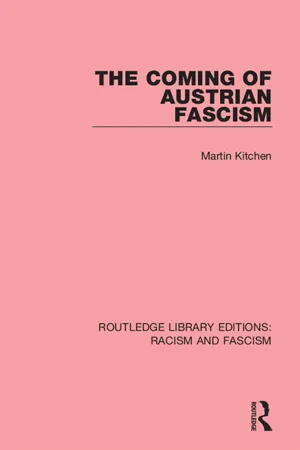
In February 1934 fighting broke out in Linz between government forces and the Social Democratic Party. Within hours Vienna was up in arms and the fighting soon spread to other parts of Austria. A few days later the party was destroyed and Austria seemed to many observers to have joined the ranks of fascist states. The violence of the fighting, particularly the shelling of the vast workers' housing complex, the Karl-Marx-Hof, and the summary execution of a number of leading figures in the fighting horrified the civilised world. This book, first published in 1980, looks at the importance of Austrian social democracy as one of the pillars of European Marxism and shows how it became a victim of the spread of fascism. The radical right and the peculiarities of Austrian varieties of fascism are given particular attention, and Dollfuss's own brand of fascistic state is analysed in terms of classic forms of fascism. Particular emphasis is placed on the economic and social problems of the Austrian Republic which led to a deepening of the political crisis and also to the foreign political ramifications of the problem. Although Dollfuss appeared to be determinedly anti-Nazi it was he who finally gave the order to destroy the Social Democratic Party little realising he was destroying himself. Thus, this study illustrates how socialism was strengthened rather than weakened by the fighting in February, and Austrian fascism far from halting German fascism, paved the way for its final triumph.
- 300 pages
- English
- ePUB (mobile friendly)
- Available on iOS & Android
eBook - ePub
The Coming of Austrian Fascism
About this book
Information
1 AUSTRO-MARXISM IN THEORY AND PRACTICE
The Austrian Social Democratic Party was constituted as a united and supranational party with a broadly Marxist programme at the party congress which met on New Year’s Eve of 1889 at Hainfeld, the ‘Bethlehem of Austrian Socialism’.1 There are a number of reasons why the party was formed at such a relatively late date. The economic backwardness of Austria had retarded the formation of a large and class-conscious industrial working class. Unity had been hampered by national differences and by regionalism, a problem that was not helped by the natural admiration of the German Austrians for the SPD in the Reich. The determination of many German Austrians to follow the model of their northern comrades gave the movement a certain Greater German bias, later to be found in the enthusiasm of Austrian Social Democrats for the Anschluss in the years before 1933, which was hardly attractive to socialists from the other nationalities of the Dual Monarchy. The repression of the working-class movement, particularly after the anti-socialist laws in Germany in 1876, exacerbated the already very marked tendency towards factionalism, making the formation of an effective and united party all the more difficult. Followers of Lassalle quarrelled with admirers of Schulze-Delitzsch, Proudhonists quarrelled with anarchists, nationalists quarrelled with internationalists. There had been considerable progress in the years before Hainfeld, particularly in the field of workers’ education, and in 1869 there were 13,350 Austrian members of the First International.2 But previous attempts to form a united party, such as the Neudörfl conference in 1874, had achieved very little. It was the combined effects of the depression from 1873 which made the Austrian labour movement far more receptive to Marxist ideas, and the undoubted diplomatic skills of Viktor Adler that made Hainfeld possible.
The Hainfeld programme, which remained in force with a few modest changes until the Linz conference in 1926, combined long-range aims such as the abolition of the private ownership of the means of production and exchange, with condemnations of the state as an instrument of class oppression, denunciations of the progressive emiseration of the working class, and short-term demands for freedom of speech, universal suffrage, free education, the separation of church and state and progressive labour legislation. As was the case with many parties in the Second International the party was committed to a programme that was essentially reformist, but spiced with Marxist notions of the contradictions between capital and labour and of the historic mission of the proletariat, without seriously confronting the problem of attaining its long-term aims or tackling the fundamentally revolutionary aspects of Marx’s thought. Hainfeld achieved unity, but the price that was paid was a loss of revolutionary élan. Immediate reforms seemed more important than distant goals so that ‘revolution’ became increasingly remote from daily political practice to the point that it was little more than an article of faith, a promised land towards which the inexorable laws of capitalist development were inevitably leading. By failing to confront the dialectical relationship between reform and revolution the party could all too easily fall prey to a confident passivity and fatalism.
In the years immediately after Hainfeld these problems seemed remote and scholastic, for there were many immediate problems to face. Much of the party’s efforts were directed towards a reduction of the length of the working day and a reform of the franchise. The opportunities afforded by the Russian Revolution of 1905 were skilfully and courageously exploited so that universal suffrage was granted, making the party the second largest party in the Reichsrat at the election of 1907. This was a great victory, but it further strengthened the reformist tendencies within the party, and ideas of a fundamental and revolutionary restructuring of society were pushed aside as the party became increasingly concerned with immediate tasks, thus tacitly accepting the existing system as at least providing enough scope for effective political action. This tendency was further strengthened by the privileged position of the Austrian workers within the Empire. They formed a labour aristocracy who tended to look down on their less fortunate comrades in Bohemia, Moravia, Hungary or the Balkans, and many feared that the end of the monarchy, which as socialists they passionately advocated, might very well mean the end of their own special status. The party’s nationality programme, adopted at Brunn in 1899, attempted to overcome these difficulties by calling for the creation of a ‘democratic federation of nationalities’ in place of the old Empire. But this was hardly a solution, for nothing was said of ways of overcoming the crass regional disparities and widely different levels of development which lay at the heart of the problem. When it was suggested that such a fundamental reform could be achieved by administrative decrees, it seemed to many that this was simply a means of continuing German domination within the Empire. It was only in 1918 when it was clear that the Empire was falling apart, and when the Soviet call for the self-determination of peoples had a tremendous impact on the nationalities, that the dream of a socialist Austria-Hungary was abandoned.
It was the American socialist writer Louis B. Boudin who coined the phrase ‘Austro-Marxism’ to describe the ideology of the party and its principal thinkers, Karl Kautsky, Rudolf Hilferding and Otto Bauer, and the expression was soon widely used.3 Austro-Marxism was the specific Austrian form of reformism, stressing gradual reform within the existing system and neglecting the revolutionary aspects of Marx’s thought. The Austro-Marxists were the most coherent and subtle representatives of the dominant ideology of the Second International. Their centralist position was strongly opposed not only to the leftist position of Lenin and Rosa Luxemburg, but also to the abandonment of Marxism by Bernstein and his revisionist followers. In theory they hoped to save the party and the International from adventurism, fractional strife and the rejection of fundamental socialist aims, but in practice their attempts to overcome the fundamental differences between left and right greatly strengthened the revisionist position. They hoped to apply Marxist methods in order to understand the fundamental changes that had occurred within society in the age of monopoly capitalism and imperialism. The result was a number of outstanding works, of which Hilferding’s Finanzkapital was the most significant, which made major contributions to Marxist literature. But although many of these works were radical in tone and far-reaching in their conclusions, they all too often provided elaborate Marxist justifications for reformist practice and were characterised by a pious faith in blind laws of historical development towards socialism which could be used to support a fatalistic wait-and-see attitude by the party leadership. From its inception Austro-Marxism was plagued by a contradiction between its apparent radicalism and its attentist practice. In the long run its position as arbiter of the fractional strife within the International could not be maintained. It was too radical for the revisionists, who objected to its Marxist rhetoric, and was roundly denounced by the left for its denial of revolution.4 Even more important was its failure to understand the imminent danger of an imperialist war and to realise the revolutionary possibilities that existed in the age of imperialism. The Austro-Marxists were traumatised by the fear of the disintegration of the party into the countless waring factions that had existed before Hainfeld. Party unity was to be preserved at all costs by radical phrases to appease the left, reformist practice to satisfy the right and a blind faith in the ‘objective’ laws of history that insured that everything would turn out all right in the end.5
The party leadership was able to maintain this balancing act in the pre-war years without serious difficulty. The party grew in size and influence and modest reforms were achieved. The outbreak of the war was the most serious test of the party’s convictions and sincerity, and the party failed miserably. The Reichsrat had been closed in March 1914, but there can be no doubt that the party would have voted for the war credits in spite of the resolutions of the International in 1907 and 1912 against an imperialist war. The party press echoed the arguments of the German party against bloody Russian aggression and called for all-out support of the war effort. Although Viktor Adler tried to restrain some of the more bellicose of his colleagues, it appeared to the rank and file of the party that the leadership was solidly behind the war, and they were thus left confused and often angry. The party had taken a strong stand against any possible war, and had a large pacifist faction; now it appeared to be swept away by an excessive chauvinism that was not shared by the average worker, who had been rendered relatively immune to such hysteria, largely due to the efforts of the party which now seemed to have abandoned its principles. The result was a rejection of the party by many faithful members, and there was a similar decline in trade union membership. In Vienna and Lower Austria, the heartland of the party, membership dropped by 65 per cent between 1914 and 1916; in some parts of Austria membership fell by 80 per cent. It only began to pick up again when the party abandoned its support of the war and assumed a more critical role.6
The attitude of the party towards the war was the direct cause of the growth of a left-wing opposition within the party. Led by intellectuals such as Viktor Adler’s son Friedrich, Robert Danneberg, Otto Bauer, Julius Deutsch and Gabriele Proft, it was but a small faction. Viktor Adler, who liked to use medical analogies taken from his experience as a doctor, and who saw socialism as a question of hygiene, felt that such factionalism was merely a typical symptom in a society that was suffering from fever.7 The left opposition followed the example of the centre of the German USPD, which were dominated by the Austrians Kautsky and Hilferding, and denied that the war was defensive but rather an imperialist and aggressive war. However, they were anxious to maintain party unity and avoided any revolutionary actions which would have been the logical consequence of their analysis of the nature of the war. Many left-wing socialists, particularly the students, became increasingly impatient with Friedrich Adler’s moderation and frequent inconsistency, and formed a left radical group which was strongly influenced by Leninist ideas. Friedrich Adler found himself trapped between the party establishment led by his father, and the increasingly attractive and vociferous left. On 21 October 1916 in an act of desperation he assassinated the Minister President, Stürgkh. Surprisingly, although Friedrich Adler was motivated more by the need to find a way out of his own intellectual and emotional problems, the assassination turned out to be a turning point in the history of the party. Friedrich Adler overnight became a folk hero. In a dramatic speech at his trial he attacked the ruling class and its war policy as well as the ‘social patriotism’ of the Social Democratic Party. The bullet that hit Stürgkh was also aimed at the entire social system which included his own father, prompting one historian to speak of ‘patricide by proxy’.8
By 1917 social tensions within the Dual Monarchy were becoming so acute that the government was obliged to make considerable concessions. The Reichsrat was reconvened. The Social Democrats were allowed to hold a party conference, and also to attend the meeting of the International at Stockholm. The position of the left was greatly strengthened. The February revolution in Russia made it even less plausible to see the war as a struggle against Russian despotism. President Wilson’s high-minded talk about democracy was a powerful propaganda weapon for the anti-war faction. The Petrograd Soviet’s call for an end to the war without reparations or annexations found a loud echo throughout Austria. At the party conference Otto Bauer, who had just returned from a prisoner-of-war camp in Russia, was the main spokesman of the left, attacking the party leadership for its chauvinism and reformism, but at the same time insisting that the party should set its own house in order and avoid any splits. The party leadership accepted much of the criticism of the party’s ‘Crown Prince’, Otto Bauer, and in doing so was able to absorb and to a large extent neutralise the effects of the sharp leftward swing of the party. The speeches and writings of the left made it appear that the party was on a radical course, but the practical politics of the party remained much the same. The old contradiction between revolutionary rhetoric and cautious practice that had characterised the party since Hainfeld remained, although in a new and more subtle form.9
During the January strike in Austria, in which almost one million workers were involved, and in which far-reaching political demands were made, including the immediate end to the war, the party played a skilful role as mediator between the strikers and the government. The party was thus able to defeat the radicals but also to gain certain concessions for the strikers so as to satisfy the party members. Much the same role was played by the party during the Austrian ‘revolution’ of 1918–19.
It is extremely doubtful whether it is permissable to use the term ‘revolution’ to describe the events in Austria at the end of the war, and it is certain that the collapse of the monarchy and the establishment of the republic were not the work of the Social Democrats, but rather the result of a process of internal decay. Whether or not a revolution was possible is still hotly debated among historians and publicists, but there can be no doubt that the party actively restrained the movement towards revolution. Otto Bauer’s suggestions for extensive nationalisation were countered by Renner’s sarcastic remark that it was no good nationalising debts, a phrase that was soon elevated to the level of a cliché by right-wing Social Democrats. The party insisted that a revolution in Austria would be countered by a blockade by the Entente, and that it would not be tolerated outside the industrial areas and would thus lead to the disintegration of German Austria. Once again ‘wait and see’ took the place of determined political action. The revolution in Austria was to be postponed until there were revolutions in the Entente countries and in Czechoslovakia. The left continued to make revolutionary noises but the party followed a policy of cautious and gradual reform as suggested by Renner and Hanusch. In the long run this policy could win little support from outside the ranks of the party faithful. Dramatic speeches in support of the Soviet governments in Munich and Hungary, and illegal shipments of weapons to Bela Kun’s supporters, horrified the right. The insistence that the objective situation in Austria would not permit a similar experiment in Soviet democracy disgusted the left.10 But the party was able to maintain its strength and influence by its very real achievements in social reform, which included the introduction of unemployment benefits in November 1918 and the long-awaited eight-hour day in December of the same year. In the following year a law introducing works councils was drawn up as part of a scheme of educating the workers in management and preparing the way for greater workers’ control and even of nationalisation of sectors of industry.
The demand for an Austrian republic on 30 October 1918 by the party was not the result of a determined effort to seize power, but because the party was forced into action by the workers of Vienna who were growing increasingly impatient with the passivity of the Social Democrats. The party accepted a National Assembly made up of deputies who had been elected before the war and which acted as a further hindrance to significant and fundamental changes in the structure of society. This feeble policy was excused on the grounds that German Austria was merely a provisional state that no one really wanted, and that within a short time an Anschluss with Germany, a Germany that appeared to be dominated by the workers’ and soldiers’ councils, would create a totally different situation. On 2 November 1918 Friedrich Adler was set free from prison and was welcomed as the greatest hero of the Austrian left. The radicals asked him to join in the formation of an Austrian Communist Party, but Adler refused. By rejecting the left and by returning to the Social Democrats Adler did more than any single individual to strengthen the position of the Social Democratic Party among the working class.11
The rejection by the party of a revolutionary Soviet solution was clearly seen in the formation of the first republican government. Under the leadership of Renner, the outstanding spokesman of the right, the party joined in a coalition with the Christian Social Party and the Greater German Party. This coalition continued after the elections of February 1919 which left the Social Democrats as the largest party in parliament, although the bourgeois parties had a majority. The right-wing parties needed the Social Democrats to contain and control the radicalised working class and to save Austria from bolshevism. Otto Bauer was ready to admit that Ferdinand Hanusch’s social legislation and the granting of votes to women was designed in part to assuage the working class that had become dissatisfied with the policies of the leadership, and appeared ...
Table of contents
- Cover
- Half Title
- Title Page
- Copyright Page
- Original Copyright Page
- Table of Contents
- Acknowledgements
- Introduction
- 1. Austro-Marxism in Theory and Practice
- 2. The Christian Social Party
- 3. The Extreme Right
- 4. The Economic Problems of the Austrian Republic
- 5. The Army and the Police
- 6. The Schutzbund
- 7. Foreign Policy: Dollfuss Between Mussolini and Hitler
- 8. The Patriotic Front
- 9. The Fighting on 12 February 1934
- 10. The Aftermath of February
- 11. Austro-fascism
- 12. Conclusion
- Bibliography
- Index
Trusted by 375,005 students
Access to over 1.5 million titles for a fair monthly price.
Study more efficiently using our study tools.
Frequently asked questions
Yes, you can cancel anytime from the Subscription tab in your account settings on the Perlego website. Your subscription will stay active until the end of your current billing period. Learn how to cancel your subscription
No, books cannot be downloaded as external files, such as PDFs, for use outside of Perlego. However, you can download books within the Perlego app for offline reading on mobile or tablet. Learn how to download books offline
Perlego offers two plans: Essential and Complete
- Essential is ideal for learners and professionals who enjoy exploring a wide range of subjects. Access the Essential Library with 800,000+ trusted titles and best-sellers across business, personal growth, and the humanities. Includes unlimited reading time and Standard Read Aloud voice.
- Complete: Perfect for advanced learners and researchers needing full, unrestricted access. Unlock 1.5M+ books across hundreds of subjects, including academic and specialized titles. The Complete Plan also includes advanced features like Premium Read Aloud and Research Assistant.
We are an online textbook subscription service, where you can get access to an entire online library for less than the price of a single book per month. With over 1.5 million books across 990+ topics, we’ve got you covered! Learn about our mission
Look out for the read-aloud symbol on your next book to see if you can listen to it. The read-aloud tool reads text aloud for you, highlighting the text as it is being read. You can pause it, speed it up and slow it down. Learn more about Read Aloud
Yes! You can use the Perlego app on both iOS and Android devices to read anytime, anywhere — even offline. Perfect for commutes or when you’re on the go.
Please note we cannot support devices running on iOS 13 and Android 7 or earlier. Learn more about using the app
Please note we cannot support devices running on iOS 13 and Android 7 or earlier. Learn more about using the app
Yes, you can access The Coming of Austrian Fascism by Martin Kitchen in PDF and/or ePUB format, as well as other popular books in Social Sciences & Sociology. We have over 1.5 million books available in our catalogue for you to explore.