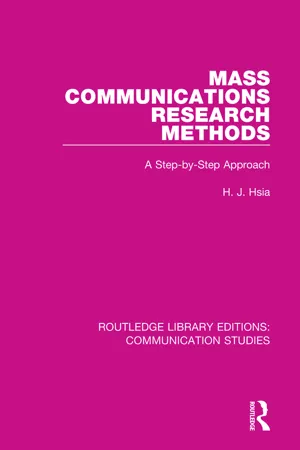
Originally published in 1988. Step-by-step, this book leads students from problem identification, through the mazes of surveys, experimentation, historical/qualitative studies, statistical analysis, and computer data processing to the final submission and publication in scientific or popular publications.
- 642 pages
- English
- ePUB (mobile friendly)
- Available on iOS & Android
eBook - ePub
About this book
Information
I
Communication Research and Research Orientation
Communication is vital to every discipline and profession. We communicate to grow, to live, and to survive, but we tend to overlook communication, not because of its absence but because of its omnipresence. Communication in all forms and manners, obvious or hidden, represents the totality of culture. Communication is also control. We communicate to control our environment, we communicate to bequeath our heritage, and we communicate to gain understanding of what is happening around us. We communicate through a physician's prescription, a sergeant's order, a student's term paper, an instructor's lecture, or a president's speech. All are carried out in an attempt to control or influence the behavior of the recipient. Without communication, it is doubtful we could survive. When King Frederick II of Sicily attempted to discover the primitive language of mankind-the first human language spoken universally by men-he gathered a number of infants and ordered the nurses to provide the infants with the best food, clothes, and care but not to speak a single word to them. He waited patiently for any infant to utter its first word which he would conclude was indicative of man's primitive language. All the infants died without uttering a single word (Farb, 1978). Because they have not yet learned verbal skills, infants need communication, which is a form of love, caring, and affection. But without communication, they are doomed.
Absolute silence in a deep cavern is unbearable. The absence of sound is a horrifying experience, as was the case when all guns in Berlin fell silent on the midnight of the German surrender at the end of World War II. Today we are exposed to thousands of TV and radio commercials, programs, news articles, advertisements, books, and films. Each has some influence on our lives. This is the reason communication must be studied and researched.
As a tool of science, communication research must observe the rigor of science; therefore, Part I starts with communication and science; exploring the relationship between science, research, and theory in chapter 1, in addition to the rationale for research. Science, theory, and research are the inseparable trio. To meet the requirements of systematic investigation in science, communication research must be oriented to theory and all its retinue (i.e., to problems, causality, explanation, prediction, logic, statistics, mathematics, reliability, and validity). These orientations are the essentials discussed in chapter 2. Chapters 3 and 4 deal with the fundamentals in research and cover topics such as variables, scales, conceptualization, operationalization, classification, logical division, and hypothesis formulation. Chapter 5 is about the nitty-gritty preparation for all types of research methods.
1
Communication Science and Research
The rise of every statesman from the lowest office to the highest office (e.g., the United States Presidency) is partly the result of effective communication. Communication is a need as essential as any biological need; it is creativity through which arts and literature flourish; it is a form of control by which man controls his environment and destiny; it is also an interaction through which man becomes a political, social, and intelligent being; and it is an instrument upon which man's biological and intellectual survival depends.
We Need Communication as Much as we Need Air
As a means of control and survival, communication is indispensable for any person, management team, or nation. More than the catalyst of development and the molder of the future, communication is one of the determinants of war and peace. As seen in technological advances embodied in modern mass and personal media, communication has not only reduced the world to a global village, but dictated to almost every life. We may add that communication encompasses the entirety of human verbal and nonverbal behavior. It includes the whole spectrum of human activities, from intrapersonal to interpersonal to international, intercultural communication, and from the very ancient times to the future. It is the key to the effective functioning of any government, institution, or family. When a marriage breaks up, it is often a failure of communication. By the same token, the generation gap is a failure of communication, too. Almost any breakdown is the result of communication failure. But, then, what is communication?
From a societal point of view, communication is lithe sharing experience, observable as the extent to which the responses of a generator and perceiver are systematically correlated to a referent stimulus" (Goyer, 1970, p. 15); it is also "an activity which gains meaning and significance from consensually shared rules" (Cushman & Whiting, 1972, p. 22). In view of the communication flow, communication is lithe process by which an individual (the communicator) transmits stimuli (usually verbal symbols) to modify the behavior of other individuals (communicatees)" (Hovland, 1958, p.371).
Functionally, communication provides people with information about a need for change, about what changes can occur, about available alternatives, about the methods and means and benefits of adopting new ideas and new ways of doing things. Communication is essential to engender acceptance of change, and to influence the decision processes that lead to trying new kind of seed, or changing a diet, or utilizing birth control devices (Schramm & Roberts, 1971).
Communication is the imparting or exchanging of ideas and knowledge (whether by speech, writing, or signs), and the transferring of thoughts and messages. The basic forms of communication are signs (sight) and sounds (hearing). Communication also can be viewed as the mechanism through which human relations exist and develop-all the symbols of the mind, together with the means of conveying them through space and preserving them in time. As stated by Cooley (1909):
It includes the expression of the face, attitude and gesture, the tones of voice, words, writing, printing, railways, telegraphs, telephones, and whatever else may be the latest achievement in the conquest of space and time. All these taken together, in the intricacy of their actual combination, make up an organic whole. Corresponding to the organic whole of human thought and everything in the way of mental growth has an external existence therein. The more closely we consider this mechanism, the more intimate will appear its relation to the inner life of mankind, and nothing will more help us to understand the latter than such consideration. (p. 61)
From a psychological point of view, communication is the discriminatory response of an organism to a stimulus. When some environmental disturbance (the stimulus) impinges on an organism and the organism does something about it or makes a discriminatory response, communication occurs. Communication is not the response itself but is the relationship set up by the arbitrary rule that the message that gets no response is not a communication (Smith, 1966). Such a statement is generally accepted; however, no response is also a form of response, sometimes more eloquent than a real response.
A blade of grass or a single leaf in a primitive sense is a complete communication system, an entity of photosynthesis orienting itself toward the sunlight. But far from being such a simple mechanism, human communication is the sharing of an orientation toward a set of informational signs (Schramm, 1971). Indeed, human communication never exists without social context: It serves as a link between man and his environment, and its effects may be explained in terms of the role it plays in enabling people to bring about more satisfying relationships between themselves and the world around them (Dexter & White, 1964).
In communication policy and planning, most definitions of communication include three fundamental elements: communication as a need (or a human right or want), as a creative activity, and as a resource. Communication is a concept elastic enough to encompass interpersonal, institutional, and mass communication. It can be broadly defined as a fundamental and encompassing process through which any social event or human behavior can be expressed.
Communication is Control
Regardless of the nuances, emphases, and orientations of various definitions, one common feature stands out: Communication is a means of control or, rather, a means of effecting control over environment and behavior. The father of cybernetics, Norbert Wiener (1950), states:
Information (communication) is a name for the content of what is exchanged with the outer world as we adjust to it, and make our adjustment felt upon it. The process of receiving and of using information (communication) is the process of our adjusting to the contingencies of the outer environment, and of our living effectively within the environment. ... To live effectively is to live with adequate information. Thus, communication and control belong to his life in society. (pp. 17-18; italics added)
Despite the proclamation that the United States had no territorial claims on the moon, the United States was in fact in control of the moon when the United States astronauts were on it. How did the United States exercise control over the moon? Simple. No nation but the United States had effective communication with the astronauts. As soon as the astronauts left. the moon, communication with the moon ceased, and control of the moon ended as well.
More than any other country, the whole political process in the United States relies upon the control of communication in molding, shaping, and changing public opinion which in turn influences, if not determines, the issues and policies of both parties and political candidates, with the press playing the intermediary role. Likewise, education is a controlled form of communication, essentially an information exchange between teachers and students. History is communication, too, with bits and pieces of facts threaded together from the past to the present, and hopefully passing from the present to the future.
Why control? Control is for survival, biological for individuals and heritable for societies and nations (Lasswell, 1948). Control is, for individual lives and social tradition as well, to enhance, enrich and embellish. Furthermore, control also steers one out of harm's way.
Particularly in a society like the United States where mass media have reached the saturation point, communication is vital for the normal functioning of the sociopolitical system. Nothing in a modern society can really function without communication. Communication research has flourished in many branches of the sciences: political science, sociology, anthropology, social psychology, genetics, biology, international relations, speech, marketing, linguistics, health science, and others. Even extrasensory perception (ESP) may be a legitimate area for communication studies, along with nonverbal communications: kinesics, paralinguistics, proxemics, and physiological communications.
We Live in Communication
Traditional areas of mass communication such as telecommunication, advertising, journalism, public relations, films, books, and photos are intricately interwoven in everyone's life. Not many people recognize the significance of communication, probably for a very simple reason: We live in communication just like fish live in water, wrapped in but unconscious of communication as much as fish are unaware of the water.
Communication is an all-encompassing phenomenon despite our misconception of communication as simply a form of written or spoken words. Communication is almost the totality of all human endeavors. From a man's conception, the gene carries sufficient information to determine our future development and growth pattern. Family communication shapes, molds, and modifies our behavior. Media program our time and influence our thoughts and behavior. Generally, we pay little or no attention to communication, not because of its absence but because of its ubiquitous presence. The effects of communication can be speculated dramatically by its absence: If there were no communication at all, no newspapers, radio, magazines, books, movies, television, letters, telephones, or conversations, modern society would come to a complete standstill, and we would be fish out of water.
Communication is so intimately related to our lives but so much neglected that we tend to overlook its effects. Television is a case in point. It has changed our lives—our hobbies, our pastimes, our information sources, our purchases, and our beliefs.
- "What time is it?"
- "It's 30 minutes before 'General Hospital'."
- "I gotta go home to watch the Dallas Cowboys."
We have been very much affected by TV but we have not conducted a single study to delineate the longitudinal, continuous, incremental, additive, and perhaps addictive effects of TV. Medicine gives us an illustrative case. Medical research has been much better endowed than any other branch of the sciences or arts. Enormous amounts of federal and private funds have been spent on medical research for diseases as serious as cancer and as common as acne and constipation. Cancer prevention (such as abstaining from smoking and periodic physical examinations) can and will save more lives than any research results that can be discovered in the short run. But communication can do more! How many teenagers would benefit had they known that one of the cures for common acne is to avoid dairy products? And how many light constipation sufferers would like to know of some wonder drug—lightly fried fresh vegetables like mustard greens or turnip leaves that are not only far more effective but much more enjoyable than any drug prescribed or bought over the counter? (But to play it safe, we should check with our physician first.)
Undoubtedly, many human diseases are related to food and nutrition. Many lives could have been saved through communication in the adoption of certain diets and exercises. Had we communicated effectively to the people and persuaded them to adopt effortless energy conservation measures, the United States could drastically cut its needs for imported oil and partially solve another problem — the trade deficits. Communicating is much simpler than medical or energy research, but it is neglected, overlooked, dismissed, and often relegated to the back burner.
Communication is on occasion far more effective and efficient than other measures, but not to the exclusion of other measures. Indeed, no effort should be spared for communication research today. In communication research, the most important characteristics must be recognized first:...
Table of contents
- Cover Page
- Half Title page
- Title Page
- Copyright Page
- Original Title Page
- Original Copyright Page
- Dedication
- Contents
- Preface
- Part I Communication Research and Research Orientation
- Part II Survey Research
- Part III Experimental Research
- Part IV Historical, Qualitative, and Secondary Research
- Part V The Taming of Statistics
- Part VI Data Processing and the Computer
- Part VII Writing and Disseminating
- Appendix A: Statistical Tables
- Appendix B: Glossary
- References
- Author Index
- Subject Index
Trusted by 375,005 students
Access to over 1.5 million titles for a fair monthly price.
Study more efficiently using our study tools.
Frequently asked questions
Yes, you can cancel anytime from the Subscription tab in your account settings on the Perlego website. Your subscription will stay active until the end of your current billing period. Learn how to cancel your subscription
No, books cannot be downloaded as external files, such as PDFs, for use outside of Perlego. However, you can download books within the Perlego app for offline reading on mobile or tablet. Learn how to download books offline
Perlego offers two plans: Essential and Complete
- Essential is ideal for learners and professionals who enjoy exploring a wide range of subjects. Access the Essential Library with 800,000+ trusted titles and best-sellers across business, personal growth, and the humanities. Includes unlimited reading time and Standard Read Aloud voice.
- Complete: Perfect for advanced learners and researchers needing full, unrestricted access. Unlock 1.5M+ books across hundreds of subjects, including academic and specialized titles. The Complete Plan also includes advanced features like Premium Read Aloud and Research Assistant.
We are an online textbook subscription service, where you can get access to an entire online library for less than the price of a single book per month. With over 1.5 million books across 990+ topics, we’ve got you covered! Learn about our mission
Look out for the read-aloud symbol on your next book to see if you can listen to it. The read-aloud tool reads text aloud for you, highlighting the text as it is being read. You can pause it, speed it up and slow it down. Learn more about Read Aloud
Yes! You can use the Perlego app on both iOS and Android devices to read anytime, anywhere — even offline. Perfect for commutes or when you’re on the go.
Please note we cannot support devices running on iOS 13 and Android 7 or earlier. Learn more about using the app
Please note we cannot support devices running on iOS 13 and Android 7 or earlier. Learn more about using the app
Yes, you can access Mass Communications Research Methods by H.J. Hsia in PDF and/or ePUB format, as well as other popular books in Social Sciences & Media Studies. We have over 1.5 million books available in our catalogue for you to explore.