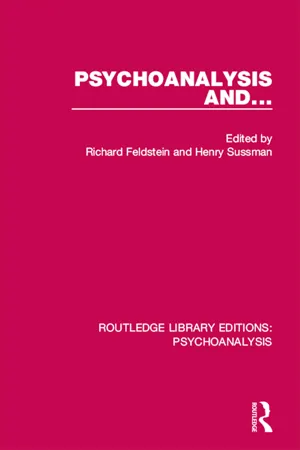
Originally published in 1990, Psychoanalysis and… brings together essays by critics whose work demonstrates the lively interpenetration of psychoanalysis and other disciplines. Andrew Ross investigates psychoanalysis and Marxist thought; Joel Fineman reads the "sound of O" in Othello; Jane Gallop asks "Why does Freud giggle when the women leave the room?"; and Ellie Ragland-Sullivan examines Lacan's seminars on James Joyce. This stimulating collection of work should still be required reading, especially for students of literature. But Psychoanalysis and… demonstrates that psychoanalysis – and theoretical criticism, and feminism, and Lacanian theory, and semiotics, and Marxism, and deconstruction, and literary criticism – was, at the time, a rich and expanding terrain.
- 224 pages
- English
- ePUB (mobile friendly)
- Available on iOS & Android
eBook - ePub
Psychoanalysis and ...
About this book
Information
Notes and References
1. Psychoanalysis as an Intervention in Contemporary Theory
1. Jacques Lacan, Ecrits: A Selection, trans. Alan Sheridan (New York: W. W. Norton, 1977), p. 34.
2. Simon O. Lesser, Fiction and the Unconscious (Chicago: University of Chicago Press, 1957), p. 98.
3. Throughout this essay I have had particular people in mind in making observations about both psychoanalytic writing practices and the reception of psychoanalysis in the academy. When I presented an earlier version of this paper at the annual convention of the Modern Language Association several years ago, I left out all specific references, so I told myself, in order to fit the paper into the time limit. A number of people in the audience—and several readers later on—asked me if I had them in mind at various points in the essay. Other people asked if I had this or that well-known critic in mind at particular points. On the latter issue a number of those who talked with me guessed right. On the first issue—the question about whether I had them in mind—people were often wrong. It became clear to me, however, that the essay would in fact be more useful if this anxiety were left open for readers. Thus I have let the essay be an uncertain mirror, a fable, if you will, in which we may or may not see ourselves.
2. Psychoanalysis, Literary Criticism, and the Problem of Authority
1. Concerning the rôle of the author in Balzac’s work, see my: Unwrapping Balzac: A Study of La Peau de Chagrin. University of Toronto Press: Toronto/Buffalo/London, 1979.
2. The Editions du Seuil have published several seminars of Lacan, and are under contract to do several more. It is also a co-plaintiff, with Miller, in the case.
3. Ecrits: A Selection, translated by Alan Sheridan, Norton: New York/London, 1977, pp. 310–311 (translation modified). In the original French edition (Editions du Seuil: Paris, 1966, p. 813), the text reads as follows:
Partons de la conception de l’Autre comme du lieu du
signifiant. Tout énoncé d’autorité n’y a d’autre
garantie que son énonciation même, car il est vain
qu’il le cherche dans un autre signifiant, lequel
d’aucune façon ne saurait apparaître hors de ca lieu.
Ce que nous formulons à dire qu’il n’y a pas de métalangage
qui puisse être parlé, plus aphoristiquement:
qu’il n’y a pas d’Autre de l’Autre. C’est en imposteur
que se présente pour y suppléer, le Législateur (celui
qui prétend ériger la Loi).
4. Sheridan translates, “soumission” as “subjection.” Cf. Ecrits: A Selection, p. 304; Ecrits [French], p. 806.
5. Navarin, Diffusion Seuil: Paris, 1985.
6. The German translation of this essay does foreground this aspect of the term, which it renders as Das Drängen des Buchstabens.
7. S. Freud, The Interpretation of Dreams, chapter VII, A: The Forgetting of Dreams, Avon Books: New York, p. 563.
8. Cf. R. Barthes, “The Death of the Author”; M. Foucault, “What is an Author?”
3. The Sound of O in Othello
1. This paper was originally delivered at a colloquium on Lacan’s Television (Paris: Editions du Seuil, 1974), sponsored by October/Ornicar?, April 9–10, 1987. The two epigraphs from Television appear in the translation published in October, no. 40, trans. Denis Hollier, Rosalind Krauss, and Annette Michelson (Spring 1987), pp. 45 and 34, respectively. All Shakespeare references are to The Riverside Shakespeare, ed. G. B. Evans, et al. (Boston: Houghton, Mifflin, 1974).
2. Forthcoming, University of California Press.
3. Joel Fineman, Shakespeare’s Perjured Eye: The Invention of Poetic Subjectivity in Shakespeare’s Sonnets (Berkeley: University of California Press, 1986).
4. For Shakespeare’s probable Greek education, see T. W. Baldwin, Shakspere’s Small Latine and Lesse Greek, 2 vols. (Urbana: University of Illinois Press, 1944). According to F. W. Gingrich’s Shorter Lexicon of the Greek New Testament, rev. F. W. Danker (Chicago: University of Chicago Press, 1983), thelō means primarily “wish,” “will,” “desire,” but, also, “resolve” and “purpose”; as with French vouloir, thelō also carries the sense of want as lack, for example, a want “to mean” or “to be,” e.g., Ac. 2:12, “ti thelei touto einai,” “what does this mean?”
5. Of the many plausible Greek etymologies to associate with the name Desdemona, Cinthio, in conclusion, stresses: “It appeared marvelous to everybody that such malignity could have been discovered in a human heart [here speaking of the Iago prototype]; and the fate of the unhappy Lady was lamented, with some blame for her father, who had given her a name of unlucky augury” (excerpt from Gli Hecatommithi [1566 edition], trans. and ed. Geoffrey Bullough, Narrative and Dramatic Sources of Shakespeare [New York, Columbia University Press, 1973], Vol. 7, p. 250). There are alternate speculations regarding Shakespeare’s source for the name Othello, e.g., Thorello, in Ben Jonson’s Everyman in His Humour (1598). Shakespeare often associates Venus, or Aphrodite, with Cyprus, referring directly to her mythological birthplace, e.g., the final couplet of Venus and Adonis: “holding their course to Paphos, where their queen/Means to immure herself, and not be seen” (1193–1194). The Revels Accounts records the first performance of Othello—before the king, on November 1, 1604—as “The Moor of Venis” by “Shaxberd” (Bullough, Sources, p. 193).
6. In his Introduction, Bullough reviews arguments for and against Shakespeare’s knowledge of Cinthio’s text (Sources, pp. 193–238). Cinthio’s text was first published in 1565, and Shakespeare may have read this; there is also a French translation, dated 1584, by Gabriel Chappuys, which Shakespeare may also have read. The first English translation appears in 1753.
7. The prefix-marker in Greek for aorist or imperfect tenses is e (є) or, under certain circumstances ē(ω). The first-person imperfect for thelō is thus ēthelōn, with the final Mn marking the first person. Hence my remarks above. Various Greek scholars with whom I have conferred are willing to hear a collation between the sound of O in Othello and the initial prefix—ē—but they also insist they do not hear a convincing collation between the sound of O and the final ōn of the first-person imperfect. Despite such philological objections, I continue to think Shakespeare—who had very little Greek indeed, and who regularly makes greater and far freer auditory free-associations in English—would have heard a connection between the sound of O and the final ōn of the first-person imperfect of thelō. However, if one does not grant this final association, then my argument above about the subjective force of the sound of O in Othello loses only one half of its two markers of the first-person imperfect, and, in either case, the argument retains its validity with regard to the subjective apprehension of the present. However, in the context of what I say later about Lacan’s account of the constitution of the subject, it is significant that the two markers of the on-going first-person past (ē at the beginning and ōn at the end) are bound up together in the sound of O in Othello, for, thus conjoined, they register the durative experience of the (insistently repeated) moment of the constitution of the subject as the sustained and immediate passing of the present, as in my discussion above of “That’s he that was Othello, here I am” (5.2.284).
8. The most immediately relevant Shakespeare Sonnets are 135 and 136. I quote them here so as to recall, first, the performative way Shakespeare exploits the fact that his name designates both male and female genitals, second, the “overplus” arithmetics of Will (for discussions of these sonnets, see Shakespeare’s Perjured Eye, chapter 5):
135
Whoever hath her wish, though hast thy Will,
and Will to boot, and Will in overplus;
More than enough am I that vex thee still,
To thy sweet will making addition thus.
Wilt thou, whose will is large and spacious,
Not once vouchsafe to hide my will in thine?
Shall will in others seem right gracious,
And in my will no fair acceptance shine?
The sea, all water, yet receives rain still,
And in abundance addeth to his store,
So thou being rich in Will ad...
Table of contents
- Cover
- Half Title
- Title Page
- Copyright Page
- Original Copyright Page
- Dedication
- Table of Contents
- Introduction
- Psychoanalysis and Theoretical Criticism
- Psychoanalysis and Feminism
- Psychoanalysis and Lacanian Theory
- Psychoanalysis and Semiotics
- Psychoanalysis and Marxism
- Psychoanalysis and Deconstruction
- Psychoanalysis and Literary Criticism
- Notes and References
Trusted by 375,005 students
Access to over 1.5 million titles for a fair monthly price.
Study more efficiently using our study tools.
Frequently asked questions
Yes, you can cancel anytime from the Subscription tab in your account settings on the Perlego website. Your subscription will stay active until the end of your current billing period. Learn how to cancel your subscription
No, books cannot be downloaded as external files, such as PDFs, for use outside of Perlego. However, you can download books within the Perlego app for offline reading on mobile or tablet. Learn how to download books offline
Perlego offers two plans: Essential and Complete
- Essential is ideal for learners and professionals who enjoy exploring a wide range of subjects. Access the Essential Library with 800,000+ trusted titles and best-sellers across business, personal growth, and the humanities. Includes unlimited reading time and Standard Read Aloud voice.
- Complete: Perfect for advanced learners and researchers needing full, unrestricted access. Unlock 1.5M+ books across hundreds of subjects, including academic and specialized titles. The Complete Plan also includes advanced features like Premium Read Aloud and Research Assistant.
We are an online textbook subscription service, where you can get access to an entire online library for less than the price of a single book per month. With over 1.5 million books across 990+ topics, we’ve got you covered! Learn about our mission
Look out for the read-aloud symbol on your next book to see if you can listen to it. The read-aloud tool reads text aloud for you, highlighting the text as it is being read. You can pause it, speed it up and slow it down. Learn more about Read Aloud
Yes! You can use the Perlego app on both iOS and Android devices to read anytime, anywhere — even offline. Perfect for commutes or when you’re on the go.
Please note we cannot support devices running on iOS 13 and Android 7 or earlier. Learn more about using the app
Please note we cannot support devices running on iOS 13 and Android 7 or earlier. Learn more about using the app
Yes, you can access Psychoanalysis and ... by Richard Feldstein, Henry Sussman, Richard Feldstein,Henry Sussman in PDF and/or ePUB format, as well as other popular books in Psicologia & Critica letteraria femminista. We have over 1.5 million books available in our catalogue for you to explore.