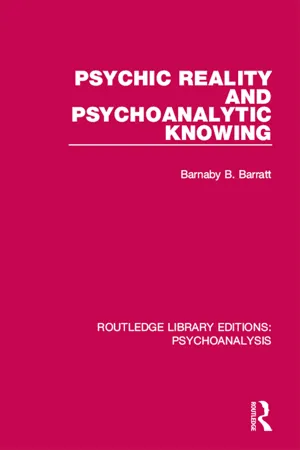
How do we know our mental life, and how is our mental life altered by our efforts to know it better? Originally published in 1984, this title attempts an epistemological and ontological discourse concerning the understanding of human mental processes, and it aims toward a definitive thesis on the dialectics of knowing and being in this work of psychological understanding. What this work reconfronts are questions pertaining to all psychology and to all human sciences. Yet much of its focus is on the understanding of unconscious mental contents, on the question of knowing and being in Freud's psychology.
- 304 pages
- English
- ePUB (mobile friendly)
- Available on iOS & Android
eBook - ePub
Psychic Reality and Psychoanalytic Knowing
About this book
Information
1 | Psychology and Psychic Reality |
How do we know our mental life, and how is our mental life altered by our efforts to know it better? This book attempts an epistemological and ontological discourse concerning the understanding of human mental processes, and it aims toward a definitive thesis on the dialectics of knowing and being in this work of psychological understanding.
My argument concerns issues of subject, “object,” being, and method in psychological knowledge. It is perhaps a rather complex argument, which needs to be apprehended as a whole. By and large, its import lies not so much in its particular components, as in their assemblage. What this work reconfronts are questions pertaining to all psychology and, for that matter, to all human sciences. Yet much of its focus is on the understanding of unconscious mental contents, on the question of knowing and being in Freud’s psychology. To set the stage for this inquiry, we need to reexamine our ideas about reality, representation, subject, and science.
PSYCHIC REALITY
In a remarkable yet somewhat elusive chapter in his Principles of Psychology, William James (1890) discusses the psychological sources of our sense of reality. He argues that “reality” necessarily entails a relation to our practical and emotional life: “the fons et origo of all reality, whether from the absolute or the practical point of view, is thus subjective, is ourselves” (Vol. 2, pp. 296–297). Attempting to forge a pragmatist’s solution to the dilemma of realist and idealist philosophies, he refers to the multiple worlds in which we live and proposes a rudimentary categorization of them. James suggests that for each of us, these worlds attain the status of “real” when they are invested with our interest. In other words, our active life is guided by a practical sense of reality, contingent upon the excitement, frustration, and satisfaction of our desires. Although James consistently shies away from the more radical implications of his ideas, he does at least set forward the problem of personal realities—the possibility of an understanding of human individuality, and of the idiographic craft of living in the world.
“As the cosmologist is,” to paraphrase Heraclitus’ pre-Socratic doctrine, “so will the cosmology be.” An understanding of the world is conditioned by the inner order and disorder of the one who understands. Each person is, in a certain sense, his or her own cosmologist. Although the history of philosophical reflection, particularly in Europe, has tended toward serious consideration of this aphorism, the dominant tradition of Anglo-American psychology, despite the promise of James’ leadership, has generally obscured the issue, often ignoring it.
In medieval times it could be believed that the world simply is as it is, given to us purely in experience. It could be believed that objects simply present themselves as they are; that truth is a matter of correspondence or adequate resemblance. The naiveté of this faith is now unarguable. Modern thinkers have had to reexamine the processes and presumptions of their knowledge. This shift from medievalist theological preoccupations toward the epistemological concerns of modern philosophy can be seen as a response to the “revolution” of Copernicus, Kepler, Galileo, and Newton. It is heralded by the developments of Continental rationalism from Rene Descartes to G. W. von Leibniz, and of British empiricism from Thomas Hobbes to David Hume. Descartes’ work—his mentalization of representational knowledge and his method of doubt in his search for mental procedures by which certainty may be secured—marks the beginning of the transition to modern problems. Immanuel Kant’s systematic, syncretic formulations, with their central thesis that experiences of the world conform to the structures and functions of the mind, represent the culmination of this transitional period.
Since the insights of this “Age of Reason” from Descartes to Kant, it has become impossible to assume that the human mind is a passive imitation of an external, independent universe, somehow given to us in the purity of experience. Accordingly, we must relinquish the assumption that “reality” is experienced or otherwise apprehended apart from the mind’s representational activity. As Goethe said, “We see only what we know.” We may still conceive abstractly of an absolute reality, of an independent, outer domain of things-in-themselves, the existence and nature of which are derived by collective agreement about observed phenomena. But in pausing to consider what is entailed by “collective agreement about observed phenomena,” the constructive activity of the mind persistently asserts itself.
Epistemology—as the study of the conditions of possibility for human experience and understanding—and psychology—in its proper etymological sense, not as a technology of behavior, but as a study of the inner ordering of experience and understanding—would not be of such interest to us were it not for the foundation of all human pursuits in the constructive activity of subjectivity and intersubjectivity. If experience in the world is conditioned by mental structures and functions, and understanding of the world is similarly formed by the mind’s representational activity, then these structures and functions of the mind effectively determine the “reality” in which we live. Epistemologically, this leads us to further examination of general statements about reality and the universally constitutive life of the mind. And psychologically, this raises important questions about reality in relation to the individuality of mental processes.
It is Sigmund Freud who offers us the indispensable notion of psychic reality, connoting the individualization of reality relative to the person’s mental processes. Freud first coined this term in a 1913 publication, although the same idea, designated “thought-reality,” appears once in his unpublished writings as early as 1895.1 Prior to Freud’s work, I am not aware of the use of this notion anywhere in the literature of Continental philosophy. The term seems without immediate or direct precedent, even though, in a certain sense, it was presaged in the writings of Friedrich Schiller, Friedrich Nietzsche, Wilhelm Dilthey, and others. After Freud’s introduction of this notion, however, several similar ideas were deployed throughout European scholarship for diverse purposes. The ethologist Jacob von Uexküll, for instance, distinguished the Umwelt as the organism’s biological world or habitat, the Mitwelt as the organism’s world of relations to others, and the Eigenwelt as the organism’s world of internal or self-relations. From a different perspective, various existential, phenomenological, and hermeneutic philosophies developed Edmund Husserl’s idea of the Lebenswelt, as the intersubjective ground of all experience and understanding.
Psychic reality is necessarily defined in terms of the particular person’s psychological processes; it comprises all that is real for the individual subject. It is an interiority of personal experiences and understandings, an Innenwelt, as Freud sometimes called it. In Freud’s writings, this psychic reality is contraposed to “external” (1895a), “factual” (1912–1913), or “material” reality (1916–1917), corresponding to what in contemporary parlance would be called “objectivity”—the conventions of general agreement about the way the world is. By contrast, psychic reality defines the world as it is experienced and understood by the individual subject. It is the private sense of reality, in which the person effectively lives.
Unfortunately, in some post-Freudian literature, under the auspices of an ideology of adaptation and following some precedent in Freud’s own writings, the term “psychic reality” has acquired a more restricted usage, connoting pathology. The “neurotic” supposedly lives in psychic reality, whereas the “normal” is clear-sightedly at home in “external” or “objective” reality. Here “psychic reality” refers to some partial sphere of a person’s mental functioning, a maladaptive aspect counterposed to a “conflict-free sphere.” Against this more restricted usage, it must be said that “normality,” as Freud suggested, is nothing but an idealization, a fiction based on certain cultural conventions. “Conflict-free functioning” is at best a relative notion, concocted for the convenience of the clinician. And “external” or “objective” reality, as will be argued throughout this book, is a matter of intersubjectivity, of general agreement concerning the way things are. Thus, for our purposes, “psychic reality” retains its broader and philosophically more cogent usage, denoting all that is real for any individual subject.
Psychic reality, then, includes not only the individual’s accession to the normative ordering of experience, to the conventions of understanding and the authority of nomothetic mentation, but also, and more especially, the individual’s transgressions from or personalizations of this normativity. The latter should not be dismissed as mere “failures” to meet the collective standard of “reality testing,” for they concern the particular truth of each person’s sense of reality, the idiographic character of all experience and understanding. Moreover, psychic reality refers not only to the world as the subject readily apprehends and articulates it, to all that is descriptively available to consciousness and preconsciousness, but also to the unconscious constituents of the individual’s sense of reality. Freud’s work, more than any other impulse of modern thought, potentiates our awareness of the full richness of the content and particularity of this inner world. Since Freud, psychotherapeutic, literary, and artistic discourse has become newly available to us in a manner that intimates the desirousness, creativity, loneliness, and terror of the personal reality underlying manifestations of “objective” or “rational” thought. Psychoanalysis consistently discovers that the individual’s particular grasp of the world is infused with wishes, memories, fantasies, and dreams, in a manner that cannot be immediately or fully apparent to the subject of conscious and preconscious mentation. This infusion—the idiographic quality of all experience and understanding—testifies to the vitality of unconscious mental activity in constituting the reality in which the person effectively lives. Comprehended from this perspective, Freud’s psychology ushers in an extraordinarily radical notion of human individuality.
In the history of Western thought, we might distinguish four phases in the notion of individuality. This is a crude distinction, not to be regarded as a chronological or necessarily sequential scheme, nor as an adequate analysis of the range of perspectives from which individuality might be conceptualized. These “phases” are suggested solely for heuristic purposes, in order to delineate one aspect of the position of Freud’s psychology within the history of humanistic ideas.
To begin with, we might point to cultures or historical periods in which no strongly operative sense of individuality is discernible. The person is not meaningfully differentiated, but identified with some extrapersonal entity that governs individual destiny. Just as slaves appear in the mind of the master as a populace without personhood, so too may there be moments in a society’s system of thinking in which individuals have no distinctive conception of their individuality. Documentation provided by classical scholars and by cognitive anthropologists—such as evidence of judicial principles in which the child is liable for the crimes of ancestors, or of name-giving procedures in which there is no form of personal designation—points to ways of thinking in which individuality, even if recognizable as such, is at best a nugatory matter.2
Individuality is assigned greater value in the next, typological conception, which differentiates the person in answer to the question: What am I? Here individuality is defined externalistically or objectivistically—contingent not upon the individual’s own experiences and self-understanding, but upon general agreement by others about the person’s observably distinctive qualities. The person’s “distinctiveness” is thus grounded extrinsically and behaviorally, referring to an outer unity rather than an inner theme. Such typological notions of individuality may initially be expressed in terms of social roles or cultural ideals; later, as generic attributes or traits. Hence individuality is comprehended as a categorization of persons along some ostensible, fixed dimension. Distinctions between persons in the same category are irrelevant, excoriated as so much “error variance.” To determine individual differences “objectively” in this manner is to deny individuality as subject, and to obscure questions about personal reality, its formation and transformation, in favor of a fixed, “external” frame of reference. Biography or life history, in this mode of thinking, appears merely as fortuitous sequence, an adventitious chronicle of deeds done.
Against this view of biography as mere chronicle, the writing of autobiography—a genre that has burgeoned since Rousseau’s and Goethe’s work at the end of the eighteenth and beginning of the nineteenth centuries—marks a shift from an extrinsic to an intrinsic notion of individuality. It implies a “self-consciousness” in the sense of G. W. F. Hegel, Friedrich Schleiermacher, or Arthur Schopenhauer—an attempt to express the personal meaning and constructivity of life experiences. This conception asserts the individual as subject, asking the inwardly posed question: Who am I? The development of this view since the Enlightenment seems related to changes in the market structure of capitalism, the educational opportunities of the bourgeoisie, the erosion of religious authority and dogma, and the shifts in the epistemological horizon to which I have already alluded. For example, from the Kantian thesis that experiences of the world conform to the (universal) structures and functions of the mind, it is the shortest of steps to Friedrich Jacobi’s subjective idealism or Lebensphilosophie, to Johann Fichte’s self-posited ego, or to Friedrich Schelling’s meditations on the “I” principle. And from there readily follows the idea that individuals may uniquely construct themselves and their worlds. To write or speak autobiographically, the subject differentiates the self and its experiences from those of all other persons. This differentiation is made not so much in terms of the exteriority of social identity and cultural ascription as inwardly, in terms of the person’s experiences of the world as having idiographic history and meaning. The autobiographical mode thus implies an interiority of personal experience and understanding. It connotes an individuality that is necessarily self-reflective; typically it implies a person’s claim to a life history that is, in some sense, self-formative.
The notion of the individuality highlights the intrinsic nature and history of the person as a self-reflective and self-formative subject. For the moment, we shall retain the Hegelian term “self-consciousness” to encompass all that is psychic. Elaboration of these ideas about self-reflection and self-formation leads us to a final notion of individuality, which not only recognizes the constructive, self-formative quality of the person’s self-consciousness, but also insists on the transformative potential of the subject’s reflection and interrogation. First prescribed by Hegelian philosophy, this conception is epitomized by Freud’s method of psychological inquiry. Freud does not, of course, suggest that all mental formation requires reflection in a deliberate sense, nor that self-reflection necessarily entails transformation. Yet Freudian discourse does establish a view of the individual in which the subject’s experiences and understandings may be transformed through a particular reflective and interrogative praxis. We are not yet ready for a detailed discussion of this notion of individuality, concerning as it does the dialectical locus of the human subject. For the moment, it returns us to Freud’s notion of psychic reality, as the grounds of a psychological praxis which claims that for the subject to inquire upon this reality within a particular mode of discourse is necessarily to transform it.
Psychoanalysis is the study of the individuality of the psychic subject as a reality—a discipline sui generis. It is an inquiry upon the particular subject’s psychic reality. Without this notion of psychic reality, there would be no such distinctive discipline as Freud’s psychology. As we shall see, it is the only adequate psychology that is methodologically directed to scientific inquiry upon the idiographic nature and history of reality relative to the person’s mental processes. Moreover, whereas other psychologies typically foreclose this individualization of reality by their epistemological and ontological presuppositions, the discourse of psychoanalytic interrogation gives credence to the subject of mental processes as formative, reflective, and transformative. In my opinion, psychoanalysis is, first and foremost, a disciplined study of the vicissitudes of personal meaning, an inquiry upon the interiority of representation and desire by which the individual human subject articulates itself and its world. This definition leads us into fundamental questions concerning psychic reality as a system of representations, the subject of this system, and the character of science as an inquiry upon this interiority of personal meaning.
A SYSTEM OF REPRESENTATIONS
What is the “reality” psychoanalysis inquires upon and from which its inquiry proceeds? Although it is irreducibly anchored in the material conditions of existence, the reality in which we each live is the reality of our representations, and the meanings by which we live inhere to this representational world. If psychic reality is the legitimate domain of any scientific psychology, then—without lapsing into an untenable idealism—the mind (individual or collective) must be conceived as a system of representations.
The notion of the mind as a system of representations implies the proposition that mental processes are constructive and significational. That is, the conditions of possibility for all human experiences and understandings are constituted by the structures and functions of the mind. In no sense is the world known to us apart from the activity and creativity of this representational system.
Since the Kantian revolution, with its insight that all experiences conform to the structures and functions of the mind, modern philosophy has been unable to appeal to the evidence of sensation and perception as the pure primordium of our experiences of the world. Such experience is constructed, signified or represented, not given to us in some untrammeled form. “Realism” has become at best an article of faith, to be treated critically. Yet Kant’s philosophy does not lapse into some arbitrary idealism. It establishes with great rigor a synchronic, architectonic epistemology, specifying a two-tier construction of knowledge. This supposedly universal epistemology admits both the noumenal—things as they are, determined by transcendental deduction of the categories of synthetic a priori judgment—and the phenomenal—things as they appear, which is the realism of empirical-synthetic experience in time and space, of that which seems given to self-consciousness yet does involve a priori representational laws comprising the conditions under which “objects”3 can appear. The point here is that the conditions of all possible experience are established in terms of mental structures and functions. Following Kant, things-in-themselves are neither directly attainable nor merely given. Reality, as an exteriority, is not concretely presented to us, but represented by us. What we know is what we represent.
A serious psychology, responsive to the critical contributions of epistemological reflection, must take account of several further propositions entailed by the tenet that the mind is a system of representations. The very idea of a system of representations denotes a totality of ...
Table of contents
- Cover Page
- Half Title page
- Title Page
- Copyright Page
- Original Title Page
- Original Copyright Page
- Contents
- Foreword
- 1. Psychology and Psychic Reality
- 2. Psychoanalytic Disputation and Psychoanalytic Misapprehension
- 3. “Analytic” Epistemology
- 4. Hermeneutic Ontology and the Dialectics of Deconstruction
- References
- Name Index
- Subject Index
Trusted by 375,005 students
Access to over 1.5 million titles for a fair monthly price.
Study more efficiently using our study tools.
Frequently asked questions
Yes, you can cancel anytime from the Subscription tab in your account settings on the Perlego website. Your subscription will stay active until the end of your current billing period. Learn how to cancel your subscription
No, books cannot be downloaded as external files, such as PDFs, for use outside of Perlego. However, you can download books within the Perlego app for offline reading on mobile or tablet. Learn how to download books offline
Perlego offers two plans: Essential and Complete
- Essential is ideal for learners and professionals who enjoy exploring a wide range of subjects. Access the Essential Library with 800,000+ trusted titles and best-sellers across business, personal growth, and the humanities. Includes unlimited reading time and Standard Read Aloud voice.
- Complete: Perfect for advanced learners and researchers needing full, unrestricted access. Unlock 1.5M+ books across hundreds of subjects, including academic and specialized titles. The Complete Plan also includes advanced features like Premium Read Aloud and Research Assistant.
We are an online textbook subscription service, where you can get access to an entire online library for less than the price of a single book per month. With over 1.5 million books across 990+ topics, we’ve got you covered! Learn about our mission
Look out for the read-aloud symbol on your next book to see if you can listen to it. The read-aloud tool reads text aloud for you, highlighting the text as it is being read. You can pause it, speed it up and slow it down. Learn more about Read Aloud
Yes! You can use the Perlego app on both iOS and Android devices to read anytime, anywhere — even offline. Perfect for commutes or when you’re on the go.
Please note we cannot support devices running on iOS 13 and Android 7 or earlier. Learn more about using the app
Please note we cannot support devices running on iOS 13 and Android 7 or earlier. Learn more about using the app
Yes, you can access Psychic Reality and Psychoanalytic Knowing by Barnaby B. Barratt,Barnaby Barratt in PDF and/or ePUB format, as well as other popular books in Psychology & Mental Health in Psychology. We have over 1.5 million books available in our catalogue for you to explore.