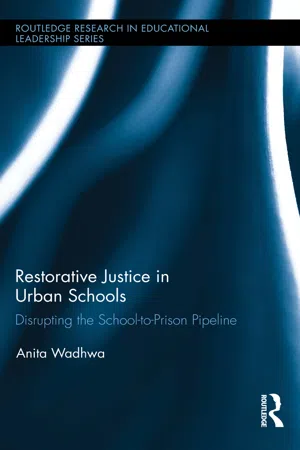
The school-to-prison pipeline is often the path for marginalized students, particularly black males, who are three times as likely to be suspended as White students. This volume provides an ethnographic portrait of how educators can implement restorative justice to build positive school cultures and address disciplinary problems in a more corrective and less punitive manner. Looking at the school-to-prison pipeline in a historical context, it analyzes current issues facing schools and communities and ways that restorative justice can improve behavior and academic achievement. By practicing a critical restorative justice, educators can reduce the domino effect between suspension and incarceration and foster a more inclusive school climate.
eBook - ePub
Restorative Justice in Urban Schools
Disrupting the School-to-Prison Pipeline
- 170 pages
- English
- ePUB (mobile friendly)
- Available on iOS & Android
eBook - ePub
About this book
Information
1 Restorative Justice and the School-to-Prison Pipeline
I wake up and smile cuz [sic] I got all my close peoples but it saddens me that most corrupted by pure evil and most falsely incarcerated by crooked racist laws where the only freedom comes from walking county halls or doin’ years in the pen hopin’ to make that first parole we live the daily life that people hope they’ll never know dis the life we live and was warned about the life teachers and parents said don’t go down that route . . .
—from “Do you know” by Martin Garcia, former student
For four years, Martin Garcia was incarcerated. Teachers aren’t supposed to have favorites, but he was one of mine. When I think of our relationship, one of my first memories is of him arguing with me more than a decade ago. I can transport myself to my old stomping grounds, my classroom on the third floor of Lee High School in Houston, Texas, and visualize it immediately. I sit on a stool by the chalkboard at the front of a first-period ninth-grade English class, clutching a thin, green, spiral-bound attendance book. It is October 2002, and I am a second-year teacher. The room is spacious. It is bound by three walls with chalkboards and one wall with windows that look out on a small, concrete courtyard. Books populate every corner, from the windowsills to the blonde wooden bookshelves that span the back of the classroom. The floors are slick from a dysfunctional air-conditioning system that spews fetid mist, and above this din I can barely detect the presence of students, some of whom pick at English muffins provided by the school breakfast program and some of whom write in their journals.
My eyes flit to each desk as I mark who is present. Martin Garcia has once again slipped out of his front-row seat to the back of the classroom. Like most of his peers, his head is down, eyes concentrated on a black composition book. Suddenly he gazes up at the journal topic written on the chalkboard behind me. He sees me, and I raise my eyebrows, tilting my head toward his empty seat. He sighs, folds his arms, and does not move. We have played this game for the past five days. I walk to the back of the classroom and kneel down next to him.
“I’m not going to tell you to move every day,” I say.
I gaze at him sternly. Martin has failed ninth grade and is larger and taller than the other students. In the hallways, he strolls to class, occasionally tugging at pants that are oversized even by the standards of his peers. He has dark, narrow eyes and full cheeks. He looks defeated, eyes downcast while he speaks.
“Why won’t you let me sit here?” he implores in a quiet and strained voice.
In a class of only 15 students, it makes no sense for him to sit four rows behind everyone else. I worry that he is trying to separate himself because he is either ashamed that he is repeating ninth grade or because he wants to project a tough image—or both.
“It’s easier for me to keep track of your progress if you sit in the front.”
“I’m failing this class anyway, so what does it matter?” He eyes the linoleum floor.
Martin makes this claim on a weekly basis. Every Friday I hand out weekly progress reports, yet he does not believe them. I consistently compliment him on the poetry he writes in his journal through long, scribbled responses. He completes his work with minimal effort, so I try to challenge him with modified assignments. He reads whatever I recommend from the classroom library—most recently, the complete works of Kafka.
“What are you talking about?” I say. “I just updated the grades. You have an 83!”
“I do?”
“Yes. Now why are you so bent on sitting all the way in the back?”
“I told the other teachers, but no one believes me,” he says. “I don’t have glasses, so I can’t see. I’m farsighted or nearsighted—I can’t remember which.”
I throw up my hands. Journal time is up, and although students are still writing, we are wasting precious learning time.
“Why didn’t you just tell me that? You could have saved us from all this arguing. Of course you can sit in the back.”
He lifts up an eyebrow. “I can?”
“Yes, I trust you. Don’t you already know that?”
He does not. Despite his looming stature, and no matter how much I have praised him, inside he is a small child in need of affirmation. I regret that I have not praised him more.
“Well, you kept yelling at me telling me to sit up there when I didn’t want to . . .”
“If I yell at you, it’s not because I don’t like you Martin,” I say. “It’s because I love you.” “Oh,” says Martin. He is silent for several seconds.
I pat him on the back. “Keep writing, and stop complaining.”
This conversation marked a turning point in my relationship with Martin. Though he continued to doubt his academic potential, he did well in my class. I incorrectly assumed that his experience in my class was a watershed moment and that he would continue to be successful for the rest of his high school career. Consumed by a new batch of students, I could not track him the following year as he disengaged from his classes, verbally battled teachers, skipped school, and failed 10th grade. He hid—or perhaps none of us teachers noticed—a severe bout of depression. He even tried to commit suicide, after which all seven of his high school teachers sat in student desks, huddled in a circle around him during our lunch period, bearing witness to the white gauze wrapped around his wrists. We begged him to come to us to work through any of his problems, and he solemnly agreed. He was referred for counseling, though he never took advantage of it, and we made a collective effort to check in with him more often throughout the year.
Regardless of this and other interventions, we could not control his life outside of school or protect him from the loss of his friends to street-related violence. Later he told me that his grief manifested into anger that erupted in fights in the hallways, leading to suspension after suspension.
At our school, we had a dictum for students like Martin: “Write them up until they go to CEP,” or Community Education Partners, the local alternative school known on the street as Children Entering Prison—a school where students were clustered with peers who had committed violent acts, profited from selling drugs, or behaved unruly in school. In 2007, police arrested him for sticking someone up. In a letter he explained to me that he carried weapons because of “paranoia” that members of a certain gang were after him and described how he got arrested:
The very night before I pulled the gun, I had been robbed at gunpoint and I had already decided to chill and not mess with [the other gang] anymore because one of my closest friends got pistol whipped and they broke his jaw and he begged me not to do anything and stop messing with them. So I agreed. After that night . . . I’m [driving] close to where I live and some guy cuts me off right in front of where I live. I spin to avoid hitting a light pole and I regain control. He stopped and [I] pulled right behind him and before he could do anything, I put the gun in his face.
After being put on probation, he returned to school and immersed himself in old patterns: boasting about his arrest, getting into fights, refusing to do work, and cycling through numerous suspensions. Years later he told me the he would attend my class first period then leave and take off with his friends to Galveston and hang out at the beach all day. The school began issuing him truancy tickets, and he failed to appear in court. He became further ensnared in gang life. The summer of 2008 at age 19, he was half a credit away from graduating and planned on taking summer school. Before the summer session began, he was sent to prison when he violated his parole by brandishing a knife during a fight—though he tells me he never had a weapon and that he was framed by five people from an opposing gang who jumped him.
The myriad pivot points that could have kept Martin engaged in school and out of jail are difficult to disentangle. Martin was not a pinball shuttled around by friends, siblings, teachers, administrators, police, judges and enemy gang members in a game whose final destinations was either school or prison. He made the choice to do or not do work, to ally himself with gang members, and to place himself in areas and around people who made him more vulnerable to attack from opposing gangs. But I can still conjecture that institutional policies, attitudes and “ordinary acts taken by educators on a daily basis” (Pollock, 2008, p. xvii) contributed to not only his successes along the way but also his ejection from school. Such factors included the practice of saddling teachers in small learning communities with multiple class preparations, such that several of us spent more time developing curriculum, grading, and fulfilling administrative tasks than developing relationships with students; the biases of some of those teachers, fed up with Martin’s indifferent demeanor, who believed he would never graduate; and a lack of viable alternatives to suspension and expulsion, save a disciplinary alternative school described by the American Civil Liberties Union as a “warehouse for poor children of color” (Plocek, 2008). And I cannot help but feel that the confluence of these acts pushed him one step closer to an inevitable path to prison where he sat until 2012, at the age of 24.
The School-to-Prison Pipeline
For students like Martin, disciplinary practices such as suspension and expulsion have the capability to reduce the chances of graduating, becoming employed and engaging with the broader community in positive ways. When I heard from a former colleague that Martin was in prison, I wrote him, unsure whether he would respond. Martin and I kept in touch through monthly letters. I sent him books that I thought he should read, and he sent me poems and asked that I provide feedback so that he could become a better writer. In one of his letters Martin wrote, “I’d like to really believe in my heart that if you would have had more resources you would have done a lot more for us. You did your best though, even with the scraps you were given, and some of us loved you for it. I did and I do.” Martin wasn’t just writing about himself but of a collective “us,” others like him who were defiant in school, faced similar hardships, dropped out—and some who also went to prison.
I had not heard of the “school-to-prison pipeline” until I came to graduate school, but the phrase, which describes the phenomenon in which students who are repeatedly suspended and expelled have an increased likelihood of dropping out of school and ending up in the justice system (Fasching-Varner, Martin, Mitchell, & Bennett-Haron, 2014; Ladson-Billings, 2001; Sandler, Wong, Morales, & Patel, 2000; Wald & Losen, 2003), seemed an apt metaphor for Martin’s situation. Nationwide, students with disabilities and Black1 students are overwhelmingly affected by this pipeline and are disproportionately suspended when compared to their White peers (Gregory, Skiba, & Noguera, 2010; Jordan & Bulent, 2009). The data on disproportionality for Latino students is sometimes less consistent (Skiba, 2001, p. 166), although a study of 364 elementary and middle schools in 2005 and 2006 revealed that both Black and Latino students were overrepresented in school suspensions and expulsions for displaying the same behaviors as their White counterparts (Skiba et al., 2011). A data snapshot (OCR, 2014) of 49 million students from every public school in the U.S. found that Native American students are also disproportionately suspended and expelled. This occurrence that has been dubbed the “racial discipline gap” (Gregory et al., 2010, p. 59).
The Racial Discipline Gap and Zero Tolerance
The racial discipline gap was first documented in 1975 when the Children’s Defense Fund found that suspension rates for Black students were two to three times those of White students (Skiba, 2001, p. 177). More than 30 years later, the gap persists. In 2007, Black students comprised only 17 percent of the public school population, yet 49 percent of Black males in Grades 6 through 12 reported being suspended at least once in their lives (National Center for Education Statistics, 2008). By contrast, White students comprised 56 percent of the population that same year, yet only 21 percent of White males in Grades 6 through 12 reported being suspended. Gregory et al. (2010) suggest that the discipline gap and achievement gap are “two sides of the same coin”; students who are repeatedly suspended miss important instructional time, can become more disengaged in school and are more likely to participate in illegal activities and eventually drop out (p. 60).
The use of suspension and expulsion as the primary modes of discipline are rooted in zero tolerance, defined by the U.S. Department of Education as a policy that “mandates predetermined consequences or punishments for specific offenses” (as quoted in Boyd, 2009, p. 573). Zero tolerance can be traced to drug enforcement policies of the 1980s, when the approach was used preemptively to prevent the expansion of drug cartels by punishing “all offenses severely, no matter how minor” (Skiba & Peterson, 1999, p. 372). The U.S. customs agency first used zero tolerance during the Reagan era to penalize cocaine, heroin and marijuana traffickers (Giroux, 2001; Martinez, 2009).
Due to mounting pressure to end the punitive policies of seizing ships, passports and private property from individuals found with even minute amounts of drugs, the U.S. Customs agency officially ended its zero tolerance policy in 1990. However, the concept had taken hold in other arenas of society: zero tolerance policies emerged in schools in the early 1990s in response to high-profile school shootings and a general fear that drug use and violence were rampant in schools (Skiba & Peterson, 1999). The Clinton administration passed the federal Gun-Free Schools Act in October 1994, which made it mandatory for administrators to expel a student who brought firearms on campus for a minimum of one year (Casella, 2003, p. 874). Schools that did not comply with the directive were denied federal funding. Following the Columbine2 shootings in 1999, administrators broadened the federal mandate of zero tolerance by expelling students for drug and alcohol use and fighting (p. 875). After 1995, zero tolerance expanded when the Gun-Free Schools Act was amended so that the word “firearms” was replaced with “weapons,” which allowed administrators to expel students who had “nail clippers, files, and pocket knives” (p. 874).
Zero tolerance has since become the de facto policy for dealing with school discipline nationwide (Blumenson & Nilsen, 2002; Gregory et al., 2010). For more than 15 years the policy has come under much scrutiny for its use in relatively minor incidents: under one school’s drug policy, two fifth graders were suspended four days for using a nasal spray inhaler (Willis, 2012); under a weapons policy, a high schooler was suspended when he brought a knife to school for a demonstration on healthy school eating (WOIW, 2014); and a teenager who posed in a photo with the number three—his football jersey number—was indefinitely suspended for presumed gang involvement (Aronowitz, 2014).
Due to the excessive reliance on suspension, exclusionary practices have increased multifold across the country; since 1973, the number of students suspended annually has more than doubled to 3.3 million (Dignity in Schools, 2009). In Chicago, expulsion increased by 3,000 percent “from 21 in 1994–95 to 668 in 1997–98,” while suspensions increased 51 percent during the same time (Michie, as quoted in Giroux, 2001).
School districts’ reliance on zero tolerance might be more understandable if the policy curbed or improved behaviors such as truancy, fighting and verbal disrespect—behaviors that administrators have reported as the most prevalent and worrisome in their day-to-day school experiences (Heaviside, Rowand, Williams, & Farris, 1996). However, a substantial body of literature points to the failure of zero tolerance to create safer schools or improve student behavior (APA Zero Tolerance Task Force, 2006; Dignity in Schools, 2009; Gregory & Cornell, 2009; Martinez, 2009; Skiba & Peterson, 1999). As Martinez (2009) explains, “If zero-tolerance is truly an effective deterrent, then it would be expected that there should be a reduction in the use of suspensio...
Table of contents
- Cover
- Title
- Copyright
- Contents
- Foreword
- Preface
- Acknowledgments
- 1 Restorative Justice and the School-to-Prison Pipeline
- 2 The Intersection of Race and Punishment in Schools
- 3 Research Design and Methodology
- 4 "Evolution, Not Revolution": Restorative Justice from the Ground Up
- 5 The Evolution Continues: Reseeding Restorative Justice through Talking Circles
- 6 "I Am Not Extraordinary": Janet Connors and the Role of Community Members in Restorative Justice
- 7 "Turning the Paradigm on Its Side": Youth–Adult Power Dynamics in a Student Apprenticeship Model of Restorative Justice
- 8 Doing Discipline in Circles: The Developmental Challenges of Restorative Justice
- 9 The Bridge to Equity: Lessons for Implementing Critical Restorative Justice in Urban Schools
- Epilogue
- References
- Index
Trusted by 375,005 students
Access to over 1.5 million titles for a fair monthly price.
Study more efficiently using our study tools.
Frequently asked questions
Yes, you can cancel anytime from the Subscription tab in your account settings on the Perlego website. Your subscription will stay active until the end of your current billing period. Learn how to cancel your subscription
No, books cannot be downloaded as external files, such as PDFs, for use outside of Perlego. However, you can download books within the Perlego app for offline reading on mobile or tablet. Learn how to download books offline
Perlego offers two plans: Essential and Complete
- Essential is ideal for learners and professionals who enjoy exploring a wide range of subjects. Access the Essential Library with 800,000+ trusted titles and best-sellers across business, personal growth, and the humanities. Includes unlimited reading time and Standard Read Aloud voice.
- Complete: Perfect for advanced learners and researchers needing full, unrestricted access. Unlock 1.5M+ books across hundreds of subjects, including academic and specialized titles. The Complete Plan also includes advanced features like Premium Read Aloud and Research Assistant.
We are an online textbook subscription service, where you can get access to an entire online library for less than the price of a single book per month. With over 1.5 million books across 990+ topics, we’ve got you covered! Learn about our mission
Look out for the read-aloud symbol on your next book to see if you can listen to it. The read-aloud tool reads text aloud for you, highlighting the text as it is being read. You can pause it, speed it up and slow it down. Learn more about Read Aloud
Yes! You can use the Perlego app on both iOS and Android devices to read anytime, anywhere — even offline. Perfect for commutes or when you’re on the go.
Please note we cannot support devices running on iOS 13 and Android 7 or earlier. Learn more about using the app
Please note we cannot support devices running on iOS 13 and Android 7 or earlier. Learn more about using the app
Yes, you can access Restorative Justice in Urban Schools by Anita Wadhwa in PDF and/or ePUB format, as well as other popular books in Education & Education General. We have over 1.5 million books available in our catalogue for you to explore.