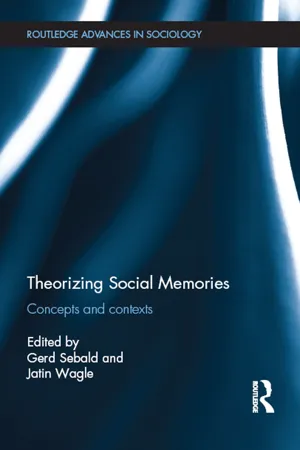
Public debates over the last two decades about social memories, about how as societies we remember, make sense of, and even imagine and invent, our collective pasts suggest that grand narratives have been abandoned for numerous little stories that contest the unified visions of the past. But, while focusing on the diversity of social remembering, these fragmentary accounts have also revealed the fault-lines within the theoretical terrain of memory studies. This critical anthology seeks to bridge these rifts and breaks within the contemporary theoretical landscape by addressing the pressing issues of social differentiation and forgetting as also the relatively unexplored futuristic aspect of social memories. Arranged in four thematic sections which focus on the concepts, temporalities, functions and contexts of social memories, this book includes essays that range across disciplines and present a variety of theoretical approaches, from phenomenological sociology and systems theory to biography research and post-colonialism.
eBook - ePub
Theorizing Social Memories
Concepts and Contexts
- 214 pages
- English
- ePUB (mobile friendly)
- Available on iOS & Android
eBook - ePub
About this book
Information
I Concepts
1 Lifeworld and trauma
Selectivity of social memories
DOI: 10.4324/9781315887111-2
Levels of meaning-formation [Sinnbildung] in the lifeworld and their selectivity
Husserl's emphasis (1970) on the natural attitude1 as the original condition in which the world acquires its layer of meaning and becomes the lifeworld of the human being has lent the concept of the lifeworld a positive character. However, in the judgment of some of the later thinkers this characterization appears to have been too positive. This assessment often accompanies the charge that the concept tends to prematurely conceal the problematic facets of the social reality. Therefore, for Habermas the lifeworld appears to be a concept that draws on ancient forms of consensual communication and thus does not suffice for the analysis of modern societies (Habermas 1981: 182–228). For Bourdieu (1976: 146–160), anchoring the sociological analyses methodologically in the structures of the lifeworld implies relinquishing the possibility of transcending the societal everyday life and subjecting it to a critical, scientific examination. But, does a phenomenological analysis of the lifeworld have to necessarily lead to such outcomes? Is the lifeworld such an innocuous location?2 I seek to answer this question by attempting to show that one of the crucial aspects shaping the structure of the lifeworld consists of selective mechanisms which constitute meaning, and which accords this structure its particular empirical form.
Helmuth Plessner (1931) had already deemed selectivity to be a constitutive moment of the conditio humana, when he realized that due to their biological blueprint Homo sapiens were compelled to forge their approach to the world on their own. In this sense, human beings are virtually “condemned” to choose from the possible courses of action open to them and to join them to self-created programs. Therein lies the natural artificiality of their world, whose apparently immediate presence opens up to them only in this mediated manner through this self-programming. The process of self-programming can then be conceived as the constitution of meaning, the way for instance Luhmann (1995: 59–60; 1996) does with reference to Husserl, when he conceives meaning as a context of references that is generated through the differentiation between the realized and potential possibilities. The results of this self-programming through the constitution of meaning represent what we know as the variety of human culture. Accordingly, it is only through the varying cultural contexts of references that particular phenomena acquire their meaning. Thus, it is evident that the processes which select and constitute meaning determine not only the approach to the world in a universal anthropological manner, but that they are also crucial for its cultural conditioning.
This finding raises at least two questions. The first pertains to the mechanisms of selection that are at work on the self-programming, while the second concerns the processes of sedimentation as well as retention of the results of this selectivity that draws on that which is experienced. In order to answer these questions one could record the traces arranged in a range of approaches that converge in some essential respects, depending on the implications of the object at hand. Following the structuralist viewpoint, arrived at via research in linguistics (Jakobson and Waugh 1987; Lévi-Strauss 1971), the infinitely varying surface of the meaningful world points to a finite number of elements and generating mechanisms, and it is through their combinations that the diversity of mundane universes of meaning [Sinnwelten] comes into being. Here, the linguistic semiosis functions as a generalizable model of symbolic selectivity: only if from a limited number of phonemes that are possible within a natural language combinations emerge which in turn become capable of carrying meaning, do sounds turn into carriers of meaning whose variation leads to a diversity of cultural forms. Thus, the crucial process of meaning-formation in this regard lies in a specification through which a particular (sound) element is accorded a particular horizon of meaning or a scheme of references through which it differentiates itself from other elements. However, Husserl's (1968; 1999) phenomenological analyses point out that such meaning-formation via difference can only take place when the carrier unit itself is grasped in its typical form that constitutes its consistently recognizable identity.
Without stepping into the debate kicked off by Derrida (1976) about the primacy of difference or identity, it can be gathered that here we are dealing with a context of meaning generation, where selection mechanisms are located at different levels, and, moreover, work in varied manners. We can assume that the different levels correspond to different processes of sedimentation and to locations retaining the generated meaning, which have their own characteristic potentials of selectivity. The systematic correlation between meaning generation and retention in the process of self-programming of individuals and social formations is depicted in its entire range by the general system theory (Bertalanffy 1968), as it simply points out that information in systems can only be effective over a longer term if it is stored somewhere. Therefore, the mode in which generated meaning becomes effective for the self-programming of individuals and social formations depends on the manner of its retention. Thus, the question regarding the functionality and form of social memory stops being merely a matter of aesthetic interest, but leads to the central processes of self-organization of individuals and society. In this context the forms of selectivity in meaning-formation are of particular interest.
Let us now turn to the context of meaning generation and its mechanisms of selection. We could distinguish between four levels of the context of meaning generation within the social reality (Srubar 2009a):
- Firstly, there is the level of the subjective constitution of meaning, i.e. those acts of consciousness that constitute reality with their temporality and intentionality as well as corporeality.
- Another level represents the temporal, spatial and social structure of the pragmatically generated world of working [Wirkwelt], with its variations and its diversification in manifold layers of meaning.
- The third level is formed by the systems of signs and their structure, which is manifested in varied semantics and media.
- Lastly, there is the level of communicative interaction and the discourses.
Before proceeding to discuss the individual levels, I would like to provide a short overview of their correlation. The intentionality of the stream of experience and the acts of consciousness that inform it, through which we perceive the world, would be as it were placeless [ortlos], if the processes of consciousness were not moored through the body and the corporality in the world. The corporal experience of the world can, however, be traced back to the working of the body in the world and therefore to action. The part of action in the constitution of reality is equally constitutive of meaning as that of the consciousness itself. Acting in the world entails an interaction with objects and with others, which has to be grasped as communication; however, a communication that can have a non-semiotic as well as semiotic character (Srubar 2012). Thus, actions acquire a character not only in terms of the generation of reality, but also in terms of signification, involving a complex semiotic order of the social reality, which in turn is based on systems of signs. On their part, systems of signs are tied to a variety of materials and vehicles for their realization, i.e. they realize themselves in varied media. The pragmatically generated knowledge, which is sedimented bodily and within the consciousness as well as in the systems of signs and in media, is characterized by different perspectives due to its genesis, since the pragmatic relevancies of individual and collective actors assume different forms. The outcome in this regard is not only a diversity of cultural forms, but also a form of knowledge production that on the one hand preserves knowledge in perpetuity, and on the other separates legitimate knowledge from the illegitimate. Thus, the discourses of power, within which this comes to pass, represent a formal mechanism of the structure of the lifeworld, in which the empirical form of a cultural world is generated.
All these levels manifest specific forms of selectivity. In order to distinguish between them, it would be useful to take a closer look at the concept of meaning-forming selectivity in general. At first glance, the selectivity of meaning-formation seems to refer to the unavoidable constructedness that characterizes the manner in which the world is present for the humankind as suggested by Plessner's concept of “mediated immediacy” (Plessner 1931: 321–330). In more recent discussions regarding the problematics, this view figures as the “primacy of mediation” (Gumbrecht: 2007), and has been interpreted in terms of Derrida's well-known concept of “différance” (1990) in the sense of the primacy of semiosis. However, the distinction between the semiotic and the typifying meaning-formation, which was made by Husserl and which Derrida attempted to reverse through his critique, shows us that there evidently exist meaning-forming selection mechanisms that cannot be subsumed under the category of “mediation.” In fact, considerable differences can be detected between the selectivity that is characteristic of the formation of types and that of symbolic representation. In accordance with Husserl (1973), one could view the formation of types as a fundamental process of selection that is situated at the level of the subjective constitution of meaning. The formation of types is tied to the structure of the intended object, which in turn is involved in the meaning-forming selection of the characteristics of the type. Therefore, the type is not necessarily a mediatized construction, even as it does not grasp one to one the object in its complete fullness. Thus, the formation of types is basically also possible in a non-semiotic manner. The sensomotoric recognition of the object within one's hand–eye field, i.e. within the manipulatory area, takes place during the interaction and communication with the object, during which it conveys its typical characteristics. However, the correlation of these qualities, comprising the typical structure of the object and enabling its recognition, does not represent an arbitrary sign. The acts of selection, which separate the essentially typical from the inessential atypical aspects of the object and thus make for its recognizable structure, do not lie in the arbitrary connection between the signifier and the signified, but are materially bound on the one hand to the object itself and on the other to its primary interpreter, i.e. the body. As a matter of course, the processes of typification similarly advance over various levels of abstraction and also grasp, as Husserl (1973: 261–264) demonstrates, ideational objects as contents purely of the consciousness. Nonetheless, the bond of meaning-formation to the structure of the intended object remains intact. Thus, the relation between the corporal as well as cognitive relevancies of the subject and the interactively experienced characteristics of the object represents the selection mechanism that bears typification.
This relation realizes itself during the interaction with the object. On the one hand, it is open to the learning that accompanies creativity of action (Joas 1992). Since typifications preserve the identity of the object by projecting its structure, once gleaned, as an expectation into the future, this structure is also retrospectively modifiable, i.e. from the perspective of its fulfilment or non-fulfilment in the corresponding “now and thus.” The thematic as well as interpretative and motivational relevancies that are typically linked to this structure are then preserved in the action virtually on recall, where the structures of relevancy which emerge in the current situation function as selective filters. However, the plasticity of the formation of types that is bound to the temporality of the consciousness stands opposed to the material structure of its object, which does not allow for a random variation of the type. This power of persistence of typification, which can be experienced and lived through the body, stems from its ability to inscribe itself as habitus in the orientation of meaning that guides action. This process of sedimentation entails conditioning of the body, manifesting itself in the incorporated patterns of behavior and action, which I wish to term here as routines. But, through this process it is also present in those cognitive structures, from which stabilized expectations result, and which then possess the character of prejudices. Since such patterns and expectations stand for the stability of the environment of the subject, there often exists an emotional bond with them and their fulfilment, which Gehlen (1975: 50–75) has described as “background fulfilment” [Hintergrundserfüllung].
The effects caused by the meaning selection of the bodily habitus as well as by the prejudice-like expectations are quite evident. Incorporated typifications, sedimented as pre-reflexive courses of actions, cannot be unlearned through reflection and can at best be deroutinized, i.e. overlaid through the habituation of other activities (Bourdieu 1976). Whereas the process of typification is focused on the material structure of the intended object in the case of routines, it is replaced by the symbolic representation of such a structure in the case of prejudice formation. Even semiotically constructed typifications can be incorporated in this manner and without any contact with the intended object stand for its identity. The subjectively experienced, corporal-emotional bonding with such typifications often affords them the character of action-oriented values, which are then, according to Heidegger (1967), embedded in the fundamental disposition [Grundbefindlichkeit] of the subject. Wuthnow (1989) terms such...
Table of contents
- Cover
- Half Title Page
- Title Page
- Copyright Page
- Table of Contents
- Contributors
- Theorizing social memories: an introduction
- PART I Concepts
- PART II Temporalities
- PART III Functions
- PART IV Contexts
- Index
Trusted by 375,005 students
Access to over 1.5 million titles for a fair monthly price.
Study more efficiently using our study tools.
Frequently asked questions
Yes, you can cancel anytime from the Subscription tab in your account settings on the Perlego website. Your subscription will stay active until the end of your current billing period. Learn how to cancel your subscription
No, books cannot be downloaded as external files, such as PDFs, for use outside of Perlego. However, you can download books within the Perlego app for offline reading on mobile or tablet. Learn how to download books offline
Perlego offers two plans: Essential and Complete
- Essential is ideal for learners and professionals who enjoy exploring a wide range of subjects. Access the Essential Library with 800,000+ trusted titles and best-sellers across business, personal growth, and the humanities. Includes unlimited reading time and Standard Read Aloud voice.
- Complete: Perfect for advanced learners and researchers needing full, unrestricted access. Unlock 1.5M+ books across hundreds of subjects, including academic and specialized titles. The Complete Plan also includes advanced features like Premium Read Aloud and Research Assistant.
We are an online textbook subscription service, where you can get access to an entire online library for less than the price of a single book per month. With over 1.5 million books across 990+ topics, we’ve got you covered! Learn about our mission
Look out for the read-aloud symbol on your next book to see if you can listen to it. The read-aloud tool reads text aloud for you, highlighting the text as it is being read. You can pause it, speed it up and slow it down. Learn more about Read Aloud
Yes! You can use the Perlego app on both iOS and Android devices to read anytime, anywhere — even offline. Perfect for commutes or when you’re on the go.
Please note we cannot support devices running on iOS 13 and Android 7 or earlier. Learn more about using the app
Please note we cannot support devices running on iOS 13 and Android 7 or earlier. Learn more about using the app
Yes, you can access Theorizing Social Memories by Gerd Sebald, Jatin Wagle, Gerd Sebald,Jatin Wagle in PDF and/or ePUB format, as well as other popular books in Social Sciences & Sociology. We have over 1.5 million books available in our catalogue for you to explore.