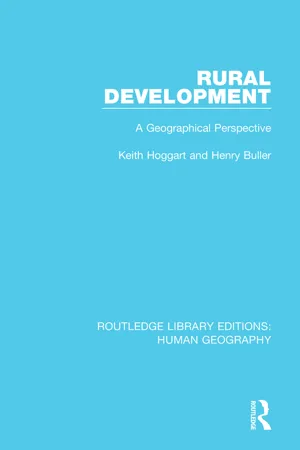
This book, originally published in 1987, provides an integrative, analytical aproach to rural areas in advanced economies. Causation and the consequences of societal change have been emphasised, in a framework which draws out processes which oeprate at different geographical scales (and with varying intensities across space).
- 318 pages
- English
- ePUB (mobile friendly)
- Available on iOS & Android
eBook - ePub
Chapter One
Introduction
Rural life and society is too often the subject of sentimental commentary. This is found in the writings of academics as much as non-academics. As W J Keith (1974:43) noted for prose on the English countryside:
We tend unconsciously to think of the countryman as a quaint survivor of an earlier stage in the world's evolution - as Hedge, the rustic 'clown', the yokel with straw in his mouth. Once the point is made in these extreme terms, of course, its absurdity becomes immediately apparent, but it is important that we recognise this temptation to think in stereotypes. Any serious discussion of rural life and literature must begin by ting and analysing our conventional attitudes to the subject.
It is not difficult to explain the quaintness of rural descriptions. In Britain in particular the general population has long held to romanticised images of rurality. The popularity of 'the cause' is seen in newspaper campaigns to 'save the countryside' against 'destruction' (e.g. The Observer Magazine 9 December 1984; see also Youngs 1985). In many nations this sentiment is evinced in the titles and arguments of books which 'attack' modern rural practices (e. g. Jim Hightower's ( 1973) Hard Tomatoes, Hard Times; Marion Shoard' s (1980) The Theft of the Countryside; and Richard Body's (1983) Agriculture: The Triumph and the Shame) • Advertisers likewise play on people's sentimentality to invoke associations between their product and 'the good life' of rural comnunities (Bouquet 1981; Goldman and Dickens 1983). That social researchers also appear prone to project romantic idealisations (Bernard 1973) is no doubt due to the comparatively slight theoretical advances of rural studies (and their seeming isolation from 'urban' theoretical insights). Certainly we are frequently told that rural analyses (in whatever discipline) are retarded in comparison with their urban counterparts (e. g. Bradley and Lowe 1984).
There are perhaps three main roots to the relative weakness of rural studies. First, there is the long and lingering adherence to notions of a rural-urban continuum. True, this is no longer accepted in its extrene form, for the vitality of critiques like Pahl's (1966) are well recognised. Yet the implication that rural areas are poorly integrated into, and slow to catch up with, dominant urban-centred activities is still present in much rural writing. Urban practices are seen to have 'penetrated' rural areas, whether in the economy (Berry 1970), in social values (Fischer 1975) or in political behaviour (Johnson 1972). The underlying implication is that rural areas are acted upon by urban forces; that resistance to change is endemic within the countryside (hence some analysts still distinguish rurality by residents' adherence to traditional values and attitudes - see Pacione 1984:3). Integral to this inage is the ideal of the rural community. This concept provides a boundless vestibule for over-idealised conmentary. The community, as Effrat (1974:2) observed, is like 'motherhood and apple pie' in that '... it is considered synonymrus with virtue and desirability'. Indeed, even in its definition, there is a problem ' ... in separating the content of the conception from the value-laden imagery of warmth and camaraderie attached to it in many cases'. The purported existence of autonomous village cormnunities, now breaking down under the impress of urban impulses, has induced nostalgic and prescriptive accounts of rural affairs (e.g. Ewart-Evans 1956). These start from an assumption of rural distinctiveness. Thus, in rural sociology, class and community have commonly been taken as polar opposites. Unlike their urban counterparts, rural social divisions have been ascribed primarily to status rather than class (Newby 1980). If this view is accepted, it is easy to find sore justification for examining rural localities using distinctive methodological, theoretical and, to some extent, even conceptual franeworks.
Leading on from this first source of weakness, rural studies have over-emphasised issues connected with the consumption (or consequences) of socio-economic change. Apart from investigations of agricultural production per se, extremely little attention has been given to the production of socio-ecooomic or other changes in rural areas. Thus, while studies of rural industrialisation have recently become popular, this owes much to the decline in urban manufacturing (e.g. Fothergill and Gudgin 1982; Keeble 1984); prior to this rural analysts were less concerned with the determinants of rural (industrial ) production than they were with the consequences of that production - as seen through the narrow questlon of local multiplier effects (cf. Summers et al 1976). Insights on processes of rural industrialisation, as opposed to their impacts on single localities, rrust still largely be culled from regional accounts of industrial change (e.g. Cobb 1982). Similar biases towards consumption-related issues are found for other activity spheres. With reference to service provision, for example, innumerable accounts exist of cuts in public transport routes, school closures, loss of village shops and the centralisation of health facilities. We kmow who loses most from these events and, to some extent, why they lose most. Comparatively little has been written abrut why such losses occur. Often in fact causation has been treated as if it were a 'natural' process; as an inevitable rutcome of modernisation or economic advancement. At the same time, studies of agricultural production have been severely weakened by a mythological screen in which the family farm and a competitive, free-enterprise ecommy is pictured to be dominant in production relationships (Vogeler 1981). Even when production is emphasised, therefore, what drives and determines societal change in rural environments has been insufficiently grasped. Instead, research has concentrated upon the consequences of broader societal changes for rural residents.
A third weakness in rural investigations stems from the separation of agricultural concerns from 'other' issues (these are often referred to as 'rural development' issues; Copp 1972; Buttel 1982). In studies of agriculture there has been an emphasis on questions of production; these have largely been linked to issues of innovation diffusion, productive efficiency and farm structure. Yet with few exceptions (e.g. Heffernan 1972), how these affect rural localities in general has rarely been analysed. This bias is even evident in government policy, for a clear separation of agricultural (production) and other rural policy-making is prevalent in many nations (Buttel 1982). Recent years have seen a closing of the gap between these two; though this has occurred over a quite narrow range of subjects (these overwhelmingly being concerned with landscape issues - e.g. Bowers and Cheshire 1983). Predominantly rural studies remain sectionalised into either production oriented investigations of agricultural systems or more consumption related socio-ecommic descriptions of settlement systems. '!he twain rreet with insufficient regularity.
When accompanied by the apparent willingness of rural researchers to treat their study sites as isolated entities (or at least as unique locales experiencing 'urbanisation'), the scene is set for an untheoretised, descriptive research agenda. This is precisely what we have in too many areas of rural research and particularly in rural geography (e.g. Clark 1982). Some writers appear to make a virtue out of their supposedly atheoretical stance. For example, in Ambrose's (1974) The Quiet Revolution: Social Change in a Sussex Vilage 1871-1971, he describes the boo in these terms: 'It tries to depict the reality not in any particular way but just to depict it' (p.xiii). Ambrose goes further in refusing to use the word 'class' since people vary in infinitely complex ways and the '••• usual attempt to order them into a limited number of categories is analytically imprecise, socially divisive and has outlived its political usefulness' (p.xiii). This is a peculiar commentary from someone who a year later published a book on urban areas (The Property Machine) with a clear class-theoretical, and even conspiratorial, overtone (Ambrose and Colenutt 1975). Class and theory are, implicitly at least, only of urban interest. Given the descriptive thrust of The Quiet Revolution, compared with the explanatory intentions of The Property Machine, we could also assume that studying causation is solely an urban issue as well. This is not to say that rural analysts have not recognised the need to investigate causation, nor have they failed to identify appropriate concepts. In a recent text on rural geography, for example, Michael Pacione (1984:7) informed us that:
The final chapter of the book is concerned with the fundamental concept of power ... The revealed redistributive effects of rural decision-making processes underlines the conclusion that to comprehend contemporary rural society fully it is essential to understand the locus and exercise of power.
Why then, if political power is so fundamental to understand ing contemporary rural society, does Pacione relegate its investigation to a final (almost tacked-on) chapter? Surely the very importance of power relations lies in the fact that they infiltrate every aspect of rural society. Hence, they must be integral to every chapter, not isolated into ore.
fundamental problems in rural studies arise from the weakness of a causal imperative in research frameworks and, where explanation is sought, the individualised nature of accounting frameworks (i.e. their poor links with broader social theory). This is not simply a problem in rural geography, for it exists in a variety of disciplinary approaches to the countryside (e.g. Newby 1983). An outcome of romanticised conceptions of rurality, seen particularly through notions of autonomous village communities, is a reluctance to theorise or generalise. The acceptance of localised communities as the societal core of rural areas has distracted analysts from the role of formal institutions and broader social forces. The idealisation of community as totality, requiring detailed investigation to elucidate its dimensions, has produced a mountain of tmique accounts which seemingly defy either abstract theorising or generalisation. By contrast urbanists have been only too inclined to generalise. All too conmonly we are told that we live in an urban society, where country areas can conveniently be compartmentalised into urban-centred regions and hence are 'urban' (e.g. Berry 1970; Simmons 1976). This is not a new phenomenon. What notably distinguished the earliest 'rural' community studies (the Lynds' Middletown) from their urban contemporaries (Park's Chicago investigations) was that while Park never ceased to generalise, the Lynds' consistently refused to do so (see Stein 1972). Urbanists have been prone to wrest any international, national, regional or local factor they happen upon and label it 'urban'. Rural investigators have too corrmonly shied away from all but the local. This division is of course a false one. There are no 'urban' forces, neither are there 'rural' ones. Social agents act, not geographical areas. Certainly, particular processes and patterns of behavioor are more common in urban than in rural areas, but they are neither 'urban' nor 'rural' per se. Social differentiation exists in both urban and rural environments. These are not distinct entities, but their dissimilar spatial structures can induce differences in social behaviour.
It is this that provides justification for presenting a book on rural development. Necessarily, because it is spatially selective in its areas of concern, this book is not directly concerned with the determination of universal processes or social structures. It is concerned with how these universal conditions produce dissimilar local manifestations. The perspective adopted does not envision rural localities as empty receptacles which act as passive recipients of mass society forces (their peculiar geographical properties perhaps then accounting for dissimilarities in the relative potency and hence the interaction of extra-local pressures). Instead, the manner in which local socio-economic systems positively and causally interact with more universal forces is explored. In essence this book seeks to elucidate the causal links between local and non-local processes which produce differences in development in rural areas.
This emphasis on development is perhaps not a common one in rural geographical circles. Textbooks an rural geography have largely been characterised by a concern with specific topics; in many instances investigated in an uncoordinated, isolated manner. Chapters on rural depopulation, counterurbanisation, national parks, public transport (or public service) problems and 'planning' are frequently present in these texts. These issues all have development implications, but authors have rarely teased these out in their work. Thus, Hugh Clout (1972:1) defined the subject area of his Rural Geography:
.. as the study of recent social, economic, land-use, and spatial changes that have taken place in less-densely populated areas which are commonly recognised by virtue of their visual components as 'countryside'.
The treatment of these changes is by individual topic, yet the very emphasis on change predefines the subject matter as developmental in orientation. If, as we contend here, development must be evaluated with reference to people (as individuals or social groups), rather than artifacts (services, money, housing), then an issue-oriented approach must detract from recognition of the correspondence and interweaving of development processes. The intention in this contribution is to focus an these inter-linkages.
Of course, to do this adequately we need to define the concepts with which we will be dealing. Hence, the next chapter is directed toward providing the reader with the conceptual background to this book. In essence, our concern in Chapter Two is with the interpretations of 'rural' and 'development' which will be employed in this text. This conceptual review provides the framework for evaluating the theoretical models of rural development presented in Chapter Three. It should be stressed at this juncture that models of rural development per se are notable by their absence. In effect this third chapter is devoted to investigating theories of societal organisation as a whole. These have implications for all development processes and need assessing in conjunction with models which account for variation across localities. From here, the book takes an explicitly empirical thrust. In organisation it adopts a spatial scaling sequence. Chapter Four starts by concentrating on international components of rural development. Its focus is on processes and structures through which rural development is either restricted or enhanced (but generally is broadly directed) by the international interactions of governments and profitmaking institutions. A similar general there runs throughout Chapter Five. The main difference is that emphasis in the fifth chapter is devoted to the national level of analysis. Except that it is at a different scale, the aim in Chapter Five is akin to that of Chapter Four; namely, to assess how social structures and practices induce uneven spatial and socio-economic distributions in rural development opportunities. The orientation of Chapter Six is somewhat different, since its focus is on localities. These are social units for which a corporate response from rural inhabitants is both more feasible and more likely. Our interest here lies in the manner in which rural residents in general seek to change socio-economic conditions in their own locality. In addition to local pressures for change, Chapter Six also investigates how the broader societal forces examined in Chapters Four and Five conspire to produce inter-local disparities in development opportunities. Such inequities are of course integral to changes in societal conditions. They do not simply have a spatial dimension. In addition, there are differential impacts on social groups (distinguished by class, ethnicity, gender, power and status). Aspects of these social differences are integral to our analysis in all chapters. In Chapter Seven they form the core subject matter; here they are examined explicitly in terms of social processes within rural localities. Using the four geographical tiers of these chapters, it is intended to illustrate similarities and dissimilarities of causal processes at different spatial scales. This then leads us into our last chapter, in which the applicability of existing approaches to social research of rural development is examined.
Chapter Two
Concepts
There are two parts to this chapter, each of which focuses on the meaning md components of a single concept. The two concepts are those which comprise the title of this book; namely, rural and development. In essence, the goal is to lay down a framework for the following chapters by outlining the interpretation of these concepts which is used in this text. No major or detailed review is intended. Rather, the aim is to indicate why particular conceptual approaches have been favoured over others.
On 'Rural'
The most strongly established and distinctive social research discipline which concentrates on rural (as opposed to agricultural) activities is undoubtedly rural sociology. Our quest for a definition of 'rural' begins with this discipline, because its central underpinning is that rural is a valuable analytical construct (with an empirical referent). It has to be acknowledged that rural sociologists have debated both the meaning and the usefulness of this concept virtually since the discipline was formally recognised. Certainly, many rural sociologists believe that 'rural' needs a more precise definition than has served in the past (e.g. Wilkinson 1985). Indeed the continuing absence of a generally accepted definition of 'rural' appears to have affected this discipline's self-confidence. Even its advocates have often criticised the discipline's poor theoretical standing and lack of analytical rigour (e.g. Newby 1980); both of which owe something to uncertainty over what the discipline's subject matter is (Bradley and Lowe 1984). While some see this as a fatal weakness, looseness of definition over a discipline's scope, content and even main themes is not problematical in its own right. In truth, any demarcation of disciplinary boundaries must be an artificial imposition. It can be justified because it promotes more detailed a...
Table of contents
- Cover
- Half Title
- Title
- Copyright
- Original Title
- Original Copyright
- Contents
- Tables
- Figures
- Preface
- 1. INTRODUCTION
- 2. CONCEPTS
- 3. THEORETICAL FRAMEWORK
- 4. THE INTERNATIONAL CONTEXT OF RURAL DEVELOPMENT
- 5. NATIONS, REGIONS AND RURAL DEVELOPMENT
- 6. LOCAL COMMUNITY DEVELOPMENT
- 7. DEVELOPMENT WITHIN LOCALITIES
- 8. SOCIAL RESEARCH AND RURAL DEVELOPMENT STUDIES
- Bibliography
- Index
- The Authors
Trusted by 375,005 students
Access to over 1.5 million titles for a fair monthly price.
Study more efficiently using our study tools.
Frequently asked questions
Yes, you can cancel anytime from the Subscription tab in your account settings on the Perlego website. Your subscription will stay active until the end of your current billing period. Learn how to cancel your subscription
No, books cannot be downloaded as external files, such as PDFs, for use outside of Perlego. However, you can download books within the Perlego app for offline reading on mobile or tablet. Learn how to download books offline
Perlego offers two plans: Essential and Complete
- Essential is ideal for learners and professionals who enjoy exploring a wide range of subjects. Access the Essential Library with 800,000+ trusted titles and best-sellers across business, personal growth, and the humanities. Includes unlimited reading time and Standard Read Aloud voice.
- Complete: Perfect for advanced learners and researchers needing full, unrestricted access. Unlock 1.5M+ books across hundreds of subjects, including academic and specialized titles. The Complete Plan also includes advanced features like Premium Read Aloud and Research Assistant.
We are an online textbook subscription service, where you can get access to an entire online library for less than the price of a single book per month. With over 1.5 million books across 990+ topics, we’ve got you covered! Learn about our mission
Look out for the read-aloud symbol on your next book to see if you can listen to it. The read-aloud tool reads text aloud for you, highlighting the text as it is being read. You can pause it, speed it up and slow it down. Learn more about Read Aloud
Yes! You can use the Perlego app on both iOS and Android devices to read anytime, anywhere — even offline. Perfect for commutes or when you’re on the go.
Please note we cannot support devices running on iOS 13 and Android 7 or earlier. Learn more about using the app
Please note we cannot support devices running on iOS 13 and Android 7 or earlier. Learn more about using the app
Yes, you can access Rural Development by Keith Hoggart,Henry Buller in PDF and/or ePUB format, as well as other popular books in Physical Sciences & Geography. We have over 1.5 million books available in our catalogue for you to explore.