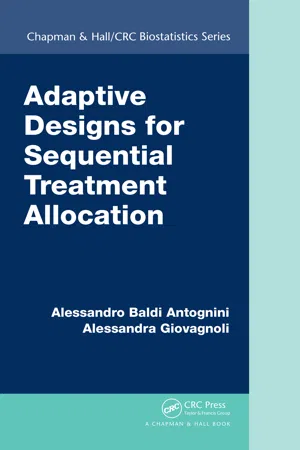
Adaptive Designs for Sequential Treatment Allocation
- 216 pages
- English
- PDF
- Available on iOS & Android
Adaptive Designs for Sequential Treatment Allocation
About this book
Adaptive Designs for Sequential Treatment Allocation presents a rigorous theoretical treatment of the results and mathematical foundation of adaptive design theory. The book focuses on designing sequential randomized experiments to compare two or more treatments incorporating information accrued along the way.
The authors first introduce the terminology and statistical models most commonly used in comparative experiments. They then illustrate biased coin and urn designs that only take into account past treatment allocations as well as designs that use past data, such as sequential maximum likelihood and various types of doubly adaptive designs. The book also covers multipurpose adaptive experiments involving utilitarian choices and ethical issues. It ends with adaptive methods that include covariates in the design. The appendices present basic tools of optimal design theory and address Bayesian adaptive designs.
This book helps readers fully understand the theoretical properties behind various adaptive designs. Readers are then equipped to choose the best design for their experiment.
Tools to learn more effectively

Saving Books

Keyword Search

Annotating Text

Listen to it instead
Information
Table of contents
- Front Cover
- Contents
- List of Figures
- List of Tables
- Preface
- Acknowledgments
- Introduction
- Chapter 1: Fundamentals and preliminary results
- Chapter 2: Randomization procedures that are functions of the past allocations
- Chapter 3: Randomization procedures that depend on the responses
- Chapter 4: Multipurpose adaptive designs: Step-by-step procedures
- Chapter 5: Multipurpose adaptive designs: Constrained and combined optimality
- Chapter 6: Randomization procedures that depend on the covariates
- Appendix A: Optimal designs
- Appendix B: Bayesian approaches in adaptive designs
- Bibliography
- Back Cover
Frequently asked questions
- Essential is ideal for learners and professionals who enjoy exploring a wide range of subjects. Access the Essential Library with 800,000+ trusted titles and best-sellers across business, personal growth, and the humanities. Includes unlimited reading time and Standard Read Aloud voice.
- Complete: Perfect for advanced learners and researchers needing full, unrestricted access. Unlock 1.4M+ books across hundreds of subjects, including academic and specialized titles. The Complete Plan also includes advanced features like Premium Read Aloud and Research Assistant.
Please note we cannot support devices running on iOS 13 and Android 7 or earlier. Learn more about using the app