- 284 pages
- English
- ePUB (mobile friendly)
- Available on iOS & Android
eBook - ePub
About this book
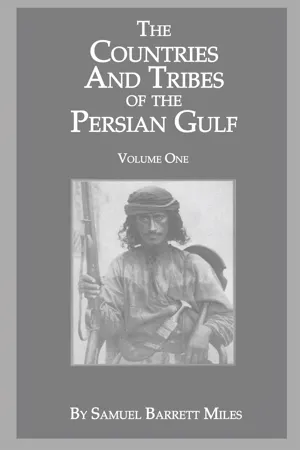
This book deals with the ancient and modern tribes and peoples of the countries around the Persian Gulf generally and Oman in particular. It records many environmental factors of the Persian Gulf, such as religious influence, social conditions, commerce, geography, agriculture, and fishing.
Frequently asked questions
Yes, you can cancel anytime from the Subscription tab in your account settings on the Perlego website. Your subscription will stay active until the end of your current billing period. Learn how to cancel your subscription.
No, books cannot be downloaded as external files, such as PDFs, for use outside of Perlego. However, you can download books within the Perlego app for offline reading on mobile or tablet. Learn more here.
Perlego offers two plans: Essential and Complete
- Essential is ideal for learners and professionals who enjoy exploring a wide range of subjects. Access the Essential Library with 800,000+ trusted titles and best-sellers across business, personal growth, and the humanities. Includes unlimited reading time and Standard Read Aloud voice.
- Complete: Perfect for advanced learners and researchers needing full, unrestricted access. Unlock 1.4M+ books across hundreds of subjects, including academic and specialized titles. The Complete Plan also includes advanced features like Premium Read Aloud and Research Assistant.
We are an online textbook subscription service, where you can get access to an entire online library for less than the price of a single book per month. With over 1 million books across 1000+ topics, we’ve got you covered! Learn more here.
Look out for the read-aloud symbol on your next book to see if you can listen to it. The read-aloud tool reads text aloud for you, highlighting the text as it is being read. You can pause it, speed it up and slow it down. Learn more here.
Yes! You can use the Perlego app on both iOS or Android devices to read anytime, anywhere — even offline. Perfect for commutes or when you’re on the go.
Please note we cannot support devices running on iOS 13 and Android 7 or earlier. Learn more about using the app.
Please note we cannot support devices running on iOS 13 and Android 7 or earlier. Learn more about using the app.
Yes, you can access The Countries And Tribes Of The Persian Gulf by Samuel Barrett Miles in PDF and/or ePUB format, as well as other popular books in Storia & Primordi della storia americana. We have over one million books available in our catalogue for you to explore.
Information
CHAPTER I.
HISTORY OF EARLY COLONIZATION
THE history of the ancient colonization of Oman in Eastern Arabia is naturally connected very closely with that of the rest of the peninsula, but the subject is so veiled in obscurity, from the absence of materials, that our knowledge of it is shadowy and fragmentary in the extreme. The only available authentic sources of information and guidance, in addition to the book of Genesis, are the monuments and documents of Mesopotamia and Egypt, which afford a few scattered rays of light.
The question, however, regarding the origin of the pristine inhabitants of the land is by no means an uninteresting one, in view of the part taken by them in promoting the cause of civilization by connecting the East and the West in commercial relations, the most prominent and active of which was probably taken by the people of Oman.
The earliest race known to have spread over and occupied the peninsula are the Cushites, of whom we read in the Bible, but of whom the origin is uncertain, though it is generally believed to be Egyptian. The epoch and duration of their occupation can only be conjectured, but of the important consequences resulting therefrom we can entertain but little doubt. For to these bold, adventurous Cushites, possibly, are due, not only the beginnings of inland trade by caravan, but also the navigation of the Arabian Sea and the infantile efforts of maritime commerce. The reasons for supposing that these seafaring efforts were more particularly the work of the Cushites of Oman will appear later on. Though the Hamitic Cushites spread over Southern and Eastern Arabia and founded most of the settlements on the coast, they were perhaps not the only race who dwelt in that region at that remote period. There were, for instance, the Phoenicians, who, according to Herodotus, came to Palestine from the Persian Gulf and appear to have sojourned in Oman during their former migrations.
The port of Soor, near Ras al-Had, has a name identical with that of Tyre or Soor in the Mediterranean, and was, beyond doubt, the prototype of it. The town of Soor, part of which is called Eijah, is situate on a rocky eminence at the mouth of a serpentine creek, and has always possessed one of the most useful, safe, and commodious harbours for native craft on the Oman coast.
The Cushite inhabitants of Arabia, though enriched by commercial enterprises, gradually dwindled in course of ages, and were overwhelmed eventually by a great wave of Semitic invasion from Northern Arabia, by which they were partly expelled and partly absorbed. These early Semitic tribes, as we learn from Caussin de Percival’s great work, are known to the Arab historians as the “ Baida “ and “ Ariba,” and are considered as extinct races.
The tribes that now dispersed and took possession of Arabia were composed of two main stocks, derived from the fourth and fifth generations from Shem. One of these stocks was Kahtan, who, identified with Joktan, son of Eber, colonized the Yemen, or the southern half of the peninsula, while the other, Adnan, who descended from Ishmael, occupied the northern part, where his posterity are mostly found at the present day. Under the one or other of these great progenitors, Kahtan and Adnan, the whole Arabian race is .comprised.
In the tenth chapter of Genesis we are informed that Joktan had thirteen sons, “and that their dwelling was from Mesha as thou goest towards Sephar, a mount of the East.” The identity of Joktan with the Kahtan of Arab tradition and of Sephar with Dhofar has been sufficiently recognized, and it is known that it is this stock of thirteen branches or tribes whose posterity has continued to occupy uninterruptedly and almost exclusively the southern half of the peninsula for 4,000 years.
Regarding the distribution of these tribes much has been written, but so far only a few of them have been traced with certitude. The identification of three of them, Hazarmaveth, Uzal, and Sheba, are perhaps indisputable. Yerah and Hadoram may be Yarab and Jorham; Havilah is probably Khaulan, a well-known district in the Yemen; while Hommel has connected Diklah with Hiddekel or Dijla, the River Tigris.
The name Obal or Wibal, as that of an ancient tribe, appears to survive in Oman, where a town so called exists in a valley now known as the Wady Beni Ruwaihah. The descendants of Kahtan, however, are differently named by the Arab genealogists, who also vary in some degree from each other. It may suffice here to give the list compiled by Kremer—numbering sixteen—Yarub, Khatar, Anmar, Mutenier, Madi, Lawi, Maiz, Gasib, Meina, Gorhum, Multenies, Katami, Zahm, Gusem, Aufar, and Nafir. We now have to fall back on the traditional accounts of the Arab historians, as we search for more light in other quarters in vain. In genealogy the Arabs have ever taken great pride and much pains, and have preserved with tolerable accuracy their pedigrees from very ancient times; indeed, it is not a little wonderful how far they have surpassed all other nations in this matter. Considering the many difficulties of the subject, it is not surprising that these genealogies abound with gross inconsistencies and contradictions, yet on the whole they may be accepted as fairly correct and trustworthy, though it was not until after the death of Mohammed that the ancient traditions were elaborated and reduced to writing by the Arabs.
The earliest inhabitants known to the genealogists are denominated by them as the Al-Ariba, who are also called the extinct tribes. Of these tribes, several are enumerated, and we are furnished with fabulous accounts of their exploits and adventures, as well as of their extirpation. The most famous of all were the Ad and Thamood, who are said to have been of gigantic stature; others were Tasm and Jadis, who were sisters of the two brothers Thamood and Sohar; Jasain, Waber, Hadboora, Abel, and Emin, nearly all of whom are known to have been represented in Oman.
The sections of the Tasm and Jadis, who migrated to Oman, appear to have settled in Al-Jow and Towwam, giving to those districts the names of the places they had occupied in their old home, Yemama. According to Wüstenfeld, Sohar is the name of the sons of Said bin Zaid. Hamza, after Bekra, thinks it identical with Ghuma Said al-Hodsin. The Sohar tribe occupied the Batineh, and gave their name to the present town on the coast. The Jasain were Amalekites and dwelt, it is said, also in Oman, where their descendants, under other names, still exist. The Thamood were probably the last of the Ariba, as they survived till the time of Christ, and are alluded to by Diodorus, Strabo, and other classical writers.
Besides the extinct tribes which existed in Oman in ancient times, there were, of course, many famous ones that helped to people the country, and whose descendants, mostly of mingled blood, were subsequently divided into branches under other names, and it may be as well to mention a few of these once renowned tribes whose history is hidden in the mists of tradition.
The Azd, who form such a large proportion of the population of Oman at the present day, are of rather obscure origin. Some derive them from the patriarch Kahtan, others from Al-Gauth bin Nabt bin Malik. There were three divisions of them: (1) the Azd Shenoo; (2) the Azd Sarat; and (3) the Azd of Oman. They were further divided into nine principal families—Ghassan, Aus, Al-Khusraj, Ibn Khodjer, Barek, Dows, Ateek, Ghafeh, and Beni Julanda. From each of these descended many tribes now known under other names. The Mazen, after whom East Arabia obtained the name of Mazoon for some centuries, were a great seafaring race and were descended from Mazen bin Azd. Sprenger thinks the Maceta of Nearchus, who sighted Cape Mussendom on his voyage, obtained its name from this tribe. “The Kamoos “ says “ the Mazen are of South Arabia and are Azdites and long afterwards joined the Ghassanites.” The Mazen had, it is said, four divisions. They appear to have occupied the Shemal or Cape Mussendom, and were succeeded there by the Shihiyyeen, a small tribe.
The Kamar or “ Moon” tribe was a large and important one in Southern Arabia in remote times, and gave its name to the Kamar Bay, and also, it is supposed, to the Comoro Island on the east coast of Africa; the tribe is now represented in Oman by the Beni Ryam, who occupy Jebel Akhdar, and also by the Beni Hadeed and probably other tribes. The Beni Kodhaa were a great tribe stretching along the southern coast from the Yemen to the Gulf of Oman, and many branches sprang from it; also some genealogists derive it from Malik bin Hamza, but it is probably of higher antiquity. The tomb of Khodhaa, the personification of the tribe, is said to have formerly existed in Shihr. Ptolemy calls the tribe Kattabene. Its descendants are still in Oman; it had a branch called Khaulan or Chavila, which formed a colony and dynasty in Oman, but at what time is not known.
The names of many other powerful and distinguished tribes have come down to us by tradition from antiquity, and some of them have left their mark in the name of the valley, town or district where they resided; for in Oman, as in Arabia generally, they called the land after their own name.
Among these may be included the Akk, a well-known tribe of doubtful origin and dwellers in the Yemen. The Azdites took refuge with them after leaving Mareb. The Wady Akk, in which they resided in remote times, is situated about fifty miles from Muscat; and the gorge in the Wadv Akk is very steep and narrow.
The Bahila, an ancient tribe of dubious derivation, which founded the town of that name in Oman Proper.
The Dibba, or Lizard Tribe: a Modhar tribe of Nejd, which probably founded the town in Cape Mussendom, where a decisive battle was fought in the year II a. i. 1632 a.d.].
The Jaalan, or Water Beetle tribe, derive from the Abdul Kais or “ Slaves of Kais,” who was one of the divinities of the ancient Arabs; the Jaalan occupied the district of that name in the Sharkiya.
Caussin de Perceval, in his essay, informs us that Yarab, descendant of Kahtan, after having destroyed the power of the Azdites, established the exclusive domination of the Kahtanites over all Southern Arabia and founded the kingdom of the Yemen, consolidating his rule by appointing his brother Jorham, to the government of the Hejaz, and his other brothers, Hadhramaut and Oman, to rule over the provinces designated by their names. This noteworthy event is reckoned by him to have occurred in the year 754 b.c., which would make it contemporaneous with the founding of Rome, and if this chronological calculation be accepted, it would mean that the Oman tribe first migrated to East Arabia in this year. The date, however, of 794 s.c., ascribed to the birth of Yarab by de Perceval, who calls him the brother of Hadhramaut, is not easily reconciled with the period usually allotted to Hadhramaut, the third son of Yoktan, or about 2,000 years before the Christian era. Moreover, if we accept Oman as the brother of Hadhramaut, the omission of his name from the list of Yoktan’s sons in the tenth chapter of Genesis is certainly singular. But whatever the period may have been, it is probable that the migratory movement of the Omanis was on a large scale, as on their arrival at their destination they were enabled to take possession of the central and most productive parts of the country, known to this day as the province of Oman Proper, a name which was subsequently extended to the whole land, in the same way that the province of Fars has given its name to the whole kingdom of Persia.
The successor of Yarab in the Yemen was Yashjob, a feeble prince, who allowed many of the provinces, including Oman, to become independent. On the death of Yashjob the succession fell to his son, Abdul Shams, to whom many remarkable actions are attributed. He invaded Egypt, completed the construction of the great dam at Mareb, the metropolis of the Sabeans, and reduced to obedience the dependencies that had revolted from his father. We may conjecture that Eastern Arabia, like the others, returned to his sway, but of this we have no certain record.
Abdul Shams left many sons, the most famous of whom were Kahlan and Himyar. Kahlan, according to some, succeeded his father and was followed by his brother Himyar, whose real name was Azanjaj, but was called Himyar on account of his wearing a red dress. His power over the whole of South Arabia was complete, extending from the Yemen to Muscat. He was the founder of the two dynasties of the Himyarites, which held paramount sway in the Yemen until the time of Mohammed. Himyar, during his reign, appears to have made his son, Malik, Governor of Oman, but on the death of Himyar the kingdom fell in disorder, and, like other governors, Malik made himself independent. Then two of his brothers, one of whom was named Wathil or Wail, resolved to try and wrest the country from him. They were unsuccessful in their efforts, and Malik not only retained his authority in Oman but left the succession to his son, whose name has not come down to us. Malik’s son, however, appears to have been attacked and defeated not long afterwards by Wathil’s son Sacsac, who then miff). over Oman. During the reign of Yasar bin Sacsac disorders broke out against him and he was constantly at war with the children of Malik. In the minority of Yasar’s posthumous son Norman, the regency was held by Dhul Raish. This account, it must be observed, conflicts with other historians, who state that Wathil was himself sovereign of Oman for many years. The subjugation, however, of Oman to the first Himyar Dynasty could not have been of very long duration, as, like the rest of the Yemen, it seems to have fallen in the middle of the sixth century b.c. to the armies of the great Cyrus, who was then engaged in extending the limits of the Persian Empire.
How long and to what degree Persian domination extended is uncertain, as traditional history of Oman at this period is extremely vague and hazy, but it is probable that Cyrus was content with merely nominal submission and the payment of tribute, and the country continued under the hegemony of its native Arab rulers.
In the history of Isidore of Charex is mentioned a king named Dhu Joaisos, who lived at Shihr and ruled over the Omanis. This king is identified by Blau with Dhu Joaisham bin Akran bin Ali Malik, who is spoken of by Hamza Ispahani. Blau further states that Dhu Joaisham reigned in the time of Dara bin Dara bin Bahman and for seventy years after. He made war on Tasm and Jadis, and his successor lived to the time of Hadhr bin Kinana. Dhu Joaisham was of royal Himyaritic family, and his presence in Oman was due to the fact that one of its progenitors was Kahlan bin Arib bin Zoheer bin Ajam bin Hamoza, who was the first to subdue Oman. Kahlan was King of Oman and his adviser was Mazen bin Azd, who was Lord of Oman. His proclamation began—
“ From Mazen a document in which is a message to all who inhabit Ajam, Arabia and Shihr.”
This fragment is of value, and indicates how much remains to be unravelled of Oman traditional history. It may be as well here tc, notice the legend given by Persian historians, which relates that Kai Kaoos, King of Persia, having subdued Oman, made peace with the Arab ruler, Dhul Sogar, on condition that the latter gave him in marriage his daughter, Sibarba, who was of rare beauty. The story of Dhul Sogar, who is variously styled Dhul Saris and Dhul Zind, is narrated by Merkhond in the “ Rouzat al-Safa,” and the subsequent adventures of Sibarba and Prince Siawash, son of Kai Kaoos, are poetically described in the” Shah Namah “of Firdusi.
It was in the time of Alexander the Great that the land of Oman was first seen by Europeans. His admiral, Nearchus, when passing up the Persian Gulf, sighted Cape Maceta or Cape Mussendom, and heard from the pilot of a great Omani emporium. This port, it is almost certain, was Sohar, which was still an emporium in the time of Mohammed. Alexander, on hearing his report, determined on sending an expedition to circumnavigate the Arabian peninsula, but his early death at Babylon put an end to this and other schemes, and for nearly a hundred years no fresh light was thrown on the land.
The first king of the Second Dynasty of the Himyarites was Harith, a descendant of Himvar through Wathil bin Gauth: Harith was a conqueror and is supposed to have invaded India, and ruled over all the provinces of Southern Arabia. He took the title of “ Tobba,” which applies to all his successors, but more strictly only to those kings who possessed besides the Yemen, Hadhramaut, Shihr, and Oman. He received the sobriquet of “Al Raish,” on account of the rich spoil he brought from foreign countries.
De Percival, in his work above mentioned, accepts the computation of Thaalibi as to Harith’s having lived about 700 years before Mohammed or about a hundred years before Christ. For some time Oman appears to have been under his subjection, but it subsequently passed under the dominion of the Parthians. It was probably in the days of Mithridates that East Arabia fell under Parthian dominion. This king, who founded the empire, ruled from 174 b.c. to 136 ‘lc., and extended his conquest‘s over an immense area, including Susiana, Persia, and Babylon; and as Oman was at that time a dependency of Persia, it necessarily followed the fate of that country and remained so until the advent of the Azdites.
We have now come to a period when we might have expected a flood of light on the general condition of Arabia, from the literary and commercial activity of the Greeks, who, after its conquest by Alexander, took possession of Egypt, and at once began to undertake trading operations with the East. Unfortunately, though we certainly have some valuable works such as the “ Periplus “ and “ Ptolemy’s Geography,” the more important labours of the Greeks on Arabia have perished. The first Greek writer to mention the Arabs was Eschylus, but the first to produce a description of Arabia was the astronomer Eratosthenes, who composed a cosmography when he was Curator of the Library of Alexandria, where he died in 196 b.c. A Eratosthenes had abundant opportunities of collecting information, his work would doubtless have contributed much to our knowledge of the Yemen, but he appears to have known nothing of Eastern Arabia, as of the four great tribes mentioned by him, only one, viz., the Beni Kodhaa, extended as far as Muscat.
From Agarthacides, who at one time resided in Egypt, and who about the year 120 b.c. wrote a work in five volumes on the Red Sea and Southern Arabia, we might have gathered a still more complete and trustworthy account of the Arabs and their country, but his labours, with the exception of a few fragments, have, like those of Eratosthenes, been lost. We learn, however, from Agarthacides, of the existence of Arabian colonists in the ports of India.
As Egyptian trade increased, so the knowledge ox Arabia extended, and Pliny’s account of the Oman coast is fairly accurate, but he knows little of the interior and he gives no historical information whatever. The Periplus of the Erythrean Sea, which was written about the year 80 a.d., is very accurate as far east as Cape Fartak, but th...
Table of contents
- Cover
- Half Title
- Title Page
- Copyright Page
- Dedication
- Table of Contents
- List of Plates
- Preface
- Biographical Note
- Chapter I. History of Early Colonization
- Chapter II. The Persian Gulf under Islam
- Chapter III. The Portuguese in Eastern Arabia
- Chapter IV. The Yaareba Dynasty