- 296 pages
- English
- ePUB (mobile friendly)
- Available on iOS & Android
eBook - ePub
About this book
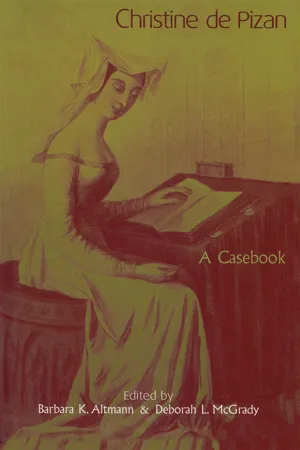
Christine de Pizan wrote voluminously, commenting on various aspects of the late-medieval society in which she lived. Considered by many to be the first French woman of letters, Christine and her writing have been difficult to place ever since she began putting her thoughts on the page. Although her work was neglected in the eighteenth and nineteenth century, there has been a eruption of Christine studies in recent decades, making her the perfect subject for a casebook. This volume serves as a useful guide to contemporary research exploring Christine's life and work as they reflected and influenced her socio-political milieu.
Information
1
Introduction
Barbara K. Altmann and Deborah L. McGrady
How dramatically a field can change over the course of a career! The observations of Charity Cannon Willard, a pioneer in Christine de Pizan research, provide a standard of measure. In her foreword to this volume, she traces the development of Christine studies from a personal perspective, charting her own entry into the profession, her early encounters with other "Pizanistes" on both sides of the Atlantic, and the increasing appeal of this author, witnessed by the number of publications that grew steadily from a trickle into the current outpouring of scholarship, editions, and translations.
Mrs. Willard reminds us in her narrative that the revival of interest in Christine in this century took place against a backdrop of war and strife just as Christine's career did. Like the author they were studying, Willard and other major figures of medieval studies persevered, undaunted by practical and institutional obstacles. During the postwar years, they laid the foundation for subsequent generations of scholars. The work of preparing reliable modern editions and translations continues. But by now, the basic information is readily available and a critical corpus is in place. We have access to Christine's biography, increasingly comprehensive descriptions of her manuscripts, and an array of well-informed and thought-provoking analyses of the texts. As a result of the explosion, we now have the luxury of engaging with a whole community of scholars and its received ideas.
An adjective often used to describe Christine is "unique." Early critics expended a good deal of effort to prove the merit of this woman writer, an anomaly of her time. The result was the shift from the perception of Christine as "blue-stocking," in Gustave Lanson's infamous phrase, to the current common designation of her as the first French woman of letters. The challenge now is to nuance our understanding of her uniqueness. The following chapters exemplify this new shift in Christine studies. Each contributor analyzes Christine's work in relation to her milieu and inherited traditions, all the while accenting how her goals and achievements distinguish her from her contemporaries.
Certainly Christine has proved to be one of the pivotal authors of late medieval Europe; her body of work is broad and copious enough to reflect in some measure all the major facets of late medieval society. As a result, she makes the ideal subject for a Casebook. The purpose of this volume is two-fold: it is intended both as an overview of the state of Christine de Pizan studies at this moment in their evolution and as a collection of new research in the field. We began by defining four research areas representative of prevailing trends of our day and essential to an understanding of Christine's significance: the historical context of her writing; her abiding interest in the status and nature of women; the major texts she authored and the different genres in which she worked; and the production of her works in manuscript and their reception in the ensuing centuries. We then commissioned articles from experts to address those topics. Each of the 15 chapters is thus new work; unlike other collections, this one contains no reprinted articles. Every contribution frames original, groundbreaking scholarship of interest to specialists with a discussion of the established literary and cultural traditions necessary for a reader new to the field. Each chapter is self-contained, with substantial notes and full bibliographic references. We have added a bibliography of selected works that functions as a resource list. The collection as a whole provides an initiation to Christine studies as the field currently stands.
The section divisions in this Casebook are organized into the research areas mentioned above, corresponding roughly to four categories: historical approaches; feminist readings; close literary readings; and issues of codicology and reception history. It goes without saying that there is a good deal of overlap among these concerns and methodologies.
The first section, "Christine in Context," establishes Christine and her writings in the larger framework of the sociopolitical and intellectual history of her day. Renate Blumenfeld-Kosinski explores the impact on Christine of the turbulent political situation of France in the early fifteenth century and how Christine engages it in her writing. Blumenfeld-Kosinski shows that it is not a topic Christine restricts to her overtly political texts, but one that filters into her entire corpus, from her lyrical poetry to her allegories. Lori J. Walters analyzes Christine's place in the tradition of translation as literary practice and metaphor. Going beyond the obvious definition of translation as the rendering of a work in a different language, Walters reveals that Christine used the multivalent term both to affiliate herself with a long line of illustrious translators associated with Charles V and to create her own unique authorial identity as a writer. Christine's use of theology is taken up by Earl Jeffrey Richards, who challenges the view that Christine's knowledge of the subject was superficial. Through a study ranging from discrete terminology to her developed arguments regarding the status of women, Richards contends that Christine was directly engaged with the writings of Thomas Aquinas, albeit as a reader who systematically questions and reworks the arguments of the great thinker. In the final chapter Margarete Zimmermann investigates the author's strategies for ensuring her future legacy. Intertwining her own memoria with that of her father and her noble patrons, Christine implements a series of strategies that depend on text, image, and reader reception to ensure her survival as a woman writer.
The second section, "Building a Female Community," explicates Christine's profeminine agenda from several different perspectives. Rosalind Brown-Grant counters anachronistic disappointment that Christine failed as a feminist, arguing that only when placed in the context of Aristotelian and theological arguments can we appreciate the extent to which Christine challenged accepted views of women's nature and role in medieval society. With regard to Christine's pragmatic conduct book for women of all classes, Roberta L. Krueger's chapter on the Livre des trois vertus demonstrates that Christine understands women's management of financial resources as a key to their well-being. Christine's advice makes it clear that women's moral standing, their honor, and their spiritual welfare are all tied to proper conduct in their economic lives. Her portrayal of women stresses the interdependence of women's economic activities across social strata and recognizes women's significant contribution to medieval economic life. Focusing on Christine's fictional portrayals of women, Thelma Fenster notes the absence of the typical romance heroine. Instead, Christine adapts and develops the complex figure of the sibyl who stands both as exemplar and purveyor of advice, overlapping to some degree with her own authorial identity. On the topic of Christine's most elaborate realization of the female community, Judith L. Kellogg explores the innovative configurations of space in Christine's Cité des dames. Kellogg argues that the allegorical city regenders the notion of the body politic, based on a redefined body of knowledge and resulting in a reformulation of power structures that allows women to participate.
The section entitled "Christine's Writings" includes fresh readings of some of Christine's best known works as well as an assessment of her achievements in lesser known genres. Tracy Adams reassesses Christine's lyric poetry in the context of her writings as a whole, explaining her use of the courtly love topos and her bereft narratorial figure as metaphors for the political situation in France and the vulnerability of the disempowered, including women and writers. Marilynn Desmond revisits the debate on the Roman de la Rose, examining Christine's participation in the querelle des femmes in terms of her remarks on the ethics of reading. Whereas scholars have identified Christine's attacks on the Rose as based on her belief that it is a misogynistic text that verbally abuses women, Desmond argues that Christine defines the moral utilitas of a work through the concrete impact it can have on an individual. Desmond concludes that the Rose serves as a manual of erotic violence and is, therefore, unworthy. Andrea Tarnowski writes on the Chemin de long estude. She argues that it marks an intermediate phase in Christine's oeuvre, one in which she assigns herself the dual function of fictional character and producer of texts, claiming, although still somewhat tentatively, the authority to write as an apprentice in the realm of learning. On the question of social progress that lies at the heart of the Chemin, Christine shows her preference for human solutions based on knowledge and experience. In her combination of allegory and social commentary, literary erudition and pragmatism, she forges for herself a legitimate role in the large debates of her day. The focus of Liliane Dulac and Christine Reno's chapter is the Advision Cristine. They survey the struggle in current scholarship to define that text: although scholars tend to classify it as either autobiography or political writing, Dulac and Reno contend that the autobiographical and political are inextricably intertwined, concluding that any appreciation of the text must begin with a recognition of its hybrid nature. Finally, Maureen Boulton reads Christine de Pizan's religious works within the larger context of late medieval devotional practices. Boulton argues that when Christine's devotional writings are compared with medieval religious material (including books of hours, Catholic doctrine, Psalms, etc.), it is clear that the dominant concerns of her secular writing, especially the plight of women, are not only manifest in these works, but represent Christine's unique contribution to religious writing.
The fourth and last section, "Christine's Books," deals with the material artifacts and scholarly processes that make Christine's work available. Taken together, James Laidlaw and Nadia Margolis's articles give a diachronic view of how and in what state Christine's works have reached her readers. Laidlaw details the production of Christine's writings during her lifetime through a discussion of the fifty manuscripts identified as autograph copies, explaining the significance of this unusually rich body of textual witnesses to our understanding of the many facets of Christine's career. He also describes two projects currently underway that will promote scholarly access to Christine's manuscripts: the "Album Christine de Pizan" and the plan to digitize British Library manuscript Harley 4431, one of the best known compilations of Christine's work. Margolis shifts our focus to the fate of that work long after the author's lifetime, providing a detailed study of Christine's posterity in the form of critical editions published from the eighteenth to the twentieth centuries. Margolis makes clear that the story of the editing of Christine's corpus is inevitably tied to political and intellectual histories and rivalries, and to trends in disciplinary concerns and institutional policies, all of which shaped the way Christine's texts were transmitted by a long line of scholars, including several compelling personalities.
This Casebook does not claim in any way to be the final word. It is meant much more modestly as a contribution to what might be considered the third wave of Christine studies. We are long past disdaining Christine's erudition, but we are also past the surprise of discovering in Christine a late medieval author who speaks to modern and postmodern concerns. Her place in the evolving canon of medieval literature would seem to be secure, and such a wealth of secondary material is available that keeping up with the field has become a daunting prospect. Without making too grand a claim, the regular appearance of Christine on the list of conference topics and in books and articles of all kinds suggests that her corpus is bountiful and rich enough to sustain close and extended scrutiny for a long time, in the manner of the inexhaustible sources best exemplified in medieval and early modern studies by Dante or Chaucer. The wealth of approaches used of late to elucidate her work has not only enhanced our appreciation of the complexity and depth of her oeuvre, but has also reshaped the boundaries of various disciplines. This volume represents how we understand Christine de Pizan at the outset of the twenty-first century. It is not intended to fix Christine in time, but to stimulate further discussion and discovery.
Finally, we would like to thank Paul Szarmach for first suggesting that we undertake this project and Angus J. Kennedy for his true generosity in sharing editorial materials that made our job much easier.
I
Christine in Context
2
Christine de Pizan and the Political Life in Late Medieval France
Renate Blumenfeld-Kosinski
Christine de Pizan came to France as a small child in 1368, four years after the accession to the throne of Charles V the Wise. In her Livre des fais d'armes et de chevalerie, written in 1410, she refers to herself as a "femme ytalienne"—just like Minerva, goddess of arms and chivalry.1 But there is no doubt that her allegiance always lay with France. The fate of her adopted country affected her deeply and informed many of her works. In this chapter we will explore the evolution of her political thought and the many literary genres Christine used to express her ideas. In particular, we will see how the worsening situation in France conditioned her own literary output, which ranged from lyrical works to allegories and finally straightforward political and polemic treatises. Indeed, Christine's trajectory from being an observer and chronicler of the events surrounding her to attempting to intervene in these events is reflected in the forms she chose for her works and the voice she adopted in them.
The three major crises addressed in her works are the Hundred Years War (1337-1453), the Great Schism of the Western Church (1378-1417), and the French civil war.2 The Hundred Years War, in reality a long series of military campaigns interrupted by many truces, began in 1337, when the English King Edward III, as a grandson of Philippe IV le Bel, laid claim to the French throne as a response to Philippe VI's occupation of the English fief, the duchy of Guyenne. It was punctuated by several major battles, almost all ending in defeat for the French. After the battle of Agincourt (1415) France became an occupied country. It was not until Joan of Arc (d. 1431) that, in a major drive, the French began to chase the English from their territory, but it would take more than another twenty years before the war can be said to have ended.
The Great Schism of the Western Church had its origins in a double papal election in 1378. Pope Gregory XI had returned to Rome from Avignon, where the papacy (almost exclusively French) had spent most of the fourteenth century, and promptly died. The cardinals elected the archbishop of Bari as Urban VI, but—or so they later claimed—they did so in fear and under duress, threatened by the Roman populace clamoring for a Roman pope. Urban VI was an austere and intransigent person, lacking any diplomatic skills. He had no intention of letting the cardinals enjoy the sumptuous life and relative independence they had enjoyed before. In response, the cardinals soon left Rome and proceeded to elect another pope, Robert of Geneva, as Clement VII, thus in effect creating two papal obediences that split Europe into two parts, with France and England on opposite sides. Charles V quickly came to support Clement VII, located in Avignon, whereas Richard II adhered to Urban's Roman papacy. The French monarchy played an important role in trying to end the Schism, in 1398 even going so far as to withdraw obedience from the Avignon pope Benedict XIII in order to pressure him,3 and, they hoped, the Roman pope as well, to abdicate. But both popes were tenacious and hung on to their office even after the Council of Pisa (1409) had elected another pope who was to replace both of them. Only the Council of Constance (1414—1417) succeeded in electing anew pope, Martin V, to whom most of Europe was willing to adhere.
The French civil war, long in the making through the rivalry of Charles V's uncles and cousins during the regency and finally the madness of Charles VI, started in earnest around 1407 with the assassination of Louis of Orléans, the brother of King Charles VI, on the orders of his cousin, the Duke of Burgundy. In 1410 Louis's son, Charles d'Orléans, formed the league of Gien with the dukes of Berry, Bourbon, and Bretagne and several counts to oppose the duke of Burgundy. This internal conflict was inseparable from the continuing hostilities of the Hundred Years War. It is difficult to keep track...
Table of contents
- Cover
- Half Title
- Series Page
- Title Page
- Copyright Page
- Dedication
- Contents
- Foreword
- 1. Introduction
- Part I Christine in Context
- Part II Building a Female Community
- Part III Christine's Writings
- Part IV Christine's Books
- Bibliography
- Contributors
- Index
Trusted by 375,005 students
Access to over 1.5 million titles for a fair monthly price.
Study more efficiently using our study tools.
Frequently asked questions
Yes, you can cancel anytime from the Subscription tab in your account settings on the Perlego website. Your subscription will stay active until the end of your current billing period. Learn how to cancel your subscription
No, books cannot be downloaded as external files, such as PDFs, for use outside of Perlego. However, you can download books within the Perlego app for offline reading on mobile or tablet. Learn how to download books offline
We are an online textbook subscription service, where you can get access to an entire online library for less than the price of a single book per month. With over 1.5 million books across 990+ topics, we’ve got you covered! Learn about our mission
Look out for the read-aloud symbol on your next book to see if you can listen to it. The read-aloud tool reads text aloud for you, highlighting the text as it is being read. You can pause it, speed it up and slow it down. Learn more about Read Aloud
Yes! You can use the Perlego app on both iOS and Android devices to read anytime, anywhere — even offline. Perfect for commutes or when you’re on the go.
Please note we cannot support devices running on iOS 13 and Android 7 or earlier. Learn more about using the app
Please note we cannot support devices running on iOS 13 and Android 7 or earlier. Learn more about using the app
Yes, you can access Christine de Pizan by Barbara K. Altmann,Deborah L. McGrady in PDF and/or ePUB format, as well as other popular books in Languages & Linguistics & Linguistics. We have over 1.5 million books available in our catalogue for you to explore.