- 376 pages
- English
- ePUB (mobile friendly)
- Available on iOS & Android
eBook - ePub
Adhesion and Bonding in Composites
About this book
This book deals with the roles played by the component material interface in composites, with special emphasis on methods used to improve the adhesion and bonding between them. It is helpful for scientists and engineers in the materials field and to engineers working with adhesives or composites.
1
Interfacial Characteristics of Composite Materials
1.1 Introduction
Composite materials are materials of composite structure comprising two or more components that differ in physical and chemical properties which have been combined to provide specific characteristics for particular uses. The boundaries between components are referred to as solid interfaces.
Recently, it has become popular to consider the boundary not as a contact interface without thickness but as an interphase with thicknesses on both components. That is, the concept involves the existence of a chemical and physical transient region or gradient in the boundary. For example, a fiber-reinforced composite material includes three phases: the surface of the fiber side, the interface between the fiber and the matrix, and the interphase. These phases are referred to collectively as the interface.
The characteristics of the interface are dependent on the bonding at the interface, the configuration, the structure around the interface, and the physical and chemical properties of the constituents. As a result the interface has a strong influence on the property of the composite material. In this chapter we describe interaction of the interface and structural change in the interface.
1.2 Composite Effect and Interfaces
A method for the estimation of composite material performance from the characteristics of fillers (reinforcing material: fiber, powder) and matrices (polymer, metal, ceramics) and from the configuration of the filler is generally called a law of mixture. In the most basic form of a law of mixture, some characteristics of a composite material are represented as a function of characteristics of constituent components and their volume fractions, as shown in Figure 1.1 [1].
For a composite material (characteristics: χc) that consists of component A (characteristics: χA, volume fraction: ϕA) and component B (characteristics: χB, volume fraction: ϕB), the basic formulas of a law of mixture are as follows:
For a composite material (characteristics: χc) that consists of component A (characteristics: χA, volume fraction: ϕA) and component B (characteristics: χB, volume fraction: ϕB), the basic formulas of a law of mixture are as follows:
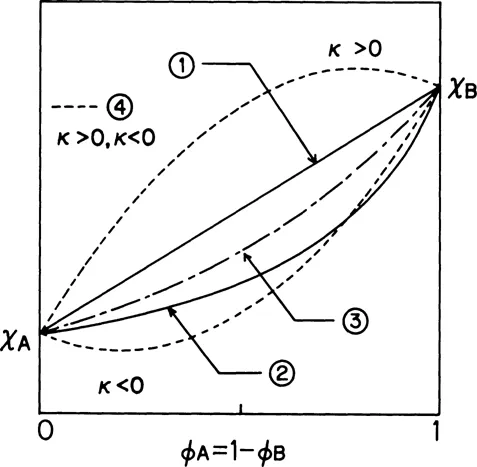
Figure 1.1 Relation between the properties of composites and various laws of mixture. (Ref. 1)
(parallel model, linear law of mixture, curve 1 in the figure) and
(series model, curve 2 in the figure). The two curves exhibit theoretical upper and lower limits, respectively, based on a simple composite effect in general. A basic formula that generalizes (1) and (2) is
wherein n(–1 ≤ n ≤ 1) represents a structural parameter which indicates the proportion of the combination mode; that is, the parallel mode is predominant when n is close to 1 and the series mode is predominant when n is close to −1. In equation (3), when n has a small absolute value,
This function is intermediate in behavior between the parallel model and the series model (curve 3 in the figure, referred to as a logarithmic law of mixture).
The law of mixture described above is valid for a simple composite system with well-known structure in which the rule of additivity holds (no interaction in the ...
Table of contents
- Cover
- Half Title
- Title Page
- Copyright Page
- Preface
- Table of Contents
- Contributors
- 1. Interfacial Characteristics of Composite Materials
- 2. Wettability and Adhesion
- 3. Surface Modification of Matrix Polymer for Adhesion
- 4. Surface Modification of Matrix Polymer by Craft Polymerization and Its Effect on Adhesion
- 5. Modification of Inorganic Fillers for Composite Materials
- 6. Surface Modification and Adhesion Improvement by the Blend Method
- 7. Adhesion of Resin to Metal
- 8. Bonding of Ceramic to Metal
- 9. Interfacial Modifications and Bonding of Fiber-Reinforced Metal Composite Material
- 10. Interfacial Effect of Carbon-Fiber-Reinforced Composite Material
- 11. Interface Analyses of Composite Materials
- 12. Interfacial Strength of Composite Materials
- Index
Trusted by 375,005 students
Access to over 1.5 million titles for a fair monthly price.
Study more efficiently using our study tools.
Frequently asked questions
Yes, you can cancel anytime from the Subscription tab in your account settings on the Perlego website. Your subscription will stay active until the end of your current billing period. Learn how to cancel your subscription
No, books cannot be downloaded as external files, such as PDFs, for use outside of Perlego. However, you can download books within the Perlego app for offline reading on mobile or tablet. Learn how to download books offline
Perlego offers two plans: Essential and Complete
- Essential is ideal for learners and professionals who enjoy exploring a wide range of subjects. Access the Essential Library with 800,000+ trusted titles and best-sellers across business, personal growth, and the humanities. Includes unlimited reading time and Standard Read Aloud voice.
- Complete: Perfect for advanced learners and researchers needing full, unrestricted access. Unlock 1.5M+ books across hundreds of subjects, including academic and specialized titles. The Complete Plan also includes advanced features like Premium Read Aloud and Research Assistant.
We are an online textbook subscription service, where you can get access to an entire online library for less than the price of a single book per month. With over 1.5 million books across 990+ topics, we’ve got you covered! Learn about our mission
Look out for the read-aloud symbol on your next book to see if you can listen to it. The read-aloud tool reads text aloud for you, highlighting the text as it is being read. You can pause it, speed it up and slow it down. Learn more about Read Aloud
Yes! You can use the Perlego app on both iOS and Android devices to read anytime, anywhere — even offline. Perfect for commutes or when you’re on the go.
Please note we cannot support devices running on iOS 13 and Android 7 or earlier. Learn more about using the app
Please note we cannot support devices running on iOS 13 and Android 7 or earlier. Learn more about using the app
Yes, you can access Adhesion and Bonding in Composites by Ryutoku Yosomiya,Yosomiya in PDF and/or ePUB format, as well as other popular books in Technology & Engineering & Chemistry. We have over 1.5 million books available in our catalogue for you to explore.