- 304 pages
- English
- ePUB (mobile friendly)
- Available on iOS & Android
eBook - ePub
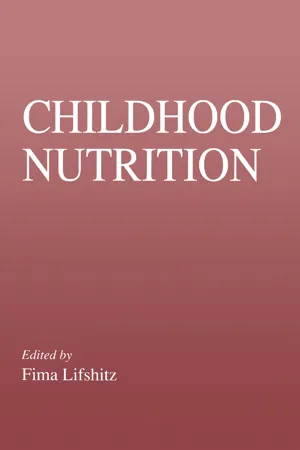
Childhood Nutrition
About this book
An invaluable resource, Childhood Nutrition provides accurate facts on current concepts in pediatric nutrition, including theories of nutrition in the pathophysiology of disease and in developing nutritional healthcare plans. Written by an outstanding group of specialists, each chapter is thoroughly researched and referenced.
Information
Chapter 1
HISTORICAL OVERVIEW AND FUTURE PERSPECTIVES ON PEDIATRIC NUTRITIONAL SCIENCE
Laurence Finberg
The history of pediatric contributions to nutritional science is much too rich to relate in a brief presentation. I shall therefore be selective and choose to use some seminal events as examples of an illustrious past.
I shall begin by retelling events that are of particular interest to me. This first event I believe marks the start of the scientific era for nutrition. During the cholera epidemic in Great Britain in 1831, a young man by the name of William Brooke O’Shaughnessy could not practice medicine because he had graduated from a Scots medical school. Licensing was controlled by the physicians of London; graduates of London schools would not grant him a license. He therefore began to study cholera patients. Although he was not the first to analyze human blood for its constituents, he was one of the early ones to do so. He performed chemical analyses of both the blood and stools of cholera patients. As a chemist he only had inorganic chemistry techniques to use for his analyses; therefore what he analyzed were the electrolytes. He noticed that the composition for the stool water in cholera victims was very similar to that of their plasma. These values were close to those of normal controls, except that the patients had markedly reduced water content. He deduced they had lost large amounts of water and salts. He suggested from these data that replacing water and salt would be beneficial to them.
The history that has been handed down to us shows that he first made known his findings by publishing his observations in a very brief letter to the Lancet in December, 1831.1 By May 1832, scarcely five months later, Thomas Latta, a practitioner in Leith, Scodand, through a surrogate, published in the Lancet a report successfully carrying out O’Shaughnessy’s suggestion.2 Mind you, he had no needles, syringes, or tubing and no one to make the solutions for him. He had to make all the equipment and solutions himself while carrying on a busy practice. In five months he had treated 16 patients, 8 of them successfully.
This landmark in medicine constitutes the first example of someone solving a problem by gathering data on human subjects and initiating the therapeutic process. Interestingly enough, of course, physicians being conservative, the general implementation of this therapy in medical practice was delayed for 80 years. It was not until roughly 1910, when technology became available and more people had demonstrated that O’Shaughnessy and Latta were right, that fluid therapy became a staple in medical practice. Fluid therapy thus begins scientific nutrition.
Referring again to the 19th century, when the industrial revolution was well under way, there were a number of social changes relevant to nutritional events. Among them were women entering the work place; mothers and, perhaps in some way more important, women who had served as wet nurses now found that they could seek more remunerative employment. The availability of breast feeding for infants had been the only source of feeding available until this time. Alternative infant feeding began to appear as an item for public and medical concern. Liebig in Germany developed a food to feed infants he considered to be perfect. The food was made of a mixture of wheat flour, malt, and cow milk. When cooked, it could be fed to babies. The mixture began to be used for the feeding of infants; however, the mortality rate for babies not breastfed was enormous, just as it continues to be today in underdeveloped parts of the world.
Looking back, we can be fairly sure that the principal problem was contamination and subsequent infection; at the time, physicians worried most about composition. Different feedings continued to appear both in Europe and North America. Science again emerged, primarily around Ruebner’s department in Berlin, where he and his associates began to look at nutrition as a science. First, they showed the interchangeability of fat and carbohydrates in metabolic systems. They then went on to develop calorimetry so that they could assess food in the production of energy. This constitutes another landmark.
A number of pediatric names surface at the turn of the century—Czerny and Finkelstein from Germany, the latter emigrating to Chile. Thomas Morgan Rotch—the Pediatric Professor of Harvard—built his career on infant nutrition using “percentage feeding,” which primarily kept women out of the work place because they had to figure out in his complicated system what to feed the baby each day. In this same exciting period, the concept of vitamins as essential substances which had to be ingested in order for metabolism to proceed came along. Mellanby, Alfred Hess, and Edwards Park began the Vitamin D story in the 1920s.
Gerstenberg, striving to find the ideal infant food, developed a product in which he modified cow milk. In order to make it resemble human milk, he took out the butter fat and replaced it with beef and vegetable fat.3 He began to promote this product—the beginning of the infant formula industry in the United States. A number of companies at this time were promoting additives, some famous ones such as Horlicks malted milk, Ovaltine, and dextrimaltose, among them.
Meanwhile, the electrolyte physiology story advanced through the work of two famous pediatricians, James Gamble and Daniel Darrow. Grover Powers, a clinician who did not do research himself but had enormous appreciation for the value of research and an intuitive understanding for the translation of the research accomplishment into clinical action, published a paper in 1925 pointing out something that remains, for me, the basis for the teaching of nutrition to physicians.4 He stated simply, “Energy is the currency of the analysis of nutrition.” He understood that of the various nutrient components of a diet, both the sources of energy and non-energy requirements are best expressed using energy as the denominator. This is something we do not teach well even today. Unfortunately, many authorities often talk in terms of requirements for protein in grams per kilogram, overlooking the fact that differently aged and sized people expend different energy differently.
By 1930, as we began to move more and more toward the “artificial” feeding of infants, the standard eventually became the use of evaporated milk modified by the addition of some sort of carbohydrate. By that time, the purpose of adding carbohydrate was to reduce renal solute load, not to reduce the fat portion of the energy as a preceding generation had postulated. In the 1950s and 1960s, manufactured infant formula took over and for a while it reduced breast feeding in the United States to a minority of infants. The “return to nature” movement of the late 1960s and 1970s brought a welcome return to breast feeding which, unfortunately, again appears to be eroding.
The most recent trend in nutritional science application to feeding infants and children concerns attempts to prevent adult “degenerative diseases” through dietary practices in childhood. In the chapters to follow, this topic will emerge more folly.
REFERENCES
1. O’Shaughnessy, W.B., Experiments on the Blood in Cholera, Lancet, 1, 490, 1931–32.
2. Latta, T., Letter to Secretary of Central Board of Health, London. Affording view of rationale and results of his practice in treatment of cholera and saline injections, Lancet, 2, 274, 1831–32.
3. Gerstenberg, H.J., Haskins, H.D., McGregor, H.H., and Roh, H.O., Studies in the adaptation of an artificial food to human milk, Am. J. Dis. Child., 10, 249, 1915.
4. Powers, G.F., Comparison and interpretation on a caloric basis of milk mixture used in infant feeding, Amer. J. Dis. Child., 30, 453–475, 1925.
Chapter 2
CONTROVERSIES IN CHILDHOOD NUTRITION
Ronald E. Kleinman
TABLE OF CONTENTS
I. Introduction
II. Goals
III. Commandments
IV. Guidelines
References
I. INTRODUCTION
Over the past fifty years there has been an interesting shift in our expectations of what our diets will provide for us. This is particularly true with regard to the diets of our children. Whereas at one time we expected only that the diet would promote optimal growth, we now take that for granted and instead expect that the diet will promote optimal long-term health and minimize the risk of chronic illness due to heart disease, hypertension, and obesity. This has led to the classification of some foods as good and healthy and others as bad and potentially responsible for causing illness. Cartoons now feature vignettes in which mothers scold their children for drinking milk or eating meat. In the following discussion, I will review some of the recent recommendations with regard to children’s diets and attempt to place them in the context of the science, or lack thereof, that underpins them.
II. GOALS
Recommendations for what children should be eating seem to fall into three categories: goals, commandments, and guidelines. For the first half of the twentieth century, the principal goal of nutritional science was to identify and quantify the nutrients which are necessary for optimal growth and development in infants, children, and adolescents. This goal has been realized, for the most part, for healthy infants and children, but remains an area of fertile research for those with unique nutritional needs, such as premature infants or children with chronic illnesses. There has therefore been a shift in current goals away from identification and quantification of nutrients to ensuring that all children have access to optimal nutrition, to identifying the effects of childhood nutrition on long-term health, and most recently, to identifying the ways in which genes and nutrients interact.
In spite of the fact that we have quantified the daily requirements for nutrients such as iron, vitamin A, iodine, calcium, and vitamin K, to name just a few, controversy still surrounds these and other nutrients and their roles in children’s diets. Iron deficiency remains the most prevalent single nutrient deficiency among children in the United States. It is particularly prevalent among low-income infants and children, and this has been well documented and recognized.1 Yet for fifty years between 1920 and 1970, unfortified or low iron formulas were recommended by a majority of pediatricians, largely because of anecdotal experiences that suggested that iron in infant formulas was responsible for significant intolerance to those feedings.2 It was also felt that iron could be obtained later in infancy or early childhood in sufficient amounts from solid foods in the diet to make fortification of infant formulas with more than 1.5 mg/1 unnecessary. The American Academy of Pediatrics, however, has recommended the exclusive use of high iron-supplemented formulas, except for those very few infants who suffer from iron overload conditions such as hemochromatosis.3 The adoption of this recommendation by the WIC program has led to a very significant decrease in the prevalence of iron deficiency anemia among this group of high-risk infants.
The requirement for vitamin A has also been well established at approximately 1300 IU/d. As is the case for iron, the role of vitamin A in growth and development has been well established, and it should therefore be an unlikely candidate for controversy. Yet recently we have come to understand that vitamin A has significant immune adjuvant effects, and recent work strongly suggests that serum ret-inol levels correlate well with the risk of mortality from measles.4, 5 This has led to controversial recommendations that all children—the well-nourished, those at high risk for malnutrition, and the malnourished—receive supplemental vitamin A. However, the benefits of providing a high dose of vitamin A to all children with measles remain uncertain. Efforts have now been directed towards providing sufficient vitamin A to children at high risk of under-nutrition and supplemental vitamin A to those who acquire measles and who are at high risk for developing complicated illness.6
Seventy years ago, it was recognized that simple goiter could easily be prevented by ensuring adequate amounts of iodine in the diet, and it was expected that goiter would be excluded from the list of human diseases within a short period of time as soon as society determined to make the effort to do so. Yet even today, iodine deficiency remains a common problem in some areas of the world,7 where one in ten infants has an elevated serum thyrotropin level, compared to one in fourteen hundred in areas where iodine is present in sufficient quantities in the diet. We also continue to argue over what the optimal iodine supplement should be, with recommendations varying tenfold from 48 ug/d to as high as 480 ug/d.
In the absence of vitamin K administration at birth, classical hemorrhagic disease of the newborn will occur in between .25% and 1.7% of infants. Similarly, late hemorrhagic disease of the newborn has an incidence of 4.4 to 72/100,000 births in Europe and Asia. A single oral dose of vitamin K will reduce this incidence to approximately 1.4 to 6.4/100,000 births. Multiple oral doses or a single intramuscular dose of vitamin K completely eliminates the incidence of late hemorrhagic disease of the newborn in these populations.
Recently, it was reported that there was a doubled incidence of leukemia among children less than ten years of age who had received vitamin K intramuscularly as prophylaxis in the neonatal period. There also was an increase in other forms of cancer, although this was not stat...
Table of contents
- Cover
- Half Title
- Modern Nutrition
- Title Page
- Copyright Page
- Dedication
- Series Page
- Preface
- Foreword
- The Editor
- Contributors
- Table of Contents
- Chapter 1 Historical Overview and Future Perspectives on Pediatric Nutritional Science
- Chapter 2 Controversies in Childhood Nutrition
- Chapter 3 Cholesterol Screening and Dietary Intervention in Childhood for Prevention of Adult Onset Cardiovascular Disease
- Chapter 4 A Clinician’s Approach to Initiating Breastfeeding
- Chapter 5 Optimal Nutrition in Low Birth Weight Infants
- Chapter 6 Infant Nutrition: The First Two Years
- Chapter 7 Iron Deficiency
- Chapter 8 Food Allergy and Atopic Disease
- Chapter 9 Nutrition Therapy of Inborn Errors of Metabolism
- Chapter 10 The Pathophysiology of Childhood Obesity
- Chapter 11 Nutrition for Special Needs—In Pediatric Gastrointestinal Diseases
- Chapter 12 Diarrhea and Malnutrition
- Chapter 13 Nutritional Complications of HIV Infection
- Chapter 14 Nutrition and Growth
- Chapter 15 Trace Elements in Parenteral Nutrition
- Chapter 16 Home Parenteral Nutrition
- Chapter 17 Prenatal and Genetic Magnesium Deficiency in Cardiomyopathy: Possible Vitamin and Trace Mineral Interactions
- Chapter 18 Nonnutritive Dietary Supplements in Pediatrics
- Chapter 19 The Ecology of Poverty, Undernutrition, and Learning Failure
- Chapter 20 Nutrition Education in Medical Schools and Residency Training
- Index
Trusted by 375,005 students
Access to over 1.5 million titles for a fair monthly price.
Study more efficiently using our study tools.
Frequently asked questions
Yes, you can cancel anytime from the Subscription tab in your account settings on the Perlego website. Your subscription will stay active until the end of your current billing period. Learn how to cancel your subscription
No, books cannot be downloaded as external files, such as PDFs, for use outside of Perlego. However, you can download books within the Perlego app for offline reading on mobile or tablet. Learn how to download books offline
Perlego offers two plans: Essential and Complete
- Essential is ideal for learners and professionals who enjoy exploring a wide range of subjects. Access the Essential Library with 800,000+ trusted titles and best-sellers across business, personal growth, and the humanities. Includes unlimited reading time and Standard Read Aloud voice.
- Complete: Perfect for advanced learners and researchers needing full, unrestricted access. Unlock 1.5M+ books across hundreds of subjects, including academic and specialized titles. The Complete Plan also includes advanced features like Premium Read Aloud and Research Assistant.
We are an online textbook subscription service, where you can get access to an entire online library for less than the price of a single book per month. With over 1.5 million books across 990+ topics, we’ve got you covered! Learn about our mission
Look out for the read-aloud symbol on your next book to see if you can listen to it. The read-aloud tool reads text aloud for you, highlighting the text as it is being read. You can pause it, speed it up and slow it down. Learn more about Read Aloud
Yes! You can use the Perlego app on both iOS and Android devices to read anytime, anywhere — even offline. Perfect for commutes or when you’re on the go.
Please note we cannot support devices running on iOS 13 and Android 7 or earlier. Learn more about using the app
Please note we cannot support devices running on iOS 13 and Android 7 or earlier. Learn more about using the app
Yes, you can access Childhood Nutrition by Fima Lifshitz in PDF and/or ePUB format, as well as other popular books in Medicine & Nutrition, Dietics & Bariatrics. We have over 1.5 million books available in our catalogue for you to explore.