- 290 pages
- English
- ePUB (mobile friendly)
- Available on iOS & Android
eBook - ePub
Obesity and Diabetes Mellitus
About this book
This book is the result of the study of metabolic and hormonal disorders in patients suffering obesity and diabetes mellitus, focusing on mechanisms of formation of atherosclerotic changes in the myocardium and vessels in diabetes mellitus patient.
Information
CHAPTER 1
FEATURES OF LIPID METABOLISM IN DIABETES MELLITUS AND ISCHEMIC HEART DISEASE
1.1 Metabolic Reaction of Lipoproteins and Hormones in a Healthy Person’s Organism
Clinical studies of recent years revealed that the main risk factors of IHD and atherosclerosis are disorders of LP metabolism — dyslipoproteinemia (DLP), arterial hypertension, smoking, obesity, DM. Disorder of LP metabolism is almost always a component of IHD and atherosclerosis The most severe manifestation of hyperlipidemia — a growth in the level of total cholesterol in the blood plasma, i.e. hypercholesterolemia — is widely known. A growth in the content of total cholesterol to above 225 mg/dl drastically increases the probability of the development of atherosclerosis. If the level of total cholesterol is 275 mg/dl and more, atherosclerosis appears still more rapidly [30, 51, 77, 189, 267, 301, 537].
In clinical observations, the pathogenesis of IHD is considered from the viewpoints of the atherogenic effect of DLP, i.e. the qualitative and quantitative disturbances of the level of blood components such as cholesterol, triglycerides, apoproteins, that are transported in the blood in the composition of LP of a very low density (VLDLP), low density (LDLP), and high density (HDLP). Lipoproteins form the structure basis of all the biological membranes of the cells of the blood and endothelium. A considerable part of them forms in the liver and in the walls of the small intestine. The LP are the main transportation form of lipids in an organism.
Structurally, LP are an association of lipids and proteins in various proportions. In the rate of settling in ultracentrifuging, they are divided into five main classes: (i) chylomicrons (CM) — they contain 2% of protein and 98% of lipids (mainly TG up to 90%); under normal conditions no CM are contained in the blood plasma when food is not being taken, (ii) VLDLP — 10% of protein and 90% of lipids (mainly TG); (iii) lipoproteins of an intermediate density (IDLP) — they are intermediate between VLDLP and LDLP in their physicochemical composition, (iv) LDLP contain 25% of protein and 75% of lipids (mainly cholesterol esters), and (v) HDLP — about 50% of protein and 50% of lipids (phospholipids form about 30%, TG and free cholesterol — 70%). Apoproteins are the protein component of LP.
The main functional role of chylomicrons is the transportation of triglycerides. They form in the walls of the small intestine and then along the lymph tracts get into a lymphatic duct and the blood. They are not atherogenic because they cannot penetrate into an artery wall owing to the large particle size [107, 167, 176, 292].
The VLDLP mainly synthesized in the liver and to a smaller extent in the wall of the small intestine are a significant atherogenic factor. They are the main transportation form of endogenic triglycerides. They are atherogenic, because owing to the smaller particle size (in comparison with that of the chylomicrons), they penetrate more readily into an artery wall and may remain in it. Moreover, in the hydrolysis of triglycerides they first transform into IDLP — remnant fine particles that can also penetrate with the blood into an arterial wall [33, 74, 302, 347, 351, 377].
The LDLP, whose main function is the transportation of cholesterol into the peripheral cells, are the richest in it; their particles are still smaller, owing to which the LDLP readily penetrate into a cell and can be deposited in it. They form mainly in the hydrolysis of TG-containing VLDLP with the participation of the enzyme lipoproteinlipase (LPL). In healthy persons, two thirds of the plasma cholesterol is contained in the LDLP. Of all the classes of LP, the most atherogenic are LDLP.
In recent years, great significance is being attached to HDLP (in particular, alpha-LP), which are divided in turn into two subclasses: HDLP2 and HDLP3 differing in their average hydrated density, magnitude of the particles, physicochemical composition, and functions. The main function of the LP of this class is the transport of cholesterol and phospholipids (PL) from a cell. The HDLP are synthesized in the liver and small intestine [116, 148, 270, 333, 423].
The work of the LP transportation system is determined in many ways by the function of the apolipoproteins, which create the pathophysiological basis of development (or inhibition) of atherosclerosis of the coronary arteries. By forming soluble complexes with the lipids owing to which the latter are readily transported by the blood, they activate individual reactions of lipid metabolism and participate in a reaction with the specific receptors of a cell, ensuring the capture of LP particles from the cells.
The apolipoproteins B (apo-B) are the main protein component of LDLP, VLDLP, and chylomicrons. The catabolism of apo-B-LP occurs in the peripheral tissues. By combining with receptors on the surface membrane of the cells, the apo-B-LP are transported into the cells, where the hydrolysis reactions proceed.
A growth in the level of apo-B-LP is generally attended by the transportation of more cholesterol into the tissues and membranes of the cells.
The main part of apo-A-1 is in the HDLP; an important role in the catabolism of apo-A-1 is played by parenchymal cells of the liver. Some authors discovered a relation between the LPL level in the blood and the apo-A-1 concentration. Forming the main part of the protein component of the HDLP, the apo-A-1 accepts and transports cholesterol into the liver and accordingly ensures its catabolism.
As already indicated, metabolism of the plasma LP regulates the content of the specific apo-LP, the main ones of which are apo-A-1, apo-A-2, apo-A-4, and apo-B. Moreover, there are also minor apo, namely apo-E, apo-C-1, apo-C-2, and apo-C-3. From the standpoints of functional biochemistry, the apo-LP play the role of specific enzymes or cofactors [58, 88, 116, 234, 453, 567].
The apo-E/apo-A-1 ratio is an important criterion of the atherogenic properties of healthy persons and of patients with IHD. The atherogenic index (AI) determines the relation between the intensity of transporting cholesterol to the tissues and the rate of its removal from the cells. The AI is calculated from the content of the total cholesterol Ctot and that of the HDLP Chdlp:
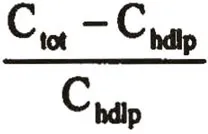
The functional reaction of the apolipoproteins with the tissue elements ensures a system of transportation of the lipids in an organism and facilitates the formation of atherosclerotic changes in the vessels. The directed transfers of apolipoproteins between the lipoproteins of different classes during fasting or taking food, performing physical exercise, and taking various metabolic drugs determine in every person the individual nature of the physiological relations of lipid metabolism.
When speaking of apo-A-1 (the main protein of HDLP), we cannot fail to consider briefly the antiatherogenic role of HDLP.
It was shown in clinical and experimental studies that the antiatherogenic function of HDLP is achieved as a result of the acception by them of unesterified cholesterol from the membranes of the smooth muscle and endothelial cells of the vessels, and also from the VLDLP and chylomicrons in the hydrolysis of their triglycerides in the blood plasma. The biochemical transformation of unesterified cholesterol into the esterified material proceeds with the participation of the enzyme lecithin acyl transferase (LAT). The product of a reaction catalyzed by LAT — esterified cholesterol — forms only on the surface of HDLP particles containing apo-A-1 in a complex with apo-D and LAT [490, 515, 617].
The particles of HDLP2 transfer cholesterol esters into the liver, where the cholesterol transforms into bile acids that are excreted from the organism. The system of with-drawing cholesterol from tissues in a healthy organism achieved by HDLP consists of several units, each of which performs a strictly definite function: (i) the protein-lipid structure of the surface monolayer ensures the building into it of unesterified cholesterol, (ii) the enzyme system conducts a reaction catalyzed by LAT with its activator apo-A-1 and inhibitor apo-A-2, (iii) the system of nonenzymatic directed transportation of cholesterol esters includes lipid-carrying proteins.
This self-regulating system under physiological conditions performs an antiatherogenic function autonomously. The degree of activity of the entire system is determined in many ways by the activity of the LAT and the intensity of removing the product of the reaction it catalyzes (esterified cholesterol) from the surface of the HDLP particles. When the rate of this reaction is higher, the inflow to the fine spherical particles of HDLP of the unesterified cholesterol from both the LP enriched in TG (chylomicrons and VLDLP) and the cell membranes is more active.
The development of the atherosclerotic process in IHD patients is affected by the ratio of the intensities of two nonenzymatic processes of transportation of cholesterol esters, namely, in the composition of HDLP2 into the liver (for the removal of cholesterol from an organism), and in the composition of VLDLP and LDLP into the smooth muscle and endothelial cells of a vessel wall [115, 203, 282, 288].
In view of the fact that the nature of lipid metabolism in every person is an integrative quantity depending both on genetic and environmental factors (the nature of feeding, physical activity, level of hormonal regulation, age, etc.), we studied 37 healthy men from 20 to 51 years old (23 from 20 to 29 years old, 6 from 30 to 39, and of 8 from 40 to 51). All of them were mental workers: students and instructors of a medical institute (22), scientific workers (7), physicians and engineers (8). None of them had arterial hypertension, endocrine disorders, obesity, diseases of the liver or kidneys, or took drugs during the investigation period, To exclude IHD, all of them were examined with the aid of instrumental and laboratory methods. No indications of disturbance of coronary blood circulation or other lesions of the myocardium were discovered on the ECG at rest. When making tests with a physical load according to the conventional scheme, all of the examined persons revealed the retaining of a high physical workability. The individual power of the threshold load varied from 900 to 1320 kgm/min (on an average 1040±42 kgm/min). No indications of ischemia of the myocardium, disorders of the rhythm and conductance (according to the results of the ECG), appearance of other symptoms requiring the stopping of the physical load in veloergometry was discovered in any of the persons tested. When collecting anamnesis for excluding IHD, we used J.Rose’s standard questionnaire.
The content of cholesterol, triglycerides, and HDLP cholesterol was determined by the chemical method in an analyzer AA-11 of the Tekhnikon firm, and the content of apo-A-l and apo-B by the method of quantitative rocket immunoelectrophoresis with the use of antiserums at the Center of prophylactic medicine.
To reveal the group with atherogenic DLP, we used the criteria proposed by...
Table of contents
- Cover
- Half Title
- Title Page
- Copyright Page
- Table of Contents
- List of Abbreviations
- Introduction
- Chapter 1. Features of Lipid Metabolism in Diabetes Mellitus and Ischemic Heart Disease
- Chapter 2. Disorders in the Hemostasis System and Changes in the Rheological Properties of the Blood in Ischemic Heart Disease and Diabetes Mellitus Patients
- Chapter 3. Diabetes Mellitus and Ischemic Heart Disease
- Conclusion
- Bibliography
- Iindex
Trusted by 375,005 students
Access to over 1.5 million titles for a fair monthly price.
Study more efficiently using our study tools.
Frequently asked questions
Yes, you can cancel anytime from the Subscription tab in your account settings on the Perlego website. Your subscription will stay active until the end of your current billing period. Learn how to cancel your subscription
No, books cannot be downloaded as external files, such as PDFs, for use outside of Perlego. However, you can download books within the Perlego app for offline reading on mobile or tablet. Learn how to download books offline
Perlego offers two plans: Essential and Complete
- Essential is ideal for learners and professionals who enjoy exploring a wide range of subjects. Access the Essential Library with 800,000+ trusted titles and best-sellers across business, personal growth, and the humanities. Includes unlimited reading time and Standard Read Aloud voice.
- Complete: Perfect for advanced learners and researchers needing full, unrestricted access. Unlock 1.5M+ books across hundreds of subjects, including academic and specialized titles. The Complete Plan also includes advanced features like Premium Read Aloud and Research Assistant.
We are an online textbook subscription service, where you can get access to an entire online library for less than the price of a single book per month. With over 1.5 million books across 990+ topics, we’ve got you covered! Learn about our mission
Look out for the read-aloud symbol on your next book to see if you can listen to it. The read-aloud tool reads text aloud for you, highlighting the text as it is being read. You can pause it, speed it up and slow it down. Learn more about Read Aloud
Yes! You can use the Perlego app on both iOS and Android devices to read anytime, anywhere — even offline. Perfect for commutes or when you’re on the go.
Please note we cannot support devices running on iOS 13 and Android 7 or earlier. Learn more about using the app
Please note we cannot support devices running on iOS 13 and Android 7 or earlier. Learn more about using the app
Yes, you can access Obesity and Diabetes Mellitus by E. I. Sokolov,Sokolov in PDF and/or ePUB format, as well as other popular books in Medicine & Cardiology. We have over 1.5 million books available in our catalogue for you to explore.