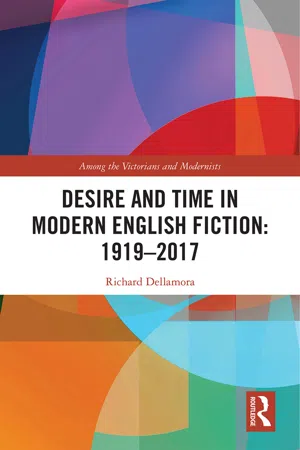
Beginning with Somerset Maugham's innovative, sexually dissident South Seas novel and tales and Alfred Hitchcock's gay-inflected revisiting of the Jack the Ripper sensation in silent film, this book considers the continuing presence of the past in future-oriented work of the 1930s and the Second World War by Sylvia Townsend Warner, Virginia Woolf, George Orwell, and the playwright and novelist, Patrick Hamilton. The final three chapters carry the discussion to the present in analyses of works by lesbian, postcolonial, and gay authors such as Sarah Waters, Amitav Ghosh, and Alan Hollinghurst. Focusing on questions about temporality and changes in gender and sexuality, especially gay and lesbian, straight and queer, following the rejection of the Victorian patriarchal marriage model, this study examines the continuing influence of late Victorian Aestheticist and Decadent culture in Modernist writing and its permutations in England.
- 264 pages
- English
- ePUB (mobile friendly)
- Available on iOS & Android
eBook - ePub
Desire and Time in Modern English Fiction: 1919-2017
About this book
Information
1 Modernity and Degeneration in Somerset Maugham and Paul Gauguin
The Moon and Sixpence and the South Sea Tales
In his recent study, Modernism and the Reinvention of Decadence, Vincent Sherry has directed attention to a temporal paradox in early modernist writing: namely, that despite its emphasis on contemporaneity, present time in works such as the seafaring fictions of Joseph Conrad is marked by an atmosphere of social, political, and cultural decline. Sherry locates this apparent contradiction in the subject-position of Conrad’s narrators, who carry with them their author’s “residual allegiance” both as a man who had once “served in the British mercantile empire” and as an observer noting “the intensifying pressure of the recognition of the end-of-empire days.”1 Sherry argues that Conrad’s fiction negates nineteenth-century narratives that equated the expansion of empire with the “Progress” (123) of civilization. Sherry instead finds in early twentieth-century works by British and Anglo-American modernists a sense of temporality as consisting in an abstract sense of “aftermath” (122), blank un-time, space in which time is suspended.2
The sense of stasis that one frequently encounters in reading the Oriental fictions of Somerset Maugham expresses in temporal terms the folding of the narrative within a sense of imperial totality. Empire provides the inescapable framework in which the action occurs. This temporality includes three dimensions. In present time, empire is experienced as coming to an as yet deferred end. This moment is also recursive, referring to an earlier time, which some characters describe as one of imperial plenitude. Third, the present foreshadows the end of empire at some definitive but as yet unspecified moment in future such as, for example, the date of the formal partition of India in August, 1947. Imperial time, then, continually anticipates decline and ending, awareness of which can be discerned in the attitudes and behavior of fictional characters, for example, in a comment by Westfield, the District Superintendent of Police (19) in George Orwell’s Burmese Days, who remarks: “This country’ll never be fit to live in again. British Raj is finished if you ask me. Lost Dominion and all that. Time we cleared out of it….. No Anglo-Indian will ever deny that India is going to the dogs, or ever has denied it—for India, like Punch, never was what it was.”3
In Maugham’s south sea tales and The Moon and Sixpence (1919), his homage to Paul Gauguin, Europeans often find themselves in a temporally suspended environment in which they are confined to remote, albeit oddly suburban, outstations with bungalows, well-tended gardens, tennis courts, golf courses, and social clubs. Further afield, at rubber plantations and in forests from which teak is extracted, time is experienced in terms of the rise and fall of the business cycle. The sense of time as repetitive or in abeyance responds to a usually unvoiced recognition that the British Empire, which reached its greatest physical extent in the decade following World War I, was time-dated, that is, that its contraction and likely end were glimpsed beyond the horizon of an already anticipated Second World War.
Nonetheless, in an introductory note to The Casuarina Tree (1926), a collection of short stories set in British Malaya, Maugham engages the temporality of Empire in positive terms. There he briefly considers the timeline of Britain’s colonial dependencies by invoking the biological metaphor of the life span of the Casuarina tree. An ungainly plant often found growing at the edge of groves of mangrove trees in waste tidelands, the species plays a key role in supporting the formation of soils suitable for agriculture. Maugham compares this de facto fecundity to the fruits of labor of British officials, engineers, and plantation managers. He perceives these individuals to be as hardy and unprepossessing as “the Casuarina tree” itself, which “stood along the seashore, gaunt and rough-hewn, protecting the land from the fury of the winds.” Similarly, he continues, “planters and administrators… with all their shortcomings have… brought to the peoples among whom they dwell tranquility, justice and welfare.”4 Maugham distinguishes three generations among these temporary settlers: first, “the pioneers who had opened these lands to Western civilization.” Next, a second generation whose “work” had helped fashion a new “country…, peaceable, orderly, and sophisticated.” Those in this group were succeeded in turn by members of “a generation” whom Maugham traveled among, “more varied, but less adventurous” (v). This genealogy is not literal but symbolic since British entanglement in India, Malaya, and Borneo began far earlier than the model implies and was much more complex in its relation to indigenous relations of power than Maugham’s comments indicate. New factors included the arrival of white women, at times as prostitutes but more often as wives of local officials. Their appearance on the scene radically affected already existing mores governing intimacies between white men and native women.5
Despite the propagandistic character of the introductory note, Maugham’s stories dally with the pleasures, pains, and ennui of decadence, a time-space continuum rendered literal in the entanglement of British and, occasionally, American subjects in the territories of India, Malaya, China, and the South Seas. For example, the young narrator of The Moon and Sixpence is divided between outward conformity to late Victorian bourgeois norms, on the one hand, and fascination with a rebellious alter ego, Charles Strickland, an émigré British artist who had abandoned his own wife and family at home in London. A successful middle-aged stockbroker and head of family, Strickland without notice deserts his family, at first for Paris, then for Marseilles, and, eventually, for Tahiti, where he lives as a bohemian art-maker and sensualist. On the pretext of agreeing to help Strickland’s wife find her husband, the narrator follows Strickland to France, then further abroad. For the remainder of the novel, the narrator seeks the solution of what he thinks of as the Strickland paradox: namely, how could this seemingly typical bourgeois morph overnight into a rebellious artist, abandoning family and business for the sake of personal and artistic freedom?
Strickland’s revolt calls to mind that of another late Victorian rebel, namely the successful Anglo-Irish playwright, journalist, man about town, social critic, and sexual dissident, Oscar Wilde, who in 1895 had been tried and found guilty on charges of gross indecency with other males. Already earlier in his career, Wilde had been singled out for denunciation by the Austro-Hungarian Jewish physician, Max Nordau, in his book, Degeneration (1892; trans. 1895). In this work, Nordau, who positioned himself as the leading scientific expert on social and cultural degeneration, defined it as an ailment of the nervous system resulting from the conditions of contemporary urban existence. Citing Paul Bourget, Nordau writes:
A society in decadence ‘produces too great a number of individuals unfit for the labours of common life’; these individuals are precisely the degenerate; ‘they cease to subordinate their energy to the total energy,’ because they are ego-maniacs, and their stunted development has not attained to the height at which an individual reaches his moral and intellectual junction with the totality, and their ego-mania makes the degenerate necessarily anarchists, i. e., enemies of all institutions which they do not understand, and to which they cannot adapt themselves. It is very characteristic that M. Bourget, who sees all this, who recognizes that ‘decadent’ is synonymous with inaptitude for regular functions and subordination to social aims, and that the consequence of decadence is anarchy and the ruin of the community does not the less justify and admire the decadents, especially Baudelaire.6
Wilde and his associates, however, saw themselves and their work as constituting a self-consciously modern tendency within late Victorian culture with linkages to contemporary feminist, left liberal, democratic, Marxian, and anarchist modes.7 Maugham’s dispassionate exploration of the condition of working-class South Londoners in his first novel, Liza of Lambeth (1897), his admiration for avant-garde French art, and his bisexual personal life demonstrated an affinity with these strains in Victorian culture.8
In The Moon and Sixpence, Maugham’s affinity is even more pronounced with Gauguin, the French painter whose years in Tahiti and the Marquesas resulted in work that helped shape twentieth-century conceptions of the artist and art-making. Gauguin’s self-fashioning as a rebel against domestic obligations, his outspoken pursuit of sensual happiness, and the prominent place that his paintings enjoyed in the First Post-Impressionist Exhibition (1910) in London all contributed to making him a legendary figure. In addition, Gauguin shared Wilde and Maugham’s attraction to young men. In his Tahitian journal, Noa, Noa, Gauguin imagines having the experience of being in the position of the receiver in sexual intercourse with an androgynous yet virile young man: “Etre une minute l’être faible qui aime et obéit.”9 While serving in an ambulance corps in France in 1914, Maugham’s own sexual identity became more defined following his meeting with a young American homosexual, Gerald Haxton. At this time, the pair began an intimacy that was to continue until Haxton’s death in 1944. Pressured into marriage in England in 1915 after having unintentionally become a father, Maugham decided to leave London behind on his first journey to Polynesia, a trip in which Haxton accompanied him.
Gauguin is a dialectical thinker who consistently undermines antithetical formulations, a procedure that results in the revaluation of key terms. When he arrived in Papeete, the capital of French Polynesia, he found not a South Sea idyll such as Herman Melville had described in Typee (1846) but instead a Maori population in course of being deracinated as a result of Tahiti’s colonial status. This condition was about to be formalized as a result of the imminent death of King Pomare, which occurred shortly after Gauguin’s arrival. To his surprise, Gauguin encountered an indigenous population in his view mimicking the signs of Western civilization. “It was Europe—the Europe which I had thought to shake off—and that under the aggravating circumstances of colonial snobbism, and the imitation, grotesque even to the point of caricature, of our customs, vices, and absurdities.”10
While still in Papeete, however, Gauguin discerned a way out of colonial degeneration. He sensed this possibility in the decoration that Queen Maraü prepared for the royal hall in which her deceased husband was la...
Table of contents
- Cover
- Half Title
- Series Page
- Title Page
- Copyright Page
- Table of Contents
- Acknowledgments
- Introduction
- 1 Modernity and Degeneration in Somerset Maugham and Paul Gauguin: The Moon and Sixpenceandthe South Sea Tales
- 2 Haunting the West End: Oscar Wilde and Silent Hitchcock
- 3 History and Revolution in Sylvia Townsend Warner’s Summer Will Show
- 4 Pathological Legacies: Patriarchy in Virginia Woolf, Lytton Strachey, and John Maynard Keynes
- 5 “A New Space of Time”: Determining the Future in The Years
- 6 Sexual Politics and Blackout in Patrick Hamilton’s Rope, Gaslight,and Hangover Squar
- 7 George Orwell, Futurity, and Male Homosexual Panic
- 8 Queering Past—and Future—in Sarah Waters’ Affinity
- 9 Ecological Time and Social Desire in Amitav Ghosh’s The Hungry Tide
- 10 Male Homoerotics in the Metamodernist Fictions of Alan Hollinghurst
- Index
Trusted by 375,005 students
Access to over 1.5 million titles for a fair monthly price.
Study more efficiently using our study tools.
Frequently asked questions
Yes, you can cancel anytime from the Subscription tab in your account settings on the Perlego website. Your subscription will stay active until the end of your current billing period. Learn how to cancel your subscription
No, books cannot be downloaded as external files, such as PDFs, for use outside of Perlego. However, you can download books within the Perlego app for offline reading on mobile or tablet. Learn how to download books offline
Perlego offers two plans: Essential and Complete
- Essential is ideal for learners and professionals who enjoy exploring a wide range of subjects. Access the Essential Library with 800,000+ trusted titles and best-sellers across business, personal growth, and the humanities. Includes unlimited reading time and Standard Read Aloud voice.
- Complete: Perfect for advanced learners and researchers needing full, unrestricted access. Unlock 1.5M+ books across hundreds of subjects, including academic and specialized titles. The Complete Plan also includes advanced features like Premium Read Aloud and Research Assistant.
We are an online textbook subscription service, where you can get access to an entire online library for less than the price of a single book per month. With over 1.5 million books across 990+ topics, we’ve got you covered! Learn about our mission
Look out for the read-aloud symbol on your next book to see if you can listen to it. The read-aloud tool reads text aloud for you, highlighting the text as it is being read. You can pause it, speed it up and slow it down. Learn more about Read Aloud
Yes! You can use the Perlego app on both iOS and Android devices to read anytime, anywhere — even offline. Perfect for commutes or when you’re on the go.
Please note we cannot support devices running on iOS 13 and Android 7 or earlier. Learn more about using the app
Please note we cannot support devices running on iOS 13 and Android 7 or earlier. Learn more about using the app
Yes, you can access Desire and Time in Modern English Fiction: 1919-2017 by Richard Dellamora in PDF and/or ePUB format, as well as other popular books in Languages & Linguistics & Linguistics. We have over 1.5 million books available in our catalogue for you to explore.