Sport is an integral part of society, playing a key role in human health and well-being, and cultural, political and economic development. As sport is becoming more complex, competitive, diverse, and increasingly reliant on technology, HFE theories, methods, and principles are progressively being applied to help understand and optimize sports systems.
Human Factors and Ergonomics in Sport: Applications and Future Directions showcases the latest in sports HFE research and practice. Including contributions from both HFE and sports science researchers, it provides a collection of state-of-the-art studies, reviews and commentaries covering a diverse set of sports and sporting issues.
"This book is an excellent resource for all academics and students in general. It provides updated theoretical foundations and applications that conceive a world where everything is connected and embedded in technology that allows us to capture, process and visualise actions and interactions, also at transdisciplinary levels."
Professor Jaime Sampaio, Head of the Research Center in Sports Sciences, Health and Human Development (CIDESD), University of Trás-os-Montes e Alto Douro, Portugal
"With the changing nature of work comes an ever-greater focus on leisure. Sport is a major dimension of this crucial form of human activity. Now comes Salmon and his colleagues who have assembled a panoply of world leaders who each provide their own individual perspectives on this intriguing world. Their emphasis on the human factors and ergonomics of these activities brings us new and exciting insights. A great read for the specialist and generalist alike."
Professor Peter Hancock, Pegasus Professor, Provost Distinguished Research Professor and Trustee Chair, University of Central Florida, USA.
"Finally, the complexity of sports and health is being considered in full. This book challenges contemporary thinking toward the prevention of injuries in sports, and provides tangible solutions to help our field into a new decade."
Professor Evert Verhagen, Amsterdam Collaboration on Health and Safety in Sports & Department of Public and Occupational Health, VU University Medical Center
Looking at and beyond the Recognition-Primed Decision Model
Anne-Claire Macquet
CONTENTS
9.1 Introduction
9.2 The RPD Model
9.3 An Overview of Studies Using the RPD Model in Sports and Discussion
9.3.1 Study Aims
9.3.2 Method
9.3.3 Results and Limitations
9.3.3.1 The Split between the Three Levels of the RPD Model
9.3.3.2 The By-Products Used to Recognise the Situation as Typical
9.3.3.3 Decisions Driven by Adaptation in the Course of Action or Anticipation
9.4 The Revisited RPD Model and Discussion
9.4.1 Two More Assertions
9.4.2 The Revisited RPD Model
9.4.3 Empirical Support for the Revisited RPD Model and Discussion
9.5 Practical Application in Sport
9.6 Conclusion
9.7 Acknowledgments
References
9.1 Introduction
In sports, athletes, coaches, and referees (ACRs) have to make efficient decisions in a short time frame. In dynamic sports, they have to rapidly determine what is happening, where and when (Macquet, 2009). Information may be available rapidly or conversely may not be available rapidly enough, even when such information seems important for decision-making. This situation’s uncertainty and time constraints involve a conflict: ACRs have to act promptly even though they may lack the information to rapidly understand a given situation. Given the time constraints, they may have to settle for partial and sufficient situation understanding in order to still have the time to carry out an action (Amalberti, 2001; Klein, 2008). Where this is the case, they can anticipate situation evolution to assist in decision-making.
Nevertheless, they risk implementing a decision that is not adapted to the actual situation. Alternatively, they can wait for the situation to evolve before making a decision, and in doing so, take the risk of implementing a decision too late. In addition to dealing with time and uncertainty, ACRs also have to manage stress and emotions. It has been suggested that stress and emotions can lead to a distortion of situation understanding (Macquet, 2016).
Most competitive situations in sports resemble dynamic situations studied using the Naturalistic Decision-Making (NDM) approach. Dynamic situations present the following key contextual factors: (a) time pressure and ill-structured problems; (b) uncertain and dynamic environments; (c) competitive goals; (d) decision loops (more than one decision); (e) many players and high stakes; and (f) organisational goals and norms (Zsambok, 1997). NDM focuses on experts’ decision-making when experts are dealing with complex, uncertain and dynamic environments as opposed to novices’ decision-making in laboratory settings (e.g. Klein, 2008).
In addition to the complexity of decisions, sports situations require experts to implement decisions using their motor skills. The level of these skills varies over the competition, depending on fatigue and emotion (Macquet, 2016). Athletes need to make decisions they are able to undertake efficiently, both physically and mentally.
Using NDM, decision-making models have been developed in dynamic and natural environments (e.g. Hoc & Amalberti, 2007; Klein, 1997; Rasmussen, 1983) to provide an alternative to the classical models of decision-making developed in static environments (e.g. Tversky & Kanheman, 1974). NDM models showed that experts did not often compare possible options; rather, they often took the first option that came to mind (e.g. Klein, 2008). Klein, Calderwood, and Clinto-Cirocco (1986) and Klein (1997) developed the Recognition Primed-Decision (RPD) model to explain how experts use their experience to make good decisions in natural settings. The RPD model postulates that experts rely on intuition to make their decisions. They use their experience to quickly draw a picture of the situation and make rapid decisions without having to compare options (Klein, 1997).
This chapter aims to provide an overview of studies using the RPD model in sports and to then revisit the RPD model in order to account for anticipation and planned decisions. More specifically, it aims to (a) explain the RPD model; (b) analyse the studies using the RPD model and their limitations; and (c) present the revisited RPD model.
9.2 The RPD Model
The RPD model is based on three assertions. First, experts use their experience to decide to implement a possible course of action similar to the first one they consider. Second, because they use their experience and pattern-matching ability, time pressure does not affect performance. They recognise the typicality of a situation and generate a typical course of action. For Klein (2009, 2015), pattern-matching involves intuition. Intuition is used when decision-makers rely on a repertoire of patterns built up from experience to make decisions. It differs from automaticity trained under controlled situations (Klein, 2015). Experience enables experts to make decisions in challenging situations with a sufficient level of success. Third, that decision-makers can generate options without comparing different options. Decision-making is an intuitive process that enables experts to know what course of action will work. Decision-makers distinguish the information needed to make a satisfactory decision (Klein, 2009).
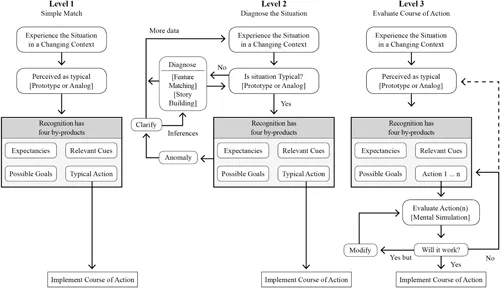
The RPD model presents three levels: (a) simple match; (b) diagnose the situation; and (c) evaluate course of action (Figure 9.1). The first refers to rapid situation recognition and the implementation of the typical action corresponding to the typical situation. For example, a fencer extended his/her elbow to hit the opponent’s arm; the opponent implemented a circular parry to prevent the sword from reaching his/her arm and riposted by touching the fencer’s thigh. The second is related to the difficulty in recognising the situation rapidly, because information is not yet available or the situation has suddenly changed. Understanding is consequently hampered by inconsistencies and anomalies. The expert needs more time to diagnose the situation in order to recognise it as typical; once he/she recognises it, he/she adapts the typical action to the current situation and implements it. For example, a volleyball player decided to move back to defend a powerful shot at the back of the court; suddenly, the ball was deflected by the block and fell into the middle of the court. The defender moved forwards to defend. The third level refers to an assessment of the workability of a course of action. If the expert simulates that it could work, he/she implements it, if not, he/she changes it (Klein, 1997; Klein et al., 1986, see Figure 9.1). For example, a basketball player aimed to pass the ball to a teammate who was marked. She/he simulated that the opponent might catch the ball, consequently she/he passed the ball to another teammate who was free of any defenders.
FIGURE 9.1 Recognition-primed decision model (Klein, 1997).
The RPD model is based on two processes: situation recognition and mental simulation. Situation recognition enables the expert to assess the situation typicality using salient features that experience has shown useful and determine whether the situation is familiar/unfamiliar or atypical. It is based on the construction of a frame (i.e. mental model) of the actual situation, which is compared with a similar frame associated with a previous situation stored in memory from experience (Klein, 1998, 2003, 2009). Frames can also refer to knowledge about a job or life, for example, for fire-fighters, it might include the way a fire develops; for sports team players, how to coordinate players from the playbook. Such models enable understanding of how things and people work.
Recognition is achieved using four by-products: (a) relevant cues (e.g. the setter is setting the ball to the centre hitter); (b) expectancies (e.g. the blocker is expecting the hitter to attack from the centre of the pitch); (c) plausible goals (e.g., block the ball at the middle of the net in volleyball); and (d) typical action to be implemented (e.g. block the centre player’s hit). These by-products are used to assess the situation and make sense of it. Bounded rationality (Simon, 1996) suggests that the decision-maker cannot connect all the data and has to prioritise certain information to reach a conclusion and complete a course of action in time. Recognition involves framing. Framing consists of fitting data into a frame and fitting the frame around data (Klein, Moon, & Hoffman, 2006a, 2006b). The frame is then compared to patterns contained in memory to identify whether it matches a typical situation associated with a typical action. Framing relates to the ‘simple match’ level of the RPD model.
The frame is dynamic: it can be changed when inconsistencies are noticed and new information is received. It is then enriched by such information (i.e. reframing). Reframing concerns the ‘diagnose the situation’ level of the RPD model. Framing is related to Piaget’s (1954) concept of assimilation, and reframing Piaget’s (1954) concept of accommodation. Framing and reframing are central to the process of sense-making. Sense-making is the deliberate effort to understand situations (Klein et al., 2007), in order to direct control of a situation or crisis (Weick, 1995).
Mental simulation provides the means to assess the situation in time-pressure settings without having to compare options (Klein, 1998) and to use analytical decision-making and problem-solving strategies (Klein & Crandall, 1995). For example, the coach noticed that an athlete was being distracted by the speaker’s voice and background noise. He/she mentally simulated that if he/she told the athlete to ignore the noise, the athlete would have paid even more attention to the noise. He/she did not have to investigate the possible options to prevent the athlete from being influenced by the noise. He/she just told the athlete to focus on his/her technique. Decision-makers use tacit knowledge based on experience to perceive affordances and make sense of a situation. Mental simulation is related to Pia...
Table of contents
Cover
Half-Title
Title
Copyright
Contents
Preface
Editors
Contributors
SECTION I Introduction to HFE in Sport
SECTION II Physical HFE Applications
SECTION III Cognitive HFE Applications
SECTION IV Systems HFE Applications
SECTION V Future Applications of HFE in Sport
Index
Trusted by 375,005 students
Access to over 1.5 million titles for a fair monthly price.
Study more efficiently using our study tools.
Frequently asked questions
Yes, you can cancel anytime from the Subscription tab in your account settings on the Perlego website. Your subscription will stay active until the end of your current billing period. Learn how to cancel your subscription
No, books cannot be downloaded as external files, such as PDFs, for use outside of Perlego. However, you can download books within the Perlego app for offline reading on mobile or tablet. Learn how to download books offline
Perlego offers two plans: Essential and Complete
Essential is ideal for learners and professionals who enjoy exploring a wide range of subjects. Access the Essential Library with 800,000+ trusted titles and best-sellers across business, personal growth, and the humanities. Includes unlimited reading time and Standard Read Aloud voice.
Complete: Perfect for advanced learners and researchers needing full, unrestricted access. Unlock 1.5M+ books across hundreds of subjects, including academic and specialized titles. The Complete Plan also includes advanced features like Premium Read Aloud and Research Assistant.
Both plans are available with monthly, semester, or annual billing cycles.
We are an online textbook subscription service, where you can get access to an entire online library for less than the price of a single book per month. With over 1.5 million books across 990+ topics, we’ve got you covered! Learn about our mission
Look out for the read-aloud symbol on your next book to see if you can listen to it. The read-aloud tool reads text aloud for you, highlighting the text as it is being read. You can pause it, speed it up and slow it down. Learn more about Read Aloud
Yes! You can use the Perlego app on both iOS and Android devices to read anytime, anywhere — even offline. Perfect for commutes or when you’re on the go. Please note we cannot support devices running on iOS 13 and Android 7 or earlier. Learn more about using the app
Yes, you can access Human Factors and Ergonomics in Sport by Paul M. Salmon, Scott McLean, Clare Dallat, Neil Mansfield, Colin Solomon, Adam Hulme, Paul M. Salmon,Scott McLean,Clare Dallat,Neil Mansfield,Colin Solomon,Adam Hulme in PDF and/or ePUB format, as well as other popular books in Technology & Engineering & Industrial Engineering. We have over 1.5 million books available in our catalogue for you to explore.