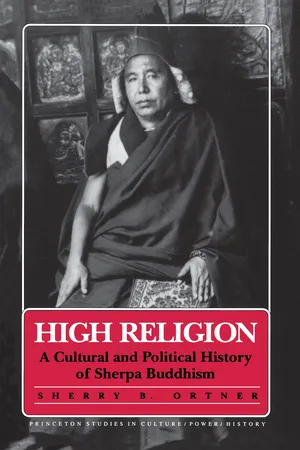
An eminent anthropologist examines the foundings of the first celibate Buddhist monasteries among the Sherpas of Nepal in the early twentieth century--a religious development that was a major departure from "folk" or "popular" Buddhism. Sherry Ortner is the first to integrate social scientific and historical modes of analysis in a study of the Sherpa monasteries and one of the very few to attempt such an account for Buddhist monasteries anywhere. Combining ethnographic and oral-historical methods, she scrutinizes the interplay of political and cultural factors in the events culminating in the foundings. Her work constitutes a major advance both in our knowledge of Sherpa Buddhism and in the integration of anthropological and historical modes of analysis.
At the theoretical level, the book contributes to an emerging theory of "practice," an explanation of the relationship between human intentions and actions on the one hand, and the structures of society and culture that emerge from and feed back upon those intentions and actions on the other. It will appeal not only to the increasing number of anthropologists working on similar problems but also to historians anxious to discover what anthropology has to offer to historical analysis. In addition, it will be essential reading for those interested in Nepal, Tibet, the Sherpa, or Buddhism in general.
- English
- ePUB (mobile friendly)
- Available on iOS & Android
eBook - ePub
About this book
Information
Publisher
Princeton University PressYear
2020Print ISBN
9780691028439
9780691094397
eBook ISBN
9780691218076
Topic
Theology & ReligionSubtopic
Buddhism
Introduction:
The Project, the People, and the Problem
THIS is the story of the establishment of the first celibate Buddhist monasteries among the Sherpas of Nepal—of how the monasteries were founded, and by whom, and especially why. It is also an essay on the relationship between worldly dominance and spiritual striving, between power and merit, politics and religion. And at the broadest level, it is an essay in thinking about human action in the world, about how people can be both created and creators, products and producers, symbols and agents, of that world.
Early in the twentieth century, the Sherpas began to build Buddhist monasteries. They had always practiced a “folk” form of Tibetan Buddhism, in which local married priests (lama) conducted rituals in village temples and in households for the benefit of the general populace. But the Sherpas had never before had the more “orthodox” monastic institutions, in which celibate individuals live and practice religion on a full-time basis. Unlike the married lamas, the monks and nuns withdraw from social life, do no (materially) productive labor, and devote their whole lives to the practice of religion.
The founding of the celibate monasteries thus represents, in about as visible a form as this sort of thing ever takes, the birth of a new (for Sherpa society) institution—an institution with its own rules, its own forms of social organization, its own values and ideals, its own raison d’etre. Once the Sherpa monasteries were built, a whole new process was set in motion: the monks launched a campaign to upgrade popular religion and to bring it into line with monastic views and values. The monasteries were thus to have a far-reaching impact on Sherpa society over the course of the twentieth century.
The effects of the newly established monasteries on Sherpa popular religion, culture, and society are the subject of a separate work (Ortner n.d.b). In the present work I will be concerned to illuminate the forces and processes that led up to the foundings in the first place. Who built the monasteries, and why? Who filled the monasteries, and why? What were the constraints—social, economic, political, cultural—on the people involved, and what were the provocations? In order to answer these questions, I have had to write a history of Sherpa society—of the society’s internal dynamics, and of the external forces that interacted with those dynamics, from the time of the Sherpa settlement in Nepal in the early sixteenth century to the time of the monastery foundings in the early twentieth.
Who Are the Sherpas?
It is relatively standard practice to start a work in anthropology with a brief sketch identifying and situating the people to be discussed. This is problematic in the present case for two reasons: first, because who the Sherpas are (in terms of institutional configuration) depends on what historical period one is talking about, and second, because who the Sherpas are (in terms of cultural configuration, or ethos) is a matter of quite divergent assessments on the part of their main ethnographers. I will be brief on both points, and provide more ethnographic detail as the need arises throughout the text.
Institutionally, the modern Sherpas are an ethnically Tibetan group living at high altitudes (between about 8,500 and 14,500 feet) in the Himalayan mountains of northeast Nepal. (Nepal is a Hindu kingdom of about 15.6 million people [Nepal 1984]; the Sherpas constitute one of many ethnic minorities within it.) They are thought to have migrated from Kham, in northeast Tibet, in the late fifteenth and early sixteenth centuries. They now occupy three connected regions of the area: Khumbu, the highest, coldest, and northernmost; Solu, the lower, (relatively) warmer, and southernmost; and Pharak, a valley running between Khumbu and Solu. There is a system of patrilineal clans, which in modern times primarily regulates (clan-exogamous) marriage. Their traditional economy combines agriculture (now mostly wheat and potatoes); herding (mostly yak and cow); and trade (selling rice from low-altitude Nepal in Tibet, and Tibetan salt in low-altitude Nepal, as well as breeding and selling dairy animals). They live in small villages and sometimes in isolated homesteads. Property in both land and animals is privately owned by families. They practice the Tibetan Buddhist religion, which includes in modern times both the monastic emphasis on merit and rebirth, and the popular emphasis on rites of exorcism and protection. Since the turn of the twentieth century, they have been very successfully involved in wage labor, as guides and porters for Himalayan mountaineering expeditions. Within the past decade or two, some have become successful entrepreneurs as well, running agencies in Kathmandu that organize mountaineering and trekking expeditions throughout Nepal.

Nepal within the greater Himalayan region
The Sherpas’ success in mountaineering was in part due to their physical hardiness and their physical and social high-altitude adaptations. But it was also due in large part—and here one arrives at the question of ethos—to their friendly and outgoing demeanor, and their willingness to work hard, long, and cheerfully for the greater good of an expedition. The Western mountaineers’ image of the Sherpa—good-natured, hard-working, loyal, reliable—was echoed by the first anthropologist to work with them (in 1954), Christoph von Fürer-Haimendorf. For example, von Fürer-Haimendorf began his monograph by saying:
What I have set out to do is to describe and analyze the type of society in which the Sherpas have developed their spirit of independence, their ability to cooperate smoothly for the common good, their courtesy and gentleness of manner and their values which are productive of an admirable balance between this- worldly and other-worldly aims. (1964:xix)
I first worked with the Sherpas in 1966. At that time, although I too found people to be quite outgoing, and in many ways quite easy to get along with, I also found much strain in social relations, a great deal of intracommunity conflict, and a general unwillingness on the part of the villagers to cooperate for the general welfare. I described Sherpa life as “premised on culturally defined and structurally induced tendencies toward individual selfishness and family insularity” (1978a:162). I also said:
Without denying that there are structures and processes of “community” in Sherpa villages . . . the point is that such community must be achieved through overcoming the basic atomism and insularity of the component family units. (1978a:41)
Much of my monograph was concerned with the way in which popular religion interacted with these structural tendencies in Sherpa society.1
There are many things to be said about these sorts of discrepancies in ethnographic observation and description, especially in the wake of the recent Mead/Freeman controversy (for an insightful review of the controversy, see Rappaport 1986). Differences in age, gender, cultural background, and the like all enter into the problem. At first I was inclined to put a great deal of weight on these more “subjective” factors. I now think, however, that the differences are relatively real and objective, and are essentially regional differences: von Fürer-Haimendorf worked in Khumbu and I, initially, in Solu. I later worked in Khumbu as well, and the people of that region did in fact appear more cooperative and community oriented. The reasons for these regional differences cannot be detailed here, and will in any event play no role in the present work. I note them here simply because, after thirty years of varied ethnographic research among the Sherpas, one can no longer give a simple account of their style or ethos.
Fieldwork
The fieldwork for this project entailed five months in the Sherpa regions of Khumbu and Solu, and in the capital of Nepal, Kathmandu, in 1979. I talked for the most part to people selected for having special knowledge of the events surrounding the foundings of the monasteries. (I had already spent seventeen months doing general ethnographic field work in the area in 1966–68, and four months making a film and collecting incidental data in 1976.) I had the impression beforehand that there might be some documentary evidence, but this turned out to play a minor role in the research.2 Rather, the work consisted almost entirely of asking people for personal memories, and for stories that they might know about the foundings of monasteries and of temples, and other aspects of Sherpa history.
Compared with earlier ethnographic fieldwork, the oral history fieldwork for this present project seemed very easy. In ethnographic fieldwork, as every field-worker knows, there are a range of difficulties in eliciting data, some general to the nature of the process, and some specific to the culture in question. For example, although the Sherpas have the concept of “custom” (as in, “What is Sherpa custom regarding X?”), nonetheless a lot of my questions about “Sherpa custom” seemed relatively meaningless to people, and they cooperated only out of kindness, or because of anxieties about the (imagined) consequences of non-cooperation. Further, the sequence of my ethnographic questions often seemed meaningless to informants, as I pursued aspects of a topic that seemed unimportant to them, rather than what they felt was the main point. This was especially the case with “expert” informants—generally lamas—who had their own agenda about what needed to be explained, and in what order, and I was more than once criticized for “jumping around” from topic to topic (from the informant’s point of view) rather than allowing the informant to present things in the “proper” order. Moreover, shortly after an interview during which the informant complained about my jumping from topic to topic, the subject of insanity came up with this same informant. I asked him about the causes of insanity, and he listed several items, including—pointedly—jumping from topic to topic.
The fact that there were indeed “experts” on certain matters (again, usually religious matters) in Sherpa society presented a different set of problems as well. Many lay people were uncomfortable acting as informants on religion, and told me to ask the lamas. My research assistant several times told me to stop asking “small” people about religion, as they didn’t really know anything. I protested that I wanted to know what a range of people knew and thought about such matters, but this did not make much sense, either to him or to others. (There was a subproblem connected with this point: I was told it was not nice to ask many different people the same question, as this implied that one hadn’t believed the first informant. The first time I was told this, it made me feel utterly despairing about the fieldwork. I simply had to ignore it in order to proceed.) Even among the lamas, the highest-status ones, from the Sherpa point of view, were not necessarily the best informants from the anthropologist’s point of view. I learned to take my informants in status order, even if it meant “wasting” a few interviews until I could get to the individual who could articulate what I needed to know.
All of these reactions were, of course, revealing in themselves, but it did mean that, to some degree, the anthropologist’s needs for certain kinds of information, and the Sherpas’ sense of what constituted meaningful information were frequently at odds. Although as time went on I learned to fit my needs better to Sherpa senses of the sensical (although I wonder now about the questions—having become somewhat Sherpaized—that I stopped even conceiving to ask), nonetheless I always felt to some degree that general, wide-ranging, ethnographic fieldwork was like the proverbial pulling of teeth.
The difference between the earlier ethnographic work and the oral history work for the present project was dramatic. For one thing, the whole project—described as “a history of Sherpa religion”—made sense to people. To a great extent, Sherpa history is a history of their religion. With a few exceptions, the only historical stories they have are connected with the foundings of religious institutions, and with the lives, miracles, and social relationships of the founders. Further, although the earlier fieldwork emphasized religion, it still covered a wide (even unlimited) range of other topics. This inquiry was much more focused. It also concentrated on the past, which I think was a relief to informants, who felt their own present personas were not under scrutiny. For the first time, I was spontaneously praised for what I was doing. As I wrote in my notes: “Everyone here is saying what a good project I’m doing, retrieving all this old information that will soon be gone, on religion, interviewing old people who will soon die, and so forth.”
Further, I did in general want to talk with people whom the Sherpas themselves considered “experts”—the people who knew the stories, or who had been personally involved in some of the events, or who had other reasons for being particularly well informed. Compared with the first project, the information seemed to flow from informants with relatively little effort on my part.
There were also historical reasons for this change in the fieldwork experience. Between 1966–68 and 1979 many Sherpas had become interested in their own history. Although there had already been some impact from mountaineering and tourism before my original field trip in 1966, this impact had been accelerating dramatically in the intervening period. The cumulative effect of this, and of other forces impinging on the Sherpas (including, it must be said, the virtually continuous presence of one or another researcher—anthropologist, Tibetologist, Buddhologist, linguist, and others—asking the Sherpas a lot of questions about themselves) was clearly an increase in Sherpa collective self-consciousness.
Based on fieldwork done in the 1950s, the ethnographer von Fürer-Haimendorf had written that the Sherpas displayed “scant interest in the past both of the Sherpa people as a whole, and of individual groups” (1964:144). By 1971, on the other hand, a Sherpa lama from the Solu region had written a religious history of the Sherpa people. The lama, Sangye Tenzing of Sehlo monastery, wrote this of his project: “I myself have had a strong desire to set down this religious history, shining forth like the splendid light of the moon” (1971:63). The lama not only wrote the book, he did fieldwork for it. In one of our conversations in 1979,
Sehlo lama was kind enough to praise my project. For himself he stressed that he did not do his out of his own head, but that he spent his own money, he went around examining chayik [the founding charters of temples and monasteries], talking to old men, and so forth.
According to the lama, the book represented two years of labor, most of which went into collecting the information—the writing itself, he said, was easy (see also MacDonald 1980b).
Other individuals made a point of claiming that they had historical interests as well. One man boasted that he had compiled a Sherpa clan history four years before the Sehlo lama, and that the Sehlo lama had looked at it when writing his book. Others whom I interviewed, who felt unsure about some point, said they planned to check on it with some more knowledgeable individual—not for me, but for their own interest. The Sehlo lama’s book was also being read by other literate Sherpas, both lamas and laymen.3
In sum, I found the fieldwork to be relatively painless. Not only was it fairly easy to elicit the information; it was fun. The process had a certain detective-story quality about it; one tracked down clues, made fortuitous discoveries, found heroes and villains, and had a sense of really “solving” something that had begun rather as a mystery.

Sangye Tenzing, head lama of Sehlo monastery and author of a history of Sherpa religion, 1976.
But if the fieldwork was easy compared with earlier fieldwork, the writing seemed doubly hard. It was precisely the narrative, mystery-story quality that caused the problems. In the first place, I simply found it difficult to assemble the narrative account of what happened in the foundings of the monasteries. I had bits and pieces of stories, and different versions of the bits and pieces, and different dates (or no dates) attached to the different versions. It took me about two months simply to construct a narrative account of the foundings of the first two monasteries. My anthropological training simply hadn’t prepared me to put together stories of this sort, and I found it all quite frustrating. (I also developed a lot more respect for narrative history.)
But there was a second, and more serious, difficulty with the writing: trying to interrelate the narrative on the one hand and what I would normally think of as “analysis” on the other. The two forms of writing and thinking kept getting in each other’s way. The story would have a certain momentum of its own, and it often seemed awkward and artificial to break into it and “do some analysis.” Yet the story could never speak for itself, could never tell its own story, as it were, and I had to intervene. The secret of the problem, of course, is that what I thought of at that point as “analysis” was essentially static, a matter of understanding what things mean and how they hang together, rather than a matter of understanding how things generate other things, or derive from other things, and so forth. Which brings me to the theoretical underpinnings of the present work.
Expanding Practice Theory
In the broadest sense, this book is meant to be a contribution to a theory of practice, that is to say, a theory of the relationship between the structures of society and culture on the one hand, and the nature of human action on the other. Practice theory has received significant attentio...
Table of contents
- Cover Page
- Title Page
- Copyright Page
- Dedication
- Contents
- List of Illustrations
- Acknowledgments
- Note on Orthography
- Dramatis Personae
- Chronology of Sherpa History
- Chapter I: Introduction: The Project, the People, and the Problem
- Chapter II: The Early History of the Sherpas: Fraternal Contradictions
- Chapter III: The Founding of the First Sherpa Temple: Political Contradictions
- Chapter IV: The Meaning of Temple Founding: Cultural Schemas
- Chapter V: The Sherpas and the State
- Chapter VI: The Political Economy of Monastery Foundings
- Chapter VII: The Big People Found the Monasteries: Legitimation and Self-Worth
- Chapter VIII: The Small People
- Chapter IX: Monks and Nuns
- Chapter X: Conclusions: Sherpa History and a Theory of Practice
- Appendix I: Two Zombie Stories of Early Khumbu
- Appendix II: Addendum to the Tengboche Chay
- Notes
- Glossary
- References
- Index
Trusted by 375,005 students
Access to over 1.5 million titles for a fair monthly price.
Study more efficiently using our study tools.
Frequently asked questions
Yes, you can cancel anytime from the Subscription tab in your account settings on the Perlego website. Your subscription will stay active until the end of your current billing period. Learn how to cancel your subscription
No, books cannot be downloaded as external files, such as PDFs, for use outside of Perlego. However, you can download books within the Perlego app for offline reading on mobile or tablet. Learn how to download books offline
Perlego offers two plans: Essential and Complete
- Essential is ideal for learners and professionals who enjoy exploring a wide range of subjects. Access the Essential Library with 800,000+ trusted titles and best-sellers across business, personal growth, and the humanities. Includes unlimited reading time and Standard Read Aloud voice.
- Complete: Perfect for advanced learners and researchers needing full, unrestricted access. Unlock 1.5M+ books across hundreds of subjects, including academic and specialized titles. The Complete Plan also includes advanced features like Premium Read Aloud and Research Assistant.
We are an online textbook subscription service, where you can get access to an entire online library for less than the price of a single book per month. With over 1.5 million books across 990+ topics, we’ve got you covered! Learn about our mission
Look out for the read-aloud symbol on your next book to see if you can listen to it. The read-aloud tool reads text aloud for you, highlighting the text as it is being read. You can pause it, speed it up and slow it down. Learn more about Read Aloud
Yes! You can use the Perlego app on both iOS and Android devices to read anytime, anywhere — even offline. Perfect for commutes or when you’re on the go.
Please note we cannot support devices running on iOS 13 and Android 7 or earlier. Learn more about using the app
Please note we cannot support devices running on iOS 13 and Android 7 or earlier. Learn more about using the app
Yes, you can access High Religion by Sherry B. Ortner in PDF and/or ePUB format, as well as other popular books in Theology & Religion & Buddhism. We have over 1.5 million books available in our catalogue for you to explore.