A guide for mining the imagination to find powerful new ways to succeed
We need imagination now more than ever—to find opportunities in adversity, rethink our businesses, and discover new paths to growth. Yet too many companies have lost their ability to imagine. What is this mysterious capacity? How does imagination work? And how can organizations keep it alive and harness it systematically?
The Imagination Machine answers these questions and more. Drawing on the experience and insights of CEOs across several industries, as well as lessons from neuroscience, computer science, psychology, and philosophy, BCG's Martin Reeves and Jack Fuller provide a fascinating look into the mechanics of imagination and lay out a six-step process for creating ideas and bringing them to life. These steps are:
Trigger: Disrupt existing mental models and put ourselves in a more imaginative mindset
Rethink: Focus on "what could be" rather than "what is"
Act: Create a feedback loop from the mind to the world and back again
Amplify: Spread an evolving idea to others to create collective imagination
Codify: Imagine a new organizational "machine" that will capture and exploit a new idea while leaving room for future reimagination
Sustain: Keep imagination alive to run and reinvent your company at the same time
Imagination is one of the least understood but most crucial ingredients of business success. It's what makes the difference between an incremental change and the kinds of pivots and paradigm shifts that are essential to success—especially during a crisis.
The Imagination Machine is the guide you need to demystify and operationalize this powerful human capacity, to inject new life into your company, and to head into unknown territory with the right tools by your side.
Corporations have changed the world radically in so many areas: medicine, consumer goods, transport, finance, agriculture, entertainment, communications. And they’ve done so by combining organizational abilities with the unique human capacity to imagine: the ability to see and create things that had never existed.
Who in the 1500s would have thought it would be possible to manufacture so many shoes and distribute them around the world? Who would have thought that writing and staging plays would turn into the television and movie industries, with performers given the same status as the nobility in ancient Rome? Who would have thought that a few people and a team of machines could run farms the size of small countries? If we had never imagined, we would have never taken the steps that led us to these once unimagined realities.
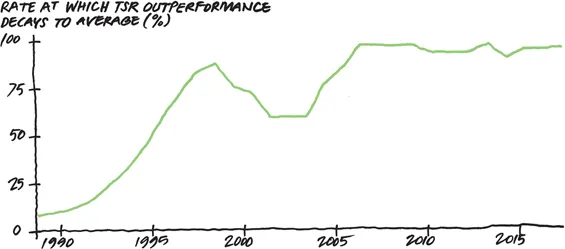
Imagination is needed now more than ever. Since competitive advantage is increasingly short-lived, driven by rapid evolution of the technological and business environment, companies constantly risk stagnation. Since the 1960s, the average number of companies exiting the Fortune 500 has increased by 36 percent annually, and the proportion of industries in which the top player has led for more than five years has nearly halved. Outperformance more quickly fades to the mean (see figure 1-1).1
Figure 1-1 Outperformance more quickly fades to the mean
Source:Data from S&P Capital IQ; BCG Henderson Institute analysis.
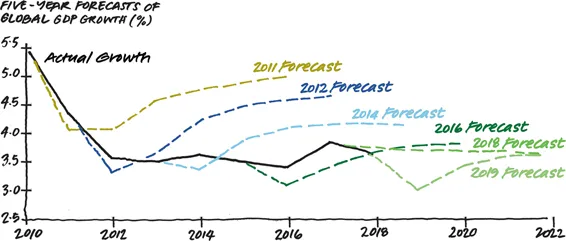
Companies also face declining market growth, driven by maturing demographics. Since 1970, worldwide GDP growth has fallen from 5.5 percent to 3.3 percent, and over the last decade, expectations have consistently fallen (see figure 1-2).
Figure 1-2 Global growth projections have shifted downward
These projections are from the fall IMF outlooks of each year; 2020 projections are not shown due to impact from Covid-19.Source:“A Bad Time to Be Average,” by Hans-Paul Bürkner, Martin Reeves, Hen Lotan, and Kevin Whitaker, July 22, 2019. Used by permission of the BCG Henderson Institute, a division of Boston Consulting Group. All rights reserved.
When everything is growing, it’s harder to see the need to imagine, explore, and experiment. Companies float on a rising tide. People have more money to buy more of your product, or an increasing population means there are more people who buy. But if you are in Europe, for instance, which grew at 5.5 percent in the 1970s and is growing at 2 percent today, you need good ideas. Participation in aggregate growth becomes harder, so growth has to be created through imagination.
And this has to happen at a higher frequency than ever. Companies need to reinvent themselves and their offerings again and again. A great model for making money and meeting people’s needs may quickly become unexceptional or even a liability, as yesterday’s assets and procedures become a source of inertia.
Corporations today all started as scrappy, entrepreneurial efforts, guided by imagination. Retaining or recovering this capacity in today’s ever larger corporations is the basis for their ongoing vitality and success.
At the same time, the world is facing a range of complex, collective problems:
Epidemics
Climate change
Inequality
Populism and social polarization
Lack of fresh water
Mental health issues
Cognitive overload
And so on
No business can afford to operate as though it is a world unto itself, independent of the systems of society and nature it is embedded in. As we have seen in the Covid-19 crisis, things seemingly far removed from a business’s concerns can suddenly undermine its ability to function. The problems listed above impact all humanity and our institutions. To address them, we will need to draw on our capacity for imagination. And business can play a central role in this.
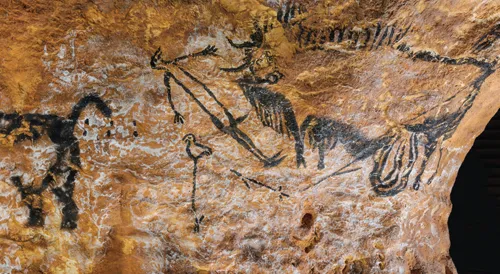
As a side note, it is interesting to reflect that imagination itself is partly responsible for our troubles. Yuval Noah Harari, historian and author of Sapiens, points out that since the beginning of agriculture, humans have been solving problems with their imagination, but that reimagining often merely sets the stage for new problems.2 We figured out how to cultivate wheat and invented ways to store it, but then wheat attracted scavengers and rivals, so we invented walls and defenses, but then settlements fostered infectious disease … and so on.
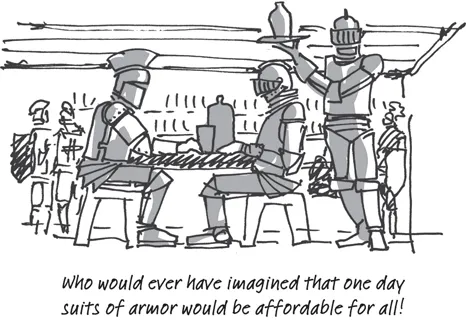
Who knew, 15,000 years ago, how much trouble the imagination would cause?Source:Courtesy of Philippe Psaila.
Any imaginative solutions will surely lead to further unexpected problems. But there is not much we can do about this, other than notice the species-level irony and make the next wave of imagination a productive one, sharpening our approach to harnessing this unique power.
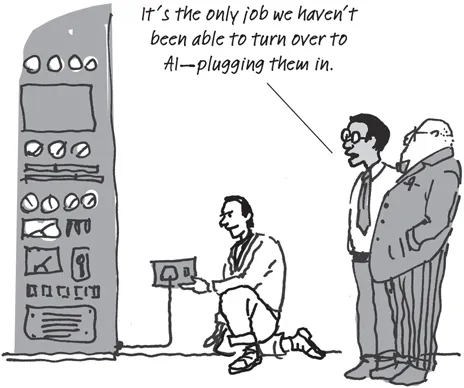
Finally, although artificial intelligence (AI) is still developing, its transformational power is clear. Unlike previous waves of technology, AI threatens to replace not routine physical work but routine cognitive work, much of which we call “management.” This raises the question: What will the humans do? The answer is that we will be left with the skills that are still unique to humans. Competitive advantage will accrue to firms that can shift focus to these skills, that develop ways of working to get the most out of human imagination and higher-level cognition, while lower-level analysis and decision making are increasingly automated.
Like the revolutions that followed from steam, steel, electricity, and the combustion engine, we won’t get the full benefits of the technology unless we reorganize our ways of working. When we invented the electric motor, we didn’t get the benefit until we reorganized the factory.3 Because AI is a cognitive technology, we won’t get the benefits unless we rethink the cognitive aspect of business—unless we build companies that cultivate and harness the most valuable mental capacities of the humans within them, working together with intelligent algorithms.
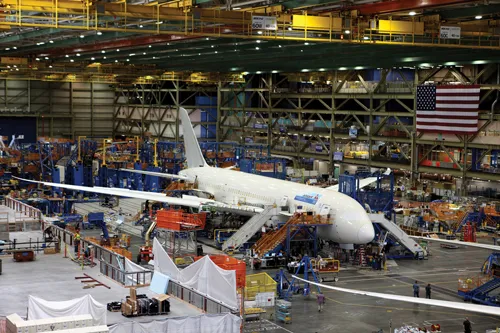
Beyond the assessment of people’s skills around hiring, promotion, and a handful of other tasks, the cognitive dimension of work has not been a big focus for business. Historically, the process of industrial production could afford to not care much about what was going on inside people’s heads, because it required little more than compliance with prescribed roles. It’s a focus that has continued to the present. Compared to, say, the industry of psychotherapy or great sports teams, people in business are primarily concerned with externals, comparatively less with the potentialities and nuances of the human mind.
We often think of business as about managing the externals, but what is going on in the brains of people here?Source:Jetstar Airways (jetstar.com).
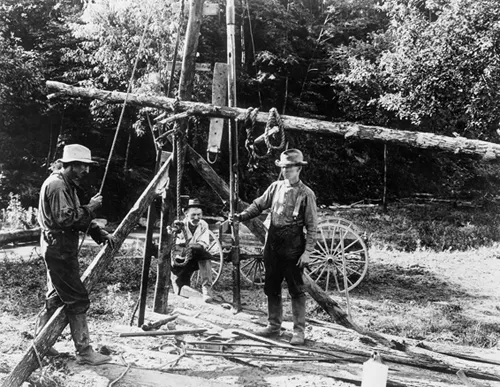
Yet the rise of AI will likely shift the focus of human work to higher-order capacities. Businesses will need to become much more knowledgeable about and competent at extracting value from unique processes in human brains. To draw an analogy, modern business applies a huge amount of ambition and competence to formidably difficult tasks, like extracting oil from miles under the ocean or from organic matter embedded in rock. We will need to apply that same level of seriousness—the desire to do it a hundred times more effectively than anyone has before—to the task of nurturing and drawing from imagination in human brains. In the early days of oil, people would just dig around and occasionally strike oil. That’s roughly where we are at with imagination today.
The early days of extracting oil. This is our current level of sophistication around extracting imaginative ideas.Source:George Rinhart/Corbis Historical via Getty Images.
In addition to changing how we work within businesses, AI also opens possibilities for radical new services and business models that will transform industries and fulfill unmet needs. With the rise of AI, we wil...
Table of contents
Cover
Praise
Title Page
Copyright
Contents
Dramatis Personae
1. Introduction
2. What Is Imagination?
3. The Seduction
4. The Idea
5. The Collision
6. The Epidemic
7. The New Ordinary
8. The Encore
9. Artificial Imagination?
10. Rekindling Imagination
Notes
Index
Acknowledgments
About the Authors
Trusted by 375,005 students
Access to over 1.5 million titles for a fair monthly price.
Study more efficiently using our study tools.
Frequently asked questions
Yes, you can cancel anytime from the Subscription tab in your account settings on the Perlego website. Your subscription will stay active until the end of your current billing period. Learn how to cancel your subscription
No, books cannot be downloaded as external files, such as PDFs, for use outside of Perlego. However, you can download books within the Perlego app for offline reading on mobile or tablet. Learn how to download books offline
Perlego offers two plans: Essential and Complete
Essential is ideal for learners and professionals who enjoy exploring a wide range of subjects. Access the Essential Library with 800,000+ trusted titles and best-sellers across business, personal growth, and the humanities. Includes unlimited reading time and Standard Read Aloud voice.
Complete: Perfect for advanced learners and researchers needing full, unrestricted access. Unlock 1.5M+ books across hundreds of subjects, including academic and specialized titles. The Complete Plan also includes advanced features like Premium Read Aloud and Research Assistant.
Both plans are available with monthly, semester, or annual billing cycles.
We are an online textbook subscription service, where you can get access to an entire online library for less than the price of a single book per month. With over 1.5 million books across 990+ topics, we’ve got you covered! Learn about our mission
Look out for the read-aloud symbol on your next book to see if you can listen to it. The read-aloud tool reads text aloud for you, highlighting the text as it is being read. You can pause it, speed it up and slow it down. Learn more about Read Aloud
Yes! You can use the Perlego app on both iOS and Android devices to read anytime, anywhere — even offline. Perfect for commutes or when you’re on the go. Please note we cannot support devices running on iOS 13 and Android 7 or earlier. Learn more about using the app
Yes, you can access The Imagination Machine by Martin Reeves,Jack Fuller in PDF and/or ePUB format, as well as other popular books in Business & Business General. We have over 1.5 million books available in our catalogue for you to explore.