An innovative history of deep social and economic changes in France, told through the story of a single extended family across five generations
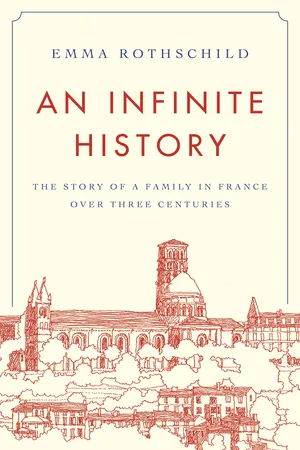
Marie Aymard was an illiterate widow who lived in the provincial town of Angoulême in southwestern France, a place where seemingly nothing ever happened. Yet, in 1764, she made her fleeting mark on the historical record through two documents: a power of attorney in connection with the property of her late husband, a carpenter on the island of Grenada, and a prenuptial contract for her daughter, signed by eighty-three people in Angoulême. Who was Marie Aymard? Who were all these people? And why were they together on a dark afternoon in December 1764? Beginning with these questions, An Infinite History offers a panoramic look at an extended family over five generations. Through ninety-eight connected stories about inquisitive, sociable individuals, ending with Marie Aymard's great-great granddaughter in 1906, Emma Rothschild unfurls an innovative modern history of social and family networks, emigration, immobility, the French Revolution, and the transformation of nineteenth-century economic life.
Rothschild spins a vast narrative resembling a period novel, one that looks at a large, obscure family, of whom almost no private letters survive, whose members traveled to Syria, Mexico, and Tahiti, and whose destinies were profoundly unequal, from a seamstress living in poverty in Paris to her third cousin, the cardinal of Algiers. Rothschild not only draws on discoveries in local archives but also uses new technologies, including the visualization of social networks, large-scale searches, and groundbreaking methods of genealogical research.
An Infinite History demonstrates how the ordinary lives of one family over three centuries can constitute a remarkable record of deep social and economic changes.
- English
- ePUB (mobile friendly)
- Available on iOS & Android
eBook - ePub
About this book
Information
Publisher
Princeton University PressYear
2021Print ISBN
9780691208183
9780691200309
eBook ISBN
9780691208176
Chapter One
THE WORLD OF MARIE AYMARD
The Historical Record
Marie Aymard was born in Angoulême in 1713 and died there in 1790.1 She was an only child. Her parents, when they married in 1711, stated that they were unable to sign their names. Her mother was the daughter of a shoemaker who had moved to Angoulême from a small community to the southwest of the town; her father was described as a shopkeeper or merchant, a marchand.2 He died when she was a little girl, and her mother married again, when Marie was five, to a widower, a master carpenter.3 In 1735, Marie was married to Louis Ferrand, an apprentice joiner or furniture-maker. She declared on their marriage, as on so many subsequent occasions, that she was unable to sign her name. Her husband, who signed the register, was an immigrant to the town, the son of a clogmaker from the diocese of Tours, some two hundred kilometers or several days’ walk to the north of Angoulême.4
Over the next fourteen years, Marie Aymard had eight children, of whom two died in infancy. It is possible, but unlikely, that she ever left Angoulême. She and her husband moved frequently, within the small parishes of the town; over the six-year period from 1738 to 1744, she gave birth to six children in four different parishes of the old center of the town.5 Louis remained an outsider; he was described as “Ferrand dit tourangeau,” the man from Tours, in the record of the baptism of Jean or Jean-Baptiste, his youngest child.6 But he became a master joiner, and by 1744 he was a “sindic” or elected official of the community (the small corporation or guild) of joiners in Angoulême.7 The acquaintances or relatives whom he and Marie chose as godparents for their eight children belonged to the same milieu of the town: a carpenter, a hatmaker, three different locksmiths, the wife of a cooper, and the wife of yet another locksmith.8
In June 1753, there was a great event in the family’s life. Angoulême was a town with a celebrated college, at the time a Jesuit foundation, which provided free instruction to local boys. In 1753, the couple’s oldest son, Gabriel, took the first step—becoming a tonsured clerk or cleric—toward ordination as a Catholic priest; he was fifteen.9 It was in December of the same year that Louis Ferrand set off to make the family’s fortune. He and another man, a carpenter, signed a contract to work for two years on the island of Grenada, for the sum of five hundred livres a year, plus all their expenses of food, lodging, and laundry, “in sickness and in health.” Their engagement was with an aspiring planter, Jean-Alexandre Cazaud, who was born in Guadeloupe and settled in Angoulême, where he married the daughter of a local silk merchant; the contract was signed on Cazaud’s behalf by his father-in-law, who was later one of the protagonists—the principal “capitalist”—in the most notorious of the legal-financial affairs in the town, or the “revolution” in commerce that began in 1769.10
Marie Aymard, at the time her husband left, had six young children, aged from four to fifteen. Her stepfather died two years later, in 1755, and her mother died in 1759; the carpenter who had gone with Louis to Grenada also died.11 Then, at some point before May 1760, Marie received the terrible news of her husband’s death. In an agreement with her son Gabriel, drawn up with a notary who was known for his “bad character,” in a town in which the number of practicing notaries was “so excessive” as to become the subject of royal regulation, she was described as the widow of Louis Ferrand.12
Gabriel was no longer a priest, or on the route to ordination. But the agreement began with a story about his intentions, which were imposing; “the said Ferrand having formed the plan of becoming a master of arts in order to provide instruction to youth, had, as a result, decided to establish a home … where he now lived, and which he had furnished at his own expense.” Gabriel then told a history of sentiments. He knew the “strict obligations of children toward those to whom they owed their existence,” and he wished to demonstrate to his mother that “his sentiments are to comfort her, as much as is in his power, and to make her life less harsh.” “Seeing his mother in a situation where she was no longer able to live, and to support herself without his help,” he had therefore entreated her to come and live with him.13
Marie Aymard’s reply—the words that she or her son dictated, or that the notary drafted—was cool. “Wishing to profit from the good heart of her son,” she said, and “assuming that his benevolence toward her will continue, and that he will not abandon her to the destiny in which a sad distress would place her,” she had decided to accept his offer, and to move to his home. She brought her furniture with her, and it was described in the notarial act. There were two old wooden beds, garnished with very worn green serge; two half-cabinets or wardrobes in poplar wood; a “worn-out” square table with “ten old bad chairs”; twelve plates, six spoons of ordinary tin, six iron forks, and six sheets. The “two parties”—Marie Aymard and her son—agreed that the value of the property was 130 livres, and that they “did not constitute directly or indirectly any sort of society or community, either tacit or customary.”14
Life continued to be hard, for the new household that was not a society, and when Gabriel was about to be married in October 1763—to Marie Adelaide Devuailly, from a family of cloth-dyers in Amiens, who had recently settled in Angoulême—he declared that his mother “at the present time has no property, furniture, or real estate in her possession.”15 A few weeks later, Marie Aymard’s furniture was again the object of a notarial act. In January 1764, she and Gabriel appeared before a different notary, Jean Bernard, who was known to have “made many instruments for the small people.” Gabriel was identified, now, as a “master writer.”16 This time, too, Gabriel Ferrand and Marie Aymard told a story. Over the period since 1760, they recounted, Gabriel had been obliged to make payments, “out of his own funds,” to a number of his mother’s creditors, who wanted to seize the “said furniture.” She owed money to a shoemaker, a maker of potash for washing clothes, someone who sold cooking fat, and a cloth merchant; the total of her debts was 290 livres.17
In order to be reimbursed for at least part of his expenditure, Gabriel said, he had considered taking out an order against his mother, for the seizure and judicial sale of the furniture. But she explained to him that the costs of a forced sale would consume almost the entire value of the furniture. She proposed that she sell it to him, “a la miable,” or in a friendly manner; he had bought everything from her, in 1763, for 130 livres.18 The following day, before yet a different notary, Marie Aymard acknowledged that her late husband’s employer, too, had paid a debt of 150 livres on her behalf, plus 606 livres—a substantial sum, more than her husband’s yearly salary—to two families of bakers in the town.19
The Power of Attorney
In October 1764, Marie Aymard appeared before the notary Jean Bernard, and identified herself as the widow of Louis Ferrand, “master carpenter,” and the mother of five minor children. “She said to us [that] her husband had left the said town of Angoulême and had gone with M. Cazaud to Martinique in the year 1753,” the notary wrote; “he then went to establish his residence in the island of Grenada.” Over the next several years, Marie Aymard “learned that her said husband had bought a certain quantity of Negroes and several mules, that he earned twenty-four livres per day, in addition to the fifteen livres that his Negroes brought him, also per day.” He had made “a small fortune during the four or five years he lived in Grenada,” and “returned to Martinique with the idea of leaving from there to return to his family.” But “he was attacked by an illness, of which he died on the third day,” in the care of a religious hospital, the “Pères de la Charité.”20
The purpose of Marie Aymard’s declaration, and of the power of attorney she requested, was to find out what had happened to the small possible fortune. Her husband, before he died, had “deposited his fortune in the hands of M. Vandax, shipowner or merchant living on the Promenade du Mouillage [in Martinique] or in Fort Saint-Pierre.” Or so she had been told; “these are the facts about which the party has been instructed at different times by certain persons in the town of Angoulême.” The informants had “at the same time reported to her that the said M. Vandax had replied obscurely to the inquiries they had made to him verbally on this subject, leading her nevertheless to hope that she would have satisfaction once her children had reached their majority.”21
It was here that matters rested, for some time. “This hope, her indigence, and the distance,” Marie Aymard declared, “had forced her to defer, until now, her researches,” as well as the effort to recover her inheritance, “without which she could no longer subsist.” But she had now learned that a sublieutenant in the merchant navy, called Pascal Chauvin, was on the point of leaving for Martinique. The power of attorney was to him, as her “general and special” representative, and the document ended in a profusion of legalisms. Chauvin was empowered to represent her before “all judges, notaries, clerks, and other public persons”; to “formulate all demands against the said M. Vandax and all others, as he sees fit”; to “request, plead, appeal, oppose, defend, and contradict.” “Promising to approve and approving” whatever he did, she indemnified him against any losses in the future, for which she “entered into obligation and mortgaged all and each of her goods and those of her said children.”22
Marie Aymard could not write: “the party declared that she did not know how to sign her name.” But she lived in a cloud of news. There were the facts about which she had been instructed, and the reports about the obscure inquiries in Martinique; there were her researches and what she had learned. She had letters written for her, and she and her husband exchanged information slowly across the ocean; she knew that he had made a “particular acquaintance” with a M. de Flavigné in the parish of “Marquis a la Cabeste” in Grenada, and with a M. Herbert du Jardin, a merchant in Saint-Pierre in Martinique, to whom she addressed her letters. She had two possible places of residence for M. Vandax. She knew names and addresses and calculations: “the fifteen livres that his Negroes brought him, also per day.”23
So this was the power of attorney, a single folded page. The story of Marie Aymard was so intriguing, at first, because it seemed to offer a vista of the busy, buzzing sources of information or misinformation about the outside world that existed in the eighteenth century, even in the deep interior...
Table of contents
- Cover Page
- Title Page
- Copyright Page
- Dedication
- Contents
- Introduction
- Chapter One. The World of Marie Aymard
- Chapter Two. The Marriage Contract
- Chapter Three. A Bird’s-Eye View
- Chapter Four. The First Revolution
- Chapter Five. The French Revolution in Angoulême
- Chapter Six. A Family in Changing Times
- Chapter Seven. Modern Lives
- Chapter Eight. Histories of Economic Life
- Chapter Nine. Family Capital
- Chapter Ten. Charles Martial and Louise
- Chapter Eleven. The End of the Story
- Acknowledgments
- Appendix One. Children and Grandchildren
- Appendix Two. The Eighty-Three Signatories
- Notes
- Index
Trusted by 375,005 students
Access to over 1.5 million titles for a fair monthly price.
Study more efficiently using our study tools.
Frequently asked questions
Yes, you can cancel anytime from the Subscription tab in your account settings on the Perlego website. Your subscription will stay active until the end of your current billing period. Learn how to cancel your subscription
No, books cannot be downloaded as external files, such as PDFs, for use outside of Perlego. However, you can download books within the Perlego app for offline reading on mobile or tablet. Learn how to download books offline
Perlego offers two plans: Essential and Complete
- Essential is ideal for learners and professionals who enjoy exploring a wide range of subjects. Access the Essential Library with 800,000+ trusted titles and best-sellers across business, personal growth, and the humanities. Includes unlimited reading time and Standard Read Aloud voice.
- Complete: Perfect for advanced learners and researchers needing full, unrestricted access. Unlock 1.5M+ books across hundreds of subjects, including academic and specialized titles. The Complete Plan also includes advanced features like Premium Read Aloud and Research Assistant.
We are an online textbook subscription service, where you can get access to an entire online library for less than the price of a single book per month. With over 1.5 million books across 990+ topics, we’ve got you covered! Learn about our mission
Look out for the read-aloud symbol on your next book to see if you can listen to it. The read-aloud tool reads text aloud for you, highlighting the text as it is being read. You can pause it, speed it up and slow it down. Learn more about Read Aloud
Yes! You can use the Perlego app on both iOS and Android devices to read anytime, anywhere — even offline. Perfect for commutes or when you’re on the go.
Please note we cannot support devices running on iOS 13 and Android 7 or earlier. Learn more about using the app
Please note we cannot support devices running on iOS 13 and Android 7 or earlier. Learn more about using the app
Yes, you can access An Infinite History by Emma Rothschild in PDF and/or ePUB format, as well as other popular books in History & Economic History. We have over 1.5 million books available in our catalogue for you to explore.