The recent years have been characterized by stormy social protests throughout the world. These protests have some commonalities, but at the same time, their sociopolitical, psychological, and economic contexts differ essentially. An important class of such protests is known as color revolutions. The analysis of these events in social and political literature is characterized by huge diversity of opinions. We remark that the sociopolitical perturbations under consideration are characterized by the cascade dynamics leading to the exponential amplification of coherent social actions. In quantum physics, such exponential and coherent amplification is the basic feature of laser's functioning. ("Laser" is acronym for light amplification by stimulated emission of radiation). In this book we explore the theory of laser to model aforementioned waves of social protests, from color revolutions to Brexit and Trump's election. We call such social processes Stimulated Amplification of Social Actions (SASA), but to keep closer to the analogy with physics we merely operate with the term "social laser."

eBook - ePub
Social Laser
Application of Quantum Information and Field Theories to Modeling of Social Processes
- 258 pages
- English
- ePUB (mobile friendly)
- Available on iOS & Android
eBook - ePub
Social Laser
Application of Quantum Information and Field Theories to Modeling of Social Processes
About this book
Information
Chapter 1
Introduction
This introductory chapter is very detailed and it aims to describe the general state of the art in applications of the mathematical apparatus and methodology of quantum theory to humanities. One the one hand, I want to convince experts in humanities that quantum theory can resolve the well-known problems, in particular, in decision theory. On the other hand, I want to convince physicists and especially those who work in quantum foundations and quantum information and probability that applications of quantum theory to humanities are not exotic. (Nowadays top-level experts, such as psychologists, work actively on quantum-like modeling.)
In principle, this introductory chapter can be skipped and the reader can jump directly to Chapter 3 on the basics of physical laser theory (the physicist can jump directly to Chapter 4).
1.1 Interplay of Psychology and Physics: Historical Overview
The present sharp separation of physics and psychology is only a peculiarity of the present moment. The 19th and the first part of 20th century were characterized by mutual influence of physical and psychological theories and the fruitful exchange of ideas between the brightest representatives From both sides. One of the best-known examples is the impact made by psychology on quantum mechanics, which resulted in borrowing the principle of complementarity [33] by Niels Bohr from William James’s book [120]. It may be less known that, in turn, the idea of complementarity was elaborated by James under the influence of 19th-century studies in thermodynamics, which led him (as well as, later, Sigmund Freud [84, 85) to the notion of psychic energy. Initially, complementarity in psychology was about complementarity of different representations of psychic energy [120]: splitting of consciousness (dissociative identity disorder), which is characterized by at least two distinct mental representations. These are analogues of the position and momentum representations in quantum mechanics. Often, one speaks about the wave–particle duality. In one context a physical system behaves as a wave and in another context as a particle. In the same way a human with multiple personality disorder can exhibit a few totally different (“incompatible”) personalities.
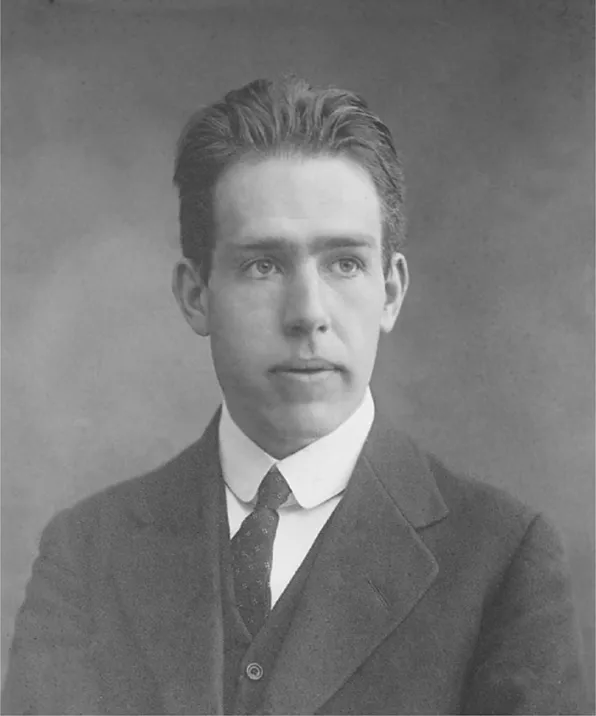
Figure 1.1 Niels Bohr.
Reviewing a variety of definitions from dictionaries and encyclopedias, we believe that we can safely state the following. Physics is the science that deals with the properties of matter. Psychology is the science that deals with mental processes and behavior.
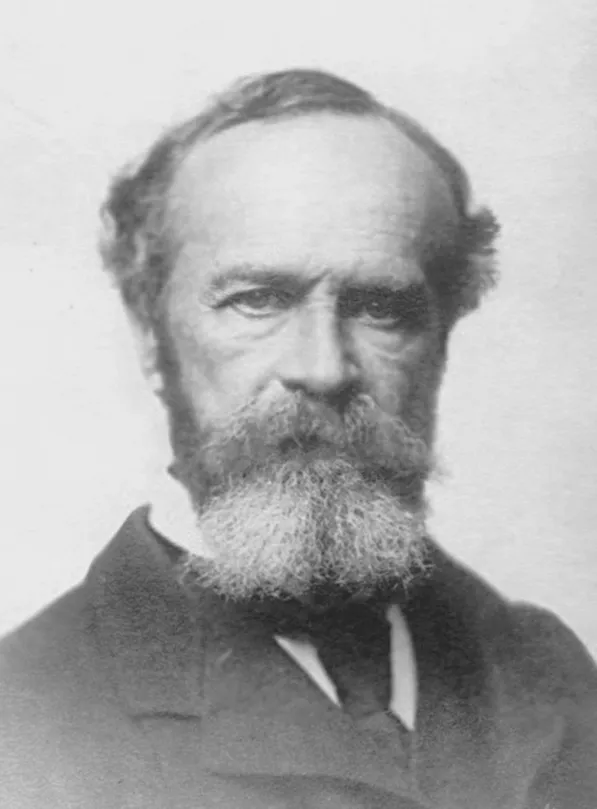
Figure 1.2 William James.
In accordance with the views of Rene Descartes, there are two basic types of substance, material and mental, and one is not reduced to the other. (It is also a Buddhist dogma that life comprises mind and matter.) Although during the last century physical reductionism captured the headlines in psychology, Descartes” ideology still penetrates the body of modern science. Naturally, physics and psychology are considered different fields of science, each with its specific theoretical and experimental methodologies. It seems that there is nothing, or very little, in common between them. Most students of physics would probably not like to spend their time studying psychology courses, and most psychology students dislike physics.
However, developments in physics and psychology are connected much more strongly than one can imagine. We can point to a few big names who contributed to establishing a connection between the two most fundamental sciences (one about nature and the other about the psyche: Hermann von Helmholtz, Sigmund Freud, Gustav Theodor Fechner, William James, Niels Bohr, Carl Jung, Wolfgang Pauli, Albert Einstein, ….
Freud was strongly influenced by the works of von Helmholtz on thermodynamics and especially on the energy conservation law. Of course, when discussing this law we have to mention the works of Germain Henri Hess, James Prescott Joule, and Rudolf Clausius. But, for Freud, the influence of von Helmholtz’s ideas was especially strong. He started his research in physiology under the supervision of Ernst Brucke, who previously worked with Hermann von Helmholtz. He noted similarities between thermodynamics and the human psyche and developed a kind of mental thermodynamics known as psychodynamics [84–86]. Freud actively used the notion of the psychic energy (libido) and the law of its conservation.
Primarily libido represents sexual energy. However, according to Freud, sexual energy is one of the forms of psychic energy, which can be transformed into other forms (see Chapter 9). In the first stage of his psychodynamical studies, Freud was influenced by the ideas of Fechner: considering physical facts related to human body and mental facts as the sides of one reality. Fechner concluded that both physical and mental phenomena must be described by the same mathematical apparatus. This remark is very important for us as foretelling the main idea of this book:
Both mind and matter behaviors nicely fit the framework of the mathematical formalism of quantum theory.
The notion of psychic energy played an important role in theorizing by James [120]. Following physicists who at that time were already using field theory, he started to operate with the notion of psychic field. This psychic field as well as a physical field can have different modes. This analogy led James [120] to the fundamental principle of complementary of information belonging to different modes of consciousness:
It must be admitted, therefore that in certain persons, at least, the total possible consciousness may be split into parts which coexist but mutually ignore each other, and share the object of knowledge between them. More remarkable still, they are complementary. Give an object to one of the consciousnesses, and by this very act you remove it from the other or others. Barring a certain common fund of information, like the command of language, etc., what the upper self knows the under self is ignorant of, and vice versa.
Now we point to the famous correspondence between Pauli and Jung [12, 122] on comparative analysis of the foundations of physics and psychology. These letters were written in a free style of discussion between friends (and, in part, a patient and a psychoanalyst). At the beginning Pauli wanted to discuss with Jung his psychical problems which might be a subject of psychoanalytic treatment. However, Jung smartly redirected Pauli to a young female psychoanalyst, and most of the Pauli–Jung correspondence is about psyche–physics interrelation. This freedom of exchange allowed them to express in psychoanalytic manner many thoughts which would be never presented in formal scientific discussions. From the letters it is clear that Jung was deeply influenced by quantum theory [12, 122] in Pauli’s presentation; e.g., Jung wrote to Pauli [122]:
As the phenomenal world is an aggregate of the processes of atomic magnitude, it is naturally of the greatest importance to find out whether, and if so how, the photons (shall we say) enable us to gain a definite knowledge of the reality underlying the mediative energy processes. Light and matter both behave like separate particles and also like waves. This ... obliged us to abandon, on the plane of atomic magnitudes, a causal description of nature in the ordinary space-time system, and in its place to set up invisible fields of probability in multidimensional spaces.
Inspired by acausal features of quantum mechanics, Jung developed his famous theory of synchronicity [121], the theory about the experiences of two or more events as meaningfully related, where they are u...
Table of contents
- Cover
- Half Title
- Title Page
- Copyright Page
- Dedication
- Table of Contents
- Preface
- 1 Introduction
- 2 Social Laser Model for Stimulated Amplification of Social Actions
- 3 Basics of Physical Lasing
- 4 Basics of Social Lasing
- 5 Information Thermodynamics
- 6 Thermodynamical Approach to Modeling Population Inversion for Social Laser
- 7 Laser Resonator
- 8 Correspondence between Notions and Parameters of the Theories of Physical and Social Lasers
- 9 Freudian Approach to Psychic Energy
- 10 Introduction to Quantum Theory
- 11 QBism: Subjective Probabilistic Interpretation of Quantum Mechanics
- 12 Decision Making: Quantum-Like Model of Lottery Selection
- References
- Index
Trusted by 375,005 students
Access to over 1.5 million titles for a fair monthly price.
Study more efficiently using our study tools.
Frequently asked questions
Yes, you can cancel anytime from the Subscription tab in your account settings on the Perlego website. Your subscription will stay active until the end of your current billing period. Learn how to cancel your subscription
No, books cannot be downloaded as external files, such as PDFs, for use outside of Perlego. However, you can download books within the Perlego app for offline reading on mobile or tablet. Learn how to download books offline
Perlego offers two plans: Essential and Complete
- Essential is ideal for learners and professionals who enjoy exploring a wide range of subjects. Access the Essential Library with 800,000+ trusted titles and best-sellers across business, personal growth, and the humanities. Includes unlimited reading time and Standard Read Aloud voice.
- Complete: Perfect for advanced learners and researchers needing full, unrestricted access. Unlock 1.5M+ books across hundreds of subjects, including academic and specialized titles. The Complete Plan also includes advanced features like Premium Read Aloud and Research Assistant.
We are an online textbook subscription service, where you can get access to an entire online library for less than the price of a single book per month. With over 1.5 million books across 990+ topics, we’ve got you covered! Learn about our mission
Look out for the read-aloud symbol on your next book to see if you can listen to it. The read-aloud tool reads text aloud for you, highlighting the text as it is being read. You can pause it, speed it up and slow it down. Learn more about Read Aloud
Yes! You can use the Perlego app on both iOS and Android devices to read anytime, anywhere — even offline. Perfect for commutes or when you’re on the go.
Please note we cannot support devices running on iOS 13 and Android 7 or earlier. Learn more about using the app
Please note we cannot support devices running on iOS 13 and Android 7 or earlier. Learn more about using the app
Yes, you can access Social Laser by Andrei Khrennikov in PDF and/or ePUB format, as well as other popular books in Mathematics & Probability & Statistics. We have over 1.5 million books available in our catalogue for you to explore.