What am I referring to when I say 'I'? This little word is so easy to use in daily life, yet it has become the focus of intense theoretical debate. Where does my sense of self come from? Does it arise spontaneously or is it created by the media or society? Do I really know myself?
This concern with the self, with our subjectivity, is now our main point of reference in Western societies. How has it come to be so important? What are the different ways in which we can approach subjectivity?
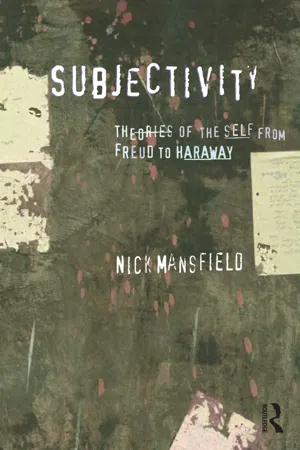
Nick Mansfield explores how our understanding of our subjectivity has developed over the past century. He looks at the work of key modern and postmodern theorists, including Freud, Foucault, Nietzsche, Lacan, Kristeva, Deleuze and Guattari, and he shows how subjectivity is central to debates in contemporary culture, including gender, sexuality, ethnicity, postmodernism and technology.
I am who? No topic is more crucial to contemporary cultural theory than subjectivity, and Nick Mansfield has written what has long been lacking-a lucid, smart introduction to work in the field.
Professor Simon During, University of Melbourne
Effortlessly and with humour, passion and panache, Mansfield offers the reader a telling, trenchantly articulate d account of the complex enigma of the self, without resorting to reductively simple critical cliches.This book, in its graceful movements between disciplines, ideas, and areas of interest, deserves to become a benchmark for all such student introductions for some time to come.
Julian Wolfreys, University of Florida
Nick Mansfield is Senior Lecturer in the Department of Critical and Cultural Studies at Macquarie University. He is co-author of Cultural Studies and the New Humanities (Oxford 1997) and author of Masochism: The art of power (Praeger 1997).
- 208 pages
- English
- ePUB (mobile friendly)
- Available on iOS & Android
eBook - ePub
About this book
Information
1
The free and autonomous Individual
THE THEORIES OF subjectivity that have dominated the last thirty years of literary and cultural studies all agree on one thing. They reject the idea of the subject as a completely self-contained being that develops in the world as an expression of its own unique essence. Uniformly, they identify this image of subjectivity with the Enlightenment.
THE ENLIGHTENMENT
The Enlightenment can be seen to span the period from Francis Bacon (1561–1626) to the French Revolution of 1789, covering developments as disparate as the origins of modern empirical science, the elaboration of universal ideals of political organisation (from totalitarianism to the liberal state) and the substitution of the cult of personal sensibility for collective religion. The Enlightenment is chosen as the target of contemporary critical thought because its ideals still underprop the institutions and processes that justify the way modern Western social and political systems operate. Yet, of course, the Enlightenment was not a single thing and is full of contradictions. Both the rationale for the modern liberal state and the ideology of its most vehement opponents can be traced to definitively Enlightenment thinkers.
The situation with subjectivity is similar: in the same way that key developments in Enlightenment thought, and early modern thought in general, first posed the question of the subject as a free, autonomous and rational being (what we call the individual), we can also find there the seeds of radical attacks on this model, which have aimed either to replace it with a different model, or to abandon the whole idea of subjectivity altogether. In other words, the very fact that it became necessary to define subjectivity at a certain moment in Western thought, that traditional practices and languages of selfhood were no longer to be taken for granted, opened up a field of contention, crisis and perpetual re-evaluation of the self. The self became an issue, a point of fundamental instability in the world. It was the Enlightenment that made the modern era the era of the subject.
DESCARTES AND THE COGITO
The work of René Descartes (1596–1650) represents major developments in the fields of mathematics (he invented the Cartesian diagram), scientific method and epistemology (the philosophy of knowledge). His most famous formula, Cogito ergo sum (‘I think therefore I am’), stands at the head of the modern tradition in Western thought, that has seen the conscious processes of observation, analysis and logic as the key instruments in the search for objective truth. As we can see from the Cogito, as it is known, Descartes’ philosophy considered knowledge in terms of the meaning of the word ‘I’. Individuality, even the very existence of the individual, was not simply to be taken for granted as obvious, incontestable or even part of the revelation of Christian religion. Descartes’ aim here was to throw everything into doubt, and only to accept that which could be verified from first principles.
That the key to knowledge was to be found in a formulation about the word ‘I’ shows the beginning of a new understanding of the human place in the world. Although the destination of Descartes’ reflection was a restrengthening of his belief in God, its linchpin was a definition of the self. Such a definition had to come first. Knowledge of the world had to wait until selfhood was made philosophically secure. This emphasis on the self as the origin of all experience and knowledge seems glaringly obvious to us, but this merely indicates how much we still live in the wake of the mutation in Western thinking that Descartes’ work represents. Yet, as we shall see when we look at other Enlightenment writings and in later chapters, this very assumption has been a fundamental bone of contention in recent debates.
The second key idea we can derive from the Cartesian Cogito is an emphasis on, or preference for, the conscious processes of thought over every other impulse or sensation. Descartes wrote: ‘‘‘I am’’ precisely taken refers only to a conscious being; that is a mind, a soul (animus), an intellect, a reason—words whose meaning I did not previously know. I am a real being and really exist; but what sort of being? As I said, a conscious being.’ (Descartes 1970, p.69). In context, when Descartes refers to consciousness, he seems to mean a general awareness of the world, rather than merely logical or rational thought. The Latin Cogitare (Descartes was writing in Latin), from which the term he uses is derived, includes the general idea of awareness, or ‘experience’ as it is sometimes translated. Yet in the above extract, a preference appears for certain ‘higher’, more active types of mental process. Conscious being may include, as it does in English usage, merely that of which one can be made aware. But increasingly from the Enlightenment on, and certainly since the Freudian naming of part of the mind as ‘the unconscious’, consciousness has been identified with the controllable, knowable, daylight functions that Descartes finds at the end of his list: intellect and reason. Certainly to later Enlightenment thinkers the operation of reason was the highest achievement of the human species, the final arbiter of every issue, even perhaps the very distinguishing feature that allowed us to know what was and what was not human.
In Descartes, therefore, we find together two principles that Enlightenment thought has both emphasised and adored: firstly, the image of the self as the ground of all knowledge and experience of the world (before I am anything, I am I) and secondly, the self as defined by the rational faculties it can use to order the world (I make sense). It is from these two principles that our summary of the Enlightenment will develop. Although, to our common sense, they seem to always everywhere go hand in hand, my aim is to show the potential contradiction between them—between the emphasis on selfhood, and the belief that it is most perfectly expressed by consciousness.
ROUSSEAU AND SENSIBILITY
First let us look at a later Enlightenment thinker, Jean-Jacques Rousseau (1712–78), whose work is the fruition of the new emphasis on the self as the ground of human existence in the world. Rousseau’s work straddles the intense rationalism of Enlightenment thought, and the emphasis on feeling and sensibility that would arise in its wake in the Romanticism of the late eighteenth and early nineteenth centuries. His political thought, especially as expressed in The Social Contract (1762), argues for a rationalised, if not regimented, society under the authority of a despotic figure who embodies the popular will. As such, it has been often seen as a justification for modern totalitarianism.
On the other hand, his Confessions (1781) emphasises the uniqueness and autonomy, the absolute governing freedom, of individual experience. We can see this from its opening:
I have resolved on an enterprise which has no precedent, and which, once complete, will have no imitator. My purpose is to display to my kind a portrait in every way true to nature, and the man I shall portray will be myself.
Simply myself. I know my own heart and understand my fellow man. But I am made unlike any one I have ever met; I will even venture to say that I am like no one in the whole world. I may be no better, but at least I am different. Whether Nature did well or ill in breaking the mould in which she formed me, is a question that can only be resolved after the reading of my book. (Rousseau 1953, p.17)
People had written confessions and memoirs before. What was to be different about Rousseau’s? How could he justify the claim that he was going to do something that had never been done before, and that would never be repeated?
Instead of emphasising a particular theme (the author’s religious experiences or political career), Rousseau’s aim is to give a complete, uninhibited and unapologetic representation of himself, not necessarily to make any point or even to justify himself (judgment, ‘whether Nature did well or ill’, will be up to others), but simply to present himself. To Rousseau, he as an individual is important and sufficient enough to justify hundreds of pages of painstaking exposition. It is not the significance of his life that makes it an adequate, even a necessary, object of description, but its uniqueness: ‘I may be no better,’ he writes, ‘but at least I am different.’ Any life is worthy of such treatment, because the individual at its centre will always tell a new and original story.
Furthermore, what binds together the disparate and disorganised places and events of this story will not be given by some theme, like a major historical event, or a particular experience (a victory in battle or a scientific discovery). The unity of the work is grounded in the feeling, living being at its centre. This sense of the sufficiency of individuality is the key to Rousseau’s Confessions. The inclusion of any material—the author’s exhibitionism and masturbation, his quasi-incestuous desires for the woman he called Mama, and the petty squabbles and rivalries of his later life—is justified by the simple fact that it all helps us get a complete picture of the ‘I’ who is writing about himself. Everything in the subject’s life is of interest and value, because any omissions would result in distortion. The individual is a total and inclusive phenomenon, a sort of massive and dynamic unity.
The idea of the sufficiency of the individual is borne out in another way: Rousseau’s trust in his own personal intuition as a way of judging the world. In a famous passage, he walks in the forest at Saint-Germain, contemplating the fallen nature of human-kind. He writes:
I dared to strip man’s [sic] nature naked, to follow the progress of time, and trace the things which have distorted it; and by comparing man as he had made himself with man as he is by nature I showed him in his pretended perfection the true source of his misery. Exalted by these sublime meditations, my soul soared towards the Divinity; and from that height I looked down on my fellow men pursuing the blind path of their prejudices, of their errors, of their misfortunes and their crimes. (Rousseau 1953, p.362)
For Rousseau, humankind was born into the world in a state of more or less perfection that history and social life have debased, leaving us engulfed in prejudice, error and crime. Human beings have distorted and diminished their own natural potential by pursuing the unnatural demands of class, religion and ambition. If only they were able to liberate their true nature, they would free themselves of the suffering they now endure. Human beings should therefore recover the sanctity and promise of the individuality with which they were born.
This hymn to the natural human self is reinforced by what is perhaps the most significant feature of this passage: Rousseau’s own dramatisation of the natural self, by withdrawing into nature and solitude in order to contemplate the truth of the human world. His insight is produced by his immersion in the very natural self he is praising. He does not derive his judgments from reading, nor from dialogue with other intellectuals, but by separating himself from the world and reawakening the individuality he sees as both humanity’s birthright and its highest goal.
Here we can see clearly ideas about individuality that have become truisms in Western culture, and that are periodically rediscovered (as they were in the counter-cultural movements of the 1960s) with radical force: the idea that the individual is a naturally occurring unit, that it is preyed upon and entrapped by society, and that true freedom and fulfilment can only be gained by rejecting social pressures, and by giving individuality uninhibited expression. Not only is this the truth of the human species, but it raises the human to a transcendent status: Rousseau found his soul raised to the level of the Divine.
KANT AND THE UNITY OF REASON
The second attribute of individuality we derived from Descartes was the emphasis on the conscious as the defining faculty of the self. We now to turn to the late eighteenth century German philosopher Immanuel Kant (1724–1804) and his Critique of Pure Reason (1781) to see an important version of this idea.
This work attempts to describe what it is about human beings that allows them to know the world. For Kant, before we do anything, we must make at least some simple observation or impression of the world around us. We turn these observations into representations as they enter our minds and become things to think about. They circulate in our minds as images. Each and every representation a human being makes of the world, according to Kant, from the most simple sensory perception to the most complex formula, is understood to be grounded in the ‘I’ that perceives. Kant writes: ‘it must be possible for the ‘‘I think’’ to accompany all my representations’ (Kant 1929, p.152). Before we perceive anything, something must be there, in place, to do the perceiving. We do not open every observation or statement with the phrase ‘I think’, especially when we are merely communicating with ourselves. Yet, although it is unspoken, any dealing with the world is impossible without it being channelled through the ‘I’. Furthermore, this ‘I’ at the heart of ‘I think’ is always ‘in all consciousness one and the same’ (1929, p.153). Since all our experiences are connected with this thinking self, they all appear to us to be happening to a single being. ‘The thought that the representations given in intuition one and all belong to me, is therefore equivalent to the thought that I unite them in one self-consciousness … I call them one and all my representations, and so apprehend them as constituting one intuition’ (1929, p.154). In sum, then, every relationship we have with the world, even the most primitive or abstract, must cross the threshold of the thinking ‘I’.
Before it does anything, however simple, the self thinks. What it thinks of at this primal stage is itself, which it conceives to be a unity. It is self-conscious, in the most intense meaning of the phrase. In order for us to be in any contact with the world, according to Kant, we must have an awareness of ourselves, and a sense of unity of self. This awareness is identified neither with a natural self-sufficiency (as in Rousseau), nor with a soul that has come into the world fully formed (as in religious discourse), but with thought. In fact, Kant would argue that before you can think the natural philosophy of a Rousseau, or the eternity of a religion, as with all ideas, impressions, impulses, representations and experiences, first you must think yourself. The self, then, is the feeling of connection or consistency between all your perceptions, the collection point of your thoughts.
If Rousseau fulfilled the first theme we discovered in Descartes (that the self is a sufficient starting-point for the analysis of the world), Kant fulfils the second: the equation between selfhood and consciousness. For Kant, subjectivity can only have content through awareness of the world. What circulates within our interior lives is a collection of mere representations. These representations meld with faculties that constitute us. Primary amongst these faculties, allowing us to have a relationship with the world, is a sense of ‘I’. This I is much more fundamental than what we call a personality, or an identity. It operates before we discover all the things that make our I separate from everyone else’s. This I is not really the fully formed individual. It is the bedrock on which that individuality is built, the sense that experience of the world is focused on a thing that is aware, that is processing the information it receives, that is turning mutations in the field of light into meaningful representations that can lead to judgment and action. Kant’s understanding of that ‘aware’ entity is more intense than merely the word ‘conscious’ would allow. Kant’s subject is not merely in the world, allowing its messages to cross back and forth across its senses. When it receives these messages, it is not merely passive. It grasps the outside world in a positive act of thought that not only connects it with things, but gives it a strong, unified and purposeful sense of selfhood.
THE LEGACY OF THE ENLIGHTENMENT
What is the relationship between the self-sufficient self of Rousseau and the conscious self of Kant? Do they fit together to complete a single workable model of the self that we have been able to build on, or is there some tension between them that may help to explain why the definition of the self has become the hidden but most persistent and compellingly urgent problem of the modern era and beyond? Rousseau’s achievement was to imagine the individual in total terms, to conceive of subjectivity in all its manifestations as a whole—not always consistent, not always admirable, not...
Table of contents
- Cover
- Half Title
- Title Page
- Dedication Page
- Series introduction
- Acknowledgments
- Contents
- Introduction
- 1 The free and autonomous Individual
- 2 Freud and the split subject
- 3 Lacan: The subject is language
- 4 Foucault: The subject and power
- 5 Femininity: From female imaginary to performativity
- 6 Kristeva and abjection: Subjectivity as a process
- 7 Masculinity: Saving the post-Oedipal world
- 8 Radical sexuality: From perverse to queer
- 9 Subjectivity and ethnicity: Otherness, policy, visibility, colonialism
- 10 Deleuze and Guattari: Rhizomatics
- 11 The subject and technology
- 12 The subject and postmodernism
- 13 Conclusion
- Glossary
- Bibliography
- Index
Trusted by 375,005 students
Access to over 1.5 million titles for a fair monthly price.
Study more efficiently using our study tools.
Frequently asked questions
Yes, you can cancel anytime from the Subscription tab in your account settings on the Perlego website. Your subscription will stay active until the end of your current billing period. Learn how to cancel your subscription
No, books cannot be downloaded as external files, such as PDFs, for use outside of Perlego. However, you can download books within the Perlego app for offline reading on mobile or tablet. Learn how to download books offline
Perlego offers two plans: Essential and Complete
- Essential is ideal for learners and professionals who enjoy exploring a wide range of subjects. Access the Essential Library with 800,000+ trusted titles and best-sellers across business, personal growth, and the humanities. Includes unlimited reading time and Standard Read Aloud voice.
- Complete: Perfect for advanced learners and researchers needing full, unrestricted access. Unlock 1.5M+ books across hundreds of subjects, including academic and specialized titles. The Complete Plan also includes advanced features like Premium Read Aloud and Research Assistant.
We are an online textbook subscription service, where you can get access to an entire online library for less than the price of a single book per month. With over 1.5 million books across 990+ topics, we’ve got you covered! Learn about our mission
Look out for the read-aloud symbol on your next book to see if you can listen to it. The read-aloud tool reads text aloud for you, highlighting the text as it is being read. You can pause it, speed it up and slow it down. Learn more about Read Aloud
Yes! You can use the Perlego app on both iOS and Android devices to read anytime, anywhere — even offline. Perfect for commutes or when you’re on the go.
Please note we cannot support devices running on iOS 13 and Android 7 or earlier. Learn more about using the app
Please note we cannot support devices running on iOS 13 and Android 7 or earlier. Learn more about using the app
Yes, you can access Subjectivity by Nick Mansfield in PDF and/or ePUB format, as well as other popular books in Media & Performing Arts & Film History & Criticism. We have over 1.5 million books available in our catalogue for you to explore.