Increasingly, Indigenous people are being drawn into global networks. In the long term, cultural isolation is unlikely to be a viable even if sometimes desired option, so how can Indigenous people protect and advance their cultural values in the face of pressures from an interconnected world?
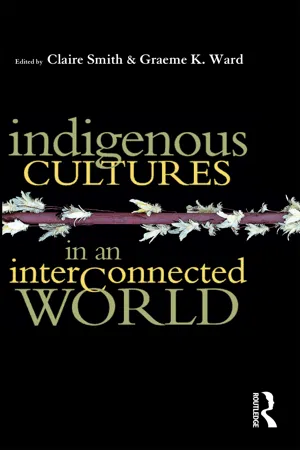
Indigenous Cultures in an Interconnected World is a comprehensive, thought provoking discussion of the challenges that globalisation brings to Indigenous peoples. It discusses successful strategies that have been used by Indigenous peoples to promote their identities and cultural values. It looks at their roles as equal and active participants and, indeed, as innovators and leaders in an interconnected world.
The chapters in this book present a global perspective on Indigenous issues. They feature a cross-disciplinary integration that takes a holistic approach in-line with that of most Indigenous peoples and include vignettes of Indigenous cultural practices.
- 248 pages
- English
- ePUB (mobile friendly)
- Available on iOS & Android
eBook - ePub
Indigenous Cultures in an Interconnected World
About this book
Information
1
Globalisation and Indigenous Peoples: Threat or Empowerment?
CLAIRE SMITH, HEATHER BURKE AND GRAEME K. WARD

Ainu performance by Masahiro Nomoto (photo: Northern Territory News)
The unchecked expansion of European nations since the sixteenth century has signalled over 400 years of significant change for the world's Indigenous1 peoples. This process of colonisation did not end with the arrival of European people but persisted as European goods, European technology and European beliefs perpetuated the process of invasion. Globalisation threatens to accelerate this process of colonisation. Networks that were once restricted to individual communities, nations or continents are becoming globalised through the latest innovations in communication technologies. With the advent of these technologies and the extreme mobility of modern peoples, the geographic boundaries that formerly shaped a people's understandings of themselves and the world are collapsing. In the rhetoric of transnational corporations and markets, globalisation entails the removal of limitations, allowing the exchange of ideas across boundaries by people from all walks of life. In reality, mass tourism is shrinking the world, bringing once-distant peoples quite literally face to face. Telecommunications technologies such as the Internet are providing worldwide access to identical information and entertainment, while consumers from opposite corners of the globe can purchase the same products from the same multinational corporations. Just as the introduction of cheaper, faster air travel since the 1950s has permitted younger, less wealthy travellers to reach once distant lands (Bankes 1995: 7), so too are modern communication technologies allowing many more peoples access to one another across the gulf between cultures. The Internet is the single fastest-growing medium of communication in the world. It took 75 years for 50 million people to be connected to the telephone—it took only ten years for the same number of people to be connected using the Internet (Nathan 1997). As cultural boundaries dissolve and fundamentally Western understandings and attitudes become dominant, more and more people are conversing in the universal language of popular culture.
While the mass changes that attend these developments are commonly censured in terms of very real social problems such as the increasing commodification of culture, the entrenchment of inequality, growing feelings of insecurity and a loss of identity, Indigenous peoples are seldom considered in discussions of the 'globalisation juggernaut' While there are approximately 350 million Indigenous persons across the world, they comprise only 6 per cent of the world's population, The process of globalisation began in the West and has mainly fostered the expansion of Western ideas, values, lifestyles and technology. Globalisation creates unprecedented opportunities for people to see, hear, visit and experience, with an ease previously unimaginable. For Indigenous peoples, globalisation threatens to extend the process of colonisation begun 400 years ago, giving rise to the possibility of a new invasion. For many non-Indigenous peoples, globalisation is merely a means of opening up new markets and finding new ways of 'selling' Indigenous culture. For some it provides access to a smorgasbord of cultural practices that are seen as public property to be 'borrowed' at will. Certainly, globalisation makes Indigenous cultures available to a wider audience, often without that audience ever having to leave home. It deliberately invites the outsiders in. The result is that Indigenous peoples are having to fight harder on a variety of fronts to ensure their cultural survival and to find new means for asserting their rights and autonomy in the face of the new threats posed by globalisation.
The key issue here is control—control over land, control over knowledge, control over the past, present and future. The object of the struggle is not only Indigenous cultural and intellectual property but the continued future of Indigenous societies themselves. This conflict establishes an arena for radical change in the social and political environments of Indigenous peoples. At the forefront is an emerging process of decolonisation, which involves not only the deconstruction of colonial processes and the many assumptions on which colonialism is based but also, as a result, the transformation of social and political orders. The value of this to Indigenous peoples lies with the empowerment that comes from identifying common goals, many of which arise from the lived experiences of colonialism, and from being active agents in the process of decolonisation; as Daryle Rigney (1996: vi) has said: 'My research is a commitment to exposing the systematic de-powering, silencing and exclusion of Nunga [Indigenous] behaviours, consciousness, culture, ideology and social formations. It is time for the Invader Dreaming to end.'
There is the potential for Indigenous peoples from those countries with colonial histories to find a sense of unity and common purpose arising from their colonial experiences. Indeed, one of the core concerns that emerge from this volume is the overwhelming extent to which Indigenous agendas are transformative, concerned with 'change in and transformation of the roles and structures which control [them]' (Daryle Rigney 1996: 2). The formation of global economic, social and political networks will no doubt be a focus of Indigenous empowerment.
Indigenous struggles for recognition and self-determination are shaped by changes in their apprehension of the world as much as by the changing ways in which the world understands them. In this vein, increasing public awareness of the diversity of Indigenous lifeways and raising concern for Indigenous issues and rights is one means to empower Indigenous communities on a scale never before possible. Contemporary forms of communication, particularly expressive media such as film, video and the Internet, thus become not only a way of sustaining and strengthening Indigenous communities but also a means of transforming them. On the one hand, the creation of new kinds of cultural forms is a means of revivifying local languages, traditions and histories, and articulating community identity and concerns. On the other hand, these new forms are also used to further social and political transformations of dominant hegemonies, as Faye Ginsburg emphasises in Chapter 2.
In this book we draw attention to some of the myriad ways in which globalisation is likely to affect the lives of Indigenous peoples, both positively and negatively. For Indigenous peoples this is a time of great opportunity, uncertainty and risk, creating the potential for cultural change at an unprecedented rate and scale. On the one hand, there are areas of serious conflict that need to be addressed. What are the implications of these new ways of knowing and new modes of access for Indigenous systems of knowledge and authority? What are culturally appropriate methods for sharing Indigenous knowledge? What protocols should be developed for its curation? On the other hand, globalisation provides the chance for Indigenous peoples to advance recognition and acceptance of their cultural values in innovative and effective ways and to empower themselves by harnessing the power of public opinion and by becoming familiar with each other's problems, solutions and successful strategies. The authors in this volume are concerned not only with the opportunities for Indigenous peoples that emerge from the development of global communication networks but also with the strategies by which Indigenous peoples are dealing with the pressures that arise from being part of an interconnected world.
Communicating identity
Fundamental to this struggle is the issue of Indigenous identity and its articulation with place. Indigenous peoples inherit rights and responsibilities to particular tracts of land. These rights to land cannot be bought, sold or reinvented. They were established in the ancestral pasts of Indigenous peoples around the world and are reiterated in the present through conceptualisations of spirituality. Thus land is central to the definition of self, is expressed in a variety of media, and is crucial to the survival of Indigenous identities.
Globalisation can involve a redefinition of identity on many levels. Integral to this is the complex interplay of forces tending towards nationalism and/or the emphasis of local Indigenous identity on the one hand, and those of globalisation and broader notions of identity on the other. Kahn (1995) has highlighted the paradoxical nature of stressing the former at a time when a 'borderless world' of communications and universal trade and investment is developing, along with a concomitant apparent cultural uniformity. This applies not only to the nation-states that Kahn discusses, but also to ethnic minorities—often defined by invasions and colonisations—of Indigenous peoples within nation-states, such as the Native Americans and Indigenous Australians, whose reactions to the pressures of, and use of the opportunities provided by, this process of 'globalisation' are the subject of this book.
The process of creating ethnic identity is a core concern of many of the chapters. Ethnicity is a phenomenon only found in complex societies, where several different communities with different cultures have to interact since they belong to a single society (Chapter 3). Within an ethnic group there is some recognition of a shared history, language, culture or religion, though this may arise as much from an external process of lumping together people with shared characteristics as from self-definition (Chapter 4). As Zimmerman and his co-authors point out, 'it is not necessarily the common culture of a group that makes them think of themselves as related, but the other way around. Once considered to be related, those so identified develop rules, or at least understandings, about who they are and who is or is not a part of the group'.
Thus for ethnic identity to emerge in Indigenous societies, the people in these societies first had to suffer incorporation into a complex society, after which an often diverse series of distinct populations commonly became combined into a single category, such as 'Indian', or 'Aboriginal'. It is possible to view Indigenous ethnicity as an artefact of colonisation, since it was colonisation that created a sense of Indigenous peoples as Other. This movement from independent Indigenous societies to ethnic minorities embedded in modern culture is at once a powerful description of the loss of identity that occurred as a result of invasion and an illustration of the power of colonialism to collapse boundaries and redefine a dwindling world. Just as colonisation demanded new expressions of Indigenous identity to combat dispossession (for example, Chapter 3), globalisation also will demand this.
Global communication technologies are clearly used by some to maintain and reinforce ethnic identity as a specific entity, while also being used to explore a broader sense of pan-identity. In Chapter 4, Zimmerman, Zimmerman and Bruguier identify two principal ways in which communication technologies are used by Native Americans: first, to emphasise the unique characteristics of particular tribes, and second, to key into a pan-Indian or even a global Indigenous identity. Likewise, in Chapter 3, Layton highlights some of the tensions involved in this process as reflected in paintings by the late Melbourne artist Lin Onus Barinja, in which he used clan designs from northern Australia (to which he did not have a birthright) in order to assert his Aboriginality in a more general, pan-Australian sense. Although this is in itself problematic, colonisation and globalisation can be viewed as two moments around which the expression of new forms of ethnic Indigenous identity crystallised in different ways. On another level, in countries such as the United States, Canada, Mexico and Australia, important facets of identity are founded on aspects of Indigenous cultures, often appropriating Indigenous imagery as a marker of a more generalised national identity (Chapter 6). It follows that any rethinking of Indigenous identities will affect conceptualisations of regional, national and global identities.
Morris-Suzuki has developed similar ideas in the context of a study of the development of modern Japan. She uses the term 'formatting' to describe the basic process of creating a 'single underlying common framework or set of rules' used to coordinate local sub-regimes (1998: 164). In discussing the development of scientific endeavour in Japan, for example, she stresses the 'importance of the distinction between the global format of methods, theories and taxonomies of knowledge (defined almost entirely in the West) and local content [as] important... for early Japanese scientific researchers' (1998: 165).
Thus for nation-states, the process of incorporation into the global system—globalisation—tends to be one of adoption and adaptation of a framework—formatting—that can be varied to meet particular circumstances, while retaining a universal familiarity. We are able to identify a comparable process happening in Indigenous communities that are, in turn, sub-sets of modern nation-states, themselves sub-regimes within a global system. In this light, the papers in this volume document the emergence of a global sense of Indigeneity that coexists with a strong sense of Indigeneity at a local level.
Histories of connectedness
Having said this, it is important to recognise that this interconnectedness between forms of identity articulated at different scales is not necessarily a new phenomenon. One of the strongest contributions that many of the papers in this volume make to the debates surrounding globalisation is one that is unique to the disciplines of archaeology and anthropology Our very description of the problems associated with globalisation could be taken to allude to the earlier Western notion of insular and isolated 'pristine cultures', unsullied by, and therefore needing to be protected from, contact with a wider world. As the many archaeologists and anthropologists in this book point out, however, this stereotype is not, and has never been, the case: many groups of Indigenous peoples have experienced considerable and extended contact with outside 'others' for centuries.
Individual histories of contact, of course, vary widely. Since at least the eleventh century, when Greenland Vikings arrived in northeastern Canada, the Innu people, for example, have had to adjust repeatedly to the challenges posed by contact with non-Innu peoples (Chapter 9). Contacts between the Innu and Thule and Dorset Eskimo groups, or with Inuit people, were common over the last 8000 years, though the pace of contact increased as the nations of Europe began to take advantage of the rich potential offered by Innu territory. French, English and Basque fishers and fur-traders first arrived in Labrador in the sixteenth century, eventually establishing series of trading posts along the northern coast and, by the eighteenth century, the expanding nations of France and England were both vying to dominate and exploit the resources of Labrador. In describing the Innu people's range of responses, both past and present, to such contact, Loring and Ashini highlight an aspect of Indigenous cultures that is central to understanding both their survival and their potential: the dynamism of cultures that repeatedly have had to adjust to the challenges posed by other peoples in competition for their resource base.
Similarly, Layton (Chapter 3) explores the original 'connected world' of the Indigenous Australians, who, before White invasion, commonly moved through landscapes of regional communities, each of which contained between 250 and 500 people. Layton examines the creation of human cultural identity and the long tradition of Aboriginal people in emphasising difference through language and symbolism, while still maintaining connectedness through a regional network of relationships. In addition, many Aboriginal groups maintained generations of contact with eastern Indonesian and Papuan peoples, contacts that influenced their social networks through art and trade (Chapter 7). Both Dransart (Chapter 8) and Zimmerman and colleagues (Chapter 4) draw attention to similar histories of connectedness among the people with whom they work, reminding us that Indigenous communities have always maintained mechanisms for cross-cultural communication.
This history of connectedness should not be underestimated in understanding the potential of Indigenous communities to take advantage of the new technologies for communication. The papers in this volume make it clear that there can be no doubt that Indigenous peoples understand the importance of communication. Indeed, exchange of information has always been imperative for survival, not least because it was essential that people knew where water and food could be found. Travel, in particular, has always been a means of acquiring status and collecting information, as a way to acquire knowledge about resources and other people (Chapter 9). Indeed, one can argue for the existence of an Indigenous imperative to communicate that arises from oral traditions that invest their energies in complex social structures, rather than in technologies. After their colonisation, Indigenous peoples have taken advantage of any means to help them keep in touch with one another. The goods that many Indigenous peoples value most highly are those to do with communication: telephones, televisions, videos, radios, cars, technologies that are often used by Indigenous peoples to restore and facilitate traditional information exchanges such as ceremonies (Michaels 1986: 5; Langton 1993: 63). This imperative to communicate places Indigenous peoples in a powerful position to take advantage of the many possibilities provided by globalisation. Through radio, film, video, recorded music and now the Internet, there is the potential for Indigenous peoples to tackle the problems posed by globalisation and to transform its technology in unigue ways.
Each of these chapters challenges the stereotype that Indigenous societies 'live in the past' and are unable to shape their culture to adjust to new challenges and situations. Indigenous societies before Contact were both dynamic and flexible, possessing a creative strand that both then and now 'repeatedly generates new variants of cultural practices and...transforms the cultural structure itself' (Layton, ...
Table of contents
- Cover
- Half Title
- Dedication
- Title Page
- Copyright Page
- Foreword
- Contents
- Figures and Illustrations
- Contributors
- Preface
- 1 Globalisation and Indigenous Peoples: Threat or Empowerment?
- 2 Resources of Hope: Learning from the Local in a Transnational Era
- 3 From Clan Symbol to Ethnic Emblem: Indigenous Creativity in a Connected World
- 4 Cyberspace Smoke Signals: New Technologies and Native American Ethnicity
- 5 History, Representation, Globalisation and Indigenous Cultures: A Tasmanian Perspective
- 6 Indigenous Presence in the Sydney Games
- 7 Elite Art for Cultural Elites: Adding Value to Indigenous Arts
- 8 Cultural Tourism in an Interconnected World: Tensions and Aspirations in Latin America
- 9 Past and Future Pathways: Innu Cultural Heritage in the Twenty-first Century
- Notes
- References
- Index
Trusted by 375,005 students
Access to over 1.5 million titles for a fair monthly price.
Study more efficiently using our study tools.
Frequently asked questions
Yes, you can cancel anytime from the Subscription tab in your account settings on the Perlego website. Your subscription will stay active until the end of your current billing period. Learn how to cancel your subscription
No, books cannot be downloaded as external files, such as PDFs, for use outside of Perlego. However, you can download books within the Perlego app for offline reading on mobile or tablet. Learn how to download books offline
Perlego offers two plans: Essential and Complete
- Essential is ideal for learners and professionals who enjoy exploring a wide range of subjects. Access the Essential Library with 800,000+ trusted titles and best-sellers across business, personal growth, and the humanities. Includes unlimited reading time and Standard Read Aloud voice.
- Complete: Perfect for advanced learners and researchers needing full, unrestricted access. Unlock 1.5M+ books across hundreds of subjects, including academic and specialized titles. The Complete Plan also includes advanced features like Premium Read Aloud and Research Assistant.
We are an online textbook subscription service, where you can get access to an entire online library for less than the price of a single book per month. With over 1.5 million books across 990+ topics, we’ve got you covered! Learn about our mission
Look out for the read-aloud symbol on your next book to see if you can listen to it. The read-aloud tool reads text aloud for you, highlighting the text as it is being read. You can pause it, speed it up and slow it down. Learn more about Read Aloud
Yes! You can use the Perlego app on both iOS and Android devices to read anytime, anywhere — even offline. Perfect for commutes or when you’re on the go.
Please note we cannot support devices running on iOS 13 and Android 7 or earlier. Learn more about using the app
Please note we cannot support devices running on iOS 13 and Android 7 or earlier. Learn more about using the app
Yes, you can access Indigenous Cultures in an Interconnected World by Claire Smith,Graeme K Ward in PDF and/or ePUB format, as well as other popular books in Social Sciences & Business General. We have over 1.5 million books available in our catalogue for you to explore.