There is more to law than rules, robes and precedents. Rather, law is an integral part of social practices and policies, as diverse and complex as society itself.
Thinking About Law offers a comprehensive introduction to the ways in which law has been presented and represented. It explores historical, sociological, economic and philosophical perspectives on the major legal and political debates in Australia today.
The contributors examine the position of Aborigines in the Australian legal system and the impact of the Mabo case; divisions of power in Australian society and law; the question of objectivity in law; the relationship between legislation and social change; judicial decision-making and other issues.
Accessibly written, Thinking About Law is essential reading for students and anyone interested in understanding our legal system.
eBook - ePub
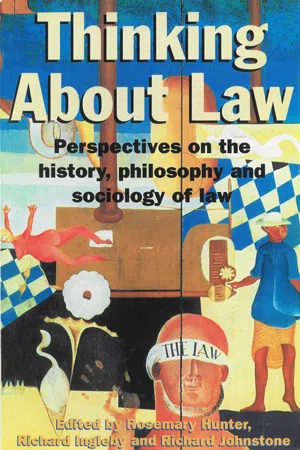
Thinking About Law
Perspectives on the history, philosophy and sociology of law
- 272 pages
- English
- ePUB (mobile friendly)
- Available on iOS & Android
eBook - ePub
Thinking About Law
Perspectives on the history, philosophy and sociology of law
About this book
Part one
1
Law and history in black and white
Where did Australian law begin? According to traditional legal historiography the origins of Australian law are found in England, around the time of the Norman conquest in 1066.1 The English law that developed in the succeeding centuries was ultimately imported to Australia by the British colonists, laying the foundation for an Australian law which grew to have a separate existence from its English parent. This account assumes that the history of law in Australia, like all other Australian histories, began only with the ‘discovery’ of Australia by Captain Cook in 1770.
For most of the past two hundred years, the very idea of a history of Australia before Cook (‘BC’, as many Aboriginal people say) has been denied. Indeed, the period before colonisation has been persistently classified as ‘pre-history’. The physical existence of the original inhabitants of Australia was undeniable, but the generic Latin name at origine bestowed by the European invaders on over two hundred distinct language groups obscured their identities,2 and their understandings of the past were categorised and dismissed as ‘myths’ and ‘legends’. ‘History’ was all about civilisation and progress. In the perceived absence of change or progress in Aboriginal societies, ‘Aboriginal history was an impossibility’.3
Just as European historiography saw Australia BC as lacking history, the Anglo-Australian common law held that Australia BC was devoid of law. Aboriginal societies did not include institutions of the kind which characterised law in European states.4 In particular, they had nothing recognisable to English lawyers as a form of land tenure. Thus the legal fiction was established that Australia was terra nullius—literally, land belonging to no one. Accordingly, the land was open for settlement by the British, who brought their own law to the new colonies of New South Wales, Western Australia and South Australia, and made the indigenous people subject to it.
Recent years have seen the establishment of ‘Aboriginal history’ as a field of study, but Aboriginal law remained largely invisible to the Anglo-Australian legal system. It was not until 1992, with the High Court’s decision in Mabo v Queensland5 (the Murray Islands case6), that legal knowledge finally shed its colonialist blinkers. In a claim by the Meriam people of the Torres Strait concerning their rights to land under their own law, the High Court held that the Anglo-Australian common law is capable of recognising and giving effect to ‘native title’—that is, title to land derived from the legal systems that existed in Australia BC. The Murray Islands case signals that, even in the eyes of the imported legal system, the history of law in Australia began long before Cook.
In order to comprehend the Murray Islands case and other Aboriginal claims, lawyers need some understanding of Aboriginal law and societies BC. Such an understanding will not be gained from traditional legal materials. Disciplines such as history, anthropology and archaeology can contribute to understanding, though they too have been associated with the colonialist enterprise. The perspectives of Aboriginal people themselves are a vital element in understanding the indigenous past. Again, however, Aboriginal people have often been compelled to translate their knowledge literally and metaphorically ‘into English’, in order to be heard at all.
This chapter examines representations of Aboriginal societies and law Before Cook. It focuses particularly on the representations made by the Anglo-Australian legal system up to and including the Murray Islands decision. The chapter concludes by looking at the prospects for further accommodation between Aboriginal and non-Aboriginal legal systems.
Representations of Aboriginal law and society BC
According to Koori7 activist Gary Foley:
Aboriginal society and European society are diametrically opposed. European society, if you want a really simplistic analysis, is essentially competitive. It is laughably referred to as a free enterprise society. It holds up materialism and individualism as being the great things to aspire to. And its basic unit is the nuclear family. Aboriginal society is different at all levels. Aboriginal people reject the concept of individuality, of materialism. Ours is a non-competitive society; for want of a better term, it is a socialist society.
And the basic unit of our society is the extended family. As far as we are concerned, we lived here in perfect harmony with each other and with the total environment.8
Here Foley uses European concepts to convey a favourable view of Aboriginal society in comparison with European society. The success of his argument depends on the extent to which the reader is prepared to accept that a ‘non-competitive’, ‘socialist’ and harmonious society is better than a competitive, materialistic and individualistic one. Such comparative language has more often been used to demonstrate the worth of European cultures and the lack of worth of the societies they displaced in the process of colonisation. Indigenous people have consistently been portrayed as the negative of the colonisers.9 They have been described as static while colonisers are active, as primitive while colonisers are civilised, as roaming the land while colonisers put it to good economic use. It has been argued that indigenous cultures were doomed to ‘wither away’ after contact with the more aggressive and progressive cultures of European settlers.10
Such European representations have been defended as objective human knowledge, based on observed historical facts. Yet the claim to objectivity is open to question, as the evaluation and interpretation of historical evidence ultimately rest upon a system of beliefs. Non-Aboriginal history, ‘based on beliefs about the basic importance of time and space, and the scientific predictability of the physical processes governing the world and its occupants… satisfies those who believe in its view of the world’.11 The following examination of accounts of Aboriginal law and societies BC, from early colonial, archaeological and anthropological perspectives, draws attention to the worldviews, systems of beliefs and disciplinary preoccupations from which the accounts were generated, and which European readers may share. The section begins, though, with an attempt to represent Aboriginal views of the past. Of course, non-Aboriginal writers cannot speak for Aboriginal people. But neither can Aboriginal perspectives be excluded, as that would simply perpetuate their invisibility.
Aboriginal histories
All Aboriginal languages were and are spoken languages, so Aboriginal histories are oral, pictorial and performative rather than written. Important knowledge is passed down the generations through dance, art, song and stories. Most significant are Aboriginal creation stories. Europeans have regarded these stories as ‘myths’ and ‘legends’ from the ‘Dreamtime’, but for Aboriginal people they are the foundations of religious-moral-legal systems. The stories tell of travelling spirit ancestors who, in the course of their journeys, formed and marked out the earth and the sky and established the law, mapping it onto the country. These ancestral beings fought with each other, and struggled with other forces. They became transformed, into rocks, landforms, animals and birds, the stars.
While Western historians might determine the truth of an historical account by checking the author’s sources, Aboriginal people use a different set of indicators to establish the truth of their stories.12 Firstly, the location of a story in ‘Dreaming’ time (before the beginning of human time, or out of time) provides it with an eternal verity. Secondly, proof of the story exists so long as the physical landmarks representing the transformed ancestors remain. Place, rather than time, is central to Aboriginal histories. Thirdly, the story is known to be true if it is told by an acknowledged custodian, to whom it has been entrusted by generations of past custodians.13 For example, in the following preamble to an historical account of Captain Cook (not a creation story) the storyteller establishes the place of the story and his own source of knowledge. The story, Captain Cook, comes from the south coast of New South Wales, and was related by Percy Mumbulla of Ulladulla and ‘recorded’ by the poet Roland Robinson:
Tungeei, that was her native name.
She was a terrible tall woman
who lived at Ulladulla
She had six husbands
an’ buried the lot.
She was over a hundred, easy,
when she died.
She was tellin’ my father
They were sittin’ on the point
that was all wild scrub.
The big ship came and anchored
out at Snapper Island
He put down a boat
an’ rowed up the river
into Batemans Bay.14
Aboriginal creation stories deal not just with the sources of the land and its people but also with the sources of the law. Thus storytellers and ceremonies renew links with the Dreaming and reinforce the law. Aboriginal law is understood as a transcendent rather than temporal phenomenon. It is said to have been established in the Dreaming rather than being created by human agents, hence it is not susceptible to alteration by humans to suit their needs at particular times.15 Moreover, law does not exist in a compartmentalised area of life, but is pervasive and all-encompassing.16 In particular, law and the land, having been created together, are closely connected. In Pat Dodson’s words, law forms part of ‘a complex intimacy between Aboriginal people and their country’.17
Aboriginal societies flourished on the Australian continent for tens of thousands of years. Today’s descendants of those societies are justifiably proud of their history. In the years following the colonisation of Australia, however, that history was subjected to sustained assault. The physical and cultural genocide of Aboriginal peoples resulted in the loss of languages, stories, land and law. Aboriginal attempts to have their laws and rights to land recognised (as discussed in later sections of this chapter) are only now meeting with some success. At the same time, Aboriginal people are concerned to record the languages and oral histories that remain18 as an important source to set alongside the extensive and readily available European accounts of the past. These efforts are inevitably interconnected. As the later discussion of the Murray Islands case makes clear, while European accounts of the past have been used by the Anglo-Australian legal system to deny claims for the recognition of Aboriginal laws and land rights, Aboriginal oral histories have become essential evidence required to support such claims.
Non-Aboriginal perspectives
Since the time of colonisation the indigenous people of Australia have been relentlessly observed and studied by Europeans. Indeed the study of indigenous peoples was a key aspect of colonialism.19 As the historian Chris Healy points out, ‘The white invasion of this continent can be written as the story of Aboriginal people being made subjects by twin forces of domination and documentation’.20
The earliest European observers of the Aborigines were sailors, soldiers and convicts, settlers, explorers, missionaries, amateur ethnographers and Protectors.21 These early observers wrote about social organisation and relationships in Aboriginal societies, education of children, ritual and economic activities, relationships to land and the natural world, and crime and punishment.22 They explained, for example, the way in which Aboriginal law was internalised through education, obviating the need for elaborate political or judicial systems.23 They represented senior males as the locus of authority and power in Aboriginal groups, although in this respect it is difficult to tell whether they were being descriptive (reflecting the actual situation) or normative (reflecting what they expected and desired to see, in their own cultural terms).24
The construction of Abo...
Table of contents
- Cover
- Half Title
- Title Page
- Copyright Page
- Contents
- Acknowledgments
- Tables and figures
- Contributors
- Introduction
- Part One
- Part Two
- Part Three
- Notes
- Bibliography
- Index
Trusted by 375,005 students
Access to over 1.5 million titles for a fair monthly price.
Study more efficiently using our study tools.
Frequently asked questions
Yes, you can cancel anytime from the Subscription tab in your account settings on the Perlego website. Your subscription will stay active until the end of your current billing period. Learn how to cancel your subscription
No, books cannot be downloaded as external files, such as PDFs, for use outside of Perlego. However, you can download books within the Perlego app for offline reading on mobile or tablet. Learn how to download books offline
Perlego offers two plans: Essential and Complete
- Essential is ideal for learners and professionals who enjoy exploring a wide range of subjects. Access the Essential Library with 800,000+ trusted titles and best-sellers across business, personal growth, and the humanities. Includes unlimited reading time and Standard Read Aloud voice.
- Complete: Perfect for advanced learners and researchers needing full, unrestricted access. Unlock 1.5M+ books across hundreds of subjects, including academic and specialized titles. The Complete Plan also includes advanced features like Premium Read Aloud and Research Assistant.
We are an online textbook subscription service, where you can get access to an entire online library for less than the price of a single book per month. With over 1.5 million books across 990+ topics, we’ve got you covered! Learn about our mission
Look out for the read-aloud symbol on your next book to see if you can listen to it. The read-aloud tool reads text aloud for you, highlighting the text as it is being read. You can pause it, speed it up and slow it down. Learn more about Read Aloud
Yes! You can use the Perlego app on both iOS and Android devices to read anytime, anywhere — even offline. Perfect for commutes or when you’re on the go.
Please note we cannot support devices running on iOS 13 and Android 7 or earlier. Learn more about using the app
Please note we cannot support devices running on iOS 13 and Android 7 or earlier. Learn more about using the app
Yes, you can access Thinking About Law by Rosemary Hunter,Richard Ingleby,Richard Johnstone in PDF and/or ePUB format, as well as other popular books in Law & Business General. We have over 1.5 million books available in our catalogue for you to explore.