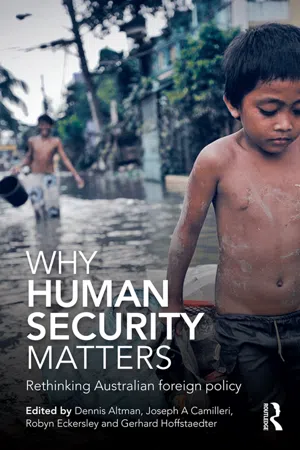
Sea level rises pose a greater long term threat to Australia's coastline and major capital cities than a military attack by a foreign power. Citizens are more likely to experience a pandemic virus than a nuclear threat. Food shortages have already occurred as a result of flood or drought, and the tentacles of international trade in drugs, money laundering and human trafficking already reach far into Australian communities.
Why Human Security Matters argues that Australian external relations needs to treat the 'soft' issues of security as seriously as it treats the 'hard' realities of military defence, but also the many complex situations in-between, whether it be civil war, political upheaval, terrorism or piracy. Australia needs to do this first and foremost in our region, but also in relation to the unresolved regional and global security issues as we confront an increasingly uncertain and turbulent world.
With contributions from leading thinkers in foreign policy and strategic studies, Why Human Security Matters is essential reading for anyone seeking a thoughtful and thought-provoking analysis of Australia's place in an age of transition.
eBook - ePub
Why Human Security Matters
Rethinking Australian foreign policy
- 232 pages
- English
- ePUB (mobile friendly)
- Available on iOS & Android
eBook - ePub
Why Human Security Matters
Rethinking Australian foreign policy
About this book
Information
1
INTRODUCTION: WHY HUMAN SECURITY MATTERS
If one were to ask most Australians whether a threat to our secur ity would be more likely to result from a conventional military attack, a terrorist movement, or a rapid increase in global warming leading to large numbers of displaced persons seeking refuge elsewhere, most would probably select the third alternative. The annual Lowy Institute Poll that reports Australians’ views on a number of security issues has found a number of issues are considered very important, including some that are largely domestic such as protecting Australian jobs and strengthening the economy. Among issues that might be conceived of as included under the rubric of ‘human security’, and that rate highly, are stopping the spread of nuclear weapons, combating international terrorism and ‘improving relations with immediate neighbours in the Pacific’. Tackling climate change has declined as a priority issue over the past few years, and support for foreign aid is reasonably high. Most interesting, perhaps, are the ways in which ‘foreign policy goals’ are conceived of as cutting across the normal divide between ‘foreign’ and ‘domestic’ (Hansen 2011).
In a common sense way, then, most of us understand that our security is dependent on much more than conventional military defence against invasion, and that many of the most vexed issues threatening global and regional stability are those related to ‘economic, food, health, environmental, personal, community and political security’, the seven themes identified by the United Nations Development Programme (UNDP) in introducing the concept of human security into mainstream discourse in the 1990s (UNDP 1994).
We live in a world in which the old assumptions of a clear division between the domestic and the international spheres no longer make sense. Writing of the greater Mekong area and the spread of HIV in the late 1990s the economist Doug Porter (1997:213–214) pointed out:
The nexus of HIV transmission across this territory is a metaphor for the globalization of investment, trade and cultural identity. Although the dominant realist tradition in international relations conceives national territorial spaces as homogenous and exclusive, what is referred to as ‘the new global cultural economy’ has to be seen as a complex, overlapping, disjunctive order which cannot be adequately understood in terms of centre-periphery, inner-outer, state border models of the past.
Why Human Security Matters asks how this understanding might be better integrated into debates about the future directions of Australian foreign policy, and our interactions with the rest of the world.
This book grew out of a research project funded by the Australian Research Council (ARC) through the Australian Academy of Social Sciences. Our original proposal stated:
The purpose of this project is to interrogate the concept of human security and the potential to apply the concept to key aspects of Australia’s foreign policy and external relations, both in the Asia-Pacific region and globally. The project will investigate the usefulness of this concept, placing particular emphasis on emerging security issues such as identity based conflicts; terrorism; the drug trade; human trafficking; new epidemic diseases; climate change and food security. It will examine how such issues might be more efficiently connected with more traditional concerns of interstate armed conflict.
Human security has become a portmanteau term capable of being stretched to encompass almost every issue of momentary concern. As Joseph Camilleri points out in his theoretical chapter, the term is often used so broadly as to be meaningless. In 2006 the then Australian Attorney-General Philip Ruddock defended strengthened government anti-terrorism provisions, bitterly criticised by civil liberties groups, as contributing to ‘human security’. This is probably not consistent with how most of our contributors would define the term.
One of the primary aims of this book is to give a coherent account of ‘human security’ as a way of thinking about the real threats that exist in an increasingly interconnected world. Australia is unlikely to face a military invasion, of the sort we might have experienced in World War II, but its security is threatened by a series of global upheavals around food, water, new epidemics, transnational crime and climate change. As a small rich country in a region undergoing very major economic and political transformations, Australia faces an almost unique challenge. Our immediate region—which is usually understood to encompass the South Pacific and Southeast Asia—contains a vast range of economic, social and political circumstances, and Australia’s relations with the diverse countries of the region inevitably means engaging with the full gamut of challenges summed up in the phrase ‘human security’ (see, regarding Southeast Asia, Kaur and Gong 2010).
Even without using the term, the issues summed up in the term ‘human security’ are of increasing concern to both government and publics, which is challenging the traditional ways of thinking about foreign policy. Thus while Cotton and Ravenhill’s edited survey of Australia foreign policy in the past five years does not even index the term it does include considerable reflection on the importance of climate change and lesser attention to a number of non-traditional security concerns (see, particularly, Elliott 2011). Perhaps the most intriguing chapter in that book is the analysis of the now largely forgotten Australia 2020 Summit organised in the first flush of Rudd’s government, where concerns about ‘emerging security challenges’, particularly around food and climate, received considerable attention (Tyler and White 2011).
One of the strange features of contemporary Australian politics is that at a time of rapidly shifting global political and economic power our political leaders seem less interested in the larger world than at any time in the past forty years. Only under the pressure of a series of international gatherings in late 2011 did Julia Gillard start to articulate a vision of Australia’s role in the world, and, other than Kevin Rudd, whose passion to give Australia a larger role on the world stage has become entwined with his own personal ambitions, it is hard to think of a leading frontbencher on either side who seems to spend much time or energy reflecting on world affairs.
As political debate appears to be becoming more polarised and uncivil, relations with the larger world remain one of the few areas of apparent bipartisanship, though more through disinterest than thought through conviction. One of the demands of the Greens after winning considerable political clout at the 2010 elections was that the first full parliamentary debate on Australia’s involvement in Afghanistan be held, ten years after the first troops were committed. In that debate (in October 2010) government and opposition seemed largely united, even if their support for what appears an open-ended commitment is regarded with scepticism by much of the electorate.
Politicians tend to fight current battles through perceptions formed in their youth, a tendency which becomes very problematic when the world changes rapidly. Common to the speeches and performance of both Julia Gillard as prime minister and Tony Abbott as opposition leader is a view of the world that reveals their political formation during the Cold War, and their uncritical acceptance of the dominant American construction of international affairs. Thus Tony Abbott still talks unselfconsciously of the United States as ‘the leader of the free world’, while Gillard, in her address to the United States Congress, made clear her admiration for the United States as the country that ‘can do anything’. President Obama’s visit late in 2011 produced bipartisan support for further strengthening of the American alliance without, it seemed, any questioning of how our eagerness to further blend into US defence structures might be perceived by regional neighbours. The prime minister did move to reassure countries such as China and Indonesia in the immediate aftermath of the Obama visit, but she has also commissioned a review of Australia’s relations with Asia to be directed by that indefatigable purveyor of advice to government, former Treasury head Ken Henry. Not necessarily a bad move, but Gillard’s comments in commissioning the White Paper made clear her concerns were essentially economic.
Of course the alliance with the United States has been the cornerstone of Australian foreign policy for the past sixty years, and successive prime ministers have sought to prove their closeness to American administrations. But while some of us might have preferred Gillard to have echoed some of the independence of, say, Gorton, Whitlam or Keating, the real point is that neither she nor her opponents seem to recognise the extent to which the Cold War framework no longer serves as an overall framework for understanding the world. The last decade has seen a rapid shift in how the world works, symbolised by the rising importance of states such as China, India and Brazil, and Australia can no longer assume that any of the old certainties will persist. A more imaginative request from the government would be one that recognises the changing shape of global relations and challenges which extend far beyond trade, investment and tourism.
Governments, of course, are often more sophisticated than their public rhetoric might suggest, and it would be a mistake to assume there is not a far more complex set of views that in practice means Australia is engaged at a number of levels in multilateral discussions on a variety of issues that rarely are publicly noticed. As Alex Bellamy points out in his chapter, there has been essentially bipartisan support for interventions to protect, where Australia has played a leading role. Taking office means that politicians are more subject to the cooler passions of public servants and international obligations than to the grandstanding of talkback radio; Julia Gillard no longer talks of how she would prefer reading to school kids than attending international meetings, and Howard’s foreign minister, Alexander Downer, was in practice far more thoughtful and engaged with our region than his public persona might have suggested.
The case for reassessing the role of major Asian powers has been made powerfully in the last couple of years by a number of commentators, most particularly Michael Wesley and Hugh White, and White in particular points to the increasing need for Australia to recalibrate its relationship with the United States as China becomes more and more significant (White 2010). As Wesley (2011:123–124) wrote: ‘Never has there been a greater gap between Australian society’s enmeshment with the world and its levels of interest in the world beyond its shores… A nation that has become profoundly cosmopolitan and well-travelled over the space of two decades has, at the same time, become more belligerently self assertive and inflexible in the face of a globalised world’s challenges.’
These sort of arguments are often attacked in deeply emotional terms as betraying our historic ties to ‘great and powerful friends’. On both sides of politics there is a deep emotional attachment to the view that Australia’s future depends upon ever closer ties to the United States, even as successive governments do their best to increase trade and investment with Asia. I have the dubious honour of having been attacked by one current cabinet minister for ‘moral equivalence’ when I suggested that we should assess our relations with the United States exactly as we would those with any other state. Apparently he heard what should be an uncontroversial (indeed old-fashioned) argument for national interest as an attack on the United States.
For a realist it would be sufficient to demonstrate that there is an ongoing contradiction arising from shifting power relations that at some point Australian foreign policy will have to address. But this is to assume a one-dimensional view of global changes which overlooks the increasing interdependence of states and the rising significance of concerns that go beyond traditional notions of state security. This interdependence of a global economy and society has been dramatically underlined by the successive economic crises of the early twenty-first century, and the effective replacement of the G8 by the G20 as the forum in which major economic powers seek to establish financial stability (Beeson and Bell 2009). Peter Costello and Kevin Rudd played a major role in helping shape these new forms of global architecture, and could justifiably claim that their success in promoting Australia’s role has not been fully appreciated.
Like economic crises, the problems of climate change underline the ways in which we are inextricably affected by global developments. Interestingly this is recognised by both proponents and opponents of Australian action: those who demand meaningful action to reduce carbon emissions do so by reference to Australia’s per capita contributions to global warming, perhaps the highest in the world, while those who disagree argue that whatever we do is irrelevant in the face of the rapid growth of emissions in very much larger economies such as China and India. Kevin Rudd of course made climate change a central issue of his leadership, and both his failure to implement a trading emissions scheme and declining commitment from significant polluters has meant declining emphasis on climate change within foreign policy.
There is a deep tension within Australia between a cosmopolitan and a parochial view of the world, which results from the ways a settler society planted so far from its historical roots has engaged with the larger world. ‘Cosmopolitan’ is a much contested term, and I use it here to convey a sense of ‘focusing on the world as a whole rather than on a particular locality or group within it. It also means being at home with diversity’ (Calhoun 2008:428). In the current world it means a positive interest in Australia’s geographic situation in the Pacific and Indian Oceans, as distinct from a deep attachment to its North Atlantic antecedents. A cosmopolitan would see in the almost unique features of Australian history and geography a remarkable opportunity to develop a particular vision of the world, rather akin to Robyn Eckersley’s (2007:689) argument for a ‘cosmopolitan nationalism’: ‘If the shape of foreign policy includes a concern with responsibility to others and not just co-nationals, with alleviating injustices beyond the nation, then such a nation may be characterised as cosmopolitan’.
Certainly huge changes in our perceptions of the outside world have occurred in the past few decades, in part as a response to the increasing diversity of our population and the economic rise of many of our neighbours. But the anxieties and paranoia that surface every time an Australian is arrested for drug offences in Indonesia suggest that there remains a deep discomfort among many Australians, fed by the media, about those countries to which we are closest geographically.
As Matt McDonald indicates, many Australians are engaged with the world in ways that are far more complex and interesting than an examination of public debate or mainstream media might suggest. Our public rhetoric may not be cosmopolitan—and the spectre of asylum seekers seems to have created a very nast...
Table of contents
- Cover
- Half Title
- Title Page
- Copyright Page
- Contents
- Contributors
- 1 Introduction: Why human security matters
- 2 Human security: From theory to practice
- 3 In defence of breadth: The broad approach to human security
- 4 Human security and national security: The Australian context
- 5 Australia’s global security: A model national strategy for a more secure world
- 6 Human security and the politics of security
- 7 Australia’s ‘new engagement’ with Africa: What role for human security?
- 8 Security from below: An alternative perspective on human security
- 9 The prevention of mass atrocities: From principle to Australian foreign policy
- 10 Conclusion: The political virtues of human security
- Index
Trusted by 375,005 students
Access to over 1.5 million titles for a fair monthly price.
Study more efficiently using our study tools.
Frequently asked questions
Yes, you can cancel anytime from the Subscription tab in your account settings on the Perlego website. Your subscription will stay active until the end of your current billing period. Learn how to cancel your subscription
No, books cannot be downloaded as external files, such as PDFs, for use outside of Perlego. However, you can download books within the Perlego app for offline reading on mobile or tablet. Learn how to download books offline
Perlego offers two plans: Essential and Complete
- Essential is ideal for learners and professionals who enjoy exploring a wide range of subjects. Access the Essential Library with 800,000+ trusted titles and best-sellers across business, personal growth, and the humanities. Includes unlimited reading time and Standard Read Aloud voice.
- Complete: Perfect for advanced learners and researchers needing full, unrestricted access. Unlock 1.5M+ books across hundreds of subjects, including academic and specialized titles. The Complete Plan also includes advanced features like Premium Read Aloud and Research Assistant.
We are an online textbook subscription service, where you can get access to an entire online library for less than the price of a single book per month. With over 1.5 million books across 990+ topics, we’ve got you covered! Learn about our mission
Look out for the read-aloud symbol on your next book to see if you can listen to it. The read-aloud tool reads text aloud for you, highlighting the text as it is being read. You can pause it, speed it up and slow it down. Learn more about Read Aloud
Yes! You can use the Perlego app on both iOS and Android devices to read anytime, anywhere — even offline. Perfect for commutes or when you’re on the go.
Please note we cannot support devices running on iOS 13 and Android 7 or earlier. Learn more about using the app
Please note we cannot support devices running on iOS 13 and Android 7 or earlier. Learn more about using the app
Yes, you can access Why Human Security Matters by Dennis Altman,Joseph A. Camilleri,Robyn Eckersley,Gerhard Hoffstaedter in PDF and/or ePUB format, as well as other popular books in Politics & International Relations & Public Relations. We have over 1.5 million books available in our catalogue for you to explore.