'Essential reading for practitioners, educators and researchers within the general field of social work with older people.' - From the foreword by Mark Lymbery, Associate Professor of Social Work, University of Nottingham
The reality of our ageing population means all social workers need to be confident in working with older people. Social workers are engaged in ongoing practice with older people in a variety of contexts, from hospitals, aged care assessment teams and mental health services to employment services, housing services and rehabilitation services.
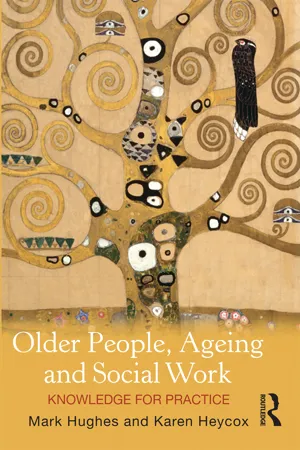
Older People, Ageing and Social Work draws on theoretical, research, policy and practice knowledge to inform contemporary practice with older people. Hughes and Heycox demonstrate that high level professional skills are required in this area as well as detailed knowledge of the issues affecting older people's lives. They argue that practitioners need to take into account the social and emotional needs of the older people they work with, as well as the practical and administrative aspects of their roles. They emphasise understanding the diversity of the older population and enabling older people to make the most of their strengths and capacities.
- 352 pages
- English
- ePUB (mobile friendly)
- Available on iOS & Android
eBook - ePub
About this book
Information
1
Introducing social work with older people
Social workers are bombarded every day with images of older people and ageing. The messages they receive from the media are complex and varying: from reports of abuses in residential facilities to the spectacle of bungee-jumping grannies; from the latest anti-ageing treatment to Grey Nomads roaming Australia in their caravans. Sometimes the messages appear positive—such as the increasing number of seniors making use of the internet—but often the images are negative—such as reports about the so-called burden of Australia's ageing population. And sometimes what might on the surface appear to be a positive representation of ageing may mask a more complex message that continues to devalue the experience of growing older. For example, some of the positive ageing messages being adopted in commercial marketing campaigns—for anything from Viagra to retirement villages—appear to value only an ageing experience that mirrors youthfulness.
Of course, social workers draw on more than media messages in understanding ageing and the issues facing older people. They also utilise wider theoretical and research knowledge gained from disciplines such as sociology, social policy and psychology. Additionally, practitioners draw on practice wisdom gained from everyday practice experiences and from personal knowledge acquired from personal experiences, intuition and cultural understandings (Drury Hudson 1997). Importantly, practitioners also make use of procedural knowledge in guiding their practice, including knowledge of relevant legislation, social policy and agency policy. In this book, we recognise the influence of these different sources of knowledge for practitioners. We hope that the book will enable social workers to not only increase their knowledge of older people and ageing, but also help them better articulate and critique this knowledge. In particular, we aim to draw on gerontology knowledge, theory and research, and to make this accessible to social workers working with older people in a range of settings including, but not limited to, aged care settings.
We see social work with older people as an exciting, challenging and rewarding area of practice. It requires high-level skills on the part of social work practitioners, as well as a detailed knowledge of the issues affecting older people's lives and their engagement with the health and human services industries. In the next chapter, we note that sometimes social work with older people may focus on the practical or administrative aspects of the work to the exclusion of the emotional and social dimensions of older people's lives. However, as with other population groups, there is considerable potential to engage older people in a wide range of social work methods, such as social action, family therapy, relationship counselling, trauma counselling and conflict mediation. Nonetheless, while we argue in this book that older people should have access to a wide range of social work interventions, it is also important to recognise that less-valued interventions—such as case management, discharge planning and providing long-term support—also involve high-level skills on the part of social work practitioners. For example, in providing long-term support, practitioners may be called upon to assist with relationship conflict, experiences of loss and grief, and the development of new social networks.
A key concern of the book is to challenge the devaluing of older people and their experience of growing older in Australian society. Like other professionals, social workers are not immune to these negative representations. It is notable that aged care settings are still frequently cited by social work students as their least preferred sites of practice (Weiss et al. 2002). And health and human services students, including social work students, demonstrate only low to moderate levels of interest in working with older people in the future (Heycox & Hughes 2006). Attitudes towards older people also tend to be less than positive, and to reflect societal images of older people as inactive, unhealthy, inflexible and complaining (Heycox & Hughes 2006). These findings highlight the importance of social work with older people challenging limited representations of older age, and enabling older people to draw on their strengths and capacities.
Social work with older people—given population ageing—is an area of practice that is likely to continue to grow. As we discuss in Chapter 3, the proportion of Australia's population that is aged 65 and over is set to increase from 13.1 per cent in 2005 to 21.3 per cent by 2031 (Australian Bureau of Statistics 2006a). This means that not only will there be more opportunities for social workers to work in the aged care field, but also more social workers in other fields will have contact with older people in their work. Indeed, we suggest that already most social workers in Australia need skills and knowledge in working with older people. In a US study, Cummings et al. (2003) identified that 77 per cent of social work graduates not employed in an aged care role had contact with older people, and 63 per cent reported that they needed gerontology knowledge in their work.
Why focus on older people and ageing?
In many ways, the complexity and potential of social work practice with older people arises from the diversity of the older population. This is not surprising, although the heterogeneity of older people is not often portrayed in the media. If older age is identified by arbitrarily dissecting the population according to a chronological position on the average lifespan (e.g. 65 and over), then it is not unreasonable to expect the same range of people, experiences and issues that could similarly be found at other points on the lifespan. Like young people and middleaged people, older people come from varied cultural and religious backgrounds. They have different abilities and disabilities, different relationships and different sexualities. Some are wealthy, some experience poverty, and some may be seen as socially excluded. And while we would not suggest that all people's experiences are the same, why should we consider the particular experiences of a 70-year-old when it comes, for example, to relationship conflict as different from those of a 50-year-old? Or for that matter, what makes the experiences of a 65-year-old different from those of a 64-year-old?
One reason why we might want to differentiate older people from others as a focus for social work practice is that as people grow older they experience more ill-health, and are thus more likely than younger people to need to access health and personal care services. However, how a 75-year-old's experience of cancer or a stroke is different from a 40-year-old's is still open to debate. Another reason is that societies, particularly governments, set different expectations for people when they are at different points in the lifespan. For example, children are expected to go to school, and young and middle-aged people are expected to engage in work, education or parenting. Older people are typically expected to retire, although in recent years Australian governments have promoted older people staying in the labour market for longer. There are also expectations that older people may contribute by providing care to partners and other family members (such as grandchildren) and by engaging in volunteering work. A further reason why we might want to identify older people as a specific group with which to work is because, as we have discussed already, they are subject to discriminatory attitudes and practices that may stereotype them and reduce their life opportunities.
However, in identifying older people as a particular group in the population with particular needs and issues that should be recognised and responded to, it is important to be mindful of some of the limitations involved in the use of the constructs 'old' and 'older', and in separating this group out from other groups. Importantly, not all people identified by others (such as researchers and practitioners) as old or older may identify themselves in this way—and indeed, some may reject these labels being applied to them (Minichiello et al. 2000). It is commonly reported that many older people resist accessing aged care services because they don't want to associate (or be associated) with older people, and that they place much emphasis on being seen to age normally rather than abnormally (Heikkinen 2000). So, because terms such as 'old', 'older', 'elderly' and 'the aged' convey not just information about the time since one's date of birth, but also socially and culturally devalued meanings (at least in Western societies), they may understandably be resisted by people who might be categorised as older.
In identifying and responding to the needs of older people, then, the issue of who is included in this group and how they come to be included raises dilemmas. Of course, the easiest way is to select a specific age category to determine who is older and who is not. The convention in Australia is 60 or 65 years of age, based mainly on the former retirement ages for women and men respectively. However, if we say that we don't want to define older age in this way, how else might we go about identifying older people? Bytheway (2005) uses the example of recruiting older people as volunteers in a research study, and we could easily apply this to recruiting older participants for a human services program. He suggests there are five possible ways that researchers (and practitioners) could respond when asked by potential participants, 'What do you mean by older? How old is older?'
- Well we're not bothered about specific ages ourselves but, if you insist, then we are thinking about something like 60: We want volunteers who are over that age. However, if you're interested but are not yet 60, then that's OK with us.
- How old? Well certainly we are not expecting to include any children or young people. Everyone else is welcome.
- How old is older? Older than me.
- We're not interested in chronological age. If you think of yourself as an 'older person' then we would like to include you.
- We want to include people of all ages who are able to talk about being older. (Bytheway 2005, pp. 370-1)
As Bytheway identifies, it is only the last two responses that enable the person to identify themselves as older. In thinking about these categorisations for gerontology research, Bytheway suggests that there are other ways of thinking about older people and older age. One further strategy is to focus more on the transitions experienced across the life course. Thus the question 'What is old age like?' can be more meaningfully refrained as 'How do people experience growing older?' or 'How are people made to feel older?' (Bytheway 2005, p. 371). Another strategy is to identify people according to some other criteria (such as their residence or the service they might be accessing) and then study their experience of ageing in that context. A further strategy is to focus more on the cultural representation of age and ageing, and how this gives meaning to the experience of being old. In each of these strategies, more emphasis is thus placed on ageing and growing older as a process than on old age as a significant category. Such a distinction is becoming more popular in gerontology, and for us it signifies a deeper and more nuanced understanding of age and its significance for people and service delivery. According to Gilleard and Higgs (2000, pp. 3-4):
We have chosen to write about 'ageing' rather than 'old age'. Old age does not figure in the 'plastic' or 'flexible' life course of men and women in current society. Rather, it acts as a kind of reference point around which various cultures of ageing revolve. Old age itself is not a site that is seriously contested or challenged. It remains a period of life that is excluded, marginalized or institutionalized. Whilst the changes that accompany ageing are being reframed and revalued—the 'empty nest', retirement, the menopause, greying, and so on—the changes that tip a person into 'old age' cannot be so easily reframed or transgressed. One may speak of nursing home cultures, cultures of health care or even cultures of dying, but old age remains an obdurately singular category—a future end that most people choose to avoid however long their lives may be.
So in this book we maintain a focus on both older people and ageing. We recognise the many limitations of arbitrarily designating a chronological cutoff, but also acknowledge that this is common practice in the health and human services industries, as well as in social policy. Like Bytheway (2005), we are interested in how people experience their own and others' ageing, and how they experience the social and cultural representation of old age. This recognises that while it is important to listen to those who might be identified by themselves and/or others as 'old' or 'older', it is also valuable to listen to other (younger) people's experiences of ageing. In this way, we hope that the book will help in breaking down age-related barriers and recognise that we all share the experience of ageing and growing older. We acknowledge the contribution social work can make to gerontology and multi-professional practice, and also focus on gerontology's contribution to social work. In the remainder of this chapter, we highlight the value of understanding ageing within the context of the life course, and identify some of the contemporary challenges in relation to social work with older people and some possible responses.
Critical reflections
- Brainstorm some words associated with ageing and older age. Which reflect positive images and which reflect negative ones?
- What are some of your own hopes and fears as you grow older? How might the images of ageing affect you?
Ageing across the life course
In the next chapter, we outline some key practice strategies in social work with older people and emphasise the potential of engaging with the social and emotional dimensions of older people's lives, in addition to responding to their practical needs. Central to this is an acknowledgement that people's later life situations are heavily influenced by both their experiences earlier in their lives and the opportunities that have been afforded them. So, in our book, we highlight the life course context of ageing.
The importance of the life course (the different stages of human development across the lifespan) in understanding older people and ageing is widely acknowledged within the field of gerontology. Specifically, the life course perspective is presented as a multidisciplinary approach: a 'convergence of thinking in sociology and psychology about processes at both macro- and micro-social levels of analysis and for both populations and individuals over time' (Bengston et al. 2005, p. 14). Some of the key features of this perspective include a recognition that:
- ageing is a dynamic lifelong process
- ageing is shaped by biological, psychological, social, political and cultural processes
- people's experiences across their life are affected by social, environmental and historical change and
- changes in patterns of ageing (e.g. an increasing proportion of older people in the population) can produce social change.
A life course perspective facilitates an understanding of the connections between one's past and current lives (Arber & Evandrou 1993). It acknowledges that there can be life themes that provide for continuity and integration between one's past, present and future.Further, there are attitudes and values which one carries throughout life, and which therefore can affect the way an older person engages with their world. It is a useful perspective in challenging the view of old age as a singular and separate category, somehow distinct or unconnected from earlier experiences. There is also much focus on diversity within and across cohorts, particularly transitions in roles and the different trajectories that unfold across people's lives (George 1996). Our decision to include an overview of theories spanning the biological, psychological, social, political and cultural dimensions in Chapter 4 reflects this broad approach to ageing.
Naughtin and Schofield (2009) support the life course perspective, seeing ageing as a phase in the lifespan, where older people's experience is greatly affected 'by their social setting and history (2009, p. 197). This particular view sees each person facing 'major transitions or times of change in each life phase that generate experiences of loss or growth or both' (2009, p. 197). People deal with these challenges by drawing on the knowledge and skills they have acquired over their lifetime (Bengston et al. 2005; Naughtin & Schofield 2009). For social workers, this perspective assists them to consider how older people have responded to previous life transitions, and therefore how they may possibly deal with current challenges.
Contemporary challenges and responses
For social workers, the challenges in working with older people are not dissimilar to those involved in working with other client groups. The political pressures—especially in terms of the impact of dominant ideology on everyday practice—are very much the same. In particular, practitioners are dealing with the impacts of neoliberalism (often framed as economic rationalism in Australia) and managerialism (Hughes & Wearing 2007). Neoliberalism refers to the promotion of values associated with free market or laissez-faire economics, not just in the economic realm but also in social policy. For example, efficiency and quality in the delivery of social services are seen to arise from the opening up of the human services sector to private enterprise and competition between providers. Managerialism, in turn, reflects the concerns by governments, funding bodies and managers to control the activities of organisational employees, especially professionals, to ensure that they work in efficient and effective ways. Managerialism reflects neoliberal values of costeffectiveness and value for money.
As enacted by the major political parties at both the federal and state levels, neoliberalism has led to a reduction in the role of government in the delivery of social welfare, and an increased role for the profit-making and voluntary sectors in the provision of services. An example of neoliberal ideas applied to policy affecting older people has been the reduced emphasis on the age pension and the expansion of market-based superannuation schemes as the primary means of securing an adequate retirement income. However, a clear drawback is the implications for older people who are attempting to retire during periods of economic instability (such as the ...
Table of contents
- Cover
- Half Title
- Title Page
- Copyright Page
- Foreword
- Contents
- Preface
- 1 Introducing social work with older people
- 2 The potential of social work with older people
- 3 Demographic and policy context
- 4 Perspectives on ageing
- 5 Diversity and disadvantage
- 6 Health, disability and advocacy
- 7 Caring, networks and community care
- 8 Dementia
- 9 Housing and residential care
- 10 Intimate relationships and sexuality
- 11 Risk and elder abuse
- 12 End of life
- 13 Meaningful ageing
- 14 Conclusion
- References
- Index
Trusted by 375,005 students
Access to over 1.5 million titles for a fair monthly price.
Study more efficiently using our study tools.
Frequently asked questions
Yes, you can cancel anytime from the Subscription tab in your account settings on the Perlego website. Your subscription will stay active until the end of your current billing period. Learn how to cancel your subscription
No, books cannot be downloaded as external files, such as PDFs, for use outside of Perlego. However, you can download books within the Perlego app for offline reading on mobile or tablet. Learn how to download books offline
Perlego offers two plans: Essential and Complete
- Essential is ideal for learners and professionals who enjoy exploring a wide range of subjects. Access the Essential Library with 800,000+ trusted titles and best-sellers across business, personal growth, and the humanities. Includes unlimited reading time and Standard Read Aloud voice.
- Complete: Perfect for advanced learners and researchers needing full, unrestricted access. Unlock 1.5M+ books across hundreds of subjects, including academic and specialized titles. The Complete Plan also includes advanced features like Premium Read Aloud and Research Assistant.
We are an online textbook subscription service, where you can get access to an entire online library for less than the price of a single book per month. With over 1.5 million books across 990+ topics, we’ve got you covered! Learn about our mission
Look out for the read-aloud symbol on your next book to see if you can listen to it. The read-aloud tool reads text aloud for you, highlighting the text as it is being read. You can pause it, speed it up and slow it down. Learn more about Read Aloud
Yes! You can use the Perlego app on both iOS and Android devices to read anytime, anywhere — even offline. Perfect for commutes or when you’re on the go.
Please note we cannot support devices running on iOS 13 and Android 7 or earlier. Learn more about using the app
Please note we cannot support devices running on iOS 13 and Android 7 or earlier. Learn more about using the app
Yes, you can access Older People, Ageing and Social Work by Mark Hughes,Karen Heycox in PDF and/or ePUB format, as well as other popular books in Social Sciences & Health Care Delivery. We have over 1.5 million books available in our catalogue for you to explore.