Teaching Aboriginal Studies has been a practical guide for classroom teachers in primary and secondary schools, as well as student teachers, across Australia. Chapters on Aboriginal history and culture, stereotypes and racism, government policies and reconciliation provide essential knowledge for integrating Aboriginal history and culture, issues and perspectives across the curriculum.
This second edition of Teaching Aboriginal Studies encompasses developments over the past decade in Aboriginal affairs, Aboriginal education and research. It features a wide range of valuable teaching sources including poetry, images, oral histories, media, and government reports. There are also strategies for teaching Aboriginal Studies in different contexts and the latest research findings. The text is lavishly illustrated with photographs, posters, paintings, prints, ads and cartoons.
Teaching Aboriginal Studies is the product of consultation and collaboration across Australia. Remarkable educators and achievers, both Aboriginal and other Australians, tell what teachers need to know and do to help Aboriginal students reach their potential, educate all students about Aboriginal Australia and make this country all that we can be.
'The importance of this book cannot be overestimated. We have been insisting for years that pre-service teachers be required to learn about Aboriginal history, culture and identity, and that it be regarded as integral to qualifying for their education degrees.' Lionel Bamblett, General Manager, Victorian Aboriginal Education Association Inc.
eBook - ePub
Teaching Aboriginal Studies
A practical resource for primary and secondary teaching
- 368 pages
- English
- ePUB (mobile friendly)
- Available on iOS & Android
eBook - ePub
About this book
Information
1
Why teach Aboriginal Studies?
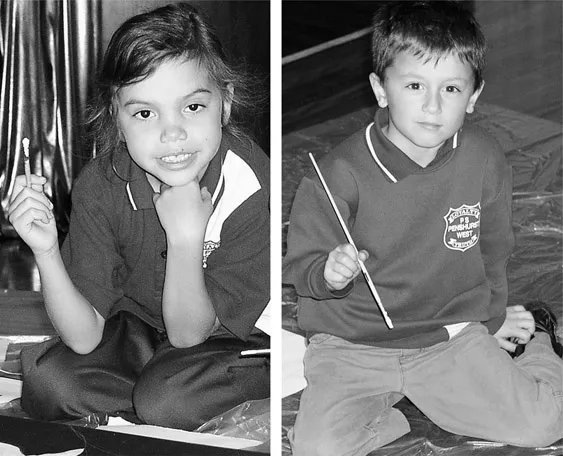
Reconciliation Day at Penshurst West Public School, Sydney. An Aboriginal girl (the author’s daughter) and a non-Aboriginal boy get into the spirit. Photo: Lisa Car.
Aboriginal Charter of Rights
We want hope, not racialism,
Brotherhood, not ostracism,
Black advance, not white ascendance:
Make us equals, not dependants.
We need help, not exploitation,
We want freedom, not frustration;
Not control, but self-reliance,
Independence, not compliance,
Not rebuff, but education,
Self-respect, not resignation.
Free us from a mean subjection,
From a bureaucrat Protection.
Let’s forget the old-time slavers:
Give us fellowship, not favours;
Encouragement, not prohibitions,
Homes, not settlements and missions.
We need love, not overlordship,
Grip of hand, not whip-hand wardship;
Opportunity that places
White and black on equal basis.
You dishearten, not defend us,
Circumscribe, who should befriend us.
Give us welcome, not aversion,
Give us choice, not cold coercion,
Status, not discrimination,
Human rights, not segregation.
You the law, like Roman Pontius,
Make us proud, not colour-conscious:
Give the deal you still deny us,
Give goodwill, not bigot bias;
Give ambition, not prevention,
Confidence, not condescension;
Give incentive, not restriction,
Give us Christ, not crucifixion.
Though baptised and blessed and Bibled
We are still tabooed and libelled.
You devout Salvation-sellers,
Make us neighbours, not fringe-dwellers;
Make us mates, not poor relations,
Citizens, not serfs on stations.
Must we native Old Australians
In our land rank as aliens?
Banish bans and conquer caste,
Then we’ll win our own at last.
—‘Aboriginal Charter of Rights’, Oodgeroo Noonuccal (2007, p. 36)
Oodgeroo (aka Kath Walker) wrote ‘Aboriginal Charter of Rights’ to present to the fifth Annual General Meeting of the Federal Council for the Advancement of Aborigines and Torres Strait Islanders (FCAATSI) in Easter 1962. This poem contributed to providing a voice for Aboriginal Australians and helped to educate other Australians about the critical need for social justice for Aboriginal Australians. Oodgeroo said it was her most expensive poem ever, as a public reading resulted in her home being invaded and her clothes and blankets slashed. This did not deter Oodgeroo from being a spokesperson for her people, an activist for social justice and a committed Aboriginal Studies educator. In fact, her life story (see Cochrane 1994; Shoemaker 1994) is a striking testimony to why implementing Aboriginal Studies is a national priority, and why educators should be committed to teaching this subject area. ‘Aboriginal Charter of Rights’ expresses poignantly Aboriginal people’s pleas that their human rights be respected. It also shows clearly that Aboriginal people’s basic human rights were not given sufficient respect, and calls for attention to social justice issues. In a nation that pays homage to the principle of a ‘fair go for all’, we can see that in Oodgeroo’s eyes this ethos clearly did not extend to Aboriginal Australians.
Aboriginal Studies is about social justice for all Australians—equity, human rights, a fair go and mutual respect for our fellow Australians. It is hard to define social justice but everybody knows what it is, particularly when it is missing. Mick Dodson famously described social justice as:
what faces you in the morning. It is awakening in a house with an adequate water supply, cooking facilities and sanitation. It is the ability to nourish your children and send them to a school where their education not only equips them for employment but reinforces their knowledge and appreciation of their cultural inheritance. It is the prospect of genuine employment and good health: a life of choices and opportunity, free from discrimination. (Mick Dodson, 1993, p. 8)
Consultations across Australia have stressed that social justice is not so much about the expenditure of vast sums of money on Indigenous programs; rather, it is about changing systems and mindsets, to recognise Aboriginal and Torres Strait Islander cultures and knowledge as being of equal validity to non-Indigenous cultures, and to secure Indigenous Australia in the frame of reference of mainstream Australia. Clearly, all schools have a critical role to play in promoting this recognition.
How many Indigenous Australians?
A total of 455 028 people identified themselves as ‘Indigenous’ in the 2006 Census. (Australian Bureau of Statistics, 2008a, p. 25). Of these, 409 525 were Aboriginal, 27 302 were Torres Strait Islanders and 18 201 identified themselves as both Aboriginal and Torres Strait Islander. Overall, 2.3 per cent of the total population of Australia in 2006 identified themselves as Indigenous, an increase of 11 per cent since the 2001 Census (Australian Bureau of Statistics, 2008a, p. 25). The Australian Bureau of Statistics recommends the estimated resident population (2008a, p. 9) of 517 174 as the official measure of the Indigenous population—this is higher because it has been adjusted for a net undercount of Indigenous people and occasions where Indigenous status is unknown (Australian Bureau of Statistics, 2008a, p. 8). In 2006, the estimated resident population of people of Torres Strait Islander origin was 53 300 (10 per cent of the Indigenous population and 0.3 per cent of the total Australian population (Australian Bureau of Statistics, 2008a, p. 168). As a whole, the Indigenous population is much younger than the non-Indigenous population: 56.5 per cent of the Indigenous population in Australia are aged under 25 compared with 32.9 per cent of the non-Indigenous population (see Figure 1.1, Australian Bureau of Statistics, 2008a, p. 17). Figure 1.1 shows double the proportion of Indigenous people up to the age of 14, and still way more in the 15–24 age group. This means there will be more and more Indigenous students in Australian schools and the Indigenous proportion of Australian population will keep on increasing, especially as their birthrate is higher.
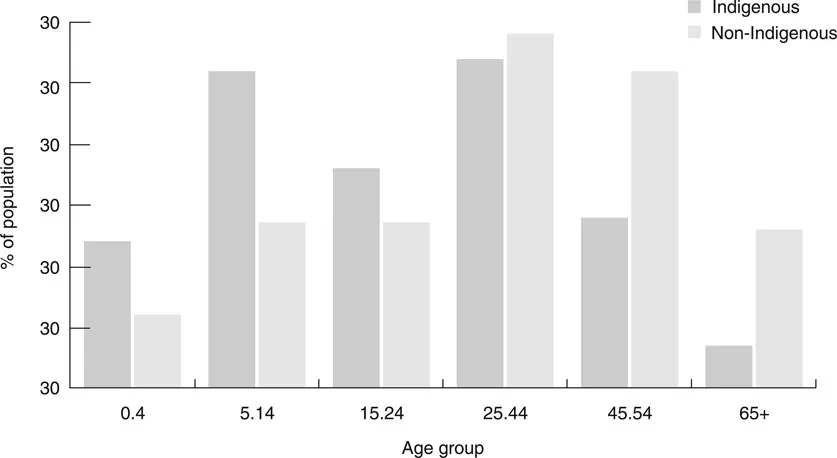
Figure 1.1 Proportion of Indigenous and non-Indigenous population in specific age groups, 2006
Source: Australian Bureau of Statistics, Population Characteristics: Aboriginal and Torres Strait Islander Australians, Catalogue No. 4713, Table 2.3. Estimated Resident Population, (27 March 2008), p. 17.
What is Indigenous Studies?
Content
Aboriginal Studies and Torres Strait Islander Studies is the study of Aboriginal societies or Torres Strait Islander societies past and present, including histories, cultures, values, beliefs, languages, lifestyles and roles, both prior to and following invasion. This study of Torres Strait Islander people and Aboriginal people presents an accurate history of Australia, and is studied in a context that:
- is central to Aboriginal societies and Torres Strait Islander societies and relevant to the total Australian community;
- presents Torres Strait Islander people and Aboriginal people within an accurate and culturally inclusive history of Australia;
- acknowledges the sophistication and complexity of Aboriginal and Torres Strait Islander kinship and social structures;
- promotes respect for the integrity of all people;
- emphasises an understanding of spiritual, political, economic and environmental issues;
- affirms the diversity of cultures within Aboriginal societies and Torres Strait Islander societies (Oliver, 1995, p. 1).
We as teachers can feel overwhelmed by the breadth and depth of this subject area as described in definitions like the one above. However, such feelings diminish when we come to understand the content and recognise that our role is to facilitate learning in this area, as opposed to being experts on all facets of the subject-matter.
Indigenous Studies comprises both Aboriginal Studies and Torres Strait Islander Studies—by definition, Indigenous Studies includes Torres Strait Islander Studies. Torres Strait Islander people are indigenous to Australia and are culturally distinct from all Aboriginal peoples. Therefore, Indigenous Studies is the study of Aboriginal and Torres Strait Islander history, societies and cultures, both as a subject in its own right and as content incorporated into all curriculum areas at all levels of education. Indigenous Studies is not just an isolated unit of
Aboriginal Studies was an experience
When I first enrolled in Aboriginal Studies at the end of Year 10. I didn’t know what to expect. I wondered how I could gain an adequate understanding of Indigenous issues in an environment as sterile as a high school. Little did I know that Aboriginal Studies was not your generic HSC subject. It was an experience.
There was always a bit of excitement upon entering Room L14. Would there be a guest hiding away in a corner? Was there a heated discussion about to break loose, unleashing passion for the issues in the people who always put on the most apathetic of fronts? The diversity of the subject was a highlight for me. We studied Indigenous culture through many forms of media. Film, documentaries, art, internet, newspaper articles and so on. Not only did you feel constantly interested and enlightened, the subject kept us, the typical cut-off-from-the-world HSC student, a little in contact with what was actually going on outside of school. Cathy Russell, our teacher, inspired and m...
Table of contents
- Cover
- Title Page
- Copyright Page
- Dedication Page
- Series Page
- Foreword
- The Teaching the Teachers story
- Contents
- Acknowledgements
- Contributors
- 1 Why teach Aboriginal Studies?
- 2 Living cultures
- 3 Misconceptions, stereotypes and racism: Let’s face the facts
- 4 Terra nullius: Invasion and colonisation
- 5 A history of special treatment: The impact of government policies
- 6 Discovering shared history: Moving towards new understanding in Australian schools
- 7 A history of Aboriginal education
- 8 Reconciliation matters
- 9 Educating for the future
- 10 Community involvement
- 11 What research can tell us
- 12 Closing the gap
- 13 Working with Aboriginal students
- 14 Teaching resources
- 15 Developing teaching activities
- 16 Together we can’t lose
- References
- Index
Trusted by 375,005 students
Access to over 1.5 million titles for a fair monthly price.
Study more efficiently using our study tools.
Frequently asked questions
Yes, you can cancel anytime from the Subscription tab in your account settings on the Perlego website. Your subscription will stay active until the end of your current billing period. Learn how to cancel your subscription
No, books cannot be downloaded as external files, such as PDFs, for use outside of Perlego. However, you can download books within the Perlego app for offline reading on mobile or tablet. Learn how to download books offline
Perlego offers two plans: Essential and Complete
- Essential is ideal for learners and professionals who enjoy exploring a wide range of subjects. Access the Essential Library with 800,000+ trusted titles and best-sellers across business, personal growth, and the humanities. Includes unlimited reading time and Standard Read Aloud voice.
- Complete: Perfect for advanced learners and researchers needing full, unrestricted access. Unlock 1.5M+ books across hundreds of subjects, including academic and specialized titles. The Complete Plan also includes advanced features like Premium Read Aloud and Research Assistant.
We are an online textbook subscription service, where you can get access to an entire online library for less than the price of a single book per month. With over 1.5 million books across 990+ topics, we’ve got you covered! Learn about our mission
Look out for the read-aloud symbol on your next book to see if you can listen to it. The read-aloud tool reads text aloud for you, highlighting the text as it is being read. You can pause it, speed it up and slow it down. Learn more about Read Aloud
Yes! You can use the Perlego app on both iOS and Android devices to read anytime, anywhere — even offline. Perfect for commutes or when you’re on the go.
Please note we cannot support devices running on iOS 13 and Android 7 or earlier. Learn more about using the app
Please note we cannot support devices running on iOS 13 and Android 7 or earlier. Learn more about using the app
Yes, you can access Teaching Aboriginal Studies by Rhonda Craven in PDF and/or ePUB format, as well as other popular books in Education & Education General. We have over 1.5 million books available in our catalogue for you to explore.