Most of us work in them, most of us live in them. Some are complex, some are simple. Some meet only once while others last for decades. Whatever form they take, groups are central to our lives.
Making Groups Work offers a comprehensive introduction to the key issues in group work. It outlines the role of groups and the history of group work, discusses group politics, and shows how groups can help promote social change. Detailed case studies are used to make the crucial link between theory and practice. The authors also offer strategies for making groups work effectively.
Making Groups Work is essential reading for social workers, health workers, counsellors, community workers, youth workers, trainers and anyone else interested in working with groups. It is also a good introductory text for students and a handy reference for professionals.
- 208 pages
- English
- ePUB (mobile friendly)
- Available on iOS & Android
eBook - ePub
About this book
Information
Acknowledgments
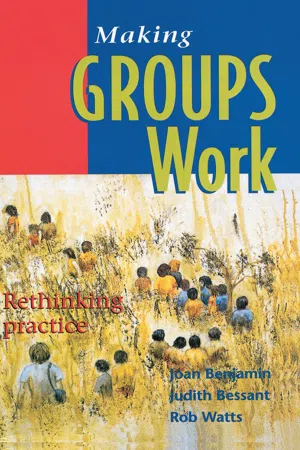
There are many people who have helped with this project and we would like to thank them. Lenny Jenner and his work with a group of people with disabilities are doing important work. We are privileged to be able to present some of their work. Colin Benjamin provided invaluable assistance and support when we needed it most. Dr Ruth Webber and Dr Bob Bessant have offered their time and expertise as readers and have provided us with valuable feedback for which we are most grateful. We would also like to thank Elery Hamilton-Smith and Roger Trowbridge for their willingness to offer advice and information on the development of modern group work. We also thank artist Judith Cameron for her contribution to the front cover of this book.
The Department of Sociology, Social Welfare and Administration at the Australian Catholic University provided a collegial culture that is strongly supportive of research and for this Judith Bessant is most appreciative. The Department of Social Sciences at RMIT supported Rob Watts in the writing of this book. Many of our students have collaborated with us in developing our understanding of groups and communities over the years and we especially appreciate the contribution of the Youth Affair students at RMIT.
Joan Benjamin
Judith Bessant
Rob Watts
Judith Bessant
Rob Watts
Part I
Introduction
Introduction: Setting the agenda for groups and group work
Introduction
It is stating the obvious to observe that all of us spend most of our lives living and working in groups. In the twentieth century, sociologists and psychologists have been fascinated by the fact that being human means being part of groups like families, schools and clubs. But this was known long before academics ‘discovered’ groups. As Samuel Johnson, the eighteenth century English writer, put it, ‘In civilised society, we all depend upon each other.’
Paradoxically, our social landscape has been shaped by the ideas and prejudices of Western liberalism and the belief that we are all ‘individuals’. Despite living and working in groups, some of us may like to think we are self-reliant and separate from ‘society’—much like Robinson Crusoe, the hero of Defoe’s novel about a sailor lost on a desert island who invents a one-man society before he is rescued. Despite such fantasies, the truth is that we spend a lot of time in an ocean of people and groups.
Some of these groups are large and others are small; some are complex and others are simple; some are groups that meet only once, while others may last for decades. Some groups are central to our experiences of becoming a person—there are certain groups that we interact with from the moment of our birth. This is especially true of that primal group we call ‘the family’, although there are many kinds of family. Other important groups where we spend a lot of time include early play and kindergarten groups or school-based groups. Other groups are optional, but provide us with a context in which to learn particular skills or ways of relating to people. Such groups include scouts or guides, or the karate or the netball club we go to after school or work. We join some groups to provide a change of environment. Women who work all day in the home may join a parents and teachers group or form a play group to provide them with some support, as well as enabling them to get out of the house and meet other people. Some men take refuge in groups at the local pub or the TAB, while others are members of groups made up of fellow workers in a trade union or professional association, or formed to raise funds for charity. Some of us join political parties and/or become involved in various forms of social action or social movements because we feel strongly about certain issues and want them solved. There are also more fluid groups of friends and relatives who we meet over drinks or dinners or at special occasions like weddings, Christmas or funerals.
Some of us join long-standing groups like the Young Women’s Christian Association (YWCA) or the Australian Women’s National League. Some of us also belong to groups that are historical and have a sense of tradition like the Masons. These are often large organisations with a vigorous ‘group-think’ culture which set out to influence their members overtly. Think of organisations like the army, various religious orders, or groups like nurses or the police.
We are not always able to decide whether or not we will become a member of a particular group. Quite often, this ‘just happens’ and we have no choice. We are born into some groups. Sometimes we join them unwittingly and occasionally absent-mindedly, or we can join them happily and sometimes leave them angrily. But whatever we do, most of us belong to groups of some kind; we live within them and experience quite different types of relationships and emotions inside them. What we experience in groups is important, especially for the people who have set them up or who join them with a purpose in mind, or who intend to work with groups and use them to achieve certain aims. This is where group work comes in.
Why we have written this book
We have used the shorthand phrase ‘group work’ to mean ‘working with groups’ and ‘working in groups’, rather than referring to a particular technique for or approach to ‘doing group work’. This book has several motives behind it.
First, we believe group work is important because working with people in groups has many advantages:
- Groups provide opportunities to share experiences, develop and pursue common aims, learn from each other and receive support from each other.
- Groups offer the chance to sort out relationship issues or political differences as well as the chance to develop and try out new skills.
- Sometimes groups help to reduce social isolation and loneliness by increasing opportunities to meet new people.
- Groups can be powerful sources of social change, which can help members challenge sexual or racial stereotypes. They can provide new role models and resources to overcome social exploitation or political oppression.
- Groups can also be major arenas for developing new political and social movements.
- Groups can help people to link their personal identity with larger social movements. For instance, they can help women integrate being feminists with the day-to-day business of working or being part of a family (see Toseland & Rivas 1984, pp. 8–9).
While believing that working in groups and understanding how groups work is important, we have been concerned about two aspects of introductory group work textbooks used in Australian universities, TAFE colleges, neighbourhood houses and community agencies: there is widespread reliance on overseas group work texts, and most group work texts used in Australia are too abstract in nature.
To address the first issue, it is important that we start to write Australian books for Australian audiences. The books used in Australia are predominantly written by British or North American writers drawing on British or North American experiences and situations to make their points. Most of the reading guides used in Australian universities and TAFE colleges are dominated by British and American texts like Sprott (1958), Rogers (1969), Milson (1973), Blumberg & Golembiewski (1976), Button (1972, 1974, 1982a, 1982b) and Douglas (1976, 1979, 1983).
There is also a vast psychological and sociological research literature on groups that lies in the background and supports such books. We are uncomfortable with the assumption that anything that comes from overseas must be better, more authoritative or more credible than any local product. Much of Australia’s history has operated on the assumption (found in all colonial societies) that ‘Home’ was somewhere else where ‘real’ ideas and ‘great’ music and painting and culture were produced. This ‘cultural cringe’ is still alive and well in Australia and needs to be challenged. Linked to this is the assumption that ideas, theories or practices can be transplanted from one place (say, England in the 1970s) to another (Australia in the 1990s) because local context and knowledge are irrelevant.
This is the first critical, contemporary and commercially published general book on group work that has been written by Australian authors for Australian human service professionals and practitioners, teachers of group work, students and community activists. However, a small and valuable body of Australian books dealing with groups does exist. Some of these are now hard to find because they have been out of print for some time—for example, the very valuable compilation of ‘structured experiences’ for group work by Watson et al. (1980). Other works include specialist books which have been around for a long time, such as Gale (1974), and the more recent general group work text by Tyson (1989), designed primarily as a tool for management and organisational development. Tyson’s book sits firmly in what we call the ‘abstracted’ style. Other works take a specialist look at one aspect of group work, such as the fine treatment of the use of psycho-drama techniques in group work in Williams (1991).
In the main, the few Australian writers who have written on group work, like the international writers, have not written about group work in a way that recognises the social complexity of groups and the people who comprise them. The exceptions include Duke & Sommerlad (1981) and Szirom & Dyson (1984). Duke & Sommerlad have drawn attention to the ways the interest in personal growth and change which characterises some group work can take place at the expense of an interest in social and political change. Szirom & Dyson offer a highly specified feminist group work model for women-only groups.
It is important in group work to remember the social context and political purpose of groups. The second major problem we have with most of the group work books used in Australia is their abstracted quality. Rarely does the reader have a sense that the author is writing about real people in real groups in real settings. Nor have many of these writers dealt with the fact that group work is a highly political process.
The tendency has been to bury the complexity and qualities of our lives in groups under the weight of ‘theory’ and abstracted writing. Many authors seem hesitant to produce ‘objective’ accounts of groups. Look at the way some of the standard textbooks answer the question ‘what is a group?’.
A group is:
- . . . a dynamic social entity composed of two or more individuals, interacting independently in relation to one or more common goals that are valued by its members, so that each member influences and is influenced by each other member, to some degree, through face to face communication. Over time, if the individuals who comprise the group continue to assemble, they tend to develop means for determining who is and who is not a member, statuses and roles for members, and values and norms that regulate behaviour of consequence to the group. (Bertcher 1979, p. 14)
- Two or more persons who are interacting with one another in such a manner that each person influences and is influenced by each other person. (Shaw 1981, p. 8)
- . . . a small, face-to-face collection of persons who interact to accomplish some purpose. The group will meet for one or more sessions, have open ended membership (where people come and go as they see fit) or closed membership (where people are constrained to attend for a specified time) and are either time limited (with the time in hours and the number of meetings usually specified) or time unlimited (without a definite ending time or date). (Brown 1991, pp. 3–4)
- . . . a plurality of individuals who are in contact with one another, who take one another into account, and who are aware of some significant commonality. An essential feature of a group is that its members have something in common and that they believe that what they have in common makes a difference. (Zastrow 1989, p. 7)
A comment
Those who offer clear and sharp definitions about people and social behaviour seem reluctant to acknowledge the overwhelming complexity of human existence. Establishing authoritative definition/s involves approaching all the big issues and questions about who we are and why we do what we do. Defining people or processes can be like putting living beings into boxes. However, given the limitations of rigid definitions, they do also have some value in that they provide a basis for some agreement on what we are talking about when we refer to a ‘group’.
We all know what a group is, despite their actual diversity, so there does not seem to be much point trying to define a group—even if such an ‘essential’ definition were possible or even useful.
Some writers talk about ‘the group’ or ‘groups’ as if they were not made up of real people with actual differences between them. Thus we get Australian writers like O’Connor et al. (1995, p. 134) stating that:
A group, like a network, may be defined as a system of relationships between and among people. The group has structure, social cohesion, goals and accepted ways of doing business.
The first sentence does not say anything that we do not already ‘know’, while the second sentence confuses prescription with description.
One of the modern doyens of group work, Douglas (1983, p. 3), writes that all human groups share certain universal characteristics:
The similarities of all human groupings can be shown to reside in an identifiable number of variables that are ubiquitously present, but in differing intensity and importance whenever human beings are gathered together.
Douglas believes that human groups are similar because the variables that allegedly make them similar are present whenever groups of people get together. Douglas (1983, p. 171) explains how a group keeps itself together:
Membership of a group is maintained by continued production of acceptable behaviour. This must equally involve rejecting the temptation to non-conforming behaviour and so too the rejection of ideas and beliefs that are contrary to, or even just different from, those held by the group in general.
Our response is that what Douglas claims is sometimes true; however, it is possible to belong to a group for many years and for that group to be full of tempestuous difficulties, different viewpoints and violent antipathies. Similarly, many women remain in violent and abusive families and marriages for years. This definition fails to address issues of gender, for example. This also points to the conspicuous absence of questions of power and gender in so much of the existing group work literature. Exceptions like Szirom & Dyson (1984) test this rule; using some of the principles of group work, these Australian authors have developed a good feminist manual of exercises and approaches designed to promote personal skills like assertiveness for young women in all-women group settings.
Further, much of the literature produced about group work is conservative and restricted both politically and ethically. Few of the texts, for example, refer to the possible use of group work by progressive or radical social movements, or discuss the work of people like Saul Alinsky or Paulo Friere, who have used groups to promote quite progressive social change. Much of the writing about group work is also abstracted and often incorrect. There is no reason to assume for example, that groups have to be ‘small’, or that groups have to operate with a totalitarian insistence on consensus, or that everyone ‘influences’ everyone else.
We live and work in a variety of institutions and organi...
Table of contents
- Cover
- Half Title
- Title Page
- Copyright Page
- Contents
- Acknowledgments
- Glossary
- Bibliography
- Index
Trusted by 375,005 students
Access to over 1.5 million titles for a fair monthly price.
Study more efficiently using our study tools.
Frequently asked questions
Yes, you can cancel anytime from the Subscription tab in your account settings on the Perlego website. Your subscription will stay active until the end of your current billing period. Learn how to cancel your subscription
No, books cannot be downloaded as external files, such as PDFs, for use outside of Perlego. However, you can download books within the Perlego app for offline reading on mobile or tablet. Learn how to download books offline
We are an online textbook subscription service, where you can get access to an entire online library for less than the price of a single book per month. With over 1.5 million books across 990+ topics, we’ve got you covered! Learn about our mission
Look out for the read-aloud symbol on your next book to see if you can listen to it. The read-aloud tool reads text aloud for you, highlighting the text as it is being read. You can pause it, speed it up and slow it down. Learn more about Read Aloud
Yes! You can use the Perlego app on both iOS and Android devices to read anytime, anywhere — even offline. Perfect for commutes or when you’re on the go.
Please note we cannot support devices running on iOS 13 and Android 7 or earlier. Learn more about using the app
Please note we cannot support devices running on iOS 13 and Android 7 or earlier. Learn more about using the app
Yes, you can access Making Groups Work by Rob Watts,Joan Benjamin,Judith Bessant in PDF and/or ePUB format, as well as other popular books in Social Sciences & Leadership. We have over 1.5 million books available in our catalogue for you to explore.