Australian television has been transformed over the past decade. Cross-media ownership and audience-reach regulations redrew the map and business culture of television; leading business entrepreneurs acquired television stations and then sold them in the bust of the late 1980s; and new television services were developed for non-English speaking and Aboriginal viewers.
Australian Television Culture is the first book to offer a comprehensive analysis of the fundamental changes of this period. It is also the first to offer a substantial treatment of the significance of multiculturalism and Aboriginal initiatives in television.
Tracing the links between local, regional, national and international television services, Tom O'Regan builds a picture of Australian television. He argues that we are not just an outpost of the US networks, and that we have a distinct television culture of our own.
'.a truly innovative book. The author ambitiously strives for a large-scale synthesis of policy, program analysis, history, politics, international influences and the Australian television system's place in the world.' - Associate Professor Stuart Cunningham, Queensland University of Technology
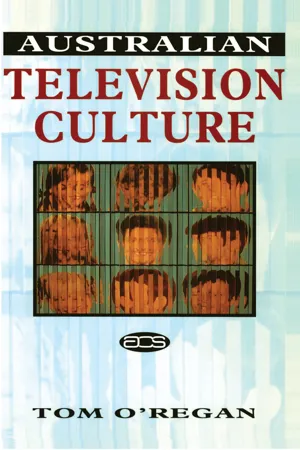
- 240 pages
- English
- ePUB (mobile friendly)
- Available on iOS & Android
eBook - ePub
Australian Television Culture
About this book
Information
1 Australia's television culture
On many counts Australian television's characteristic form can scarcely be claimed as its own. By the time television was introduced in 1956 to Sydney and Melbourne, its form had become stabilised as a free, governmentally regulated, broadcast service for a well-defined geographic area. The US had pioneered commercial television, and the British established public service and later mixed broadcasting environments (with the commercial ITV and the BBC). US and British programming models were on hand to instruct Australian program production and have continued to do so to this day. US and British programs also dominated that half of Australian television schedules taken up with imports. Given the minimal Australian contribution to television drama in the 1950s, to feature films until the 1970s feature revival, and to limited episode television drama until the mini-series boom of the 1980s (production of which has greatly declined since), these imports tended to define particular program categories. In the process they have become integral features of the Australian television landscape. Contemporary innovations such as indigenous television were first developed in Canada (Barker 1984; Brisebois 1990). Australian television audiences, in terms of their viewing habits and uptake of television are not markedly different from those in the US and Britain. They tune in and out of programs, advertisements and limited episode serials in similar ways to UK and US audiences (Barwise & Ehrenberg 1988, pp 5-7) with the percentage of Australian households with the VCR roughly matching US, UK and Canadian figures.1
But if television services around the world share many technological and distribution features, these services still need to be tailored to the environmental, social, commercial, cultural and political conditions of the country in question. Television policy, regulation, programs, broadcasting, scheduling, criticism and buying take distinctive national routes (see chapters 2 and 3). The general transnational form of television represented by the US and the UK became indigenised in Australia. If this ensured there would always be close family resemblances between Australian and US and UK television, it also made Australian television subtly and distinctively different.
To understand Australian television's distinctiveness it will be necessary to look to the use made of the same television technologies, the nature of the public and commercial broadcasting mix, the local trajectories of domestic and imported programming (see chapter 4), the relation between television and national culture (chapters 5 and 6), the nature and direction of local television criticism, and of the exhibition and distribution networks for television (its market settings, and its regulations controlling television's introduction, viewing area, number of licences, and new television services).
Australia's national broadcasters (ABC and SBS) and its commercial stations are different from their British and US counterparts. Australian television indigenised imported programming concepts, often taking them some distance from their US or British original. It developed its own drama concepts with reference to Australian cultural forms and adjacent US and British programming. Audiences customised and broadcasters framed the imported programming in an Australian informational and cultural context. Similar sorts of television regulation in Australia and the US led to different outcomes. Television technologies—like videotape and satellites—were used to different ends. By the same token multicultural and indigenous television evolved their own shapes in SBS-TV (see chapters 7 and 8) and Aboriginal television initiatives (see chapter 9).
Given Australia's poly-ethnic society, the geographic dispersal of television markets, and the different television environments across the country, it is important to allow for the internal diversity of the Australian experience of television. Television viewing was different in regional Australia to the metropolitan centres (until 1990-91 most of regional Australia—making up some 30 per cent of the viewing audience—had only one commercial television station and the ABC). It was also different for ethnic groups at some cultural distance from mainstream Australian society (chapters 7 and 8). This is shown for instance, in that regional Australia and immigrant groups had a higher uptake of the VCR during the first half of the 1980s than did the rest of the Australian population (Connor Report 1985, p 405). Such cultural disparities led in the 1980s to regional television equalisation and the 'minorities initiatives' of SBS-TV and Aboriginal television.
COMPARING TELEVISION CULTURES
Australian television should be regarded as distinct from—not worse or better than—UK and US television. US and Australian commercial television regulations governing ownership and control have mostly borne a distinct family resemblance to each other. Each prohibited ownership above a stipulated number of television station licences until the mid-1980s. In Australia the limit was two stations, in the US a limit of five VHF stations and seven stations overall. Both had localism doctrines encouraging local ownership, programming and control of television stations. Their regulation initially permitted cross-media ownership of radio, press and television franchises in the one service area and prohibited the ownership of more than one television station in a given market. Subsequently, both regulated against cross-ownership; the US in 1970, Australia in 1986. As part of a deregulationist agenda both moved after 1985 to clear up the glaring anomalies created by the limitation on station ownership rule—which, in the Australian case, saw owning Townsville and Cairns licences treated as equivalent to owning Sydney and Melbourne licences. The US raised the number of station licences permitted to twelve and set a ceiling on the audience share any one group could have at 25 per cent of the nation's population (Head & Sterling 1990, p 452); Australia adopted an audience share of 60 per cent of the nation's population, scrapped station ownership limitations expressed in numbers of stations, and simultaneously introduced cross-media ownership rules.
Despite these similarities the outcome on the ground was different. Because US networks pioneered television services they retained the control over the television service they had exercised in radio (Barnouw 1975, pp 22-96). Yet Australia's major radio network, Macquarie, failed to gain the place in television it had expected (McKay 1959). In Australia, newspaper companies—not radio companies—dominated the principal broadcasting markets and benefited from the station licensing process. By 1953 in the US, local television stations were little more than rebroadcasting outfits as networks provided affiliates with 'a reasonably full schedule of sponsored evening programs' (Summers & Summers 1966, p 96). The development of coaxial and microwave links was critical to US networking (New York and Chicago were linked in 1949 and East and West coasts were linked in 1951 [Summers & Summer 1966, p 76]). These links enabled the three networks (CBS, NBC and ABC) to reach over 95 per cent of homes with television by the mid-1950s (Head & Sterling 1990, p 69), By contrast, Australian commercial television networks (Seven, Nine and Ten) did not obtain this audience coverage until the advent of three commercial stations in the major regional Australian markets between 1990 and 1991. It was only then that Australia's commercial networks offered a national schedule simultaneously broadcast around Australia, and something approximating US network affiliation came to Australia. Significant differences remained, as Australia's non-network-owned stations retained control over advertising but now had less control over their schedule than did their US counterparts.
Station independence has been the norm for most of Australian television history. Stations in Australia never surrendered their control over advertising to networks or to advertisers. Networking arrangements between Sydney, Melbourne, Brisbane, and Adelaide (SMBA) were cooperative arrangements between independent stations, with each contributing towards both the purchase and production of programs according to their market size (Walker 1967, pp 293-294; Moran 1985, p 22). Such arrangements only started to be formalised in this way during 1963 and 1964 (some seven years after television's introduction). Up until the mid-1980s programs were mostly distributed by transporting film prints and videotapes—sometimes the same copy, sometimes a multiple copy—from station to station, usually by aeroplane (called program bicycling or syndication) for later broadcasting at the convenience of local stations. The use of this more loosely organised and cheaper form of program distribution meant co-axial and microwave linkages were not as critical to the development of television services as they had been in the US. Consequently, they took time to develop (Sydney and Melbourne were not linked until 1962, and it took another eight years to complete the east-west connection to Perth). Like US television, Australian television screened much the same programs nationwide. However it did not schedule them at the same time or on the same day. This only changed in the five major capital cities (Sydney, Melbourne, Brisbane, Adelaide and Perth) during 1988 and 1989 and in most regional television markets between 1990 and 1991 (see chapter 2).
Characteristically, the US television industry distinguishes between the more loosely organised syndicated programming distribution structure used for repeats and items of regional interest, and the more tightly organised nationally networked daily schedule of programs. The Australian equivalent of this programming mix is the distinction between imported and locally produced programming. Local programs needed to be networked around SMBA to cover immediately a sufficient proportion of production costs for programming to be viable, while imported programs (with their lower purchase costs) did not (they could be profitably sustained through syndication). Because roughly half the schedule was made up of imported programming (mostly US on the commercials, British on the ABC, and European on SBS) Australian television could purchase this half of its programming requirements on a station-by-station basis from US distributors, not the Australian networks. This market structure enabled commercial stations to remain for many years relatively independent from each other. The situation was only reversed with changes in the regulations governing ownership and control, and the advent of satellite program distribution.
In the US, the networks were less tied to the stations than in Australia. Although the US networks—CBS, NBC, and ABC—owned television stations in the most profitable and largest markets, this never amounted to the significant levels of ownership of the system possible in the Australian system. In the US, ownership of five VHF stations amounted to, at most, access to 23 per cent of the total US audience; a figure the three major networks roughly owned each (Reel 1979, p 43). Even with the 1985 regulatory changes in the US, this situation continued. In Australia there was no real separation between network and stations. Networks were controlled by the Sydney and Melbourne stations because the Australian two station ownership rule in force from 1956 to 1986 permitted two then, after the third commercial station in 1965, three groups to control 43 per cent of the entire Australian viewing audience through controlling licences in Sydney and Melbourne. When total audience reach regulation was developed in 1986 enabling an upper limit of 60 per cent of the viewing audience, this control was further reinforced. The 1986 regulations permitted ownership of two of the three next largest Australian cities—Brisbane, Adelaide, and Perth—in addition to Sydney and Melbourne. It was this extension of ownership which drove US-style national networking and scheduling in Australia in the late 1980s. By contrast, lack of common ownership drove the network-affiliate relations characteristic of US television history.
Even the same hardware led to different outcomes. For instance, US television introduced videotape so that East and West coasts could see the same programs at the same time irrespective of time zones. US television evolved—indeed, was principally sold to advertisers—as a broadcasting medium with identical network program scheduling across the country. In Australia, videotape was one of the factors which enabled stations outside Sydney and Melbourne to remain relatively independent in terms of their identity and their control of program scheduling. It helped them maintain separate profiles before advertisers while broadcasting the same programs. It held back the extensive use of telecommunications infrastructure on a routine basis. The ABC was encouraged to use these telecommunication facilities while the commercials did not make nearly so much use of them. (In similar fashion the ABC was encouraged to restructure its operations around AUSSAT in the mid-1980s.) Not until the late 1970s with the advent of greater commercial television interest in nationally packaged sporting events and current affairs television—notably Australian rules football with Victorian Football League (now Australian Football League), World Series Cricket, The Mike Walsh Show (later The Midday Show), and 60 Minutes—did commercial television make extensive use of telecommunications facilities.
Differences can be also observed with broadcast satellites. In the US, broadcast satellites helped diminish the power of the networks. These enabled local stations to better develop their own news and information structures, conferring upon themselves relative informational independence from network feeds leading to a regionalisation of news broadcasts (Fields 1987, p 84). With greater station independence from the networks syndication became of greater importance to stations. Additionally, a combination of cable television and satellites launched new television services such as CNN, Home Box Office and the Nashville Network. These new services eroded network shares and hastened the development of a long-awaited fourth broadcast television network (Rupert Murdoch's Fox). In Australia, the satellite justified the extension of the metropolitan television environment of three commercial stations, the ABC and SBS to regional Australia in a process called 'equalisation'. Regional commercial operators—like RTQ 7 in Rockhampton in Queensland, which had been the only commercial station operating in its service area—were forced into network affiliation and turned their stations into relay facilities for network scheduling. The domestic satellite was critical to Australian networks asserting their national dominance. Current affairs feeds were concentrated into centralised operations in Sydney and, to a lesser extent, Melbourne. The era of A Current Affair, Real Life, Lateline and Hinch had arrived. The importing sources available to commercial television contracted as the independent buying organisation Regional Television Australia folded as a direct consequence of equalisation; the ABC reduced its operations in Brisbane, Adelaide, Perth, and Hobart (BAPH is the industry acronym for these metropolitan centres) and its regional operations (in Rockhampton and Townsville). Unlike in the US, new television services using the satellite (like Pay TV) were held back to permit equalisation. The Hawke government shelved Pay TV in 1983; the moratorium on its provision ended in 1991, with 1992 and 1993 (then) dominated by policy changes but little commercial development (see Cunningham 1992, pp 104-36).
Australia's mixed public and commercial broadcasting arrangements also differed from those obtaining in Britain. Unlike the BBC, the ABC was cast into a secondary role. The British situation—until the late 1980s—insisted upon the 'equality' of the commercial and public broadcasters. The British regulated commercial broadcasting through a policy of complementarity with, rather than competition to, the BBC, and this helped ensure that public and commercial broadcasters resembled each other. British broadcasting policy did this by restricting the number of commercial licences, doubling the number of BBC channels to two, and creating closely supervised regional monopolies in commercial television. In Australia, the ABC was always competing against two and then three commercial stations in the major population centres. Under these conditions the Australian national broadcaster did not occupy the central position that the BBC did, with government spending on non-commercial television and radio services per capita being less in Australia than in Britain and Canada—Geller put the 1989 figures at Australia $25, the UK $30, and Canada $36, with Australia still spending slightly more than Japan ($18), and five times more than the US ($4.56) (Geller 1990, pp 115-16, Australian dollars). The Australian arrangement, whereby commercial stations can pick up product after its ABC screening and achieve greater ratings with it, would be impossible in Britain. Yet this is what happened to Mother and Son in 1987. Screened on the ABC, it rated between 14 and 18 in Melbourne; its subsequent Ten Network screening saw it rate in the 20s (ABT 1991a, p 154). In these circumstances, the ABC developed a characteristic identity crisis. It sought to be competitive with the commercials to justify taxpayer expenditure, but this drew criticism for chasing ratings and therefore aping the commercials. Expected to provide a complementary service, the more it takes this route the more it draws criticism for failing to 'speak to the people of Australia' to justify taxpayer expenditure on such a low rating network. The ABC was always and peculiarly susceptible to 'reform' compared to its British c...
Table of contents
- Cover
- Half Title
- Series Page
- Title Page
- Dedication
- Copyright Page
- Foreword
- Contents
- Abbreviations
- Acknowledgements
- Contributors
- Glossary
- Introduction
- 1 Australia's television culture
- 2 High communications policy in Australia
- 3 The rise and fall of entrepreneurial television, 1986-92
- 4 Television's double face: Of imported and local programming
- 5 Television and national culture
- 6 National television in the new cultural order
- 7 SBS-TV: Symbolic politics and multicultural policy in television provision (with Dona Kolar-Panov)
- 8 SBS-TV: A television service (with Dona Kolar-Panov)
- 9 An Aboriginal television culture: Issues, strategies, politics (with Philip Batty)
- Endnotes
- Bibliography
- Index
Trusted by 375,005 students
Access to over 1.5 million titles for a fair monthly price.
Study more efficiently using our study tools.
Frequently asked questions
Yes, you can cancel anytime from the Subscription tab in your account settings on the Perlego website. Your subscription will stay active until the end of your current billing period. Learn how to cancel your subscription
No, books cannot be downloaded as external files, such as PDFs, for use outside of Perlego. However, you can download books within the Perlego app for offline reading on mobile or tablet. Learn how to download books offline
Perlego offers two plans: Essential and Complete
- Essential is ideal for learners and professionals who enjoy exploring a wide range of subjects. Access the Essential Library with 800,000+ trusted titles and best-sellers across business, personal growth, and the humanities. Includes unlimited reading time and Standard Read Aloud voice.
- Complete: Perfect for advanced learners and researchers needing full, unrestricted access. Unlock 1.5M+ books across hundreds of subjects, including academic and specialized titles. The Complete Plan also includes advanced features like Premium Read Aloud and Research Assistant.
We are an online textbook subscription service, where you can get access to an entire online library for less than the price of a single book per month. With over 1.5 million books across 990+ topics, we’ve got you covered! Learn about our mission
Look out for the read-aloud symbol on your next book to see if you can listen to it. The read-aloud tool reads text aloud for you, highlighting the text as it is being read. You can pause it, speed it up and slow it down. Learn more about Read Aloud
Yes! You can use the Perlego app on both iOS and Android devices to read anytime, anywhere — even offline. Perfect for commutes or when you’re on the go.
Please note we cannot support devices running on iOS 13 and Android 7 or earlier. Learn more about using the app
Please note we cannot support devices running on iOS 13 and Android 7 or earlier. Learn more about using the app
Yes, you can access Australian Television Culture by Tom O'Regan in PDF and/or ePUB format, as well as other popular books in Social Sciences & Media Studies. We have over 1.5 million books available in our catalogue for you to explore.