Revisiting Paulo Freire’s Pedagogy of the Oppressed
eBook - ePub

Revisiting Paulo Freire’s Pedagogy of the Oppressed

Issues and Challenges in Early Childhood Education

  1. 216 pages
  2. English
  3. ePUB (mobile friendly)
  4. Available on iOS & Android
eBook - ePub

Revisiting Paulo Freire’s Pedagogy of the Oppressed

Issues and Challenges in Early Childhood Education

About this book

This reflection on Paulo Freire's seminal volume, Pedagogy of the Oppressed, examines the lessons learnt from Freire and their place in contemporary pedagogical theory and practice. Freire's work has inspired ground-breaking research which Vandenbroeck has collated, demonstrating the ongoing influence on early childhood educators.

Vandenbroeck brings together an international cohort of early childhood experts to present cross-cultural perspectives on the impact of Freire's research on education around the globe. This book covers discussions on:

  • The background to and impact of Freire's work
  • Alternative approaches to supporting child development
  • Pedagogical approaches in Portugal, South Africa, Japan, New Zealand and the United States

Vandenbroeck concludes with a vision for theorising and implementing emancipatory practice in early childhood education in contexts of neoliberalism.

An insightful resource for academics and students in the field of Early Childhood Education and Care, Revisiting Paulo Freire's Pedagogy of the Oppressed is a benchmark of the progress made in the field over the last half a century.

Frequently asked questions

Yes, you can cancel anytime from the Subscription tab in your account settings on the Perlego website. Your subscription will stay active until the end of your current billing period. Learn how to cancel your subscription.
No, books cannot be downloaded as external files, such as PDFs, for use outside of Perlego. However, you can download books within the Perlego app for offline reading on mobile or tablet. Learn more here.
Perlego offers two plans: Essential and Complete
  • Essential is ideal for learners and professionals who enjoy exploring a wide range of subjects. Access the Essential Library with 800,000+ trusted titles and best-sellers across business, personal growth, and the humanities. Includes unlimited reading time and Standard Read Aloud voice.
  • Complete: Perfect for advanced learners and researchers needing full, unrestricted access. Unlock 1.4M+ books across hundreds of subjects, including academic and specialized titles. The Complete Plan also includes advanced features like Premium Read Aloud and Research Assistant.
Both plans are available with monthly, semester, or annual billing cycles.
We are an online textbook subscription service, where you can get access to an entire online library for less than the price of a single book per month. With over 1 million books across 1000+ topics, we’ve got you covered! Learn more here.
Look out for the read-aloud symbol on your next book to see if you can listen to it. The read-aloud tool reads text aloud for you, highlighting the text as it is being read. You can pause it, speed it up and slow it down. Learn more here.
Yes! You can use the Perlego app on both iOS or Android devices to read anytime, anywhere — even offline. Perfect for commutes or when you’re on the go.
Please note we cannot support devices running on iOS 13 and Android 7 or earlier. Learn more about using the app.
Yes, you can access Revisiting Paulo Freire’s Pedagogy of the Oppressed by Michel Vandenbroeck in PDF and/or ePUB format, as well as other popular books in Education & Education General. We have over one million books available in our catalogue for you to explore.

Information

Publisher
Routledge
Year
2020
eBook ISBN
9781000177398

1

Facts matter. And so do ideologies

Michel Vandenbroeck
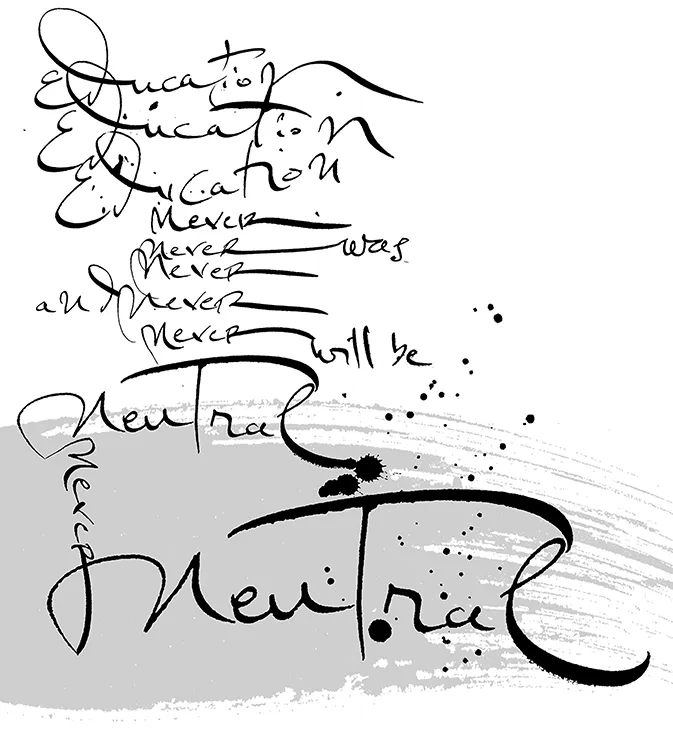
Calligraphy by John Wiliam Decoene (White Rabbit)
Quote from Freire, P., Freire, A. M. A., & de Oliveira, W. (2014). Pedagogy of solidarity.
Walnut Creek CA: Left Coast Press.
Why dig up a 50-year-old book from the archives?
XXIV
O que nós vemos das coisas são as coisas.
Porque veríamos nós uma coisa se houvesse outra?
Porque é que ver e ouvir seria iludirmo-nos
Se ver e ouvir são ver e ouvir?
O essencial é saber ver,
Saber ver sem estar a pensar,
Saber ver quando se vê,
E nem pensar quando se vê,
Nem ver quando se pensa.
Mas isso (triste de nós que trazemos a alma vestida!),
Isso exige um estudo profundo,
Uma aprendizagem de desaprender
E uma sequestração na liberdade daquele convento
De que os poetas dizem que as estrelas são as freiras eternas
E as flores as penitentes convictas de um só dia,
Mas onde afinal as estrelas não são senão estrelas
Nem as flores senão flores,
Sendo por isso que lhes chamamos estrelas e flores
Alberto Caeiro, in “O Guardador de Rebanhos - Poema XXIV”
Heterónimo de Fernando Pessoa
From The keeper of flocks I, Alberto Caeiro (= Fernando Pessoa), 1914
What we see of things is things.
Why would we see one thing as being another?
Why is it that seeing and hearing would deceive us
If seeing and hearing are seeing and hearing?
The main thing is knowing how to see,
To know how to see without thinking,
To know how to see when you see,
And not think when you see
Or see when you think.
But this (poor us carrying a clothed soul!),
This takes deep study,
A learning to unlearn
And sequestration in freedom from that convent
Where the poets say the stars are the eternal brothers,
And flowers are penitent nuns who only live a day,
But where stars really aren’t anything but stars,
And flowers aren’t anything but flowers,
That being why I call them stars and flowers.
Translated by Routledge
In his much-celebrated book Pedagogy of the Oppressed, Freire elaborated on this epistemological question on what is real, what is true. He raised the existential question whether the world can exist, whether mountains and lakes can exist, when there are no “men” to name them.
There is no true word that is not at the same time praxis. Thus, to speak a true word, is to transform the world. To exist, humanly, is to name the World, to change it. Once named, the world in its turn reappears to the namers as a problem and requires of them new naming. Men are not built in silence, but in word, in work, in action-reflection.
(p. 75–76)
These are questions that have renewed their significance in what is now called the “post-truth era” and these questions urge us to look again, to think again, to act again about what we consider as truth in early childhood education. The opening sentence of Freire’s Pedagogy of Hope, written some 25 years after Pedagogy of the Oppressed, as a comment on that iconic book, reads
We are surrounded by a pragmatic discourse that would have us adapt to the facts of reality. Dreams, and utopia, are called not only useless, but positively impeding.
(p. 1)
And indeed, today, the early childhood community is submerged with cool facts and figures about the alleged return on investment in early childhood education – it seems to be 7 dollars for each dollar invested now, yet it fluctuates as markets do. Every few years, the OECD tells us how many standard deviations the bright youngsters in Singapore or Shanghai are ahead of their Belgian peers. Studies reveal what percentage of variation in school results can be associated with quality assessment scores of the Kindergarten attended years before. Under the vast amounts of facts and figures, the question of what education in general and early childhood education in particular is for, the question of the dreams and the utopias, seems to have vanished. As equally has the question of who is entitled to define what education is for, what the horizon may be. One can argue with Donaldo Macedo that in the quest of objectivity and scientific rigor, the “scientific” educators have often contributed to a fragmentation (and thus depoliticisation) of knowledge because of their reductionist view of the act of knowing (Macedo, 1998: xi). Macedo (as indeed Freire) argues that this “objectivation” of the educational sciences, with its narrow focus on quantitative analyses, has obscured our vision of the larger picture. In a metaphorical sense, one could say that, at present, the obsessions with pixels in the neuroscience has taken the place of the social or societal question on what is the good life. We risk becoming reduced to our brain and that brain risks being reduced to coloured pixels on a screen. One salient example of this narrowing vision is that the meaning of education is reduced to econometric calculations of the alleged return on investment that early childhood education is supposed to yield (e.g. Barnett, 2011; Barnett & Masse, 2007). Even more worrying – however – is that the question to what extent the social or societal value of education is to be measured in econometric terms, has become obsolete. As a result, there is no space left for this eminently political question about what matters. In that vein, one could interpret the argument of Macedo and Freire as a plea for taking some reflective distance from the modernist belief on a single truth that will be revealed through scientific progress. However, some could also argue that this reads as a too shallow post-foundationalist plea to get rid of the facts and figures, as if the lived experiences of people and only the lived experiences mattered. Or as if everything is perspective and therefore disputable and every opinion is equally valid.

Post-foundationalism

As Moss (2018) eloquently explains in his introduction for students and practitioners, post-foundationalism is first and foremost concerned with offering alternatives. It does not believe that there is only one truth, nor that human and social sciences need to adopt the same research paradigms than, let’s say, physics. The mission statement of the “Contesting Early Childhood” book series celebrates that there are many, many ways of thinking about early childhood, and doing early childhood:
This diversity, so it seems to us, is welcome and inevitable, since we live in a world rich in diversity and multiple perspectives; invigorating, since encounters with difference can provoke experimentation, movement and new thinking; and a necessary condition for a democratic politics of education, since democracy requires the recognition and valuing of alternatives and confrontation and contestation between them.
In healthy and vibrant democracies, ‘contesting early childhood’, meaning confrontation and debates between ‘a multitude of perspectives’, should be an everyday and everywhere occurrence, whether in services themselves, in their surrounding communities, in the academy, or among policy-makers and politicians.
(Moss et al., 2016a)
The main concern is that one of the narratives in early childhood education has begun to drown out all others (and thus has become a dominant discourse, meaning that it becomes quite hard to think any other way), silencing the democratic debate, “for truth, or what counts as truth, is a system of exclusion” (Moss et al., 2016a). The dominant discourse views the world from the position of a paradigm of positivism, believing the world can be truly understood through the discovery of universal, stable and replicable laws, objectively arrived at through processes of measurement and reduction that overcome (control for) complexity and context. With natural science as an ideal, this paradigm puts much faith in the figure of the objective, rational and authoritative expert, able to muster the evidence that will reveal to us how things truly are and what we must do to change them. By contrast, a story such as that of democracy, experimentation and potentiality views the world from the position of what might be termed a paradigm of post-foundationalism. Truth, from this perspective, is not something that is absolute and immutable, “out there” awaiting discovery by an impartial scientist, but is “the contingent product of particular, situated ways of comprehending the world”; better, indeed, to speak of truths, not the Truth. A historical hindsight shows that what is considered True in a specific period, not only may become obsolete in another period, but is always contingent with the social, economic and eminently political context of that period in time and of a specific geographical area (Vandenbroeck, 2017). While the positivist values and seeks certainty, control and objectivity, the post-foundationalist welcomes and seeks to work with complexity, uncertainty and unpredictability (Moss et al., 2016).
Yet, we also need the courage to raise the following question: what can be the meaning of the critique of the alleged objectivity of facts and figures as the ultimate way of understanding the world and giving meaning to it, in an era when a president of the U.S. won the elections, despite many declarations that proved to be false, or the British people voted to leave the European Union, after being confronted with false arguments. Or when a candidate for the French presidency declared to a journalist who confronted her with facts contradicting her statements replied: “Well that means that the figures are lying”.1
One could critically raise the concern that post-foundationalism may have gone too far in criticising the scientific quest for truth. When we celebrate everyone’s own subjective vision of the world, without hierarchy between lay and expert knowledge, does that not contribute to the era of fake news, post truth and populism (Suiter, 2016)?
Has post-foundationalism (and in its slipstream post-colonialism, post-feminism, post-humanism, etc.) paved the way for a post-truth era? Has the end of the great ideologies – or the end of history for that matter – paved the way for an early childhood education without any ideology? Has it made historical insights obsolete? Have all these “post” criticisms lead to the believe that if “everything is dangerous” (Foucault, 1983), and if subjectivity is the new truth, this means that anything goes?
Facts matter, but so does ideology

In the U.S., the top 10 percent earn half of the total fiscal income, while this was only slightly above 30 percent in the 1970s. They own around 75 percent of all wealth in the U.S. In South Africa the same top 10 percent earn more than 60 percent of all income (https://wid.world, the world inequality data base). The Gini coefficient (a measure for inequality of income) has reached the highest value on record since the mid-1980s. In most European countries not only the income gap between top and bottom is widening, also the middle class is eroding (Vaughan-Whitehead, 2016). It has been thoroughly documented how growing inequality affects well-being in several domains of health and well-being, not only for the poor but for entire populations (Wilkinson & Pickett, 2009). The numbers of children living in poverty are on the rise in many countries. In the Flemish region of Belgium, one of the richest areas in the world (where I happen to live and work), an appalling 14 percent of children are born in poor households and this number has almost doubled in one decade (Kind en Gezin, 2018). These are also facts and figures. And these facts and figures matter to all of us.
However, it is remarkable that, contingent with the rise of inequality and poverty, a dematerialisation of poverty seems to occur in policy and a discourse is spreading that the most salient source of poverty is education, rather than a lack of resources, income inequality or failures of the welfare state. International organisations, including UNICEF, UNESCO, the World Bank and others, now depict early childhood care and education as “the greatest of equalisers” (Morabito et al., 2013). One could say with Freire (1970: 23) that these organisations are “closing themselves into circles of certainty from which they cannot escape”. They make their own truth and “they suffer an absence of doubt”. It is an international discourse that bears striking resemblance with the nineteenth-century liberal adagio that it is education and not the social condition that causes poverty. It entails the risk that early childhood educators are (ab)used to advocate for a political status quo of a meritocratic neoliberal social order in which the interest of the child is seen as fundamentally different from the interest of her parents and in which, consequently, parents risk being blamed for their poor social condition. Early childhood education, in this vein, is then a remedy for the shortcomings of the (poor and thus failing) family in the combat against child poverty. The discourse reads as a modern version of the famous quote of Freire (1970: 60):
They [i.e. parents in poverty] are treated as individual cases, as marginal men who deviate from the general configuration of a “good, organized, and just” society. The oppressed are regarded as the pathology of the healthy society, which must therefore adjust these “incompetent and lazy” folk to its own patterns by changing their mentality.
The truth is, however, that the oppressed are not “marginals”, are not men living “outside” society. They have always been “inside” – inside the structure which made them “beings for others”. The solution is not to “integrate” them into the structure of oppression, but to transform the structure so that they can...

Table of contents

  1. Cover
  2. Half Title
  3. Series Page
  4. Title Page
  5. Copyright Page
  6. Table of Contents
  7. List of figures
  8. Acknowledgements
  9. List of contributors
  10. Introduction: On Paulo Freire, Pedagogy of the Oppressed and this book
  11. 1. Facts matter. And so do ideologies
  12. 2. Paulo Freire: His modernity and new ways of thinking about early childhood education
  13. 3. A Freirian view of early childhood education in Portugal: A complicit response to Michel Vandenbroeck’s Introduction
  14. 4. Pedagogies of children and youth in South Africa: Why Paulo Freire is crucial in this age of neoliberalism
  15. 5. Contesting the evidence: Alternate approaches to supporting children’s development through critical consciousness
  16. 6. Power to the Profession? Reading and repoliticizing early childhood workforce development in the United States
  17. 7. The praxis of local professional groups exploring alternatives for the banking concept of early childhood education in Japan
  18. 8. The depoliticisation of professional development in Australian early childhood education
  19. 9. Transforming early childhood education: Dreams and hope in Aotearoa New Zealand
  20. 10. Discussion: Early childhood education as a locus of hope
  21. Index