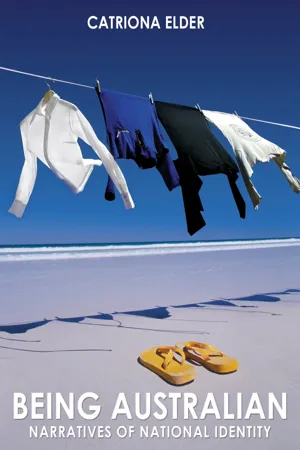
After a century of speculation by writers, filmmakers, travelers and scholars, being Australian' has become a recognisable shorthand for a group of national characteristics. Now, in an era of international terrorism, being seen as un-Australian' has become a potent rhetorical weapon for some, and a badge of honour for others.
Catriona Elder explores the origins, meaning and effects of the many stories we tell about ourselves, and how they have changed over time. She outlines some of the traditional stories and their role in Australian nationalism, and she shows how concepts of egalitarianism, peaceful settlement and sporting prowess have been used to create a national identity.
Elder also investigates the cultural and social perspectives that have been used to critique dominant accounts of Australian identity, including ideas of class, gender, sexuality, ethnicity and race. She shows how these critiques have been, in turn, queried in recent years.
Being Australian is an ideal introduction to studying Australia for anyone interested in understanding Australian society, culture and history.
A clever work: incisive and original. At a time when Australian identities have never been more debated, Elder finds an open way through the closed doors which often restrict cultural representations of Australian-ness.'
Professor Adam Shoemaker, Dean of Arts, ANU
This is a timely and significant new analysis essential reading on issues of identity and our own anxieties about national belonging and what it means to be Australian' in a globalising world.'
Kate Darian-Smith, Professor of Australian Studies and History, University of Melbourne
- 400 pages
- English
- ePUB (mobile friendly)
- Available on iOS & Android
eBook - ePub
About this book
Information
Part 1 STORIES IN THE MAKING
1 IMAGINING NATIONS
Telling national tales
NATIONS ARE RELATIVELY new ways of organising people and authority. Today the word ‘nation’ is used interchangeably with ‘state’ or ‘countr y’, but it is worth exploring the distinctions between these terms. When the idea of a nation emerged in early nineteenth-centur y Europe, it referred to a group of people who had a shared ethnicity language and culture—a nation was not a political entity, cultural one. This contrasts with the concept of a state, defined a sovereign political entity with set territorial boundaries that has to answer to no higher political power. Australia is obviously a Technically, Australia is not a nation in the way nineteenth-centur thinkers understood the term. A group such as the Waradjuri nation (a coalition of Koori people from central New South however, would be understood as a nation in these terms. However the Waradjuri are not recognised as a state. More contemporar understandings of nations define what members of a nation share as being civic values. In this sense Australia is a nation. Yet the idea a shared ethnicity still informs many stories of the Australian nation.
Today it is common to link nation and state together to produce the hyphenated term ‘nation–state’. Jointly, this suggests political territorial entity and the idea of shared culture and tage. Nation–states develop initiatives, policies and legislation reinforce or encourage the belief that the people within their territor y are culturally homogenous (Shapiro 1999: 45). In these terms, governments of the Australian nation–state work to encourage the idea of a coherent and shared identity amongst a group of people of diverse ethnicity, sexuality, religious conviction, economic status, age, cultural affiliation and geographic location. Over time, governments passed legislation setting out what is expected of an Australian citizen, enacted policies shaping the type of Australian histories children will be taught, and declared particular days to be holidays of national significance. All these initiatives are designed to create feeling of national togetherness over and above any differences.
If a nation is about cultural similarity, then nationalism can described as the feeling of attachment to the culture of that nation. Like nations, nationalism is not natural: these feelings are constructed. Nationalism is a power ful method for securing and maintaining feelings of ‘unity and identity’ amongst a group of people who ‘share historic territory’ (Smith 1996: 359). Ernest Gellner (1983) provided an historical explanation for the emergence of nationalism in Europe. He posits that nationalism resulted from ‘the organisation of human groups into large, centrally educated, culturally homogenous units’ (1983: 35). Gellner argues that the new skill demands and urban-isation associated with the Industrial Revolution encouraged higher levels of education and increased geographic mobility amongst people who previously had been more settled and physically isolated. mobility led to increasing social and economic connections between previously fragmented or separated communities. As a result, emerging ‘national’ governments had to devise ways in which control and connect the increasing number of urban-based communities distanced from their traditional affiliations. Governments placed more emphasis on the need for a common language and common values to help facilitate these connections. The newly emerging central governments also emphasised the links between themselves the people.
Nationalism seems so simple—who would not want to love their country? Nationalism can have productive effects: a sense of shared destiny and sameness encourages citizens to act in ways that benefit the general community, but not themselves personally (Moran 2005: 55). However, nationalism is complex in the way structures how individuals and groups of people understand themselves in relation to states. Nationalism is an ideology: it does not simply reflect what the nation is. As cultural theorist Graeme Turner (1993: 123) puts it:
the dominant version of Australian nationalism. . . is not dominant because most Australians ‘lived it’, or because it is an unmediated reflection of social conditions at any one point in time. Rather, it dominant because it is currently accepted as the construction...of nationalism in Australia.
Nationalism helps make particular stories of Australian-ness. longevity or centrality of particular national stories does not reflect the truth of these stories or their accuracy; rather, it reflects power of the story. Or, more importantly, it reflects the power the story makers.
Historian Benedict Anderson (1983) argues that nations constructed rather than given. He calls them ‘imagined communities’. Anderson’ s argument is that in a modern nation there are too many people for citizens to feel any real connection with each other (as a person might feel for their extended family or a club where all the members are known). There are also as many differences connections between citizens. To overcome or accommodate these gaps, the national community is imagined. Anderson suggests that what links the citizens of a nation is not the fact that ever yone knows each other, but that citizens of a nation share a common imaginar y— a common set of stories. Instead of meeting all the people in one’ nation and thinking ‘ah yes they are like me’, citizens are given— through education, popular culture and political rhetoric—images and stories, sayings and histories that encourage a feeling connection and shared values, where they might not actually exist. However, to say a nation is imagined is not to suggest the stories the nation are just made up. National narratives are usually based on real historical events—indeed, historical stories and myths integral parts of ‘imagined communities’. The imagining is process of encouraging citizens to identify with one set of stories that are said to have formed the nation over another.
A nationalistic narrative posits that citizens all share beliefs and values, even though the reality is that many citizens are living experiencing different sorts of lives to the ones told in the stories. Graeme Turner (1993) calls these stories of an imagined community shared ‘representational codes’. Citizens are encouraged to draw on these shared sets of understandings and feelings of what it means to be Australian. For example, if there is an international sporting event and an Australian participant or team wins, the stories that produced tend to suggest that all Australians will feel the same joyful and proud emotions. Media headlines will declare, or politicians will say: ‘All Australians feel proud today!’ Sometimes connections made by referring to historical moments that are declared important to all Australians. This can mean calling contemporary sports heroes ‘diggers’ or an Australian-bred horse winning the Melbourne as ‘preser ving Anzac pride’ (Thomas 2002). The outcome is to reinforce a feeling of national connection between citizens connection with a particular historical past. This is what nationalism is: the belief that citizens of the Australian nation will common understanding of being Australian, and that this under-standing—seen to have historical roots—bonds them together a common love for their shared nation. Over time, the dominant story or representational codes become naturalised and come to stand as commonsense.
National identit(ies)
The emphasis on shared values means that, within national stories, there is an emphasis on a shared identity—a national identity. Stuart Hall (1990: 226) explains what identities are: ‘identities are names we give to the different ways we are positioned by, and position ourselves within, the narratives of the past’. Overall, the process creating national stories works to produce ‘a mythic connection between nationhood and personhood in the form of a story of how the nation arises naturally from the character of its people’ (Shapiro, 1999: 47). So not only is the national community presumed to based on commonality and shared purpose, but it is often suggested that nations are made up of ‘types’ of people. National identity seen to be based on what are considered to be shared character traits often deriving from histor y. A good Australian example is the idea of the ‘Aussie bloke’ and the belief that this type of person is unique to Australia.
Yet any individual will understand themselves in terms of multiple identities—for example, their gender, class, age, sexual preference, ethnic heritage and national affiliation. Given the multiple nature of individual identity, it is very hard to believe that a single or unified identity could describe an entire nation. However, national identity is still a belief Australians have found hard to give up. Over the years, scholars have debunked particular versions of the Australian national character or identity. For example, feminists demonstrated women were excluded from the masculine bush legend and Anzac ideal. Indigenous peoples showed how ideas of national identity excluded them. The interesting point to note is that the sense of national identity is hard to displace: it is persistent. If one national story of identity is discounted, another more expansive one is rapidly developed to fill the gap. The possibility of a national identity is not often rejected. So what cultural and political work does the perpetuation of the story of a national identity do?
Despite the perpetuation of singular nationalist stories, the unity of a nation is never complete or total. The notion that Australians are all proudly bonded together by a series of shared ideas and shared history is obviously not true. Citizens of Australia have a multitude of different attitudes about all sorts of things. However, nationalism and the idea of a singular national identity encourage citizens to conform to particular ways of doing or seeing things. This is why, if one citizen disagrees with another citizen’ s actions, an easy way to discredit their opinion is to call them ‘un-Australian’. The insult suggests that the argument put forward by one person is outside the parameters shared ideas about Australian-ness, insinuating the person does not love their countr y and is not worthy of it. This ploy closes off debate. However, calling someone ‘un-Australian’ also introduces the possibility of different ways of being Australian—even if they are viewed by some citizens as negative. In this sense, dominant national stories are set up against un-national stories. Different—or other—stories presumed to exist.
National identities and national stories are not truths that reflect the total experience of the citizenr y. Rather, they reflect the experiences and desires of particular—often powerful—groups. partial and invested aspect of nationalism is often not ledged. It is uncommon to hear a business person saying: ‘I need Australians to love their countr y because I want to make millions of dollars selling subscriptions to them to watch their national sports team play on pay television.’ A politician never says: Australians to identify with a specific stor y of Australian-ness because it makes it easier for my government to justify a particular policy Instead, stories of Australian-ness are told as if all Australians equally invested and everyone reaps equal rewards. In truth, these stories suit dominant groups—groups with the most power produce and sustain their own stories and to overwhelm (though not necessarily end) other stories. Importantly this dominant dominating) story encourages a sense of consensus and that the shared national story is the most pertinent one for Australians. Given that consensus necessarily depends on omission, this has meant that women, Indigenous people, gay men lesbians and non-white migrants have frequently been marginalised or omitted in Australian national stories. These omissions sometimes acknowledged; however, more frequently these ‘divisions or conflicts within society are minimised in deference to [what are suggested to be] the overriding, accepted priorities of the nation which unite the people’ (Turner 1993: 108). A national story is not an innocent reflection of a state and its peoples; rather, it is a way in which complexity and differences can be silenced by reference to ‘bigger’ unifying story.
Exclusion
The exclusion of particular ideas or people from national stories not an unfortunate or innocent by-product resulting from natural limitations of dealing with such a large concept as the nation. On the contrar y, exclusion is intrinsically built into the idea of nation. Philosopher Linnell Secomb (2003: 9) argues that stories of communities necessarily require some exclusion. She contends that the way humans exist is communal—what she calls ‘being-together in-community’. This ‘being together’ suggests more than humans living in proximity; Secomb argues that people who ‘together -in-community’ also share things in common. They form an ‘in-common community’. However, Secomb goes on to explain that ‘the formation and perpetuation of in-common community requires the estrangement of those who threaten its commonality’.
Community is something that humanness is defined by often the way in which community is enacted by humans has built into it the need to ‘marginalise’, ‘vilify’, even ‘brutalise’ others order to secure that community (2003: 9). Using Secomb’ s ideas the ‘in-community’ of a nation, it is possible to see how of commonality are so frequently premised on exclusion. The common’ stories of the national ‘in-community’ set up an us them dualism. This can seem (and probably is) harmless in many cases. For example, a headline screaming ‘Poms Thrashed by Aussies’ creates for many Australians a sense of ‘being in-common’ with other Australians through a sporting victory. Although it marginalises the English; such a headline would probably be met with nothing more than a roll of the eyes or a sigh by any English people reading However, other ‘in-common’ marginalisations have more disturbing effects—for example the marginalisation of a female Muslim student at school because she wears the hijab; the vilification of people of particular ethnicity or the violent bashing of a gay man have profound effects in terms of creating an ‘in-common’ story of the nation.
Though nations are a power ful way in which the world and people are organised at the moment, and though it has so pleasures for many citizens, given the limits of this idea it is necessar y to draw on other imaginings about how communities organised.
Never-ending stories
Though the argument that nations are ‘imagined communities’ (Anderson 1983) and the ideology of nationalism suggest a lack reality, this is not in fact the case. The concept of Australia as ‘imagined community’ does not suggest that the Australian nation exists only as an imagined concept. There are obviously real laws that structure real relationships between real citizens w...
Table of contents
- Cover
- Half Title
- Dedication
- Title Page
- Copyright Page
- Contents
- Figures and Tables
- Acknowledgements
- Introduction
- Part 1: Stories in the making
- Part 2: Ways of being Australian
- Glossary
- Bibliography
- Index
Trusted by 375,005 students
Access to over 1.5 million titles for a fair monthly price.
Study more efficiently using our study tools.
Frequently asked questions
Yes, you can cancel anytime from the Subscription tab in your account settings on the Perlego website. Your subscription will stay active until the end of your current billing period. Learn how to cancel your subscription
No, books cannot be downloaded as external files, such as PDFs, for use outside of Perlego. However, you can download books within the Perlego app for offline reading on mobile or tablet. Learn how to download books offline
Perlego offers two plans: Essential and Complete
- Essential is ideal for learners and professionals who enjoy exploring a wide range of subjects. Access the Essential Library with 800,000+ trusted titles and best-sellers across business, personal growth, and the humanities. Includes unlimited reading time and Standard Read Aloud voice.
- Complete: Perfect for advanced learners and researchers needing full, unrestricted access. Unlock 1.5M+ books across hundreds of subjects, including academic and specialized titles. The Complete Plan also includes advanced features like Premium Read Aloud and Research Assistant.
We are an online textbook subscription service, where you can get access to an entire online library for less than the price of a single book per month. With over 1.5 million books across 990+ topics, we’ve got you covered! Learn about our mission
Look out for the read-aloud symbol on your next book to see if you can listen to it. The read-aloud tool reads text aloud for you, highlighting the text as it is being read. You can pause it, speed it up and slow it down. Learn more about Read Aloud
Yes! You can use the Perlego app on both iOS and Android devices to read anytime, anywhere — even offline. Perfect for commutes or when you’re on the go.
Please note we cannot support devices running on iOS 13 and Android 7 or earlier. Learn more about using the app
Please note we cannot support devices running on iOS 13 and Android 7 or earlier. Learn more about using the app
Yes, you can access Being Australian by Catriona Elder in PDF and/or ePUB format, as well as other popular books in Social Sciences & Art General. We have over 1.5 million books available in our catalogue for you to explore.