Composites in Biomedical Applications presents a comprehensive overview on recent developments in composites and their use in biomedical applications. It features cutting-edge developments to encourage further advances in the field of composite research.
Highlights a completely new research theme in polymer-based composite materials
Outlines a broad range of different research fields, including polymer and natural fiber reinforcement used in the development of composites for biomedical applications
Discusses advanced techniques for the development of composites and biopolymer-based composites
Covers fatigue behavior, conceptual design in ergonomics design application, tissue regeneration or replacement, and skeletal bone repair of polymer composites
Details the latest developments in synthesis, preparation, characterization, material evaluation, and future challenges of composite applications in the biomedical field
This book is a comprehensive resource for advanced students and scientists pursuing research in the broad fields of composite materials, polymers, organic or inorganic hybrid materials, and nano-assembly.
N. A. Abu Osman,1,4A. Ataollahi,1S. M. Sapuan,2,3Y. Nukman,1and R. A. Ilyas2,3
1Centre for Applied Biomechanics, Department of Biomedical Engineering, Faculty of Engineering, University of Malaya, Malaysia
2Advanced Engineering Materials and Composites Research Centre, Department of Mechanical and Manufacturing Engineering, Universiti Putra Malaysia, Malaysia
3Laboratory of Biocomposite Technology, Institute of Tropical Forestry and Forest Products (INTROP), Universiti Putra Malaysia, Malaysia
4The Chancellery, Universiti Malaysia Terengganu, Malaysia
CONTENTS
1.1Introduction
1.2Implant Fixation Methods
1.3Total Hip Replacement Failure
1.3.1Osteolysis
1.3.2Primary Stability
1.3.3Stress Shielding
1.3.4Cement Failure
1.3.5Debonding
1.3.6Implant Fracture
1.4Material and Geometry of Artificial Hip Joint Constituents
1.4.1Femoral Head and Acetabular Cup
1.4.2Femoral Prosthesis (STEM)
1.4.3Femoral Prosthesis Geometry
1.4.4Femoral Prosthesis Materials
1.5Surface Finishing
1.6Materials Utilized in Artificial Hip Joint Components
1.6.1Metals
1.6.2Polymers
1.6.3Ceramics
1.6.4Composites
1.7Numerical Methods in Hip Joint Biomechanics and Implant Study
1.8Load Transfer in the Proximal Femur
1.9Bone
1.10Conclusion
References
1.1Introduction
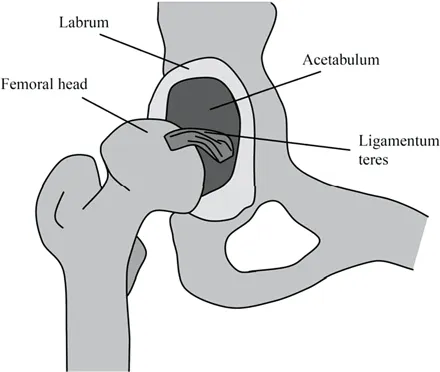
This chapter presents a brief on hip joint and total hip replacement (THR). The hip joint is composed of soft and hard tissues. A joint comprises the femoral head, acetabulum, cartilage, and ligaments (Figure 1.1). The hip joint is classified as a ball-and-socket joint (Polkowski & Clohisy, 2010). The ball-and-socket joint provides three rotational movements, namely, flexion–extension, abduction–adduction, and internal–external rotation. The femoral head is connected to the femur via the femoral neck. The cartilage supplies a frictionless joint. The stability of the hip joint is supplied by the ligaments and muscles. This structure provides optimal stability for the stance and bipedal locomotion, but the hip joint endures complex dynamic and static loads (Bowman Jr et al., 2010).
FIGURE 1.1The hip joint (Stops et al., 2011).
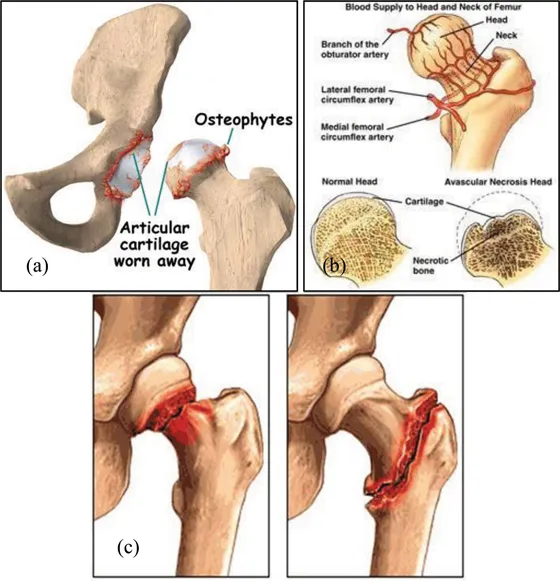
Mechanical injury, chemical process, and/or their combination can cause degeneration and dysfunction in the articular hip joint (Bougherara et al., 2011). The most common causes of hip joint degeneration are osteoarthritis, fracture of the hip, inflammatory arthritis, femoral head necrosis, and rheumatoid arthritis (Figure 1.2).
FIGURE 1.2Three typical hip joint diseases: (a) osteoarthritis, (b) necrosis, and (c) neck fracture. (Reproduced with permission from Dunne and Ormsby (2011) and Ilesanmi (2010), Creative Commons Attribution 3.0 License 2012, IntechOpen.)
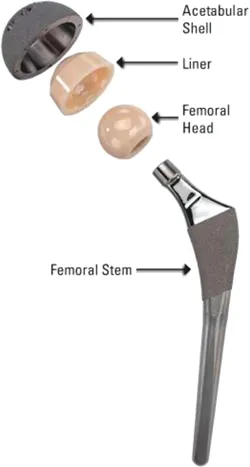
The final recourse but the most successful procedure to remedy a severely degenerated hip joint is THR (Caeiro et al., 2011). This procedure alleviates the pain and restores hip joint function. In THR, the natural hip joint is replaced with an artificial hip joint, which consists of the femoral head, acetabular cup (acetabular shell and liner), and femoral prosthesis (stem) (Figure 1.3). The artificial hip joint components are formed in a modular or monoblock structure. A femoral head may also be included in a femoral prosthesis in a monoblock structure.
FIGURE 1.3A typical artificial hip prosthesis. (Reproduced with permission from Li et al. (2014), Creative Commons Attribution 3.0 License 2012, IntechOpen.)
1.2Implant Fixation Methods
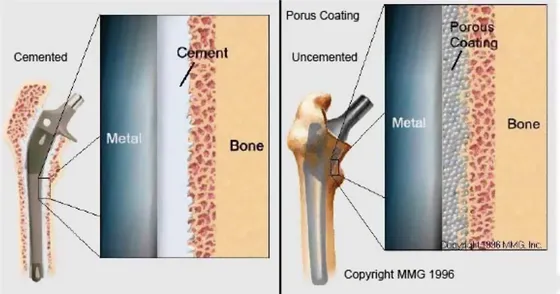
The implants are fixed inside the bone with or without cement (Figure 1.4). Cemented prosthesis fixation secures an orthopedic cement prosthesis within the bone. An orthopedic cement is made of polymethylmethacrylate, which is a self-curing and nonadhesive polymeric material (Pal et al., 2013). Therefore, interlocking the spongy bone–cement and cement–implant features provides fixation (Pal et al., 2013). However, in a cementless prosthesis, fixation is performed by press fitting or screwing the components in the bone. This procedure guarantees primary stability for the in-growth and on-growth of the bone to the implant surfaces, thus providing secondary fixation and long-term durability. Porous and hydroxyapatite (HA) coatings are applied on the surface of a cementless prosthesis to strengthen primary and secondary fixation.
FIGURE 1.4Typical cemented and uncemented fixation. (Reproduced with permission from Izzo (2012), Creative Commons Attribution 4.0 License 2012, IntechOpen.)
Moreover, a hybrid THR is a process in which cementless and cemented methods are used to fix the artificial hip joint components in THR. Bone quality is the most influential criterion in selecting a fixation procedure. Young and more active patients have better bone quality than old and less active patients. Accordingly, a cementless prosthesis is more appropriate for young patients, whereas a cemented prosthesis is more suitable for older patients. Each implant fixation method has advantages and disadvantages. For example, cement provides instant fixation, but a cementless prosthesis bone must grow to secure the prosthesis in the bone. In addition, a cemented prosthesis requires a bigger hole or more reaming inside the bone than a cementless prosthesis. The revision rate of patients who underwent THR with cemented prosthesis is lower than that of patients with cementless prosthesis.
1.3Total Hip Replacement Failure
Developments in the design, technology, and technical operation increased the success rate of THR. However, THR failure remains a problem, so revision surgery is essential and unpreventable. For example, 10% of all THR surgeries in the USA per year undergo THR revision surgery (Brown & Huo, 2002). Accordingly, the components of the old artificial joint are partially or totally replaced with new components. Mechanical factors are more common causes of THR failure than infection. Aseptic loosening is the most important cause of THR failure (Gross & Abel, 2001). The mechanisms leading to aseptic loosening remain ambiguous. Osteolysis, l...
Table of contents
Cover
Half Title
Title
Copyright
Contents
Preface
Editors
Contributors
Chapter 1 The Hip Joint and Total Hip Replacement
Chapter 2 A Review of Biocomposites in Biomedical Application
Chapter 3 Biocomposites in Advanced Biomedical and Electronic Systems Applications
Chapter 4 Resin-Based Composites in Dentistry—A Review
Chapter 5 Classifications and Applications of Biocomposite Materials in Various Biomedical Fields
Chapter 6 Conceptual Design of Composite Crutches
Chapter 7 Conceptual Design of Kenaf Fiber Reinforced Polymer Composite Chair with Input from Anthropometric Data
Chapter 8 A Review on Nanocellulose Composites in Biomedical Application
Chapter 9 Medical Rubber Glove Waste As Potential Filler Materials in Polymer Composites
Chapter 10 Fabrication and Properties of Polylactic Acid/Hydroxyapatite Biocomposites for Human Bone Substitute Materials
Chapter 11 Hydrogel-Based Composites in Perfusion Cell Culture/Test Device: Drug Delivery through Diffusion
Chapter 12 Nanocomposites for Human Body Tissue Repair
Chapter 13 Advances in Marine Skeletal Nanocomposites for Bone Repair
Chapter 14 Magnesium Metal Matrix Composites for Biomedical Applications
Index
Trusted by 375,005 students
Access to over 1.5 million titles for a fair monthly price.
Study more efficiently using our study tools.
Frequently asked questions
Yes, you can cancel anytime from the Subscription tab in your account settings on the Perlego website. Your subscription will stay active until the end of your current billing period. Learn how to cancel your subscription
No, books cannot be downloaded as external files, such as PDFs, for use outside of Perlego. However, you can download books within the Perlego app for offline reading on mobile or tablet. Learn how to download books offline
Perlego offers two plans: Essential and Complete
Essential is ideal for learners and professionals who enjoy exploring a wide range of subjects. Access the Essential Library with 800,000+ trusted titles and best-sellers across business, personal growth, and the humanities. Includes unlimited reading time and Standard Read Aloud voice.
Complete: Perfect for advanced learners and researchers needing full, unrestricted access. Unlock 1.5M+ books across hundreds of subjects, including academic and specialized titles. The Complete Plan also includes advanced features like Premium Read Aloud and Research Assistant.
Both plans are available with monthly, semester, or annual billing cycles.
We are an online textbook subscription service, where you can get access to an entire online library for less than the price of a single book per month. With over 1.5 million books across 990+ topics, we’ve got you covered! Learn about our mission
Look out for the read-aloud symbol on your next book to see if you can listen to it. The read-aloud tool reads text aloud for you, highlighting the text as it is being read. You can pause it, speed it up and slow it down. Learn more about Read Aloud
Yes! You can use the Perlego app on both iOS and Android devices to read anytime, anywhere — even offline. Perfect for commutes or when you’re on the go. Please note we cannot support devices running on iOS 13 and Android 7 or earlier. Learn more about using the app
Yes, you can access Composites in Biomedical Applications by S. M. Sapuan, Y. Nukman, N.A. Abu Osman, R.A. Ilyas, S. M. Sapuan,Y. Nukman,N.A. Abu Osman,R.A. Ilyas in PDF and/or ePUB format, as well as other popular books in Technology & Engineering & Biotechnology in Medicine. We have over 1.5 million books available in our catalogue for you to explore.