This book gives us fresh insights into the complex task of child protection and must be essential reading for all those engaged in this demanding work. Both practitioners and policy makers will find much to stimulate them here.'
Robbie Gilligan, Professor of Social Work and Social Policy and Associate Director of the Children's Research Centre at Trinity College Dublin
This book moves beyond investigation and risk assessment to decision making about the most effective ways of working with a family. Trotter provides a strong case for why practitioners should make these decisions evidence based. Only with such an approach is it going to be possible to increase the confidence of those working in child protection.'
Professor Margaret Lynch, Editor, Child Abuse Review 1992-2003
Child protection is one of the most challenging and at times frustrating fields of practice in the human services. In Helping Abused Children and their Families Chris Trotter explains what works and what doesn't work in child protection.
Drawing on a major study and current international research, he shows that rates of re-abuse and client and worker satisfaction can be improved with an evidence-based approach to intervention. He develops his research based practice model, including role clarification, problem solving, pro-social modelling and client-worker relationship skills. Using case studies, Trotter shows how this model can be used in a range of situations.
Helping Abused Children and Their Families is an invaluable reference for child protection workers and for students. It will also appeal to readers interested in an evidence-based approach to work in child welfare and child protection.
eBook - ePub
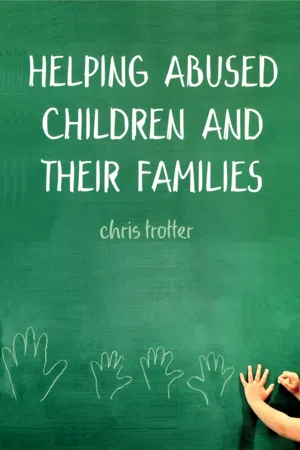
Helping Abused Children and their Families
Towards an evidence-based practice model
- 200 pages
- English
- ePUB (mobile friendly)
- Available on iOS & Android
eBook - ePub
About this book
Information
1
CHILD PROTECTION IN CRISIS?
I had visited Mr Pope for some months and I knew I should focus on my relationship skills. We should be working together—in partnership. I had read enough to know that the big stick approach did not work.
But I also knew he had hit his two-year-old child on two occasions, once so severely that she had to be admitted to hospital. And he seemed to show little, if any, remorse for what he had done. I was also being told by my supervisor that protection of the child from further abuse was my primary responsibility. How was I supposed to work in partnership and protect the child? How could I get him to understand that hitting his child not only damaged her physically but would also cause irreparable long-term damage to her.
I was never quite sure what I was supposed to say to him. Should I be reminding him of the damage he could do, telling him about other children who had been killed by their parents, confronting him about his lack of understanding and remorse? Or should I be working in partnership? Did this mean accepting his twisted perspective? What was it exactly that I could say and do to make little Sophie safer?
I was also expected to conduct an ongoing risk assessment. If the risk continued to be high we would have to go back to court to have an order made so I could keep seeing the family. Somehow I was supposed to work in partnership with Mr Pope, be open about my role and purpose, but also find out whether he was lying to me about how he was treating Sophie. In order to get the information to protect Sophie I could not be completely open about what I was doing. I had to visit without warning, catch him off guard, or encourage him to give himself away. Anyway it never seemed like partnership.
I was also never quite sure how I was supposed to be helping this family with their problems. I had persuaded Mr Pope to start seeing a social worker at United Family Services. The social worker was trying to get him into a parenting skills group. A nurse from the Deparment of Health was also visiting several times a week again in an attempt to help Mr Pope with caring for Sophie. The other workers seemed to be in the partnership but I didn’t.
These words, uttered by Margaret, who has worked in child protection for some years, reflect the dilemma which so many professionals face in child protection and child welfare work. How do you work in partnership and simultaneously assess risk and exercise authority?
This book is about how Margaret and other child protection workers can help people like Mr Pope to provide better care for their children. It is about how you can help children and their parents in what have often become proceduralised and forensic child protection systems. It is about what works and what doesn’t.
There are of course many instances when the best interests of children are served by removing them from their families. The focus of this book is not, however, about making decisions regarding whether or not children should be removed. It is more about how to work with families and children, where the families are together but there continues to be ongoing child protection concerns.
The book is about work in government child protection services. It is, however, also relevant to those who work with abused children in voluntary agencies or family support programs.
I have used the term ‘client’ to refer to parents, children or carers who are involved in the child protection system. It is acknowledged, however, that the interests of an abused child are often very different to those of a parent. In fact it is often argued that the child or young person who has been abused or neglected should be viewed as the client. So while I have used ‘client’ to describe all service recipients I have tried throughout the book to distinguish between two types of clients—clients who are parents or carers (and in many cases perpetrators) and clients who are children or young people who have been the victims of child abuse and neglect.
The media gaze
For the past two decades the field of child protection has been full of controversy. In the words of one American commentator,
Fifty years ago the nation’s press would not cover the story of mistreated children at all, because it was ‘indecent’. Twenty-five years ago, investigative reporters began climbing all over the story, but mostly for its shock and scandal value. Today . . . they are still limited by space and vision. (Levey 1999: 997)
There have been a number of high-profile cases in which children have died despite the involvement of social workers and other helping professionals. One of the most well-known examples is the case of Maria Colwell in the United Kingdom. Maria, at the age of six months, was placed in foster care because of neglect by her mother. At the age of six years she was returned to her mother and stepfather under court supervision. About nine months later she was beaten to death by her stepfather. Between the time she was placed with her mother and stepfather and her death she was visited on 56 occasions by child protection workers and other professionals, and 30 complaints were made about her care. Each of the professionals involved assumed that someone else was providing the primary service to the family (Howells 1974).
The Daniel Valerio case in Australia was similar. Daniel was murdered by his de facto father in 1990. At the time of his death he had 104 bruises on his body and two fractured collarbones which had started to heal despite the fact that he had received no treatment for them. In the three months before his death, Daniel had been seen by more than 20 professionals, including doctors, social workers, medical specialists, police and community workers. Each of those who visited was suspicious that he was a victim of child abuse. None of them, however, took action to remove Daniel from the family or to protect him from his father.
In these and in other high-profile cases individual social workers have often been severely criticised by the courts and the press. When Kim Anne Poden, a nineteen-month-old child under the supervision of the Children’s Aid Society in Canada, died of head injuries in 1976, the judge was highly critical of the way the case was handled by the Children’s Aid Society. A subsequent judicial inquiry placed much of the blame at the feet of individual social workers.
These cases led the courts, the press, children’s welfare organisations, government departments and politicians to question the systems that allowed these deaths to happen. They also led to an increasing interest in and awareness of the dangers of child abuse.
The ethical and value-based nature of child protection work has also come under scrutiny. One very good example of this is the high-profile debate which has raged in Australian newspapers in recent years about whether or not the Australian nation should apologise to the stolen generation—those children who, a generation ago, were forcibly removed from their families simply because they were Aboriginal. Similar debates have been seen in relation to North America’s indigenous populations.
Anthony McMahon (1998) in his book, Damned if you do, Damned if you don’t, suggests that public interest in child abuse has been further fuelled in the United States by the involvement of high-profile media identities. Oprah Winfrey, for example, publicly acknowledged that she had been raped as a child.
No doubt, as a result of this growing interest in child protection there has been an expansion in many western countries of government child protection and child welfare services. Alongside this expansion there has been a dramatic increase in the numbers of child protection reports, in many cases as a direct result of the introduction of mandatory reporting systems which require professionals who work with children to report instances of abuse to child protection authorities. In the decade between the mid-1980s and the mid-1990s most English-speaking countries saw increases in reports of child abuse of more than 200 per cent. The United States today sees something like three million reports a year. So despite the increase in services the ability of the system to investigate and deal with these reports is often compromised (Department of Health and Human Services [US] 2001). And the high-profile child protection ‘failures’ have continued to occur.
The Climbie case in the United Kingdom is an example. In 2001, Victoria Climbie, in the words of Lord Laming who conducted an inquiry into her murder, spent the cold winter months prior to her death
bound hand and foot, in an unheated bathroom, lying in the cold bath in a plastic bag in her own urine and faeces and having to eat what food she could get by pressing her face onto the plate of whatever was put in the bath beside her. (Laming 2003: 2)
Yet Victoria had been known in the ten months before her death to ‘no fewer than 4 social service departments, 3 housing departments, two specialist child protection teams in the metropolitan police, she had been admitted to 2 different hospitals and referred to the National Society for Protection of Children’. The most striking feature of the case was the ‘sheer number of occasions when the most minor and basic intervention on the part of the staff concerned could have made a material difference to the eventual outcome’.
Child protection—helping or social control?
The development of child protection systems in English-speaking countries over the past two decades has been paralleled by an increasing focus on what might be termed forensic or investigatory approaches to child protection work. Services are more and more characterised by a focus on whether abuse has occurred and, if so, the likelihood that it will be repeated. If it is found that abuse has occurred then this might lead to a notification becoming substantiated or the family concerned being placed on a child protection register. Most services now routinely use risk assessment processes that aim to determine which cases are high risk and therefore need immediate attention.
The risk assessment process provides a method of dealing with the increases in referrals. Scarce resources can be devoted to high-risk and substantiated referrals. Low-risk and unsubstantiated cases can be left alone. There are, however, many critics of the current systems. It is argued that they are legalistic, they focus on surveillance rather than welfare and they do not achieve the very purpose for which they have been set up—to protect children from harm. It is argued that most of the energy of child protection services is directed towards risk assessment rather than treatment, and it is hardly surprising that families and children are not being helped (Jack 1997; Gough 1993; Krane and Davies 2000; Parton, Thorpe and Wattam 1997). In the words of Anne Cohn Donelly (1999: 990) in relation to the American system, ‘Victims rarely get what is needed to repair the hurt and break the cycle.’
There is certainly some evidence for this view. A study by Elaine Farmer (1999) examined case planning meetings in the United Kingdom in the early 1990s. She found that the meetings focused primarily on risk issues and whether children should be placed on the child protection register. Only about fifteen per cent of the time was spent discussing treatment plans for the children and their families. A study by Gray and colleagues (1997) also in the United Kingdom suggested that clients feel they get little in the way of treatment from statutory child protection services. They suggest that clients feel there are gaps in services and workers are often out of touch.
David Gough (1993: 21) in an extensive review of research on the effectiveness of child protection suggests that child protection services have contributed little in terms of improved outcomes for children: ‘There is little evidence that child protection services improve outcomes for children or reduce re-referral rates (except where children are permanently removed).’
It seems that the pressure felt by Margaret in the case example referred to earlier—the pressure to establish the extent and nature of the abuse and to assess risk—is reflected in the practice and the organisation of many child protection services around the world.
The critics of child protection services in the United Kingdom have pointed to the different nature of services in Western Europe. British, North American and Australian child protection services are characterised by many layers of command. A senior child protection worker reports to a team leader, who reports to a child protection manager, who reports to a regional manager and so on. Most important decisions, even decisions to continue working with a family, are taken by someone up the hierarchy, whereas child protection services in Europe tend to have flatter management structures and give more responsibility to the frontline workers. Decisions, even decisions to remove children from the home, may be the ultimate responsibility of the child protection workers themselves. The focus of this type of child protection intervention is on helping the family with their problems, rather than determining whether abuse has occurred or the risk of future abuse. In only rare instances are children taken to court (Heatherington et al. 1997; Littlechild 1998).
This approach is well illustrated in a child protection service I visited in Austria. The child protection workers, rather than refer to other agencies or other expert workers, would seek advice from expert panels. Those panels might include medical staff, drug and alcohol experts and other advisers and they would help the worker to work with the family. They would also help the worker to make decisions such as whether or not a family should be taken to court. The system provides for maximum continuity of contact between one worker and one client, something which does not occur in the more specialised case management or contracting models which operate in most English-speaking countries.
The difference between the European and British systems is characterised by comments reputed to have been made by two child protection workers on initial visits to a mother and father suspected of child abuse. The British child protection worker commented: ‘We have had a report that you have been harming your children and I am here to investigate this.’ The European child protection worker on the other hand commented: ‘I have heard that you might be having some trouble with your children and I am here to see if I can help you with them or with any other problems you might have.’
Critics of the British system in particular have argued that their child protection services should be more like the European services. They should focus more on welfare and less on risk assessment (e.g. Littlechild 1998; Heatherington et al. 1997). They argue that it is not possible to distinguish between high-risk and low-risk cases in the early stages and that the divisions are artificial. It is pointed out that in the vast majority of cases children remain with their families and the focus on risk assessment diverts child protection workers from helping those children and their families.
Others have argued that cases should be moved away from the child protection services into voluntary services where families receive welfare rather than investigatory services. According to David Thorpe,
There are children who are the victims of serious neglect, physical or sexual assaults. They require protection and approximately ten per cent of children drawn into the mouth of the child protection net will filter down into this category. The use of emotive words such as abuse, maltreatment and perpetrator should be confined to those cases. (1994: 202)
It seems, however, that despite the increased focus on the investigatory function and despite the arguments that child protection services are now too investigatory, some commentators in the popular press are still not satisfied. As I mentioned earlier new child protection ‘failures’ continue to be publicised usually with the suggestion that child protection workers failed to assess the situation adequately.
There is also some recent criticism by academics of child protection assessment processes. Janet Stanley and Chris Goddard (2002), for example, argue that sometimes child protection workers underestimate the levels of abuse in families because they feel intimidated and threatened by parents. In other words children are not protected because the child protection workers do not focus sufficiently on their protective function. They point to initiatives by the New Zealand government as potential solutions to the problem. These initiatives include dangerous situations teams, independent reviews and fast tracking of access to specialist services.
The controversy about the role of child protection is ongoing. High-profile criticism of child protection failures has led to an increase in investigatory approaches. This has in turn led to criticism of the new focus on investigatory approaches. Despite this, however, the adequacy of the investigatory approaches continues to be questioned.
Case management
Child protection services in English-speaking countries for the most part work on a case management system. In other words, welfare services...
Table of contents
- Cover
- Half Title
- Title Page
- Copyright Page
- Acknowledgement
- Contents
- 1. Child protection in crisis?
- 2. Gathering the evidence
- 3. Child protection workers—helpers or investigators?
- 4. Dealing with client problems
- 5. Working with other agencies and case conferences
- 6. Pro-social perspectives
- 7. Relationship building skills
- 8. Staff supervision and what the evidence tells us about good practice
- References
- Index
Trusted by 375,005 students
Access to over 1.5 million titles for a fair monthly price.
Study more efficiently using our study tools.
Frequently asked questions
Yes, you can cancel anytime from the Subscription tab in your account settings on the Perlego website. Your subscription will stay active until the end of your current billing period. Learn how to cancel your subscription
No, books cannot be downloaded as external files, such as PDFs, for use outside of Perlego. However, you can download books within the Perlego app for offline reading on mobile or tablet. Learn how to download books offline
Perlego offers two plans: Essential and Complete
- Essential is ideal for learners and professionals who enjoy exploring a wide range of subjects. Access the Essential Library with 800,000+ trusted titles and best-sellers across business, personal growth, and the humanities. Includes unlimited reading time and Standard Read Aloud voice.
- Complete: Perfect for advanced learners and researchers needing full, unrestricted access. Unlock 1.5M+ books across hundreds of subjects, including academic and specialized titles. The Complete Plan also includes advanced features like Premium Read Aloud and Research Assistant.
We are an online textbook subscription service, where you can get access to an entire online library for less than the price of a single book per month. With over 1.5 million books across 990+ topics, we’ve got you covered! Learn about our mission
Look out for the read-aloud symbol on your next book to see if you can listen to it. The read-aloud tool reads text aloud for you, highlighting the text as it is being read. You can pause it, speed it up and slow it down. Learn more about Read Aloud
Yes! You can use the Perlego app on both iOS and Android devices to read anytime, anywhere — even offline. Perfect for commutes or when you’re on the go.
Please note we cannot support devices running on iOS 13 and Android 7 or earlier. Learn more about using the app
Please note we cannot support devices running on iOS 13 and Android 7 or earlier. Learn more about using the app
Yes, you can access Helping Abused Children and their Families by Chris Trotter in PDF and/or ePUB format, as well as other popular books in Social Sciences & Health Care Delivery. We have over 1.5 million books available in our catalogue for you to explore.