- 308 pages
- English
- ePUB (mobile friendly)
- Available on iOS & Android
eBook - ePub
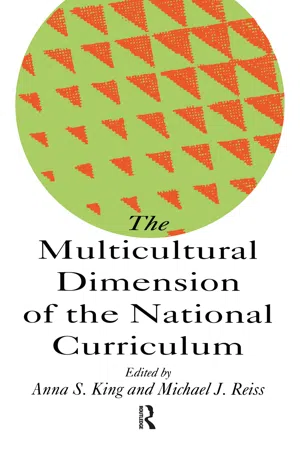
The Multicultural Dimension Of The National Curriculum
About this book
Given the National Curriculum Council's failure to issue any formal guidance on the subject, multicultural education is becoming increasingly marginalized and left to individual schools. This book provides guidance and advice to schools on issues of racial equality and cultural diversity. It helps teachers, managers and governors implement the requirements and expectations of new educational legislation since the 1988 Education Reform Act and its associated non-statutory advice and guidance.; Within a whole school curriculum framework, chapters provide analysis and practical guidance for each subject area of the National Curriculum. With responsibility for multicultural education resting largely on individual schools, this book sets out to aid schools of all kinds, primary, secondary, grant maintained and LEA, to ensure that issues of racial equality and cultural diversity are addressed throughout the whole curriculum.; It is aimed at teachers at all levels, Heads of Education Departments, Mentors, Governors, Advisers, INSET course tutors, students on PGCE, BEd.MEd. courses and those doing a BA in Education.
Information
Part One
The Context
Chapter 1
Introduction
Anna S. King
The Education Reform Act of 1988 is a landmark in the history of English and Welsh education — a landmark quite as significant as the legislation of 1870 and 1944. For the first time a British government took direct responsibility for the school curriculum and its assessment. The long term consequences of this legislation for multicultural education are not clear, although its general implications, potentialities and shortcomings have been fiercely debated. Yet, whatever the political future of the Education Reform Act (ERA), it seems certain that a national curriculum is here to stay. Issues of racial equality and justice must be addressed and redressed through this statutorily imposed curriculum.
There are therefore very urgent reasons why there should be informed debate of what the National Curriculum Council (NCC) calls ‘the multicultural dimension’. The first is that in our preoccupation with new legislative developments, we should not lose sight of the fact that education for the late twentieth century is necessarily pluralist, and that multicultural perspectives and practices are integral to all good teaching and learning. Secondly, the National Curriculum has created an entirely new situation for teachers and schools committed to pluralist approaches to education. Yet the fact that the National Curriculum Council has decided not to issue formal guidance on the multicultural cross-curricular dimension means that at present there are no unifying guidelines to support its implementation. References to issues of cultural diversity and racial justice, where they exist, are dispersed in statutory Orders and in non-statutory guidance documents. Thirdly, the formative literature on multicultural and anti-racist education refers to the situation prior to the advent of a mandatory national curriculum and is becoming increasingly outdated. Thus, educators, teachers and management now have a very real practical need for advice on issues of cultural diversity and racial justice within schools. 1
This need is all the more pressing since it is the response of school management, governors, teachers and parents that has become critical. The regulations governing the National Curriculum do not prescribe its manner of delivery and the National Curriculum Council’s guidance on the whole curriculum and on the cross-curricular elements is not statutory. Thus individual schools now have the responsibility for developing and interpreting the National Curriculum for multicultural purposes. Without their active support and enthusiasm, there must be a real fear that the multicultural dimension will be diminished, marginalized or even lost.
We therefore decided to invite contributors with a variety of responsibilities — subject specialists, practising teachers and heads, teacher educators, advisers and inspectors — to respond to the emerging documents and assessment procedures of the National Curriculum. This has proved a challenging task, not only because the issues themselves are innately controversial and complex, but also because information is constantly changing. Although the Orders for all subjects of the National Curriculum are in place and being implemented by schools, they remain subject to reappraisal and revision. Moreover, a few contributors have had the formidable task of evaluating interim Working Reports or consultation documents while they waited for the publication of the final Orders. Meanwhile, there is a continuing flow of legislation and official advice on assessment and testing procedures, the role of Local Education Authorities (LEAs), Her Majesty’s Inspectorate (HMI) and the new Registered Inspectors and on possible harmonization with Europe. The 1992 Education White Paper promises even more radical changes (DFE, 1992a).
We are writing at a time of great educational change and uncertainty; a time when the role, funding and centrality of multicultural education is open to intense debate. For some writers the very emphasis on a National Curriculum and a national system of testing has implications which are incompatible with the internationalist curriculum that is one of the objectives of the multicultural approach. For others there is scope within the subject areas and the cross-curricular elements for ensuring that the curriculum becomes more relevant to our modern multiethnic, multifaith and multilingual society.
However inadequate, muddled or attenuated NCC references to multicultural education may be, the documents can be used collectively to justify and assert the importance of the pluralist approach, and it can be argued that those working for anti-racist, multicultural and global approaches to the curriculum now have considerable statutory and non-statutory support. The multicultural cross-curricular dimension is an accepted entitlement for all pupils in all maintained schools, and multicultural education is defined as the professional responsibility of all teachers. Within many documents it is possible to find an emphasis not only on cultural pluralism but also on equal opportunities, and both these strands are given a clear non-racist perspective. All schools are to engage directly with issues of racism, racial discrimination and disadvantage, and to eradicate racism and prejudice within their own structures and policies. Similarly, the general advice on the whole curriculum requires the specific needs of ethnic minority pupils to be met. Their cultures, languages and religions are to be treated with dignity and respect and are regarded as an educational enrichment for all pupils. Lastly, we can find within much of the advice a moral base. Pupils themselves are to be encouraged to consider fundamental issues of social justice and equality and to develop an appreciation of, and commitment to, the principles of equality and justice.
The major question which this book addresses is how these educational ideals are to be given significance, within each separate subject area and the curriculum as a whole. It investigates how these general principles can be translated into practical action. Indeed, it is only through the detail of practice that these precepts can be properly understood. Theory and practice illuminate each other.
It has been argued that the National Curriculum, by providing a single system of attainment targets and programmes of study, actually enables primary and secondary teachers to create links between and within schools and to share multicultural resources and expertise across the curriculum. In this book we hope to substantiate this claim by giving practical examples of resources which can be precisely focused, and by suggesting activities and strategies which have been found to be valuable at different key stages.
In trying to explore issues of cultural identity and racial justice throughout the curriculum, we are aware that we are writing for a wide and diverse audience. We want to support those teachers and professionals who are already committed and who will interpret any curriculum in ways that challenge racism and empower pupils. We want also to persuade those managers and governors who remain unconvinced or even frankly sceptical.
Our assertion is that multicultural education is simply good education, which will result not only in a happier school environment for all children but in higher standards and achievement — quality as well as equality. By developing in pupils the principles of justice and equality and enriching the educational experiences of all, it raises standards and ultimately benefits both the pupils themselves and society in general. 2
We are writing for both primary and secondary teachers, and have sought to reflect both primary and secondary perspectives. The fact that primary teachers are, to a great extent, responsible for teaching the whole curriculum creates all kinds of opportunities for multicultural teaching which are not often shared by their secondary colleagues. This holistic understanding is enhanced, despite the subject-based nature of the National Curriculum, by the thematic and cross-curricular teaching which is still practised in most primary schools.
Finally, we should like to contribute to an educational debate that is rapidly intensifying in political importance. Issues of diversity and cohesion, of personal and national identities, of ‘belonging’ and of openness to a variety of perspectives are becoming increasingly sensitive and challenging as Britain enters Europe and as the need to educate pupils for responsible citizenship as members of a global community becomes inescapable. The National Curriculum cannot ignore such concerns. If it does, it will offer pupils an education ‘fettered by the past and fearful of the future’.
The Education Reform Act 1988
As long ago as 1977, the Green Paper, Education in Schools: A Consultative Document, called for a core curriculum reflecting the cultural and ethnic diversity of Britain and its interdependence with the wider world. The Swann Report of 1985 a...
Table of contents
- Cover
- Half Title
- Dedication Page
- Title Page
- Copyright Page
- Contents
- Preface
- Part One – The Context
- Part Two – The Curriculum
- Part Three – The School
- Part Four – Policy and Practice
- Index
Trusted by 375,005 students
Access to over 1.5 million titles for a fair monthly price.
Study more efficiently using our study tools.
Frequently asked questions
Yes, you can cancel anytime from the Subscription tab in your account settings on the Perlego website. Your subscription will stay active until the end of your current billing period. Learn how to cancel your subscription
No, books cannot be downloaded as external files, such as PDFs, for use outside of Perlego. However, you can download books within the Perlego app for offline reading on mobile or tablet. Learn how to download books offline
Perlego offers two plans: Essential and Complete
- Essential is ideal for learners and professionals who enjoy exploring a wide range of subjects. Access the Essential Library with 800,000+ trusted titles and best-sellers across business, personal growth, and the humanities. Includes unlimited reading time and Standard Read Aloud voice.
- Complete: Perfect for advanced learners and researchers needing full, unrestricted access. Unlock 1.5M+ books across hundreds of subjects, including academic and specialized titles. The Complete Plan also includes advanced features like Premium Read Aloud and Research Assistant.
We are an online textbook subscription service, where you can get access to an entire online library for less than the price of a single book per month. With over 1.5 million books across 990+ topics, we’ve got you covered! Learn about our mission
Look out for the read-aloud symbol on your next book to see if you can listen to it. The read-aloud tool reads text aloud for you, highlighting the text as it is being read. You can pause it, speed it up and slow it down. Learn more about Read Aloud
Yes! You can use the Perlego app on both iOS and Android devices to read anytime, anywhere — even offline. Perfect for commutes or when you’re on the go.
Please note we cannot support devices running on iOS 13 and Android 7 or earlier. Learn more about using the app
Please note we cannot support devices running on iOS 13 and Android 7 or earlier. Learn more about using the app
Yes, you can access The Multicultural Dimension Of The National Curriculum by Anna King,Michael Reiss in PDF and/or ePUB format, as well as other popular books in Education & Education General. We have over 1.5 million books available in our catalogue for you to explore.