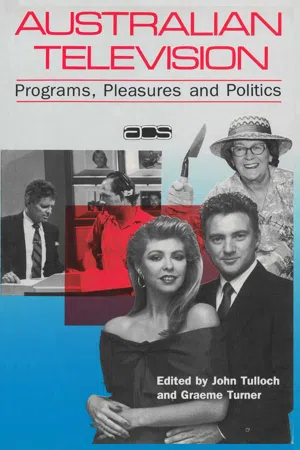
Media, communications and cultural studies form a rapidly growing part of secondary and tertiary education in Australia, yet there have been few books dealing specifically with Australian television. This is the first wide ranging study of television in Australia, and includes a coverage of the cultural and institutional history of Australian television as well as examining a wide range of television programming.
Prisoner, Perfect Match, Hey Hey It's Saturday, A Country Practice, Vietnam and Beyond 2000 are some of the programs described and analysed. Issues are raised such as the relationship between children and television, the role of the television documentary and the function television serves in constructing communities.
The contributors to Australian Television: Programs, Pleasures and Politics include some of the leading researchers in Australian television and cultural studies and their articles employ a wide range of methods - from semiotic analyses to cultural histories. Despite their dealing with often quite sophisticated problems, the chapters are written in an accessible and lively manner. This is an important collection which opens out space for more informed and challenging discussions of Australia's television culture - its programs, its meanings, its pleasures and its politics. It will be an invaluable text for all tertiary television, media studies, communications studies, Australian studies and cultural studies programs.
- 220 pages
- English
- ePUB (mobile friendly)
- Available on iOS & Android
eBook - ePub
About this book
Information
1
Three Stages of Australian Television
Australia is a ‘region of recent (white) settlement’ whose staple-based economy has been linked to that of Argentina and Canada. Australian television is locked into international television in terms of the flow of technology, programs and programming practices. The 30-odd years since the introduction of television in 1956 seems like one continuous period. Certainly the period is unified as one of television broadcasting; the television narrowcasting, now developing in the United States has not yet begun in Autralian television.1 But when we survey these years of Australian television in more detail it is apparent that there are many breaks and discontinuities. Australian television from this perspective falls into three stages: the first to 1965 can be called ‘radio with pictures’, the second from 1965 to 1975/6 sees the emergence of a local TV drama production industry. Since 1975, Australian television has been marked by the introduction of new technologies, the rise of new media conglomerates, growing internationalisation and an increasing overlap with the Australian feature film production industry. This third stage is still with us.
Radio with pictures
The first stage of Australian television seems both familiar and remote from a present day point of view. All programs were broadcast in black and white. Under an agreement with the major Hollywood film companies, films made before 1948 were available to television and the great majority of these, too, were in black and white. Many other programs, especially variety shows, were broadcast live. The only form of recording available, a system known as kinneying, filmed images off a TV monitor but these images were poor in quality and the system was not widely used.
The hours of television transmission were restricted. Initially stations in Sydney and Melbourne opened in the later afternoon and broadcast until shortly before midnight. The hours of broadcasting on the weekend were more extended, because of live sport broadcasts. Such practices as breakfast shows and midnight-to-dawn news, sport and movies lay many years into the future.
Australian television developed according to a pre-arranged pattern. Two commercial television licences were awarded to operators in Sydney, Melbourne, Brisbane and Adelaide and one each in Canberra, Perth and Hobart. One commercial licence was awarded in smaller cities and towns throughout the rest of the country. This development occurred in several stages. Following the implementation of Stage 4 of the Development of Television Services in 1964/65 nearly 80 per cent of the country came within the net of television. The service extended to smaller cities and towns such as Kempsey in New South Wales and Bunbury in Western Australia.2
The granting of two licences in Sydney, Melbourne, Brisbane and Adelaide both facilitated the development of networking arrangements in the four most populous cities and restricted these arrangements to those cities. Networking here was understood as combining, for the purposes of cost sharing, on program buying and program production. Frank Packer’s Consolidated Press had, before the coming of television, some informal arrangements with the Herald and Weekly Times Group for the purpose of buying newspaper comics, overseas news and other press material. The link continued into television—Packer’s TCN Channel 9 had links with HSV Channel 7 from 1956 to 1960. However, Packer had ambitions to establish a television network chain, initially applying unsuccessfully for commercial licences in Brisbane and in country areas of New South Wales. In 1960 he bought GTV Channel 9 in Melbourne and the Nine Network came into being. Later in the decade the Seven Network emerged.
The ABC was unaffected by these developments. Single ABC television stations began in Sydney and Melbourne in late 1956-early 1957 and other ABC stations rippled out across the country. Under its long-serving general manager, Sir Charles Moses, the ABC gave little thought to its new television service. By and large, it saw television as an extension of radio so that nowhere was it truer to say that television was simply radio with pictures.
Television owners and station executives in this first stage of television did not give a great deal of thought to programs. Instead their main concern was with the capital cost of establishing and operating a station. Although several would-be licensees made expressions of commitment to the idea of locally produced programs at both the hearings of the Royal Commission on Television (1953) and at the Licence Inquiries (1955–59), their early practice did not encourage local production. Instead the economics of this first stage of television were that in order to buy the necessary kind of equipment to set up television stations the commercial operators offset capital costs against the relatively cheap costs of imported American material. They commissioned one of the cheapest forms of local content, namely variety shows, as a way of further underwriting establishment costs. This made most commercial television stations highly profitable, leading operators to echo the famous dictum of Lord Thompson that having a television station was like having a licence to print money.
The television stations were both distributors and producers of programs, like supermarkets which also manufactured the goods they sold. The programs were made at the station by the station. The most notable of the stations for in-house production were ATN Channel 7 Sydney and GTV Channel 9 in Melbourne. GTV Channel 9 would continue with its successful In Melbourne Tonight for several years after the Packer takeover but gradually its drama production fell away. ATN Channel 7 persisted with in-house production until 1970.
The early television schedule was constructed on units of a quarter hour. News programs, soap opera and some early teenage music programs were fifteen minutes in length, although most programs were a half hour in length. A few imported drama series, such as Perry Mason and Wagon Train, plays and variety programs were longer, running 60 or 90 minutes. The programming schedule was dominated by half-hour programs such as The Mickey Mouse Club, The Cisco Kid The Lone Ranger, Sergeant Bilko, Hancoc’s Half Hour and others. Many of these would be stripped (programmed in the same time slot over the five days of the week) in the early evening for children viewers. Thus when we find them in prime time they project a childish image in the schedule.
The dominant drama genres were westerns, crime and situation comedies. Popular westerns included Rawhide, Wagon Train, Cheyanne Sugarfoot Wanted Dead or, Alive and Bonanza; popular crime series included 77 Sunset Strip, The Untouchables and Dragnet; Leave it to Beaver, Father Knows Best, Life of Riley and I Love Lucy were favourite situation comedies. Of these genres the latter two have remained a staple of the television schedule over the remaining periods while the western had faded from mass popularity.
The period was also marked by the popularity of the one-off television play. There were two kinds of play: the first, emanating from the BBC, was dominated by a West End conception of drama and theatre. It favoured theatrical works of famous British playwrights such as Shakespeare, Shaw and, in the modern period, Noel Coward and Terence Rattigan. This model was the one adopted by ABC television. From the late 1950s it combined imports from the BBC with television versions of some famous Australian plays. But essentially it was working on the basis of adapting pre-existing theatrical materials to television. The frame of mind of the drama department of the ABC at that time is well conveyed by Colin Dean, a producer with the ABC, responsible for its first television drama series, The Hungry Ones, in 1960:
The ABC has a very honourable place in the life of the Australian theatre. During the war, in the 1950s and early 1960s, the ABC in its live dramas kept alive the traditions of the theatre giving work to actors, writers and others, giving them the opportunity to practice their craft.3
The other kind of play came from American television. In the early 1950s, in programs such as The US Steel Hour and Playhouse 90, playwrights such as Sterling Stilliphant, Paddy Chayefsky and Tod Mostel had written a series of original social realist plays for television including Marty, The Miracle Worker and Requiem for a Heavyweight. The model was adopted in Australian television by ATN Channel 7 and its partner station, first GTV Channel 9 and then HSV Channel 7, under the sponsorship of both Shell and General Motors. Notable plays written for television under the aegis of these sponsors include Other People’s. Houses, Tragedy in a Temporary Town and Thunder of Silence
An absence from the television schedule in this early period was current affairs. Four Comers, modelled on the BBC’s Panorama, did not begin on the ABC until 1961. In its earliest form it was more of a newsreel or news digest program with several items in each episode rather than the hard-hitting investigative program we have become more familiar with. Its first producer, Bob Raymond, left the ABC in 1963 and began Project 63 on TCN Channel 9. These programs can be seen as forerunners to the kind of current affairs television that blossomed in the later 1960s and 1970s.
Instead of investigative current affairs, this period had a more sedate form of public affairs television, well exemplified in TCN Channel 9’s Meet the Press. Meet the Press was scheduled at a late hour on Sunday evening and featured a discussion cum interview between an eminent visitor to Australia or distinguished guests and senior newspaper executives of Consolidated Press. The discussion was usually polite and dignified, the questions were never probing or uncomfortable and the general atmosphere was usually one of exclusivity and smugness. The fact that the journalists were press journalists rather than television journalists is a sign of how far the concept of current affairs television has shifted since this first stage of television.
There was little in the way of locally oriented documentary films on Australian television at this particular time. Such material was mostly brought in from elsewhere. The ABC did not establish a filmmaking pool, consisting of teams of cameramen available to both news and documentary program, until 1959. There was an enormous reliance on overseas material.
If there was any kind of presence of what we might call ‘Australian Content’ on Australian television in this period, it occurred in cheaper production genres such as variety and quiz shows. Indeed there was a boom in local variety shows. Programs such as In Melbourne Tonight, The Graham Kennedy Show, In Sydney Tonight, Delo and Daly, Startime, Revue 60 and Revue 61, Bandstand, Six O’Clock Rock, Sing Sing Sing, Curtain Call, The Bobby Limb Late Show, The Mobil-Limb Show and The Johnny O’Keefe Show were important landmarks. In Brisbane and Adelaide local Tonight Shows were hosted by figures such as George Wallace Junior, Gerry Gibson and Ernie Sigley. Among early successful local quiz shows were Wheel of Fortune, Concentration and Tic-Tac-Dough, all packaged for TCN Channel 9 by Reg Grundy. The success of these variety and quiz shows meant that, despite the overwhelming presence of American and British programs, Australian programs had a distinct place in the television schedule. It was through the presence of this variety cycle that Australian television was given a local look or flavour and developed a deliberate programming mix between overseas drama and local variety. But variety shows often had international guests, so that even if they qualified under Broadcasting Control Board regulations as Australian content, nevertheless they had a distinctly international flavour.
This period, both in Australia and elsewhere, was marked by the attempt to switch various formats, programs and personalities that had worked well in radio across to television. Some of the familiar kinds of genres, shows and personalities once heard on radio took on visible material form. Overseas programs such as Gunsmoke, The Nelsons and Hancock’s Half Hour, and Australian programs such as Consider Your Verdict Pick-A-Box and Wheel of Fortune, made a successful transition from radio to television. There was also an attempt to move soap opera from radio to television in the late 1950s when ATN Channel 7 produced Autumn Affair and The Story of Peter Grey. But these found neither sponsors nor audience. Although several personalities, including Bob Dyer and Graham Kennedy, moved successfully across, a notable casualty of the new medium was Jack Davey.
Enter Hector’s inspectors
The second period of Australian television between 1964 and 1975 was marked by a good deal of stability. The novelty phase of television was at an end, the Box had become part of the lounge-room, and young children who had never known a world without television were now teenagers.
Between 1963 and 1965 a new commercial station appeared in Sydney, Melbourne, Brisbane, Adelaide and Perth. The new stations formed themselves into the 0–10 network so that east coast Australia now had three commercial networks. Of these, the newcomer was the weakest in terms of audience and ratings—so much so that in 1973 a new federal Labor government briefly contemplated taking away the licences. Apart from the licensing of the 0–10 stations there was no other change to the structure of Australian television.
The advent of the new network meant that there was barely enough imported program material for the commercial networks and the ABC. This was an important factor in the sudden rise of local television drama. The new cycle began with the rather unexpected success of the police series Homicide, made in Melbourne by Crawford Productions, and which began production in late 1964. By the end...
Table of contents
- Cover
- Half Title
- Series Page
- Title Page
- Copyright Page
- Contents
- General Editor’s Preface
- Preface
- Contributors
- 1 Three Stages of Australian Television
- 2 The Converging of Film and Television
- 3 Transgressive TV: From In Melbourne Tonight to Perfect Match
- 4 Textual Innovation in the Australian Historical Mini-Series
- 5 In Praise of Prisoner
- 6 Everyday Quizzes, Everyday Life
- 7 Television Documentary
- 8 Publicising Progress: Science on Australian Television
- 9 Soaps and Ads: Flow and Segmentation
- 10 Continuous Pleasures in Marginal Places: TV, Continuity and the Construction of Communities
- 11 Children and Television
- 12 Changed Times, Changed Tunes: Music and the Ideology of the News
- 13 Afterword: Approaching Audiences-A Note on Method
- Index
Trusted by 375,005 students
Access to over 1.5 million titles for a fair monthly price.
Study more efficiently using our study tools.
Frequently asked questions
Yes, you can cancel anytime from the Subscription tab in your account settings on the Perlego website. Your subscription will stay active until the end of your current billing period. Learn how to cancel your subscription
No, books cannot be downloaded as external files, such as PDFs, for use outside of Perlego. However, you can download books within the Perlego app for offline reading on mobile or tablet. Learn how to download books offline
Perlego offers two plans: Essential and Complete
- Essential is ideal for learners and professionals who enjoy exploring a wide range of subjects. Access the Essential Library with 800,000+ trusted titles and best-sellers across business, personal growth, and the humanities. Includes unlimited reading time and Standard Read Aloud voice.
- Complete: Perfect for advanced learners and researchers needing full, unrestricted access. Unlock 1.5M+ books across hundreds of subjects, including academic and specialized titles. The Complete Plan also includes advanced features like Premium Read Aloud and Research Assistant.
We are an online textbook subscription service, where you can get access to an entire online library for less than the price of a single book per month. With over 1.5 million books across 990+ topics, we’ve got you covered! Learn about our mission
Look out for the read-aloud symbol on your next book to see if you can listen to it. The read-aloud tool reads text aloud for you, highlighting the text as it is being read. You can pause it, speed it up and slow it down. Learn more about Read Aloud
Yes! You can use the Perlego app on both iOS and Android devices to read anytime, anywhere — even offline. Perfect for commutes or when you’re on the go.
Please note we cannot support devices running on iOS 13 and Android 7 or earlier. Learn more about using the app
Please note we cannot support devices running on iOS 13 and Android 7 or earlier. Learn more about using the app
Yes, you can access Australian Television by Graeme Turner,John Tulloch in PDF and/or ePUB format, as well as other popular books in Social Sciences & Film & Video. We have over 1.5 million books available in our catalogue for you to explore.