- 552 pages
- English
- ePUB (mobile friendly)
- Available on iOS & Android
eBook - ePub
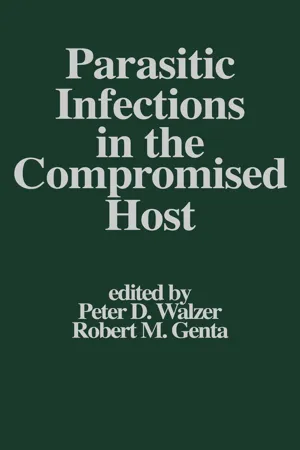
Parasitic Infections in the Compromised Host
About this book
The first in a new series created to acknowledge the explosion of knowledge in fields related to infectious disesases and clinical microbiology. Thirteen contributions focus on organisms which are of major medical importance in this country or which have contributed to an understanding of pathology.
Information
1
The Compromised Host: AIDS and Other Diseases
HENRY MASUR
Clinical Center, National Institutes of Health, Bethesda, Maryland
Clinical Center, National Institutes of Health, Bethesda, Maryland
I. Introduction
Patients who lack normal resistance to infection because of a deficiency in any of their multifaceted host defense mechanisms are referred to as "compromised hosts." In the 1980s physicians have been confronted with a rapidly expanding population of patients who fit into the category of compromised hosts. Compromised hosts are increasing in numbers because the medical sciences are employing more aggressive surgical and medical techniques to control or cure previously hopeless diseases including congenital immunodeficiencies, malignant neoplasms, and end-stage cardiac, hepatic, or renal failure. In addition, their number is increasing because of exposure to environmental hazards such as that which occurred at Chernobyl but more dramatically because of infection with human immunodeficiency virus (HIV, previously known as HTLV-III or LAV or ARV). Clinicians have made rapid strides over the last two decades in managing the hemorrhagic and metabolic disorders that formerly were lethal for many of these patients. Now, to an ever-increasing degree, infection is the major factor that limits the quality and duration of life for many of these populations.
In North America and Western Europe, where sanitation and arthropod control are well-developed public health priorities, most clinicians give scant consideration to protozoan and helminthic organisms. For physicians dealing with immunocompetent patients, protozoans and helminthic diseases are rarely considered and even more rarely recognized. However, a large percentage of the population is exposed to such organisms and may harbor them for life. About 15-40% of the North American population become infected with Toxoplasma gondii, for example, and have viable cysts in their muscle and brain for their lifetime after acute infection (1,2). About 4-7% of visitors to certain endemic areas in the United States are infected with Babesia microti (3). Giardia lamblia is present in 20-50% of children in some day care centers and in high fractions of residents of certain areas with contaminated water supplies (4). Homosexual men are likely to have Entamoeba histolytica or G. lamblia in their stool in 30-40% of cases depending on their sexual activity and city of residence (4-6). Strongyloides stercoralis is endemic in many parts of the southern United States and has been reported to be frequent in certain institutionalized populations (7). As a final example, the frequency of Pneumocystis pneumonia in all groups of North American patients who develop AIDS suggests that this protozoan is ubiquitous in North America. Since each of these protozoan and helminthic organisms requires immunological and nonimmunological host defense mechanisms to protect the exposed host from serious disease, and since host defense mechanisms are, to an increasing degree, being seriously compromised by environmental, infectious, and iatrogenic processes, it is not surprising that clinicians are recognizing more and more protozoan and helminthic diseases in their patient populations.
The epidemic of HIV infection in North America has provided a graphic demonstration of the precarious balance between human beings in North America and the protozoa in their microbial environment. The immunological defect that is central to AIDS appears also to be central to much of antiprotozoan host defense. As a result, protozoan diseases such as pneumocystosis, toxoplasmosis, cryptosporidiosis, and isosporiasis are major causes of serious morbidity and death in this population.
For compromised patients who live in tropical ares or who have emigrated to North America or Western Europe, the problem of protozoan and helminthic infection is clearly magnified, since exposure to Plasmodia, Trypanosoma, Leishmariia, E. histolytica, G. lamblia, and S. stercoralis is so common. Each geographical area has its unique protozoan and helminthic ecology that demands special consideration. In many parts of North America where refugees from tropical areas are concentrated, where the indigenous population travels or lives abroad for business or pleasure, or where foreign nationals come seeking health care, protozoan and helminthic diseases are increasingly important considerations.
The focus of this chapter is to provide an overview of protozoan and helminthic diseases as one component of the interrelationship between the compromised host and his or her microbial environment.
II. Host Defense Mechanisms
For patients whose host defense mechanisms are less capable than normal, a variety of terminologies are loosely used, including "compromised host," "abnormal host," "immunocompromised patient," and immunosuppressed host." It is important to recognize that although some of these terms can be used interchangeably, the latter two refer specifically to those patients whose immunological or inflammatory defense mechanisms are compromised, while the former terms refer to patients who might be deficient in any of their physical, chemical, inflammatory, or immunological defenses. For protozoa and helminths, compromise of immunological defense mechanisms is the major predisposition to life-threatening disease, in contrast to ther microbial pathogens, such as bacteria, for which physical and chemical and inflammatory barriers have more importance.
Host defense mechanisms against microbial agents are an increasingly important issue. Medical science has made rapid strides in artififical joint construction, cardiac valve replacement, organ transplatnation, thermal injury rescue, and treatment of inflammatory and neoplastic diseases. Many of these advances depend on the use of aggressive surgical techniques that breach physical barriers and that often insert foreign bodies into the patient. Many of these advances also utilize increasingly potent anti-inflammatory and cytotoxic pharmacological agents. Noninfectious complications such as hemorrhage, uremia, electrolyte disorders, endocrinological dysfunction, and organ rejections are being managed with increasing success. Infection is becoming the major threat to the quality and duration of patient survival. Bacterial and fungal infections continue to be the major causes of morbidity and mortality. Rapid advances are being made in the management of bacterial processes; it seems likely that fungal, viral, and protozoal problems will become increasingly important. Moreover, in parts of the world where protozoan and helminthic diseases are highly endemic and where these aggressive immunosuppressive techniques are introduced, protozoan and helminthic diseases will almost cert...
Table of contents
- Cover
- Half Title
- Series Page
- Title
- Copyright
- Dedication
- Series Introduction
- Preface
- Contributors
- Contents
- 1. The Compromised Host: AIDS and Other Diseases
- 2. Host Defenses Against Prototypical Intracellular Protozoans, the Leishmania
- 3. Pneumocystis carinii
- 4. Toxoplasma gondii
- 5. Cryptosporidium spp.
- 6. Giardia lamblia
- 7. Entamoeba histolytica
- 8. The Host Immune Response Against Parasitic Helminth Infection
- 9. Strongyloidiasis
- Index
- About the Editors
Trusted by 375,005 students
Access to over 1.5 million titles for a fair monthly price.
Study more efficiently using our study tools.
Frequently asked questions
Yes, you can cancel anytime from the Subscription tab in your account settings on the Perlego website. Your subscription will stay active until the end of your current billing period. Learn how to cancel your subscription
No, books cannot be downloaded as external files, such as PDFs, for use outside of Perlego. However, you can download books within the Perlego app for offline reading on mobile or tablet. Learn how to download books offline
Perlego offers two plans: Essential and Complete
- Essential is ideal for learners and professionals who enjoy exploring a wide range of subjects. Access the Essential Library with 800,000+ trusted titles and best-sellers across business, personal growth, and the humanities. Includes unlimited reading time and Standard Read Aloud voice.
- Complete: Perfect for advanced learners and researchers needing full, unrestricted access. Unlock 1.5M+ books across hundreds of subjects, including academic and specialized titles. The Complete Plan also includes advanced features like Premium Read Aloud and Research Assistant.
We are an online textbook subscription service, where you can get access to an entire online library for less than the price of a single book per month. With over 1.5 million books across 990+ topics, we’ve got you covered! Learn about our mission
Look out for the read-aloud symbol on your next book to see if you can listen to it. The read-aloud tool reads text aloud for you, highlighting the text as it is being read. You can pause it, speed it up and slow it down. Learn more about Read Aloud
Yes! You can use the Perlego app on both iOS and Android devices to read anytime, anywhere — even offline. Perfect for commutes or when you’re on the go.
Please note we cannot support devices running on iOS 13 and Android 7 or earlier. Learn more about using the app
Please note we cannot support devices running on iOS 13 and Android 7 or earlier. Learn more about using the app
Yes, you can access Parasitic Infections in the Compromised Host by Peter D. Walzer,Robert M. Genta in PDF and/or ePUB format, as well as other popular books in Medicine & Immunology. We have over 1.5 million books available in our catalogue for you to explore.