In this book, Eric J. Heikkila explores a truly important question that has not been adequately analyzed to date: how the rise of China alters the context in which the broad spectrum of policies in the United States should be assessed. Here, the policy domain of the U.S. government is carved into three broad spheres:
economic policies: fiscal policy and deficits, trade policy, and employment and income
sustainability policies: climate change, urban policy, and energy policy
geopolitical policies: homeland security, defense policy, and foreign relations.
For each domain, Heikkila assesses the key policy issues and tradeoffs, examining how the balance of such tradeoffs shifts due to China's rise. In doing so, he demonstrates how a rising China exerts its gravitation pull on U.S. policy, not so much through lobbying or negotiation, but through the very nature of its being. A concluding chapter presents a workable synthesis derived from these diverse perspectives.
At a time of increasing tensions, it is all the more important for U.S. policy makers to focus on the many substantive policy questions that are impacted by China's rise. China from a U.S. Policy Perspective will be of key interest to scholars, practitioners, and students of policy analysis, U.S. politics, Chinese politics, and International Relations.
This book is about policy analysis in the United States in the era of a rising China. Policy analysis is distinct from the political processes by which policies are formulated, enacted, and implemented. Policy analysis focuses on the substance of policies themselves. For the purposes of this book, the policy domain of the U.S. government is carved into three broad spheres: economic policies, sustainability policies, and geopolitical policies. At a time of increasing tensions between the United States and China, it is all the more important for U.S. policy makers to focus less on rhetorical flourishes and more on the many important and substantive policy questions that are prompted by China’s rise.
Policy analysis is contextual. Policies that are compelling in one time and place may be wholly inappropriate in another. The changing context that is the focus of this book is the rise of China, but the book is not about China per se – it is about how the rise of China alters the context in which the broad spectrum of policies in the United States should be assessed. From a U.S. perspective, the rise of China is certainly consequential, but the nature of those consequences varies by policy sphere. The rise of China looks very different from a U.S. employment and income perspective, for example, than it does from a U.S. climate change or homeland security perspective.
The analytical method applied here is essentially what economists refer to as comparative statics. For each policy domain, the book sets out the key policy issues and tradeoffs that need to be assessed, and it then examines how the balance of such tradeoffs shifts due to China’s rise. That shift in the balance of policy tradeoffs is, by definition, the impact of China from a U.S. policy perspective. It is analogous, in a somewhat poetic way, to the influence of the moon on the Earth’s tides. Even if one’s interest is strictly earthbound, to properly analyze what is happening here on Earth, one must consider how the moon’s movements pull the equilibrium in one direction or another. Likewise, the focus of this book is on how a rising China exerts its gravitational pull on U.S. policy, not so much through lobbying or negotiation, but through the very nature of its gravitas.
This book does not seek to compete with current news cycles, but instead articulates more enduring policy fundamentals. Administrations come and go and the views of one may be diametrically opposed to those of its predecessor, but the underlying tradeoffs do not change so abruptly, whether the topic in question is climate change, trade tariffs, or relations with Taiwan. The book strives to be neutral, to the extent that it is indeed possible to allow policy analysis to inform and shape one’s thinking, rather than the converse. In this sense, it shares a certain kinship with reports produced by the Congressional Research Service that strive for the same objective: to set out the relevant policy tradeoffs in a clear, informative, well-researched, and balanced manner. Notwithstanding this balanced approach, the book does not shy away from staking out a firm viewpoint wherever that is warranted.
In order to take on a full range of policy issues in the United States impacted by China’s rise, it is necessary to carve up the policy domain of the United States government in some meaningful way. To a certain extent there is an unavoidable arbitrariness to this task. Policy domains in fact lie more along a continuum rather than in discrete packets neatly labeled “Energy,” “Employment,” or “Defense.” We take as a first cut the actual policy spheres that are set out explicitly in the structure of the Executive branch of the United States government, and in particular those corresponding to U.S. federal departments with Cabinet-level appointments. There is actually good reason for this, insofar as these Cabinet positions are themselves endogenous to the collective policy making process at the federal level in the United States, as these governmental structures are negotiated outcomes ratified by Congress and enacted into law. The focus of this book is on the policies themselves rather than the departments. Accordingly, the book is thus grouped into three main Parts comprising the policy domains shown in Table 1.1.
Other pertinent policy domains are tucked away within these groups. Agriculture policy as pertains to China, for example, is subsumed under trade policy. Policies entailing domestic transfer payments (Social Security benefits, Medicare and the like) are not included here because such internal transfers are not directly impacted by the rise of China. The fiscal dimensions of such payments are addressed via fiscal policy and deficits. Policies linked to food and drug safety and to disease control are subsumed under homeland security. Similarly, policy issues of a judicial nature that may be linked to the rise of China here fall under foreign relations. Finally, transportation policies are considered here in conjunction with housing and other urban policies. In all cases, these changes are intended to add analytical clarity to the overall whole.
TABLE 1.1 U.S. policy realms
Economic policies
Sustainability policies
Geopolitical policies
• Fiscal policy & deficits
• Trade policy
• Employment & income
• Environmental protection
• Urban & transport policies
• Energy policy
• Homeland security
• Defense policy
• Foreign relations
A central premise underpinning the entire book is that there is no single U.S. policy perspective on the rise of China. Each of the topical areas outlined above has earned a meaningful place in public policy discourse within the United States. As this book makes emphatically clear, the rise of China looks very different through each one of these policy lenses. This accords with the adage that “Where I stand depends on where I sit.” Each of these perspectives has validity and importance in its own right, and this is the book’s foundational principle. In its chapters, the public policy issues for each of these perspectives are analyzed and assessed on their own terms. Ultimately, however, it is necessary to have a workable synthesis derived from these diverse perspectives, and the final chapter of the book is dedicated to that task.
An Overview of China’s Rise
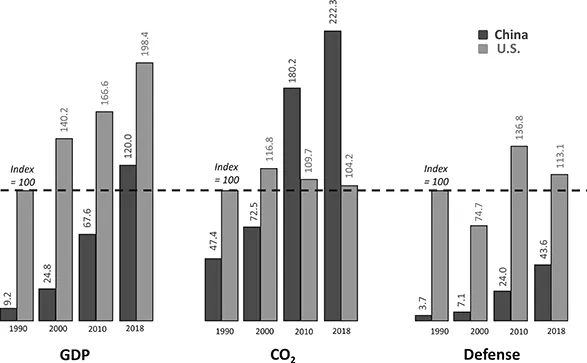
China’s remarkable transformation over the past several decades has been one of the most remarkable and significant global events of our time, or indeed of any time. It is also the impetus for an examination of U.S. policy responses to this compelling phenomenon that is reshaping the economic, ecological, and geopolitical contours of the globe. While each of the subsequent nine chapters examines in much more detail the relevant aspects of China’s rise as they impact relevant policy domains of the United States, it is useful here to take a quick preview. Figure 1.1 sets out a sampling of three aspects of China’s rise over the past three decades. To enhance comparability, the corresponding U.S. figure for the year 1990 in each case is indexed to 100.
The first graph indicates total gross domestic product (GDP) in constant 2010 U.S. dollars. Subsequent to 1990, GDP in the United States has doubled, while that of China increased thirteen-fold. China’s total GDP in 1990 was a mere 9.2 percent of that of the United States, but by 2018 it was more that 60 percent. The economic impacts of China’s rise are felt in terms of trade, global supply chains, deficits, and labor dislocations. Those and other economic policy realms are dealt with in Chapters 2–4. The second graph in Figure 1.1 shows total CO2 emissions in China, again benchmarked against U.S. counterparts. Three decades ago, China’s emissions were less than half of those in the U.S., but are now well over double. During this same period, U.S. emissions rose initially but then decreased gradually and are now roughly unchanged from three decades earlier. These developments have had a momentous impact on global attempts to meet the severe challenges posed by climate change. That in turn has important implications for energy and transportation policies and for the broad set of policies at the federal and more local levels that impact the day-to-day lifestyles of everyone residing in the United States. These policy implications are examined in detail in Chapters 5–7. The third graph in Figure 1.1 compares military expenditures between China and the United States. It is instructive not only to compare the two countries over time but also the corresponding shares of military expenditures as a proportion of GDP. In 1990, China’s military expenditures were a mere 3.7 percent of those in the United States, but are now well over 40 percent. The growth in China’s military expenditures has been more or less proportionate to the corresponding growth in China’s GDP, and in that sense reflect a growing economic base. In the U.S., in contrast, military expenditures (in constant dollar terms) have scarcely grown over the past 30 years, while GDP has doubled, so the military budget in the U.S. comprises about one half of the share of GDP that it did at the outset.
FIGURE 1.1 US-China comparisons: GDP, CO2 and defense
Source: Based on data retrieved from:
• GDP – In constant 2010 US$, World Bank (n.d.)
• CO2 – In million tons, Crippa et al. (2019).
• Defense – In constant 2017 US$, Stockholm International Peace Research Institute (n.d.).
Part I Economic Policy Perspectives on China’s Rise
The policy focus of Chapter 2 (Fiscal Policy and Deficits) is on fiscal policy generally, and maintaining the creditworthiness of the U.S. government. This necessarily entails an examination of U.S. federal deficits, trade deficits, savings deficits, and the relationship between them. Historical trends show striking patterns in the variable growth of U.S. deficits. An appendix includes a primer on the national income accounts. The analysis shows that while the rise of China has facilitated U.S. trade deficits, a more fundamental cause lies in U.S. policies that encourage consumption in excess of production.
Chapter 3 (Trade Policy) shifts the policy focus from the U.S. deficits to trade policy. A key element of this is establishing international agreements, both bilateral and multilateral, that set the rules within which international trade is undertaken. The World Trade Organization (WTO) and other institutions for managing global trade are struggling to remain relevant in the face of rapidly evolving trade patterns. With proliferating global supply chains, international trade is increasingly between the Global North and Global South. Where the WTO has failed to produce comprehensive trade agreements, there has been a tendency to default to a plethora of bilateral or regional agreements. One positive aspect of the WTO has been the incorporation of Trade-Related Aspects of Intellectual Property Rights (TRIPS). These trade issues with China have been compounded by enforcement issues, so even where agreements are in place, they may have relatively little effect in practice. A careful examination of the renminbi (RMB) exchange rate policy suggests that the root cause of U.S. trade problems lie elsewhere.
Chapter 4 (Employment and Income) begins with an overview of the labor movement and of trends in employment and income disparities in the United States. These trends are linked to parallel developments and transformations in the modes of production of the U.S. and the global economy, with special emphasis on the more recent trend toward global value chains. The analysis then extends to the displacement of jobs in the U.S. attributable to the importation of goods from abroad, especially from China. The evidence suggests that such impacts are more likely to be in low-skilled jobs in sectors confronting significant competition from imports. This is consistent with economic theory that links wage growth to labor productivity. From this perspective, a more dynamic and forward-looking solution is to encourage investment in human capital and the high-wage jobs that skilled labor can command. Enhanced labor mobility within the U.S. can also help to redeploy individuals to those sectors that offer the best opportunities for gainful employment. The penultimate section of this chapter examines the cost-effectiveness of training and education programs, such as the Trade Adjustment Assistance Program, to boost wages. Evidence here suggests that enhancing labor mobility may be the more effective solution. Finally, the chapter concludes that consumer gains from imported goods, in the aggregate, likely outweigh negative wage impacts, but the distribution of those gains and losses may be problematic.
Part II Sustainability Policy Perspectives on China’s Rise
Chapter 5 (Climate Change) begins by recounting the formation of the U.S. Environmental Protection Agency and its contentious origins in the budding environmental movement in the late 1960s. It frames environmental policies as a classical problem of regulation in the context of externalities, whereby pollutants are an unintended consequence of economic processes. The policy challenge is how to encourage productive economic activity while minimizing these negative externalities. These challenges are compounded in the context of global warming, where the requisite levels of international cooperation are difficult to sustain. From this perspective, the rise of China magnifies and intensifies the problem because it has quickly emerged as the world’s leading emitter of greenhouse gases. From an environmental perspective, the rise of China is a global problem. The chapter examines the institutional challenges of coordinating an effective global response to climate change. It also delves into the underlying economic aspects of regulatory approaches within the U.S., and includes an appendix offering a primer explaining the pros and cons of a carbon tax versus the cap-and-trade approach.
More than 83 percent of Americans reside in urban areas, and Chapter 6 (Urban Policy) begins with an overview of the complexities of managing cities. China’s rise impacts our cities in several ways. ...
Table of contents
Cover
Half Title
Title Page
Copyright Page
Dedication
Table of Contents
List of Figures
List of Tables
Preface
Acknowledgments
List of Abbreviations
1 Introduction
PART I: Economic Policy Perspectives
PART II: Sustainability Policy Perspectives
PART III: Geopolitical Policy Perspectives
Index
Trusted by 375,005 students
Access to over 1.5 million titles for a fair monthly price.
Study more efficiently using our study tools.
Frequently asked questions
Yes, you can cancel anytime from the Subscription tab in your account settings on the Perlego website. Your subscription will stay active until the end of your current billing period. Learn how to cancel your subscription
No, books cannot be downloaded as external files, such as PDFs, for use outside of Perlego. However, you can download books within the Perlego app for offline reading on mobile or tablet. Learn how to download books offline
Perlego offers two plans: Essential and Complete
Essential is ideal for learners and professionals who enjoy exploring a wide range of subjects. Access the Essential Library with 800,000+ trusted titles and best-sellers across business, personal growth, and the humanities. Includes unlimited reading time and Standard Read Aloud voice.
Complete: Perfect for advanced learners and researchers needing full, unrestricted access. Unlock 1.5M+ books across hundreds of subjects, including academic and specialized titles. The Complete Plan also includes advanced features like Premium Read Aloud and Research Assistant.
Both plans are available with monthly, semester, or annual billing cycles.
We are an online textbook subscription service, where you can get access to an entire online library for less than the price of a single book per month. With over 1.5 million books across 990+ topics, we’ve got you covered! Learn about our mission
Look out for the read-aloud symbol on your next book to see if you can listen to it. The read-aloud tool reads text aloud for you, highlighting the text as it is being read. You can pause it, speed it up and slow it down. Learn more about Read Aloud
Yes! You can use the Perlego app on both iOS and Android devices to read anytime, anywhere — even offline. Perfect for commutes or when you’re on the go. Please note we cannot support devices running on iOS 13 and Android 7 or earlier. Learn more about using the app
Yes, you can access China from a U.S. Policy Perspective by Eric J. Heikkila in PDF and/or ePUB format, as well as other popular books in Politics & International Relations & Economic Policy. We have over 1.5 million books available in our catalogue for you to explore.