Solution-based casework is an approach to assessment, case planning, and case management that combines what we know from clinical social work with what we value about sound social work practice. It is grounded in family-centered social work and draws from clinical approaches within social work and mental health. By integrating problem- and solution-focused approaches that form the clinical and social work traditions, treatment partnerships are more easily formed between family, caseworker, and service provider.
Solution-Based Casework is a skill-based, practice-oriented text that provides the specific guidance that students and new practitioners need in order to make sense quickly of the complex tasks of assessment and case planning in child welfare. The book flows out of a long practice experience, and was developed in consultation with workers and supervisors who were attempting to remedy problems viewed as contributing to recurrent abuse and neglect.
It seeks to end adversarial relationships in casework and advocates case plans based on specific outcome skills rather than on those written with vague outcome goals measuring attendance in counseling. It serves as a common conceptual framework for integrating disparate segments of a response network, thereby allowing all providers in a therapeutic system to work toward common goals.</p><p>The text is divided into three sections. In Section I the conceptual history and theoretical foundations of solution-based casework are presented so that the reader can place this approach to casework within the ongoing professional conversation about what constitutes sound practice. Section II addresses issues of assessment and case planning. Section III focuses on case management issues and how treatment team members experience a solution-based casework approach.
Chapter 7 The Process of Writing Objectives and Tasks
The Advantages of Being Specific and Measurable
Case planning is at the heart of casework, both successful and ineffective casework. Like any other profession, careful planning and purposeful implementation will usually result in a quality product. Also as in other professions, lack of planning or lackadaisical implementation will usually result in a poor outcome. Returning to an early analogy, few people would engage an attorney who did not plan a careful trial strategy before entering the courtroom. Even if the attorney was very experienced, few clients would say, "Just shoot from the hip and we'll see how it goes." If the attorney complained, "I hate all that paperwork, it's not really important," would you as client be impressed? Change these scenarios to those of another professional like a physician or an airplane pilot and our attitudes about the importance of careful planning and detailed implementation are even more compelling. Effective casework decisions often involve equally important issues of personal safety and well-being, e.g., the removal or return of children, the termination of parental rights, or the care of the elderly. Casework planning requires a professional commitment to thoughtful planning and detailed implementation of defined and measurable goals.
What Should be Measured?
The assessment question of what should be measured as outcome is a critical question considering the importance of the decisions that are made based upon the outcome criteria. In the past, the social services have been criticized for using measurements of progress that did not accurately assess the behaviors that were occurring in the family (Minuchin, 1984). Some objectives were not only unhelpful to the family but increased the caseworker's liability. When a worker is unable to identify with the family what behaviors need to occur in order for a child to be returned home or to avoid termination, the worker is left in a vulnerable, liable position, and the family is left confused and powerless. Previous measurements that have been used in the past were often stated in general terms like:
compliance with court orders
attendance at counseling
attendance at parenting classes
participation in a drug treatment program
admission of wrongdoing
minimal compliant behaviors
finally, the presence or absence of a family member
Although each of these activities could be viewed as potentially useful, the only thing you can measure in most of them is compliance, or attendance, i.e., they showed up and "got treatment." Under such general objectives, clients and their attorneys argue that clients have substantially complied1 with the objectives as they were written. If the family member has substantially complied (e.g., attended counseling) then the court is typically obligated to rule in favor of the client, e.g., to return the child to the home. However, it should be clear that whether someone attends classes or has received treatment does not measure whether or not the family members have learned and practiced prevention behaviors within the specific difficult situations.
A solution-based approach to relapse prevention defines more clearly the necessary skills a family must have in order for the caseworker to be able to predict safety in the home more accurately. As stated in Chapter 5, the specific and measurable prevention skills of identifying high-risk situations, recognizing early warning signals, and developing actions to avoid, interrupt, and escape harmful behaviors are measurable outcomes that represent quality casework planning.
The Case For Written, Relevant, and Measurable Plans
If we are to be honest, we must conclude that for too many caseworkers, the task of writing a case plan has become "more paperwork." Over time, these workers have divided their professional life into the "real work" they do directly with families and the "paperwork" they do back at the office to get their supervisor off their back. This separation often evolves over time due to the crisis nature of social service work, where immediate needs of people who are hurting or who are in trouble require a direct and meaningful response. In a crisis, writing down specific actions can appear to be an afterthought, not forethought. It isn't until further into the case (e.g., the family's life after the crisis subsides) that the need for a well thought out, defensible, written case plan becomes more clear.
In fact it is often when the crisis subsides and the resulting peace wears thin that the old patterns return and the worker feels frustrated because "Nothing has changed, they are back doing the same old thing." It is not unlike the discouragement the family feels when the same old problem patterns return. Without well thought out written objectives and tasks to guide relapse prevention, the old pattern is free to slip back into practice, seemingly without notice until one day the phone rings in the caseworker's office and a family member relates the frustrating news that "nothing has changed." It is then that the caseworker realizes that he/she has little to guide the next actions. Something has failed, but what? Did the caseworker have a plan more specific than attending counseling? Did the family start to follow that plan and then something kept them from success? Even a seasoned caseworker can experience confusion over what to do now, frustration with the family, and a lack of confidence that they have the ability to solve their problems, and self-doubts can even enter the worker's mind.
When Case Plans Become Court Documents
For most mental health and social service professionals, the courtroom is not an arena in which they feel particularly competent and comfortable. This uneasiness is particularly pointed when they have to go into court over an issue of child protection:
Do they have enough evidence to protect a child?
Do they have enough evidence to return a child?
Do they have evidence to plan for the future placement of a child?
Their fears may be compounded when the case they are petitioning the court about is one in which there has been a history of casework with the family and, for whatever reason, the family has new reports of problems. In these cases the casework records will be scrutinized. Even though the workers' efforts are to continue to assist families in remaining together and safe, there are times that removal will still be necessary. When a worker does not have the evidence to present to the court that behavioral changes did not occur in the family, then social services lose cases. Children are returned who shouldn't be and unfortunately some of those children do get hurt. Although the initial and primary intent of writing specific measurable case plans with the family is to assist them in developing a clear road map for finding their own solutions, it is also true that those well-written case plans will build the necessary evidence to prove the family's inability to protect their family members.
Writing a Case Plan that is Focused on Solutions
In Chapter 6, we discussed the role of assessment in case planning. It was noted that consensus with the family was a key component in establishing a partnership focused on change. In this chapter, we will give specific directions for constructing the written version of that consensus. Although every state, jurisdiction, and even agency typically has its own protocols and policy regarding case plans, we will offer an approach here based on the principles of solution-based casework. This example should not imply that there is only one way to write case plans, but to illustrate that the approach to writing and documenting change should be consistent with the mission, philosophy, and theory of change of those responsible for writing the case plans. The approach that will be demonstrated will further focus on the needs of social service caseworkers and their clients (adaptations for treatment providers are discussed in Chapter 9). With that as an introduction, we believe that quality case plans have the following common characteristics:
A clearly defined overall goal for the family.
The goals are broken down into objectives at both the family level and the individual level; they clearly define behaviors the family and its members will use instead of the harmful or unproductive behaviors.
Each objective is broken down into detailed and sequential tasks (steps).
Each objective is attainable.
The tasks cover both case management issues and everyday family behavior.
The tasks have clear descriptions of who will be involved in each step, what will be done, and when the task is to be done.
Uniting Around a Family Goal
The family goal is a broad statement that describes the desired outcome for the case. In developing the goal, the caseworker and the family build upon the strengths of the family. All work done should be consistent with that common goal. As we have discussed, building consensus with the family toward a common goal is critical to the casework process. The most common overall goals in social services relate to very basic family needs, (like remaining together and staying safe). The following goals are examples of the kinds of general overall goals that have been useful:
Family will prevent abuse and remain safe together at home.
Family will prevent neglect and remain safe together at home.
Family members will be protected from harm.
Family members will live independently at home without harm.
Family will support adolescent in successful completion of court orders.
Family will support placement of a family member with a relative.
Family will support permanent substitute care for a family member.
Family will support adoption as best alternative for a family member.
Family will support activities for independence of a family member.
As the reader can see from these examples, the overall family goal provides a general direction for the family and hopefully speaks to either their motivation to keep the family together, or if that effort has failed, to see that the family members are well cared for. Case plans may start out with the goal of family reunification and need to be renegotiated (if possible) to reflect the failure of reunification efforts. Partnership is not simply a way to think about casework when the goal is reunification, but also when family members must make difficult decisions for the good of its more vulnerable members.
Breaking Down the Goal into Family Objectives
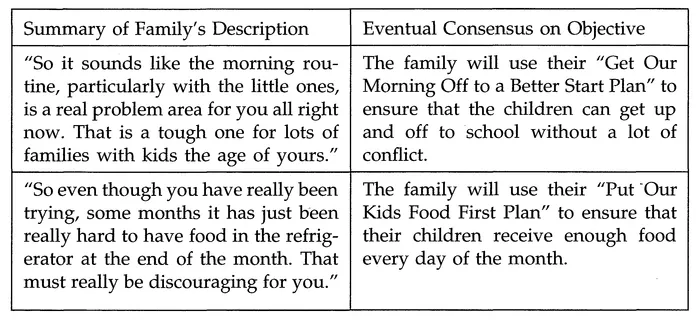
As discussed in Chapter 6, building consensus around family (and individual) objectives must begin with the first summary statements of the caseworker. As the caseworker tracks the sequence of family events that occurred when someone lost control (e.g., abuse) or when someone didn't adequately provide (e.g., neglect), the family's story must be responded to in such a way that problems are increasingly framed as developmental tasks. Statements such as, "So the morning routine with the little ones is a real problem area for you right now," or "So even though you have really been trying, having food in the refrigerator at the end of the month has really been difficult," allow objectives to be formalized around developmental tasks. Figure 7-1 illustrates how summary statements regarding family interaction can eventually lead to consensus around family-level objectives.
The challenge to writing good case plans becomes easier if the caseworker has helped the family progressively expand their definition of what is wrong. This expanded definition usually makes the transition from descriptions of problems with people (e.g., "He did . . . or "She never does . . .") toward a description of problem situations (e.g., "Mornings don't go well," or "Bedtime is a nightmare"). Situational definitions of everyday life events are representative of developmental issues in which the family struggles. Such problem definitions leave more room for people to work cooperatively on the problem without unproductive defensiveness. As stated previously, using an umbrella definition of the problem (i.e., family situations) doesn't mean the caseworker can ignore individual self-control problems that occur within those family events: it just means that individual problems will be worked on within the framework of helping resolve or improve a particular family situation. A solution-focused problem definition is not simply semantics, it can be the difference between a working partner or a contentious adversary.
Figure 7.1. Summary statements on family interaction.
For an example of a menu of family-level objectives (see Appendix to this chapter). The menu illustrated there is just one way to assist the caseworker in thinking through the possibilities for problem definition. Other taxonomies could be used, such as developmental stages based on the age of the children, e.g., beginning couple, school age objectives, or adolescent objectives.
In summary, family-level objectives serve as the umbrella description of what the partnership will be trying to accomplish to reduce risk to family members. The objectives will describe what the family will be doing in everyday life to successfully resolve the problem or meet the needs. Therefore, it must clearly relate to known incidents of risk. The objective must be behaviorally specific so that tasks to accomplish the objective will also be appropriately specific and measurable.
Going from Family-Level Objectives to Individual-Level Objectives
The individual-level objective represents the new behavior that the individual(s) will be exhibiting in order to participate successfully in the family-level objective. One way to think of the process for identifying individual-level objectives is for the caseworker to ask him/herself, "When this family has attempted to [set rules, get everyone off to work and school, toilet train, etc.], who loses self-control?" By thinking in this way, the worker will identify more readily who might get too angry, who might get too depressed, or who might drink too much. As we have discussed, families can tolerate a certain level of personal problems and still accomplish their developmental tasks. In such cases, other family members do more or move to insulate the effects of the personal problems on other family members, or in some cases ...
Table of contents
Cover
Half Title
Title Page
Copyright Page
Contents
Introduction
I. HISTORICAL CONTEXT
II. ASSESSMENT
III. MANAGEMENT ISSUES
References
Index
Trusted by 375,005 students
Access to over 1.5 million titles for a fair monthly price.
Study more efficiently using our study tools.
Frequently asked questions
Yes, you can cancel anytime from the Subscription tab in your account settings on the Perlego website. Your subscription will stay active until the end of your current billing period. Learn how to cancel your subscription
No, books cannot be downloaded as external files, such as PDFs, for use outside of Perlego. However, you can download books within the Perlego app for offline reading on mobile or tablet. Learn how to download books offline
Perlego offers two plans: Essential and Complete
Essential is ideal for learners and professionals who enjoy exploring a wide range of subjects. Access the Essential Library with 800,000+ trusted titles and best-sellers across business, personal growth, and the humanities. Includes unlimited reading time and Standard Read Aloud voice.
Complete: Perfect for advanced learners and researchers needing full, unrestricted access. Unlock 1.5M+ books across hundreds of subjects, including academic and specialized titles. The Complete Plan also includes advanced features like Premium Read Aloud and Research Assistant.
Both plans are available with monthly, semester, or annual billing cycles.
We are an online textbook subscription service, where you can get access to an entire online library for less than the price of a single book per month. With over 1.5 million books across 990+ topics, we’ve got you covered! Learn about our mission
Look out for the read-aloud symbol on your next book to see if you can listen to it. The read-aloud tool reads text aloud for you, highlighting the text as it is being read. You can pause it, speed it up and slow it down. Learn more about Read Aloud
Yes! You can use the Perlego app on both iOS and Android devices to read anytime, anywhere — even offline. Perfect for commutes or when you’re on the go. Please note we cannot support devices running on iOS 13 and Android 7 or earlier. Learn more about using the app
Yes, you can access Solution-based Casework by William C. Barrett in PDF and/or ePUB format, as well as other popular books in Social Sciences & Social Work. We have over 1.5 million books available in our catalogue for you to explore.