eBook - ePub
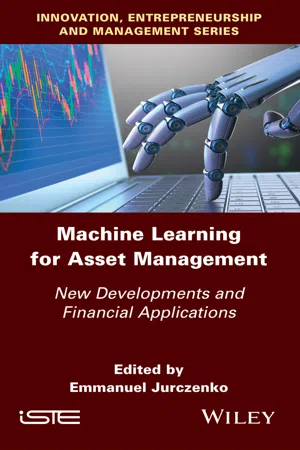
Machine Learning for Asset Management
New Developments and Financial Applications
- English
- ePUB (mobile friendly)
- Available on iOS & Android
eBook - ePub
About this book
This new edited volume consists of a collection of original articles written by leading financial economists and industry experts in the area of machine learning for asset management. The chapters introduce the reader to some of the latest research developments in the area of equity, multi-asset and factor investing. Each chapter deals with new methods for return and risk forecasting, stock selection, portfolio construction, performance attribution and transaction costs modeling. This volume will be of great help to portfolio managers, asset owners and consultants, as well as academics and students who want to improve their knowledge of machine learning in asset management.
Information
1
Time-series and Cross-sectional Stock Return Forecasting: New Machine Learning Methods
This chapter extends the machine learning methods developed in Han et al. (2019) for forecasting cross-sectional stock returns to a time-series context. The methods use the elastic net to refine the simple combination return forecast from Rapach et al. (2010). In a time-series application focused on forecasting the US market excess return using a large number of potential predictors, we find that the elastic net refinement substantively improves the simple combination forecast, thereby providing one of the best market excess return forecasts to date. We also discuss the cross-sectional return forecasts developed in Han et al. (2019), highlighting how machine learning methods can be used to improve combination forecasts in both the time-series and cross-sectional dimensions. Overall, because many important questions in finance are related to time-series or cross-sectional return forecasts, the machine learning methods discussed in this chapter should provide valuable tools to researchers and practitioners alike.
1.1. Introduction
Researchers in finance increasingly rely on machine learning techniques to analyze Big Data. The initial application of the least absolute shrinkage and selection operator (Tibshirani 1996, LASSO) – one of the most popular machine learning techniques – in finance appears to be Rapach et al. (2013), who analyze lead-lag relationships among monthly international equity returns in a high-dimensional setting. More recently, Gu et al. (2019) employ a comprehensive set of machine learning tools, including the LASSO, to analyze the time-series predictability of monthly individual stock returns, while Chinco et al. (2019) use the LASSO to predict individual stock returns one minute ahead. Freyberger et al. (2019) apply a nonparametric version of the LASSO to accommodate nonlinear relationships between numerous firm characteristics and cross-sectional stock returns. Kozak et al. (2019) use the LASSO in a Bayesian context to model the stochastic discount factor based on a large number of firm characteristics. Incorporating insights from Bates and Granger (1969); Diebold and Shin (2019), Han et al. (2019) propose procedures for forecasting cross-sectional returns using the information in more than 100 firm characteristics1.
In this chapter, we show how the approach of Han et al. (2019), originally designed for forecasting cross-sectional stock returns, can be modified for time-series forecasting of the market excess return. A voluminous literature investigates market excess return predictability based on a wide variety of predictor variables2. In the presence of a large number of potential predictor variables, conventional forecasting methods are susceptible to in-sample overfitting, which often translates into poor out-of-sample performance. Rapach et al. (2010) employ forecast combination (Bates and Granger 1969) to incorporate the information in a large number of predictor variables in a manner that guards against overfitting. They find that a simple combination forecast – the average of univariate predictive regression forecasts based on the individual predictor variables – substantially improves out-of-sample forecasts of the US market excess return. Extending the methods of Han et al. (2019) to a time-series context along the lines of Diebold and Shin (2019), we describe how the elastic net (Zou and Hastie 2005), a well-known variant of the LASSO, can be used to refine the simple combination forecast, resulting in what we call the combination elastic net forecast. Intuitively, as explained by Han et al. (2019), the elastic net refinement allows us to more efficiently use the information in the predictor variables by selecting the most relevant predictors to include in the combination forecast. In an empirical application, we show that the combination elastic net approach indeed...
Table of contents
- Cover
- Table of Contents
- Foreword
- Acknowledgments
- 1 Time-series and Cross-sectional Stock Return Forecasting: New Machine Learning Methods
- 2 In Search of Return Predictability: Application of Machine Learning Algorithms in Tactical Allocation
- 3 Sparse Predictive Regressions: Statistical Performance and Economic Significance
- 4 The Artificial Intelligence Approach to Picking Stocks
- 5 Enhancing Alpha Signals from Trade Ideas Data Using Supervised Learning
- 6.1. Introduction
- 7.1. Introduction
- 8 Machine Learning Optimization Algorithms & Portfolio Allocation
- 9 Hierarchical Risk Parity: Accounting for Tail Dependencies in Multi-asset Multi-factor Allocations
- 10 Portfolio Performance Attribution: A Machine Learning-Based Approach
- 11 Modeling Transaction Costs When Trades May Be Crowded: A Bayesian Network Using Partially Observable Orders Imbalance
- List of Authors
- Commendations
- Index
- End User License Agreement
Trusted by 375,005 students
Access to over 1.5 million titles for a fair monthly price.
Study more efficiently using our study tools.
Frequently asked questions
Yes, you can cancel anytime from the Subscription tab in your account settings on the Perlego website. Your subscription will stay active until the end of your current billing period. Learn how to cancel your subscription
No, books cannot be downloaded as external files, such as PDFs, for use outside of Perlego. However, you can download books within the Perlego app for offline reading on mobile or tablet. Learn how to download books offline
Perlego offers two plans: Essential and Complete
- Essential is ideal for learners and professionals who enjoy exploring a wide range of subjects. Access the Essential Library with 800,000+ trusted titles and best-sellers across business, personal growth, and the humanities. Includes unlimited reading time and Standard Read Aloud voice.
- Complete: Perfect for advanced learners and researchers needing full, unrestricted access. Unlock 1.5M+ books across hundreds of subjects, including academic and specialized titles. The Complete Plan also includes advanced features like Premium Read Aloud and Research Assistant.
We are an online textbook subscription service, where you can get access to an entire online library for less than the price of a single book per month. With over 1.5 million books across 990+ topics, we’ve got you covered! Learn about our mission
Look out for the read-aloud symbol on your next book to see if you can listen to it. The read-aloud tool reads text aloud for you, highlighting the text as it is being read. You can pause it, speed it up and slow it down. Learn more about Read Aloud
Yes! You can use the Perlego app on both iOS and Android devices to read anytime, anywhere — even offline. Perfect for commutes or when you’re on the go.
Please note we cannot support devices running on iOS 13 and Android 7 or earlier. Learn more about using the app
Please note we cannot support devices running on iOS 13 and Android 7 or earlier. Learn more about using the app
Yes, you can access Machine Learning for Asset Management by Emmanuel Jurczenko in PDF and/or ePUB format, as well as other popular books in Business & Management. We have over 1.5 million books available in our catalogue for you to explore.