eBook - ePub
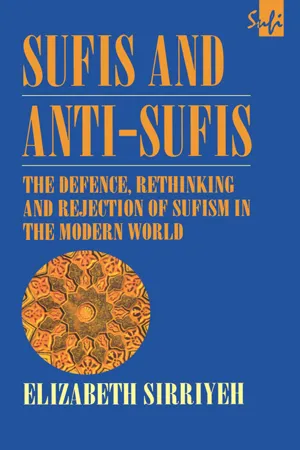
Sufis and Anti-Sufis
The Defence, Rethinking and Rejection of Sufism in the Modern World
- 190 pages
- English
- ePUB (mobile friendly)
- Available on iOS & Android
eBook - ePub
Sufis and Anti-Sufis
The Defence, Rethinking and Rejection of Sufism in the Modern World
About this book
Despite its continuing appeal in the Muslim world, Sufism has faced fierce challenges in the last 250 years. This volume assesses the evolution of anti-Sufism since the middle of the eighteenth century and Sufi strategies for survival. It also considers the efforts of a few significant Muslim intellectuals to contemplate a future for a mystical approach to Islam without traditional Sufism. Many studies of Islam in the modern period have focused on the attempts of Muslim 'modernists' or 'fundamentalists' to come to terms with western modernity, and Sufis have often been marginalised in the process. Elizabeth Sirriyeh redresses this neglect by assigning to Sufism a central place in the broader history of Islam in the modern world and by examining how changing understandings of Sufism's role in modern conditions have affected Muslims of all shades of opinion.
Information
1
Sufis and their Critics Before the Impact of Europe
The eighteenth century has commonly been viewed as a dark age for the world of Islam, a time of political, economic and cultural decline in the three great Islamic states: the Ottoman Empire, Safavid Iran and Mughal India. Writing in the early 1970s, Marshall Hodgson lamented: ‘Though the eighteenth century was not without its interesting and creative figures, it was probably the least notable of all in achievement of high-cultural excellence; the relative barrenness was practically universal in Muslim lands.’1 Yet from the viewpoint of religion, and more especially of the Sufi spiritual tradition, it was not all dark and barren. There was a widespread sense of decline and concern over the debasement of Sufism among the masses, sunk in superstition and entranced by the extravagant claims of wonderworking charlatans. But this apprehension led also to vigorous reform efforts, both by individuals and mass movements, gaining momentum into the nineteenth century. Such efforts would have far-reaching results for the revitalization of Islamic spirituality within the central lands of Islam. They would also work for the spread of the faith into those peripheral areas only superficially Islamized and, in some cases, not previously reached: in Africa South of the Sahara, South East Asia and on the northern borders in the Caucasus and the steppes of Central Asia and across into China.
Most of this struggle for religious renewal would come from within Sufi ranks, whether from scholarly shaykhs noted for their intellectual achievements in other branches of Islamic learning or from those noted solely for their devotion to the spiritual life, or indeed from the many ordinary members of Sufi ṭarīqas that espoused the reforming cause. Occasionally, however, discontent with the prevailing abuses of Sufism ran too deep for any reform of the orders to constitute an acceptable solution. Virulent anti-Sufism then erupted, taking its most famous organized form in the Arabian movement of the Wahhābīs, ideological forerunners of many modern Muslim opponents of the Sufis.
It is proposed here first to note the nature of the anxieties about Sufi decadence in this period before examining some of the attempts to counter it. After exploring the contributions of two pivotal figures in the Sufi reforming thought of the eighteenth century, there follows an examination of mass reform within the Sufi orders with special focus on nineteenth century Africa, before a final consideration of the Wahhābī radical rejection of the ṭarīqas.
The Mood of Decline
In 1950 A. J. Arberry launched a savage attack on the later manifestations of Sufism, but especially that of the eighteenth and nineteenth centuries.2 He strenuously denounced the decay in Egypt and generalized beyond it across the world of Islam. The picture presented is one of outrageous violation of the Sharīʿa, open immorality and fraudulent opportunism. Witchcraft is remarked as taking the place of reason with the calculated aim of deluding and exploiting the ignorant masses.
Every village or group of villages acquired its local saint, to be supported and revered during his lifetime, worshipped and capitalized after his death. Few indeed were the voices that dared protest against this ruinous order of things, for politician and theologian alike feared to oppose the true masters, and found it easier and more profitable to share in the swindle.3
The ‘true masters’, the Sufi orders, are thus categorized as a vicious power in Egypt, conspiring to defraud the people, with the understanding that the same situation prevailed everywhere. Arberry proceeds to quote a ‘brave spirit of the eighteenth century’, al-Badr al-Ḥijāzī, but suggesting that his criticism is an isolated case:
Would that we had not lived to see every demented madman held up by his fellows as a “Pole”.4
Their ulema take refuge in him; indeed they have even adopted him as a Lord, instead of the Lord of the Throne;
For they have forgotten God, saying, “So-and-so provides deliverance from suffering for all mankind.”
When he dies, they make him the object of pilgrimage and hasten to his shrine, Arabs and foreigners alike:
Some kiss his grave, and some the threshold of his door, and the dust –.5
Allowing for the exaggerations of Arberry’s account, he, nevertheless, reflects the concerns of Sufism’s critics of the period, who were somewhat more numerous than he seems to suggest. The poet was by no means alone in his distress at corruptions to the faith through popular innovations (bidaʿ), especially those associated with local pilgrimages to the tombs of supposed Sufi ‘saints’, ‘God’s friends’ (awliyā’ Allāh). The image of the mad ‘saint’ (majdhūb), robbed of his sanity by an overwhelming experience of the Divine, would become all too familiar to eighteenth and nineteenth century European travellers. The concerns about the exaltation of such men and belief in their powers of intercession were indeed widespread among Muslims, whether Sufi or non-Sufi.
Among those who felt particularly deep revulsion were the Arabian Wahhābīs, who shared a passionate conviction of the urgency of purifying and revitalizing the faith. The voice of the Wahhābīs’ founder, Muḥammad b. ʿAbd al-Wahhāb (1703–92), is one of the earliest and most strident, seeing his own age as another Jāhiliyya, but darker and more decadent than the pre-Islamic age of ignorance of true religion:
The idolaters of our own time are worse in their idolatry than the ancients because the ancients were worshipping God in times of affliction and associating others with Him in times of prosperity, but the idolaters of our own time are always guilty of associating others with God whether in prosperity or affliction.6
Not only were they guilty of association, but there was even greater harm and sinfulness in the act because those that they associated with God were immoral and corrupt Sufi shaykhs. Ibn ʿAbd al-Wahhāb’s son, Shaykh ʿAbd Allāh, expanded on the disastrous state in mid-eighteenth century central Arabia before his father’s reforming campaign.7 Criticizing exaggerated popular devotion to Sufis, he noted that, for the masses, attendance at Sufi gatherings had become more important to them than regular prayers and that they flocked to saints’ tombs, decorating them with gold and silver and marble, while avoiding the mosques. Listening to Sufi poetry, they wept with emotion, but recital of the Qur’ān was treated casually by them and aroused no such feelings. Some even told stories of calling upon God in vain, but calling upon a dead Sufi and being answered and assisted. False Sufism had even corrupted their view of the Prophet and relationship to him. Such people made Islamically unacceptable claims for the Prophet’s knowledge and powers, and even for those of Sufi saints, so as to approximate the Christians’ belief in the Messiah. He comments: ‘The Messiah for them (the Christians) is a name denoting divinity and humanity combined and this is what some extreme Sufis and Shīʿīs say, speaking of the union of divinity and humanity in the prophets and holy men, just as the Christians say of the Messiah.’8
However, the voices of criticism also came from within Sufism. Thus a letter from a prominent shaykh, Aḥmad b. Idrīs (1760?-1837), to his disciple travelling to the Sudan warns him of the dangers to his spiritual state from the ordinary people around him:
Know, my son, that the people of your time, even if they flatter you outwardly, yet they are faint-hearted and this will bring them no benefit with God. And what God, may He be praised and exalted, ordered the Prophet was that he have patience only with “those who call upon their Lord morning and evening desiring His face” (Qur’ān 18.28). The companionship of rabble, who in their companionship have no desire for God and His Prophet, is a lethal poison which instantly destroys faith unless God preserves it. So be wary of the people of your time, for they are not sincere in their love of God. And may God preserve you from the people.9
It seems that the shaykh has a low opinion of many African Sufis, although he recognized the existence of the genuinely pious among the Sufis of the Sudan.
In North Africa similar feelings are expressed by his contemporary Aḥmad al-Tijānī (1737–1815) in a letter to one of his disciples in Fez: ‘And know that nobody in these times can keep away from sin since it falls on human beings like heavy rain.’10 On another occasion he lamented: ‘This time is one in which the bases of divine ordinance have been destroyed …; and it is beyond the capacity of any person to carry out God’s command in every respect in this time.…’11
The mood of the times is one of gloom, for the common people, in the reformers’ eyes, were failing to achieve true spirituality. The picture is less black than that painted by the Wahhābīs, but it is black enough and the understanding is that illumination is rare, that this age is particularly sinful and the unenlightened masses bear a heavy burden of shame owing to their inability to live up to Sufi ideals.
Sufi Reformers: Shāh Walī Allāh and Aḥmad b. Idrīs
Among the most forceful voices pressing for change were two outstanding eighteenth century Sufis: Shāh Walī Allāh of Delhi, a major Indian intellectual Sufi whose influence has been deeply felt to the present among the Muslims of South Asia and more indirectly further afield, and Aḥmad b. Idrīs of Morocco, already noted, who was to play a key role in inspiring the foundation of new reforming orders in Africa.
Shāh Walī Allāh of Delhi (1703–62)
A critical event that shaped Shāh Walī Allāh’s commitment to reform took place in 1731–32. This was his journey from India for a fourteen-month stay in the Holy Cities of Mecca and Medina. Once in the Ḥijāz, he studied Ḥadāth with some of the senior scholars of his day and received guidance in Sufism and initiation into four Sufi orders from the noted mystic Abū Ṭāhir Muḥammad (d. 1733).12 But in addition to his exposure to different legal schools and a variety of scholarly views on religious questions, he experienced visionary dreams which were to affect the pattern of his life. On 14 August 1731, he records how the Prophet’s grandsons, Ḥasan and Ḥusayn, appeared to him in a dream:
Ḥasan carried in his hand a reed-pen, of which the point was broken. He stretched out his hand to give it to me, and said: “This is the pen of my grandfather, the Messenger of God.” Thereupon he (withdrew his hand and) explained: “Let Ḥusayn mend it first, since it is no longer as good as when Ḥusayn mended it the first time.” So Ḥusayn took it, mended it and gave it to me.13
Ḥusayn then proceeded to clothe him in the Prophet’s mantle. Through this and other dreams Shāh Walī Allāh developed a deepening spiritual relationship with the Prophet, spending much time in Medina in contemplation at his tomb and on his return journey to India underwent a vision of him, in which the Prophet personally clothed Shāh Walī Allāh in a mantle.
Through his experiences, his external journey to the Ḥijāz and his internal spiritual journey, he was awaking to an awareness that not all was well with the contemporary state of Islam, as symbolized by the broken reed-pen of Prophet Muḥammad, but also that he had a major role to play in rectifying that state of affairs, being the recipient of the mended pen and the Prophet’s mantle. His belief in his own very special position is in ample evidence from his writings, for he understood himself to be entrusted by God with the reform of religion in his age as a renewer (mujaddid), as the Prophet’s plenipotentiary (waṣī) to command worldwide obedience and as the pole of the age (quṭb), the head of all God’s saints on earth. Perhaps it is understandable that those who did not share his convictions would find him almost insufferably conceited and be shocked by some of his claims, which would appear to go well beyond those of even Ibn al-ʿArabī. Nevertheless, Shāh Walī Allāh’s image has survived remarkably well and he has won respect among many in the twentieth century subcontinent and beyond as a great pioneering reformer, presenting the acceptable face of Sufism and paving the way for a much broader renewal with a modern tinge. He has seemed to mark a clear break with the medieval past and with the perceived corruptions of his own day. However, a large part of his endeavours for which he has earned this kind of reputation has little or nothing to do with his Sufism. It concerns his radical efforts for the overhaul of Islamic jurisprudence, where he seems to foreshadow modern juristic reforms in his calls for a new systematic comparison of the four Sunni legal schools with the Qur’ān and Sunna, his demands for a fresh independent interpretation (ijtihād) in opposition to the imitative following (taqlīd) of medieval authorities. It emerges also in his bold attempt to provide an annotated Persian translation of the Qur’ān for an educated Indian readership, despite the opposition of the religious scholarly establishment. Finally, Western observers have been particularly attracted by his revolutionary and distinctly modern-looking social and economic ideas.
But our concern here is with the specifically Sufi aspects of his career. Much of his initial training in early life was undertaken by his father, a specialist in jurisprudence, but also a noted Sufi. It was his father who initiated him at the age of fifteen into the widespread Qādirī and Naqshabandī ṭarīqas, and also into the Chishtiyya, one of the great orders of medieval India. Two years later he died, but this was not the end of his spiritual guidance as far as Shāh Walī Allāh was concerned. The son continued to visit the father’s tomb in the years preceding his journey to the Holy Cities of Arabia, seeking communion with his spirit as practised in the Sufi tradition. This time may be seen also as a period of preparation for the dramatic experiences of that journey which would cause him to perceive serious problems within the Sufism of his own time, as also in other branches of the faith.
Shāh Walī Allāh was disturbed by the popular regard for wonderworking Sufis, admiration for their ecstatic poetry to the neglect of the Qur’ān and Sunna and obsession with the visitation of tombs for purposes other than the pursuit of spiritual progress. His position in this respect was not, however, new, but is evidently very close to that of the great Ḥanbalī jurist Ibn Taymiyya (d. 1328), whom he admired and whose views he shared on a number of issues, including the dangers of shrine cults. Where Ibn Taymiyya had been troubled by corruption of the faith through Jewish and Christian contacts in Syria, Shāh Walī Allāh was similarly anxious to eradicate Hindu influence in the Indian context. He agreed with Ibn Taymiyya also in his concerns over the potentially pernicious influence of Ibn al-ʿArabī’s theosophy but differed from him in ...
Table of contents
- Cover
- Half Title
- Title Page
- Copyright Page
- Dedication
- Table of Contents
- Preface
- Abbreviations
- 1 Sufis and Their Critics Before the Impact of Europe
- 2 The Challenge of European Anti-Sufism
- 3 Traditional Sufism or a Religion of Progress?
- 4 The Sufism and Anti-Sufism of the Salafis
- 5 Strengthening the Soul of the Nation
- 6 Contemporary Sufism and Anti-Sufism
- Conclusion: Many Ways Towards the One
- Bibliography
- Index
Trusted by 375,005 students
Access to over 1.5 million titles for a fair monthly price.
Study more efficiently using our study tools.
Frequently asked questions
Yes, you can cancel anytime from the Subscription tab in your account settings on the Perlego website. Your subscription will stay active until the end of your current billing period. Learn how to cancel your subscription
No, books cannot be downloaded as external files, such as PDFs, for use outside of Perlego. However, you can download books within the Perlego app for offline reading on mobile or tablet. Learn how to download books offline
Perlego offers two plans: Essential and Complete
- Essential is ideal for learners and professionals who enjoy exploring a wide range of subjects. Access the Essential Library with 800,000+ trusted titles and best-sellers across business, personal growth, and the humanities. Includes unlimited reading time and Standard Read Aloud voice.
- Complete: Perfect for advanced learners and researchers needing full, unrestricted access. Unlock 1.5M+ books across hundreds of subjects, including academic and specialized titles. The Complete Plan also includes advanced features like Premium Read Aloud and Research Assistant.
We are an online textbook subscription service, where you can get access to an entire online library for less than the price of a single book per month. With over 1.5 million books across 990+ topics, we’ve got you covered! Learn about our mission
Look out for the read-aloud symbol on your next book to see if you can listen to it. The read-aloud tool reads text aloud for you, highlighting the text as it is being read. You can pause it, speed it up and slow it down. Learn more about Read Aloud
Yes! You can use the Perlego app on both iOS and Android devices to read anytime, anywhere — even offline. Perfect for commutes or when you’re on the go.
Please note we cannot support devices running on iOS 13 and Android 7 or earlier. Learn more about using the app
Please note we cannot support devices running on iOS 13 and Android 7 or earlier. Learn more about using the app
Yes, you can access Sufis and Anti-Sufis by Elizabeth Sirriyeh in PDF and/or ePUB format, as well as other popular books in Teología y religión & Teología islámica. We have over 1.5 million books available in our catalogue for you to explore.