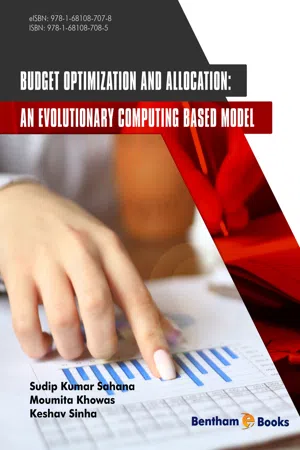
Budget Optimization and Allocation: An Evolutionary Computing Based Model is a guide for computer programmers for writing algorithms for efficient and effective budgeting. It provides a balance of theory and practice.
eBook - ePub
Budget Optimization and Allocation: An Evolutionary Computing Based Model
- English
- ePUB (mobile friendly)
- Available on iOS & Android
eBook - ePub
Budget Optimization and Allocation: An Evolutionary Computing Based Model
About this book
Information
Result and Discussion
Keshav Sinha, Moumita Khowas, Sudip Kumar Sahana
Abstract
This chapter deals with the result section of budget allocation and optimization of the Secondary Education department of the Republic of India which has many schemes. Plot wise prediction is carried out and compared with the available reports to analyze the accuracy and effectiveness. The output shows that, the developed model has a great potential to allocate and optimize funds and also provides a high agreement for validation of the said mathematical model for budget allocation.
Keywords: Equal Allocation (EA), Genetic Algorithm (GA), Growth Rate, Optimal Computing Budget Allocation (OCBA).
Simulation work has been performed using Eclipse Indigo programming paradigm version 12.1 on Windows 8.1 platform, having a hardware specification: Processor Intel core i5, CPU frequency 1.70GHz Single Core Processor, 4GB RAM on x64-bit operating system. In Table 5, year wise allocated amount has been shown for different schemes in secondary education.
Table 5 The year wise amount allocated in Secondary Education Schemes.
| SCHEME | 2009 | 2010 | 2011 | 2012 | 2013 | 2014 | 2015 |
|---|---|---|---|---|---|---|---|
| National Council of Education Research and Training (NCERT) | 137.41 | 147.3 | 170 | 227.7 | 243.3 | 259.72 | 225 |
| Kendriya Vidyalaya Sangathan (KVS) | 2112.8 | 2002 | 2235 | 2436.24 | 2599.24 | 3290.8 | 3278.47 |
| Navodaya Vidyalaya Samiti (NVS) | 1641.29 | 1755.4 | 1608.8 | 1701.05 | 1748.29 | 2038.4 | 2061 |
| Rashtriya Madhyamik Shiksha Abhiyan (RMSA) | 1700 | 2423.9 | 3124 | 3983 | 5000 | 3565 | 1353.98 |
| Scheme for setting up of 6000 model school at block level | 350 | 425 | 1200 | 1080 | 1000 | 1200 | 1 |
| Information and communication Technology in schools | 300 | 400 | 500 | 350 | 350 | 0 | 0 |
| Integrated Education for disabled children | 0 | 0 | 0 | 0 | 0 | 0 | 0 |
| Inclusive education for the disabled at secondary school (IEDSS) | 70 | 70 | 100 | 70 | 50 | 0 | 0 |
| National Institute of open schooling | 15 | 15 | 15 | 0.1 | 0.1 | 0 | 0 |
| SCHEME | 2009 | 2010 | 2011 | 2012 | 2013 | 2014 | 2015 |
|---|---|---|---|---|---|---|---|
| Access and Equity | 0.01 | 0.5 | 0.1 | 0.1 | 0 | 0 | 1 |
| Central Tibetan schools society Administration | 38 | 39.82 | 45 | 49 | 52.14 | 55.85 | 50 |
| Vocationalisation of Education | 37 | 25 | 25 | 100 | 80.1 | 0 | 0 |
| Scheme for universal access and quality at the secondary stage SUCCESS | 0 | 45 | 45 | 0 | 0 | 0 | 0 |
| National Scheme For Incentive To Girls For Secondary Education SUCCESS | 50 | 95 | 230 | 100 | 100 | 0 | 0 |
| National Merit Scholarship Scheme | 0 | 0 | 0 | 0 | 0 | 0 | 0 |
| New Model School | 0 | 0 | 0 | 0 | 0 | 0 | 0 |
| Upgrading 2000 KGBVs residential schools, hostel/girls hostel | 0 | 0 | 0 | 0 | 0 | 0 | 0 |
| Scheme for construction and running of girls hostels | 60 | 10 | 25 | 450 | 450 | 0 | 0 |
| Appointment of language teacher | 16 | 15 | 5 | 6 | 5.8 | 0 | 0 |
| National means-cum merit scholarship for class 9 to 12 | 75 | 90.5 | 60 | 70 | 70 | 0 | 0 |
| Other programs | 3.6 | 4.08 | 4 | 3.8 | 2.7 | 2.7 | 2.7 |
| Total | 6606.11 | 7563.5 | 9391.9 | 10626.99 | 11751.67 | 10412.47 | 6973.15 |
The experimental results for budget allocation have been drawn according to the Growth Rate, Percent Growth Rate, and Mean & Standard Deviation, as a parameter for Optimal Computing Budget Allocation [1], EA and Genetic Algorithm [2].
4.1. TEST CASE 1: GROWTH RATE CALCULATION
Growth Rate is referred to the percentage change in amount, within a period in a particular context. For fund regulation, the growth rates typically represent the compounded annual rate of growth in revenues...
Table of contents
- Welcome
- Table of Contents
- Title
- BENTHAM SCIENCE PUBLISHERS LTD.
- FOREWORD
- PREFACE
- DEDICATION
- SUMMARY
- Introduction
- Literature Review
- Research Methodology
- Result and Discussion
- APPENDIX A
- APPENDIX B
- APPENDIX C
- LIST OF ABBREVIATIONS
Trusted by 375,005 students
Access to over 1.5 million titles for a fair monthly price.
Study more efficiently using our study tools.
Frequently asked questions
Yes, you can cancel anytime from the Subscription tab in your account settings on the Perlego website. Your subscription will stay active until the end of your current billing period. Learn how to cancel your subscription
No, books cannot be downloaded as external files, such as PDFs, for use outside of Perlego. However, you can download books within the Perlego app for offline reading on mobile or tablet. Learn how to download books offline
Perlego offers two plans: Essential and Complete
- Essential is ideal for learners and professionals who enjoy exploring a wide range of subjects. Access the Essential Library with 800,000+ trusted titles and best-sellers across business, personal growth, and the humanities. Includes unlimited reading time and Standard Read Aloud voice.
- Complete: Perfect for advanced learners and researchers needing full, unrestricted access. Unlock 1.5M+ books across hundreds of subjects, including academic and specialized titles. The Complete Plan also includes advanced features like Premium Read Aloud and Research Assistant.
We are an online textbook subscription service, where you can get access to an entire online library for less than the price of a single book per month. With over 1.5 million books across 990+ topics, we’ve got you covered! Learn about our mission
Look out for the read-aloud symbol on your next book to see if you can listen to it. The read-aloud tool reads text aloud for you, highlighting the text as it is being read. You can pause it, speed it up and slow it down. Learn more about Read Aloud
Yes! You can use the Perlego app on both iOS and Android devices to read anytime, anywhere — even offline. Perfect for commutes or when you’re on the go.
Please note we cannot support devices running on iOS 13 and Android 7 or earlier. Learn more about using the app
Please note we cannot support devices running on iOS 13 and Android 7 or earlier. Learn more about using the app
Yes, you can access Budget Optimization and Allocation: An Evolutionary Computing Based Model by Sudip Kumar Sahana,Moumita Khowas,Keshav Sinha in PDF and/or ePUB format, as well as other popular books in Computer Science & Artificial Intelligence (AI) & Semantics. We have over 1.5 million books available in our catalogue for you to explore.