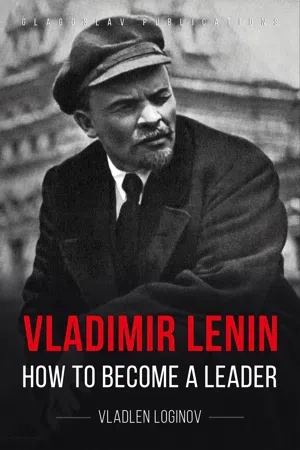
Vladlen Loginov is no newcomer to the study of Lenin’s life. He published an article on the theme of Lenin and the Bol’shevik newspaper Pravda in 1962 at the height of the Khrushchev thaw and has retained an interest in Lenin’s career ever since. Loginov knows his Lenin back to front, so it is perhaps surprising that in this detailed account of the young Lenin, he sets himself a rather modest task. The image of Lenin, Loginov believes, has been over-politicised in the twentieth century and as a result the more literature that appears, “the more confused the issues surrounding the analysis of Lenin’s life and activities become”. An antidote is necessary, in Loginov’s view, and “this book’s intention”, as he makes clear in the preface, “is not to offer an explanation, but to present some material for consideration, a few details of his biography hitherto unknown to the reader, to apply some additional touches to Lenin’s portrait”. Emulating the German nineteenth century historian Leopold von Ranke, who argued that the facts should speak for themselves, Loginov wants Lenin’s life to speak for itself.
Not all the details given here are “hitherto unknown” to western scholarship, but very many are. Simply adding a few new details to the Lenin story, however, is not the main achievement of this book, for all the modest intentions of the author. The great strength of Loginov’s work is to put Lenin in the context of his time, to show that he was a product of his time. As Loginov puts it, “the circumstances and events of each era did influence actions, did determine the destiny of lives, and did define modes of living just as profoundly as familial heritage.” Does the reader need to know about Lenin’s paternal and maternal grandparents? Well, yes, because this information shows how upwardly mobile Lenin’s family was. At the apex of Russian society in the nineteenth century little changed, the Tsar still ruled as an absolute monarch. Below the surface, however, Russian society was being transformed in the middle years of the nineteenth century and Lenin’s family was part of that process.
Lenin’s father was only a generation away from serfdom, someone who advanced a successful career through education, first at the Astrakhan Gymnasium and then Kazan University. Unsurprisingly, he believed all his life that others could benefit through education in the same way, devoting his life to the cause of education for all. He was a man of the “Sixties”, the decade when Tsar Alexander II, the liberator of the serfs, seemed to be encouraging further reform. Until the Tsar closed them down in 1862, an early sign that his reputation as a reformer was exaggerated, Lenin’s father was active in establishing Sunday Schools to educate the poor. Later, his move from being a successful classroom teacher to becoming an education bureaucrat, a schools’ inspector, reflected his commitment to a universal programme of education - and this included the Muslim Chuvash people of the Volga region, at the request of his father Lenin gave a local Chuvash teacher Greek lessons so that he could enter university.
On his mother’s side, Lenin’s Jewish ancestry has always been the subject of speculation, grist to the mill of those on the political right who think of all Marxists as Jews and rant about a Judeo-Bol’shevik conspiracy to subvert society. The main point about his maternal grandparents, however, has nothing to do with ethnicity but upward mobility, they too were members of a family moving smartly up the social ladder. The family adopted Christianity to escape the poverty of village life in the Jewish Pale of Settlement, idealised in the twentieth century by the 1970s musical Fiddler on the Roof. They moved to St. Petersburg, where Lenin’s grandfather, no longer hampered by the limitations on Jewish access to higher education, became a successful doctor, respectable enough to marry into the minor aristocracy; and he retired to run the small estate of Kokushkino not far from the river Volga. It was the purchase of this estate in 1859 which gave the family and its heirs, Lenin included, the status of hereditary nobles.
By the time Lenin was born in 1870, his was a family of some means. His parents had their own house, a couple of servants and the estate at Kokushkino to retreat to in the summer. A decade later, things were beginning to unravel. Russian society was changing and the era of reform was over. Alexander II was assassinated in 1881 and the new Tsar Alexander III epitomised reaction rather than reform – Autocracy, Orthodoxy and the National Spirit became the watchwords of the day. One of Alexander III’s early targets was education. For him, the primary education of peasant children should be the concern of the Orthodox Church rathe...